A small town in a river valley gets all its electricity from one power station beside the river, which burns natural gas day and night. The town council wants to burn less gas. On the hills above the town the wind blows most days, the fields are sunny in summer, and the river runs out into an estuary where the tide comes in and goes out twice a day. Could any of these make the town's electricity instead? By the end of this part you can describe how each energy resource gives us useful energy or electricity, and where its energy came from in the first place.
 (enlarge)
Turning a turbine
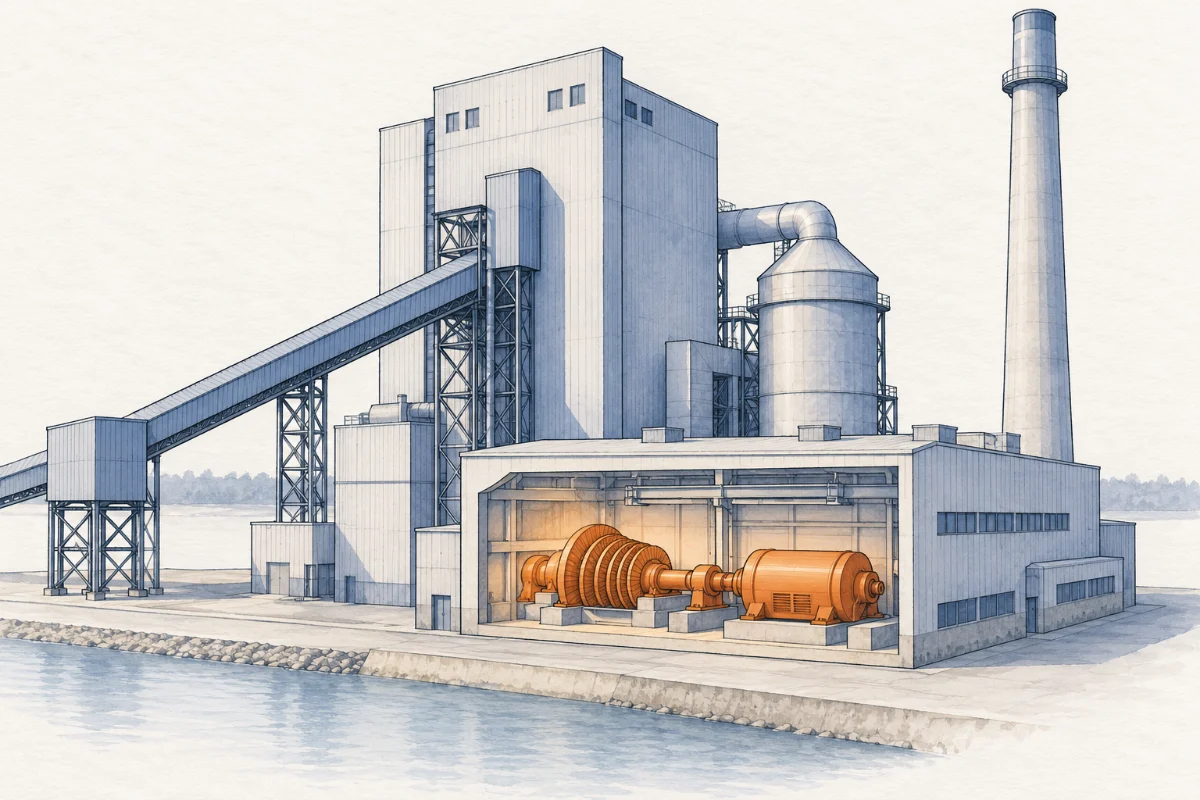
Almost every power station, whatever it uses, ends in the same two machines: a turbine and a generator. A turbine is a wheel with many blades on a shaft. When something pushes hard on the blades, the turbine spins, so energy goes into its kinetic store. The turbine's shaft turns the shaft of a generator, and the spinning generator produces an electric current: energy is transferred electrically to the cables that carry it to homes. (How a generator does this comes later in the course.)
What pushes the turbine round depends on the station. In a station that burns fuel, it is steam. The fuel burns in a boiler, which heats water until it boils into steam at high pressure. The steam rushes through the turbine and pushes its blades round. After the turbine, the steam is cooled back into water and pumped round to the boiler again; the cooling water carries away heat to a river or the air, often through a cooling tower.
 (enlarge)
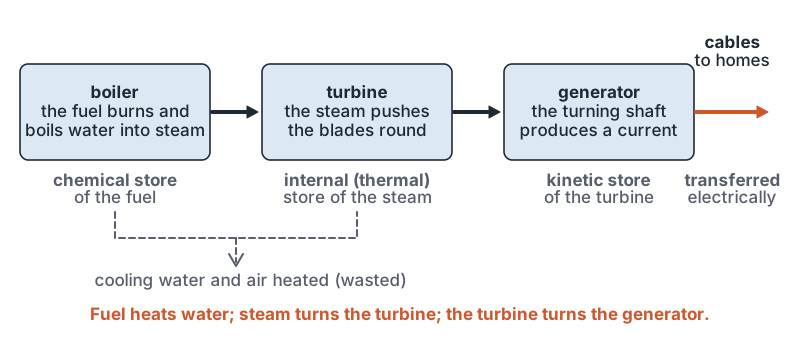
Inside the station, the energy moves through a chain of stores:
 (enlarge)
Trap: “The flame turns the turbine.” The flame only heats the water in the boiler. It is the steam, rushing through at high pressure, that pushes the turbine blades round; the turbine then turns the generator.
Worked example
Inside a gas-fired power station
Describe how the town's gas-fired power station generates electricity, naming the energy store at each stage.
The gas has energy in its chemical store. It burns in the boiler, and the energy heats water, which boils into steam at high pressure: the energy is now in the internal (thermal) store of the steam. The steam pushes on the blades of the turbine and makes it spin, so energy goes into the turbine's kinetic store. The turbine turns the generator, which produces a current, and energy is transferred electrically to the cables. Not all of the gas's energy gets that far: part of it heats the cooling water, the river and the air. So the chain is: chemical store of the gas → boiler → steam → turbine → generator → electrical current in the cables.
Fuels: fossil fuels and biofuels
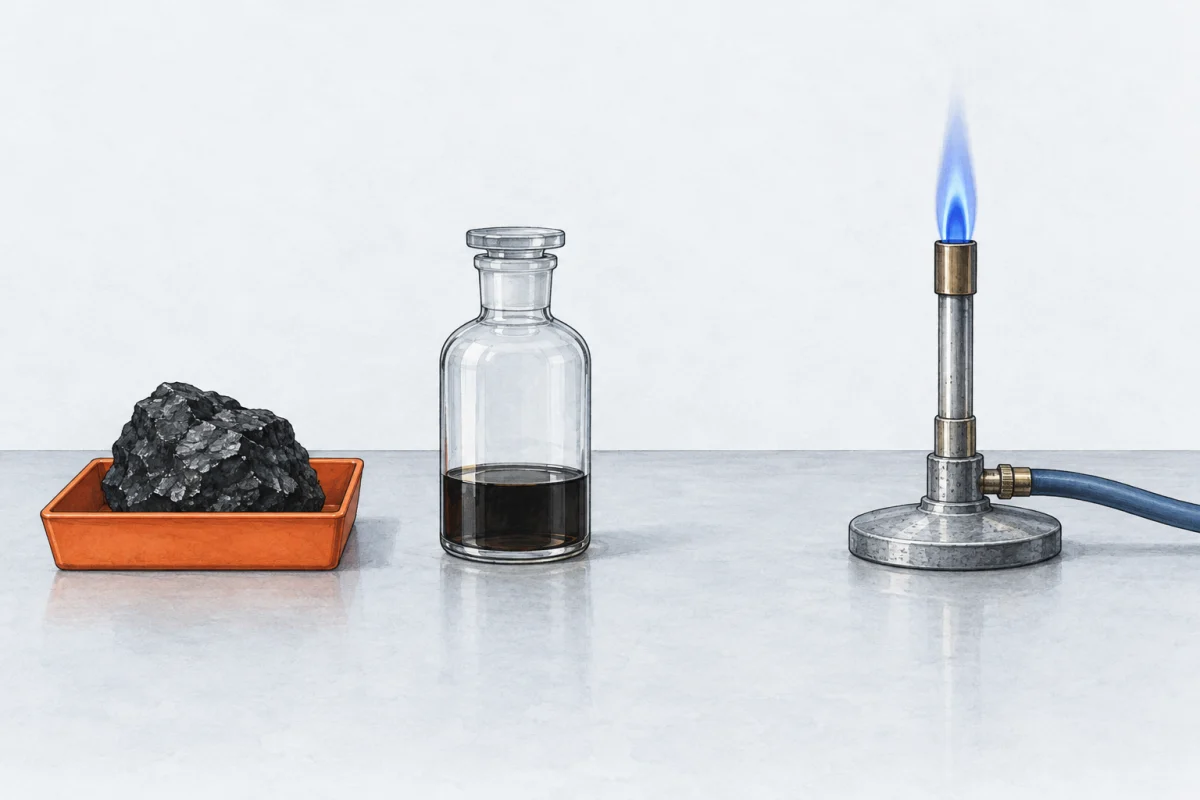
Fossil fuels are coal, crude oil (which petrol and diesel are made from) and natural gas. They formed over millions of years from the remains of plants and tiny sea creatures, buried under mud and rock and squashed. Their energy is in a chemical store, released when they burn. In a power station they heat a boiler, as above. In a car or a lorry, petrol or diesel burns inside the engine and the useful energy goes straight into the vehicle's kinetic store, with no electricity at all; a gas boiler at home burns gas to heat water for the radiators.
Biofuels are fuels made from plants or animal waste that grew recently: wood, ethanol made from sugar cane or maize, biodiesel made from oil crops, and biogas from rotting food and farm waste. Their energy is in a chemical store too, captured by the plants from sunlight as they grew. They are used in the same ways as fossil fuels: burnt in a boiler to make steam for a turbine and generator, or burnt in an engine.
 (enlarge)
Trap: “Biofuels are clean: burning them gives out no carbon dioxide.” Burning a biofuel gives out carbon dioxide, just as burning a fossil fuel does. New crops take carbon dioxide from the air as they grow, but growing, harvesting, processing and transporting them also give some out.
Nuclear fuel and geothermal energy
Nuclear fuel is usually uranium. In the reactor of a nuclear power station, uranium nuclei split apart, and energy from their nuclear store heats the reactor. That heat boils water into steam, and from there the station is like a fuel-burning one: the steam drives a turbine, which turns a generator. Nothing burns, so a nuclear station gives out no carbon dioxide while it runs, but its used fuel is radioactive and has to be stored safely for thousands of years.
Geothermal energy comes from hot rocks deep underground. In a few places, such as Iceland, New Zealand and Kenya, very hot rocks lie close enough to the surface to use. Cold water is pumped down into them and comes back up as steam or very hot water. The steam drives a turbine and generator, and the hot water can also heat homes directly. Where the hot rocks are too deep, geothermal power isn't possible.
Water: dams, tides and waves
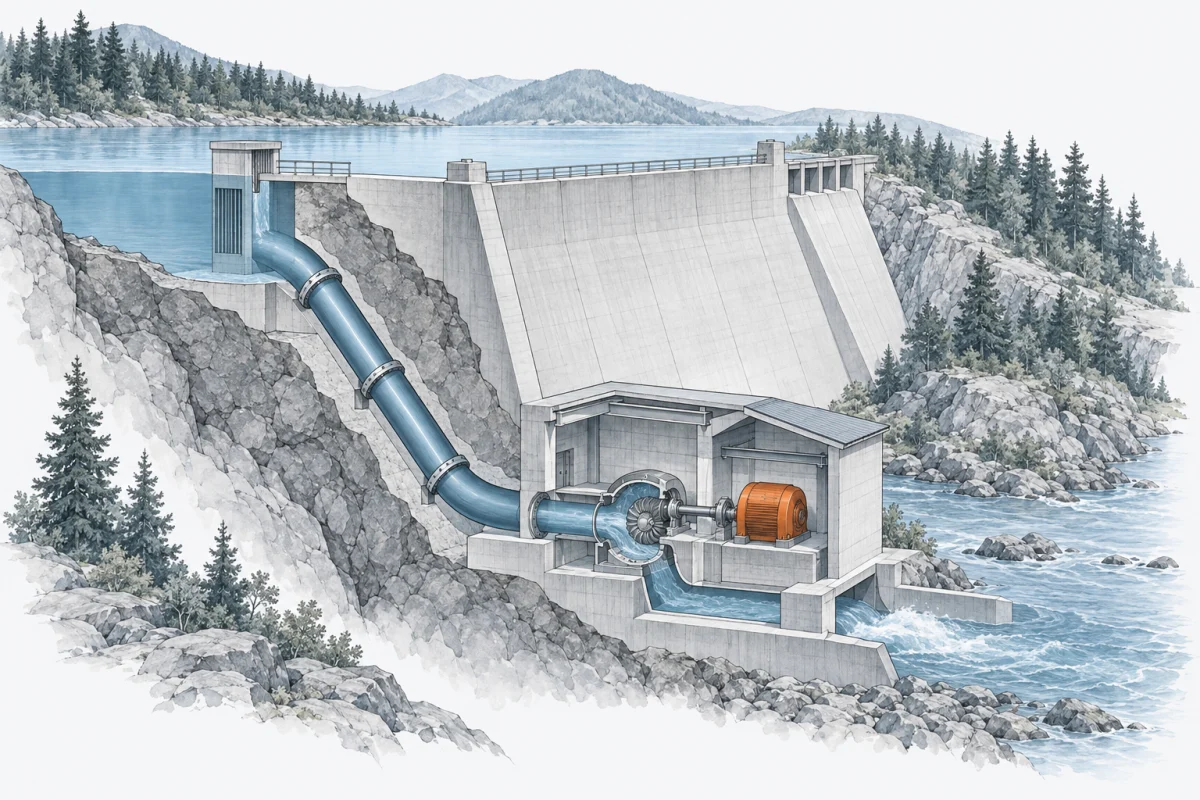
A hydroelectric dam holds back a river high in the hills and makes a lake behind it, the reservoir. The water in the reservoir is high above the valley, so it has energy in its gravitational potential store. When the gates open, the water rushes down large pipes inside the dam and its kinetic store fills; at the bottom it pushes the blades of a turbine, which turns a generator. No fuel burns and there is no boiler, because the moving water pushes the turbine itself.
 (enlarge)
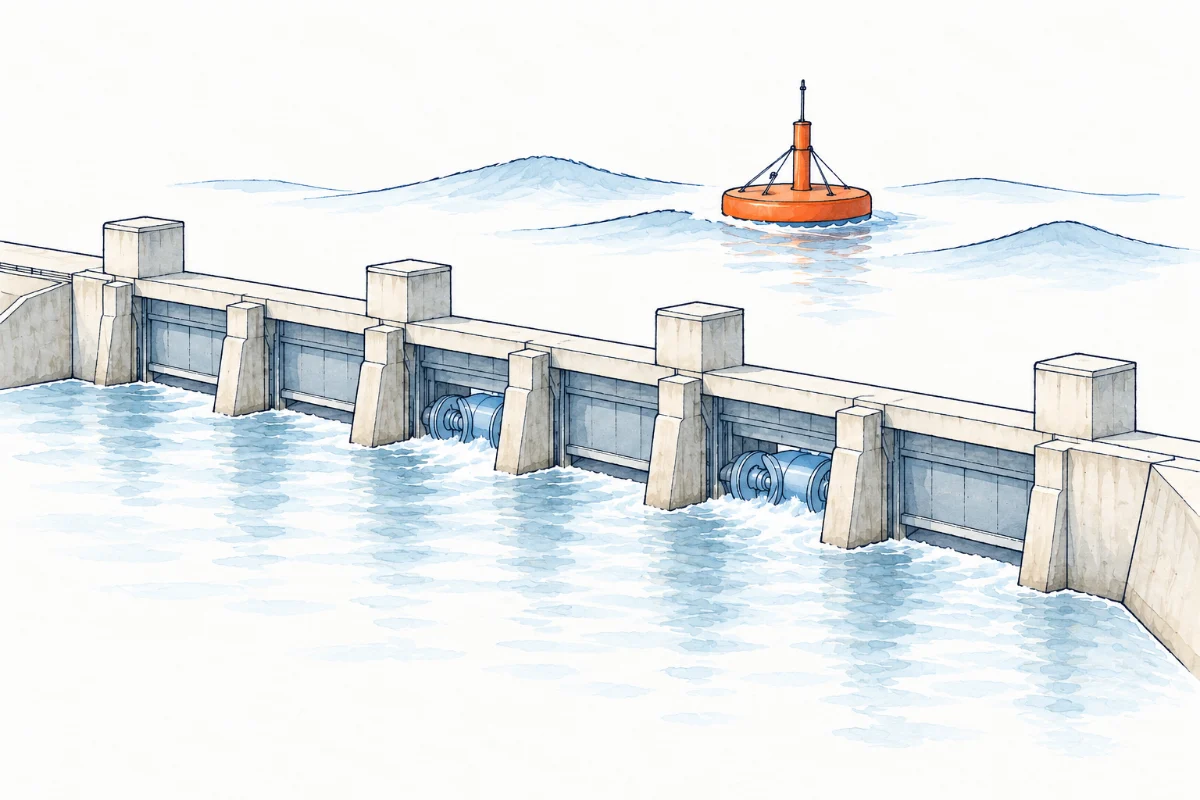
The tides are caused by the pull of the Moon's gravity on the oceans as the Earth turns, so the sea rises and falls about twice a day. A tidal barrage is a low dam across an estuary with gates and turbines in it. At high tide the water fills the estuary behind the barrage and the gates close. As the tide goes out, the sea outside falls, and the trapped water, now higher than the sea, flows back out through the turbines and turns the generators. The times of the tides are known years in advance.
Waves are made by the wind blowing over the sea. A wave machine floats on the surface or sits just below it; as the waves lift and drop it, the movement drives a generator inside it, and a cable takes the current to the shore. One wave machine gives only a small power.
 (enlarge)
Worked example
A hydroelectric dam
Describe the energy transfers in a hydroelectric power station, from the water in the reservoir to the current in the cables. Explain why the station has no boiler.
The water in the reservoir is high above the turbines, so it has energy in its gravitational potential store. As it flows down the pipe, it falls, and that store empties into the water's kinetic store. The fast-moving water pushes the turbine blades, so energy goes into the kinetic store of the turbine, and the turbine turns the generator, which transfers energy electrically to the cables. A boiler is only needed to make steam that pushes a turbine. In a hydroelectric station the falling water pushes the turbine itself, so there is nothing to burn and no steam to make.
Sunlight and wind
The Sun gives us energy directly in two different ways, and they are easy to mix up.
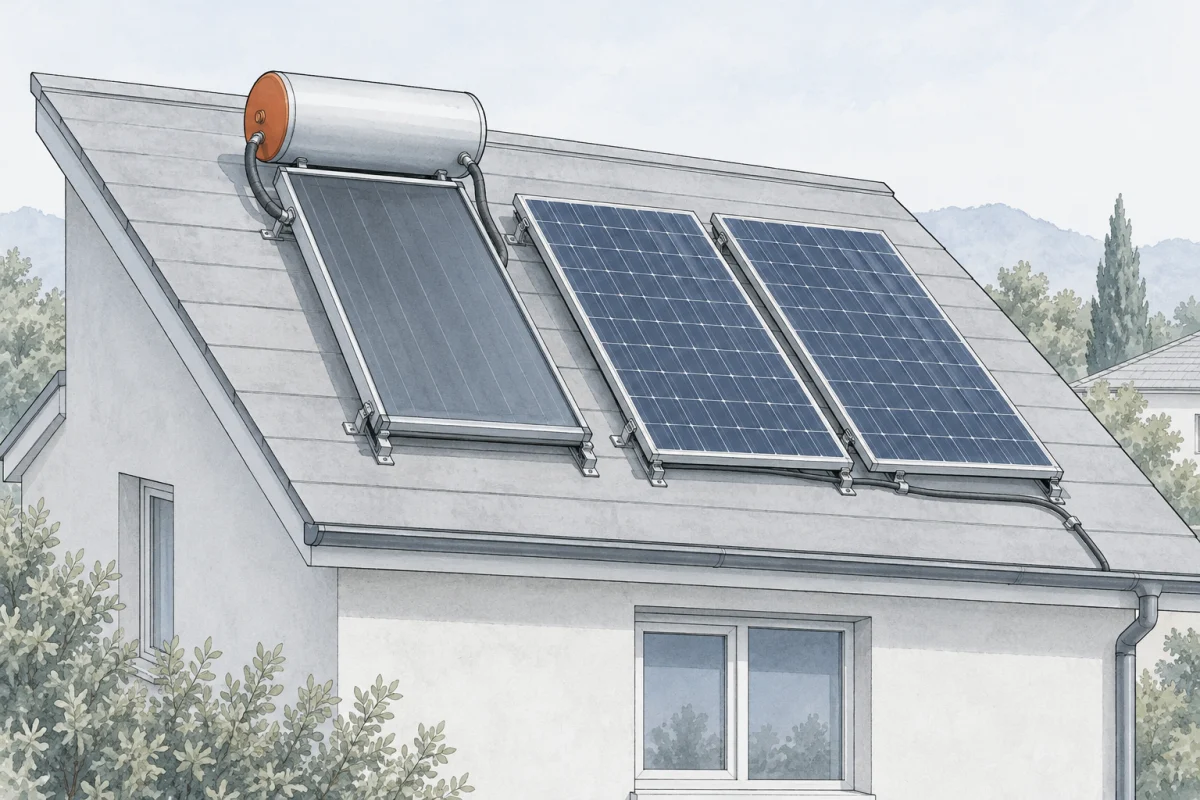
- Solar cells (photovoltaic cells) are thin flat layers of silicon. When light falls on them, they produce an electric current directly: there is no turbine and no generator, and nothing moves. They work only while light falls on them, so they give no electricity at night and much less when it is cloudy.
- Solar panels for heating water are dark panels behind glass. They absorb infrared and other electromagnetic waves from the Sun, and water pumped through pipes inside them gets hot and is stored in a tank. They give hot water, not electricity.
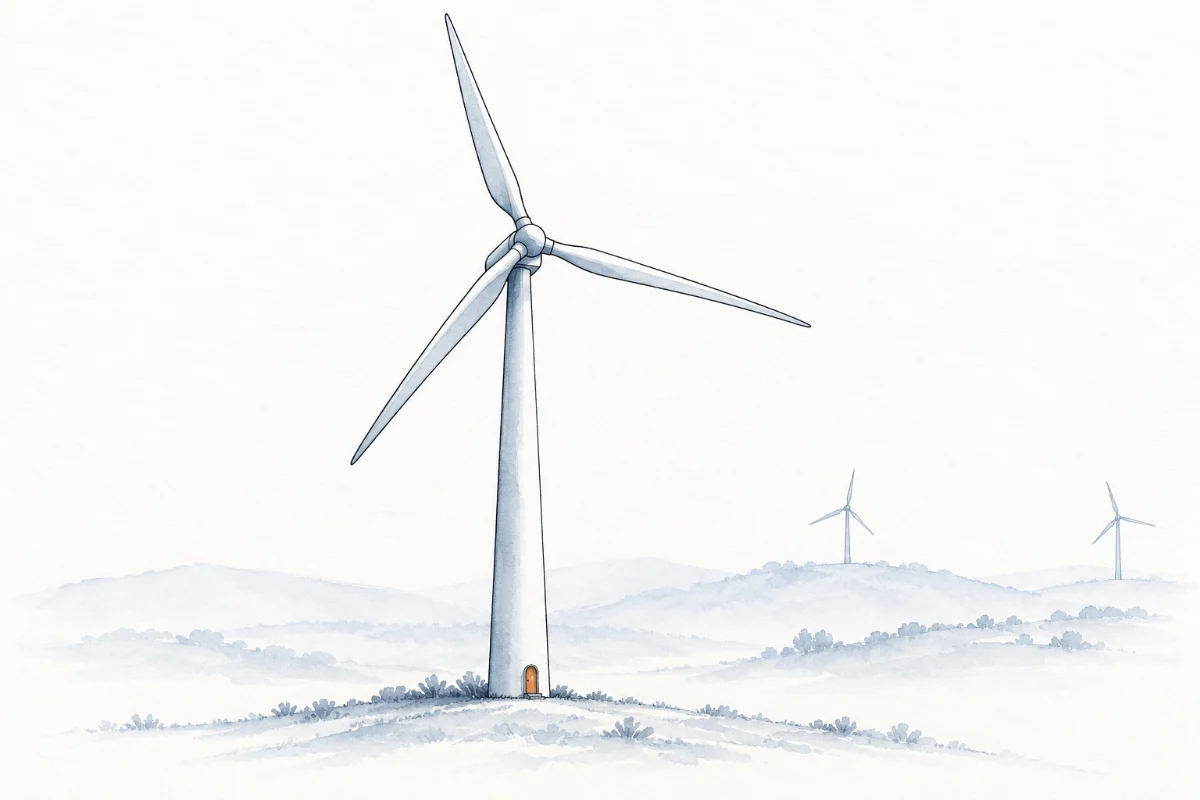
The Sun is also the source of the wind. It heats the Earth's surface unevenly, so in some places the air above the ground gets warmer than in others. The warm air rises and cooler air moves in to take its place, and this moving air is wind. In a wind turbine the wind pushes the long blades round, so energy goes from the kinetic store of the air to the kinetic store of the blades, and they turn a generator at the top of the tower. There is no boiler. Wind farms are built on hilltops and out at sea, where the wind is strongest and blows most often.
 (enlarge)
Trap: “Solar panels and solar cells are the same thing.” Solar cells turn light into an electric current. Solar panels for heating water absorb infrared to heat water, and they give no electricity at all.
Worked example
Two kinds of panel on one roof
The house in the picture has two kinds of panel on its roof. Name each kind, say what it gives the family and which waves from the Sun it uses, and say what each gives at midnight.
The collector joined by pipes to a tank is a solar panel for heating water: it absorbs infrared (and other electromagnetic waves) from the Sun and heats the water, which is stored in the tank, so it gives the family hot water. The panels with a grid of cells and a cable are solar cells: light falling on them produces an electric current. Both need the Sun, so at midnight neither collects any energy. The tank keeps its water hot for a while, but the solar cells give nothing. Only the solar cells give electricity; the other panel gives hot water.
Power the town
Now try the town's power station, and then see what the wind and the Sun can add.
What is in the scene. A model of the town in its valley. The gas-fired power station stands beside the river; it can give up to 15 MW (megawatts: 1 MW is 1 000 000 J every second). A tray of tiles holds a wind farm of five turbines (10 MW in a strong wind), solar cells (up to 10 MW at noon in full sunshine) and solar panels for heating water, and there are empty sites on the hilltop and in the field. A card in the sky (on a phone, in the card under the scene) shows a whole week, Monday to Sunday: the grey line is the power the town needs at each hour, the coloured bands are what each resource gives, and the orange line is the total supply. Under it are the gas burnt and the carbon dioxide given out. Energy over a time is in megawatt-hours: 1 MWh is the energy transferred in one hour at a power of 1 MW.
What you do. Predict what spins the generator, then look inside the power station. Predict whether gas alone can keep up all week, and run the week. Choose where the wind farm should go and which tile makes electricity from sunlight, predict what the solar cells give at midnight, and run the week again. In the Supplement step, trace the energy of the gas, the wind and the sunlight back to where it came from.
What the experiment showed
Do the experiment before you read on. With gas alone, the orange supply line lay on top of the grey demand line all week, from 5 MW in the small hours to 14 MW in the evening. The station could do this because it simply burns more gas when the town needs more power and less when it needs less. To give the town 1540 MWh of electricity in the week, it burnt 3850 MWh of gas.
With the wind farm and the solar cells as well, the gas station only had to fill the gaps. These are the two weeks (values from the model, see “About this model” at the end):
| Week | Resources | Wind farm (MWh) | Solar cells (MWh) | Electricity from gas (MWh) | Gas burnt (MWh) | Carbon dioxide (t) |
|---|---|---|---|---|---|---|
| 1 | gas only | — | — | 1540 | 3850 | 770 |
| 2 | gas, wind farm, solar cells | 828 | 333 | 530 | 1325 | 265 |
The solar cells gave nothing at all every night, and much less on the three cloudy days. On Thursday and Friday the wind dropped almost to nothing, so the gas station did most of the work again. In a few windy, sunny hours the wind and the Sun gave more than the town needed, and the extra had to be switched off (151 MWh in the week), because the town has nowhere to store it.
Key idea: The wind farm and the solar cells cut the gas burnt by about two thirds, but nobody can turn them up when the town needs more power. The gas station filled every gap.
Supplement: Energy from the Sun
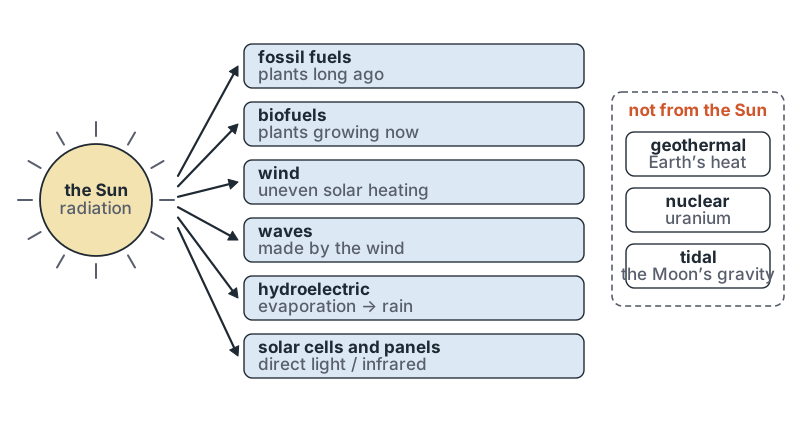
Trace each energy resource back far enough, and most of them lead to the Sun. Radiation from the Sun is the main source of energy for all our energy resources except geothermal, nuclear and tidal.
- Fossil fuels: millions of years ago, plants captured energy from sunlight as they grew, and tiny sea creatures fed on them; their buried remains became coal, oil and gas.
- Biofuels: the crops captured energy from sunlight as they grew, this year or a few years ago.
- Wind: the Sun heats the ground unevenly, and the air moves.
- Waves: the wind makes the waves, so their energy comes from the Sun too.
- Hydroelectric: the Sun evaporates water from the sea; it falls as rain on the hills and fills the reservoir high above the turbines.
- Solar cells and solar panels: directly from the Sun's light and infrared.
Three resources do not get their energy from the Sun's radiation. Geothermal energy comes from the heat inside the Earth. Nuclear fuel has its energy in the nuclear store of uranium nuclei, which were in the Earth's rocks before there was any life. Tidal energy comes from the Moon's gravity pulling on the oceans as the Earth turns.
 (enlarge)
Supplement: Fusion in the Sun
The Sun releases its energy by nuclear fusion. Deep in its core, where it is extremely hot and the pressure is enormous, hydrogen nuclei are squeezed so hard that they join together to make helium nuclei, and energy is released from their nuclear store. That energy travels out to the Earth as light, infrared and other electromagnetic waves.
Fusion is not what happens in today's nuclear power stations, which split large uranium nuclei apart. Scientists and engineers are researching how energy released by nuclear fusion could be used to produce electricity on a large scale: experimental fusion reactors, such as ITER in France, are being built to find out how to hold matter hotter than the centre of the Sun for long enough. None of them supplies electricity to homes yet.
Worked example
Petrol and the Sun
A car runs on petrol, made from crude oil. Explain why the energy that moves the car came, in the end, from the Sun, and say how the Sun released it.
Crude oil is a fossil fuel, formed over millions of years from the remains of tiny sea plants and the creatures that fed on them. Those plants captured energy from sunlight as they grew and stored it in their chemical store, and it stayed there, through the crude oil, into the petrol. The car's engine burns the petrol and the energy goes into the car's kinetic store. The Sun released the energy by nuclear fusion in its core, where hydrogen nuclei join to make helium. So: nuclear store of the Sun → radiation (sunlight) → chemical store of the plants → crude oil → petrol → kinetic store of the car.
Case closed
The town's gas station makes electricity by burning gas in a boiler: the steam pushes a turbine round, and the turbine turns a generator. Nuclear fuel and geothermal heat make steam in the same way, while falling water in a dam, the tide flowing out of a barrage and the wind push a turbine directly. Solar cells turn light straight into a current, and solar panels heat water without making any electricity. The wind farm and the solar cells cut the gas the town burns by about two thirds, but they can't be turned up when the town needs them, so the gas station still filled the gaps. In the next part you find out whether the tide and the river can take over that job.
About this model
The experiment is a model of a town, not a real one. The town needs the same power at each hour of every day, from 5 MW in the small hours to 14 MW from 6 p.m. to 8 p.m., 220 MWh a day and 1540 MWh in a week. The week's weather is made up: four sunny days and three cloudy ones, with the wind strong at the start of the week and almost calm on Thursday and Friday. The wind farm gives up to 10 MW and the solar cells up to 10 MW at noon in full sunshine (about 9 MW on this week's sunny days); they give nothing at all at night. The model works out the power at the middle of each hour. Extra power from the wind and the Sun is switched off, because the town has no batteries and no link to other towns. The gas station gives up to 15 MW at once whenever it is needed (a real one takes time to start up), and its efficiency is 40 %: every 1 MWh of electricity needs 2.5 MWh of gas. Burning 1 MWh of gas gives out about 0.2 t of carbon dioxide, a typical value for natural gas.