The wind farm and the solar cells already cut the gas the town burns by about two thirds. Now the council asks a harder question: could the town stop burning gas altogether? The estuary has big tides, the sea beyond it has waves, and a river comes down from the hills above the valley. Some people want a nuclear power station instead. Choosing well means asking the same questions about every resource, and finding out how much of the energy put into a power station comes out as electricity. By the end of this part you can compare energy resources and explain what efficiency means.
 (enlarge)
Five questions to ask about a resource
Every energy resource has advantages and disadvantages. To compare them fairly, ask the same five questions about each one.
- Is it renewable? A renewable resource is replaced by nature as fast as we use it: sunlight, wind, waves, tides, falling water, geothermal heat, and biofuels as long as new crops are grown. A non-renewable resource will run out, because it took millions of years to form or can't be made again: the fossil fuels and nuclear fuel.
- Is it available here? A hydroelectric dam needs hills and a river; a tidal barrage needs an estuary with a big rise and fall of the tide; geothermal power needs hot rocks near the surface; wind turbines need a windy site and solar cells a sunny one. Fuels can be carried to a power station almost anywhere.
- Is it reliable? Can it give electricity whenever people need it? A fuel-burning, nuclear or geothermal station can run day and night, and a fuel-burning one can be turned up and down as needed. A hydroelectric station can be turned up quickly, but only while there is water in the reservoir. Tides change all the time, but their times are known years ahead. Wind and sunlight depend on the weather, and solar cells give nothing at night.
- What is its scale? How much power can one installation give? A nuclear or coal-fired power station gives about 1000 MW, and a big hydroelectric dam can give more. One wind turbine on land gives 2 to 5 MW at most, one wave machine less than 1 MW, and the solar cells on a house roof only a few kilowatts.
- What is its environmental impact? Burning any fuel gives out carbon dioxide, a greenhouse gas that adds to global warming, and burning coal also gives out gases that cause acid rain. Mining coal and drilling for oil and gas damage the land and the sea. Nuclear stations leave radioactive waste. A dam floods a whole valley, and a tidal barrage changes the mud flats where birds feed. Wind farms change how the hills look and can harm birds, and large solar farms cover land.
Trap: “Renewable resources do no harm to the environment.” Renewable means only that the resource won't run out. A dam still floods a valley, a barrage still changes an estuary, and burning a biofuel still gives out carbon dioxide.
Comparing the resources
| Resource | Renewable? | Advantages | Disadvantages |
|---|---|---|---|
| Fossil fuels (coal, oil, gas) | no | reliable, can be turned up and down; large scale | carbon dioxide and other pollution; will run out |
| Biofuels | yes, if new crops are grown | reliable like a fossil fuel; crops take in carbon dioxide as they grow | still gives out carbon dioxide; uses farmland |
| Nuclear fuel | no | very large scale; no carbon dioxide while running | radioactive waste that must be stored safely for thousands of years |
| Geothermal | yes | reliable, day and night; little pollution | only where hot rocks are near the surface |
| Hydroelectric dam | yes | turned up within minutes; no pollution while running | floods a valley; needs hills and a river; limited by the water in the reservoir |
| Tidal barrage | yes | times known years ahead; no pollution while running | only in a few estuaries; changes the habitat; no power at some times of day |
| Waves | yes | no pollution while running | small scale; depends on the weather; hard to build at sea |
| Wind | yes | no pollution while running | depends on the weather; changes the landscape |
| Solar cells | yes | no pollution while running; work on any sunny roof | nothing at night, less when cloudy; small scale for the land they cover |
| Solar panels for heating water | yes | hot water from sunlight, no fuel burnt | no electricity; little in winter |
Worked example
Wind or gas for the town?
The town must choose between a second 15 MW gas-fired power station and a wind farm that gives 15 MW in a strong wind. Compare the two in terms of renewability, reliability and environmental impact.
The wind is renewable: it will never run out, while natural gas is a fossil fuel and is non-renewable. The wind farm gives out no carbon dioxide while it works; the gas station gives out carbon dioxide all the time it burns gas (770 t a week if it supplied the whole town), which adds to global warming. But the gas station is reliable: it gives power whenever it is needed and can be turned up in the evening, while the wind farm gives nothing on a calm day, whatever the town needs. The wind farm is better for the environment and never runs out, but only the gas station can be relied on in a calm, so a town using wind still needs something it can turn up.
Build the town's supply
Now try to supply the town without burning gas.
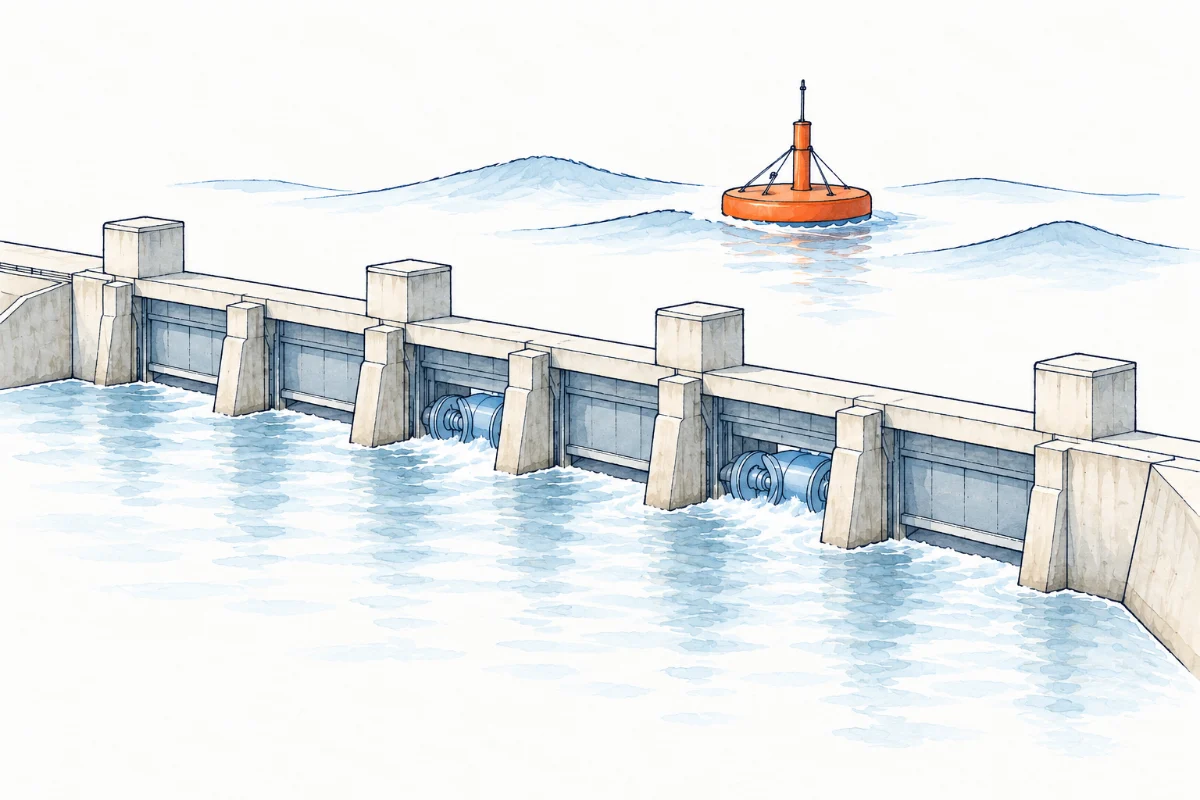
What is in the scene. The same town, with its gas station, wind farm and solar cells. The tray now holds a tidal barrage for the estuary (6 MW as the tide goes out), wave machines for the open sea (1 MW), a hydroelectric dam for the hills (6 MW, with a reservoir that starts full and holds 150 MWh), a nuclear power station and a geothermal power station. The card in the sky shows the week as before; the hours when the supply can't meet the demand are hatched grey, and the card counts them.
What you do. Predict when the barrage generates (the barrage then stands across the estuary and the wave machines float out at sea), and choose where the dam should go. Predict what happens without gas, switch the gas station off and run the week. Choose what fills the gaps and run it again. Then follow 100 J of energy from the gas through the power station. In the Supplement step, work out its efficiency.
What the experiment showed
Do the experiment before you read on. Without any gas, the wind farm, solar cells, barrage, wave machines and dam together could have made 1794 MWh in the week, more than the 1540 MWh the town used. Even so, the town was short of power for 27 hours. On windy, sunny afternoons there was far more than the town needed and 343 MWh had to be switched off, but on calm evenings there wasn't enough. The barrage gave two bursts a day, about 50 minutes later each day, exactly as the tide tables say. The dam kept the lights on for many evenings, but its turbines give only 6 MW, and by the end of the week its reservoir had run down from 150 MWh to 1.5 MWh.
A nuclear power station gives about 1000 MW, about 70 times the town's busiest hour: far too big for one town (scale). There are no hot rocks near the surface in the valley, so a geothermal station isn't possible here (availability). More solar cells give nothing in the evening, when the gaps come (reliability). Keeping the gas station as a backup, switched on only when the rest can't keep up, filled every gap.
| Week | Resources | Electricity from gas (MWh) | Gas burnt (MWh) | Carbon dioxide (t) | Hours short | Switched off (MWh) |
|---|---|---|---|---|---|---|
| 1 | gas only | 1540 | 3850 | 770 | 0 | 0 |
| 2 | gas, wind farm, solar cells | 530 | 1325 | 265 | 0 | 151 |
| 3 | wind, solar, tidal, waves, dam; no gas | 0 | 0 | 0 | 27 (88.5 MWh missing) | 343 |
| 4 | as week 3, with the gas station as a backup | 88.5 | 221 | 44 | 0 | 343 |
Key idea: Making enough energy over a week is not the same as giving enough power at every hour. A supply must meet the demand hour by hour, so it needs at least one resource that can be turned up when the others fall short.
Efficiency
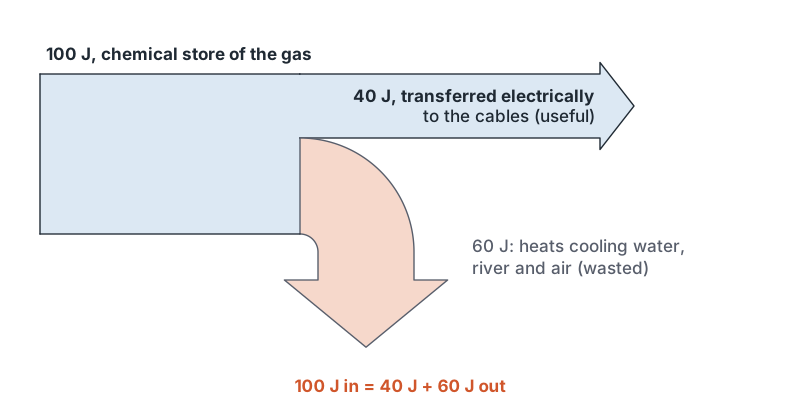
The gas station doesn't turn all the energy of the gas into electricity. For every 100 J of energy in the chemical store of the gas it burns, it transfers about 40 J electrically to the cables. The other 60 J heats the cooling water, the river and the air around the station. That energy is wasted, because nobody can use it, but it is not destroyed: energy is always conserved, and here it has spread out into the internal store of the surroundings.
The efficiency of a device or a power station describes how much of the energy put into it ends up where we want it, as useful energy. The more efficient it is, the less it wastes. Nothing is ever 100 % efficient, because every real machine heats its surroundings a little. A more efficient power station needs less fuel to give the same electricity, so it also gives out less carbon dioxide.
A Sankey diagram shows this with arrows drawn to scale: each arrow is as wide as the energy it carries. The useful part goes straight on, and the wasted part bends away.
 (enlarge)
Typical efficiencies (rounded values):
| Device | Useful output | Efficiency |
|---|---|---|
| filament lamp | light | about 5 % |
| LED lamp | light | about 40 % |
| solar cell | electricity from light | about 20 % |
| gas-fired power station like the town's | electricity from the gas | about 40 % (newer stations do better) |
| wind turbine | electricity from the wind passing its blades | about 40 % |
| hydroelectric station | electricity from the falling water | about 90 % |
Trap: “The wasted energy is used up.” Wasted energy isn't destroyed. It heats the surroundings, where it is spread out so thinly that it can't easily be used again.
Worked example
Two lamps
A filament lamp and an LED lamp give the same amount of light. The filament lamp gets too hot to touch; the LED lamp only gets warm. Which lamp is more efficient? Explain, and say what happens to the energy that does not become light.
The useful output of both lamps is light, and they give the same amount. The filament lamp gets much hotter, so far more of the energy it takes in heats the lamp and the air: only about 5 J of every 100 J becomes light. The LED lamp turns about 40 J of every 100 J into light, so it needs much less electrical energy to give the same light. The energy that doesn't become light heats the lamp and the air around it; it isn't destroyed. The LED lamp is more efficient, because a larger fraction of the energy put in comes out as useful light.
Supplement: Calculating efficiency
The efficiency can be worked out from the energies, or from the powers:
(%) efficiency = (useful energy output ÷ total energy input) × 100 %
(%) efficiency = (useful power output ÷ total power input) × 100 %
Both energies (or both powers) must be in the same unit, so the units cancel and the efficiency has no unit; without the “× 100 %” it is a decimal, such as 0.40. Because energy is never created, the useful output is always less than the input, so the efficiency is always less than 100 % (less than 1 as a decimal). If you get more than 100 %, you have put the numbers the wrong way up.
To find the useful output, multiply the input by the efficiency as a decimal; to find the input, divide the useful output by the efficiency as a decimal.
Worked example
The gas-fired power station
The town's gas station burns gas at a rate of 25 MW and delivers 10 MW of electrical power to the cables. Calculate its efficiency. In the week on gas alone it delivered 1540 MWh of electricity: how much energy from the gas did it burn, and how much was wasted?
The useful power output is 10 MW and the total power input is 25 MW, so efficiency = (10 ÷ 25) × 100 % = 40 %. As a decimal this is 0.40. The energy input = useful energy output ÷ efficiency = 1540 MWh ÷ 0.40 = 3850 MWh. The wasted energy is 3850 MWh − 1540 MWh = 2310 MWh, which heated the cooling water, the river and the air. The station is 40 % efficient: it burnt 3850 MWh of gas to give 1540 MWh of electricity, and 2310 MWh heated the surroundings.
Worked example
A wind turbine
Each second, 5.0 MJ of the wind's kinetic energy passes through the circle swept by a wind turbine's blades, and the generator delivers 2.0 MJ of electrical energy. Calculate the turbine's efficiency. In a lighter wind, the turbine has the same efficiency and delivers 0.60 MW. What power does the wind carry through the blades?
Efficiency = (useful energy output ÷ total energy input) × 100 % = (2.0 MJ ÷ 5.0 MJ) × 100 % = 40 %. In the lighter wind, total power input = useful power output ÷ efficiency = 0.60 MW ÷ 0.40 = 1.5 MW. The turbine is 40 % efficient, and in the lighter wind the wind carries 1.5 MW through its blades.
Case closed
The town can't simply stop burning gas with these resources. Over the week, the wind, the Sun, the tides, the waves and the dam could have made more energy than the town used, but on calm evenings they couldn't give enough power, and the reservoir ran down. Keeping the gas station as a backup filled the gaps and burnt about 94 % less gas than in the first week. Choosing a resource means weighing it up: is it renewable, is it available here, is it reliable, is its scale right, and what does it do to the environment? And every power station wastes part of the energy put into it: the town's gas station is 40 % efficient, so 60 J of every 100 J of gas heats the surroundings.
About this model
The experiment is a model of a town, not a real one, with the same demand and weather as in the first part. The barrage gives up to 6 MW as the tide goes out, twice a day; each tide comes about 50 minutes later than the day before, as real tides do. The wave machines give up to 1 MW, more when the wind blew the day before. The dam's turbines give up to 6 MW; its reservoir holds 150 MWh and starts full, the river refills it at 0.5 MW, and when it is full the extra water flows over the spillway. Each hour the model uses all the wind, sunlight, tide and waves first, then the dam while it has water, then the gas station if it is switched on. Extra power is switched off: the town has no batteries and no link to other towns (a real town is joined to a national network of cables, which comes later in the course). Building costs and prices are left out. The nuclear and geothermal tiles can't be placed: one real nuclear station gives about 1000 MW, and the valley has no hot rocks near the surface.