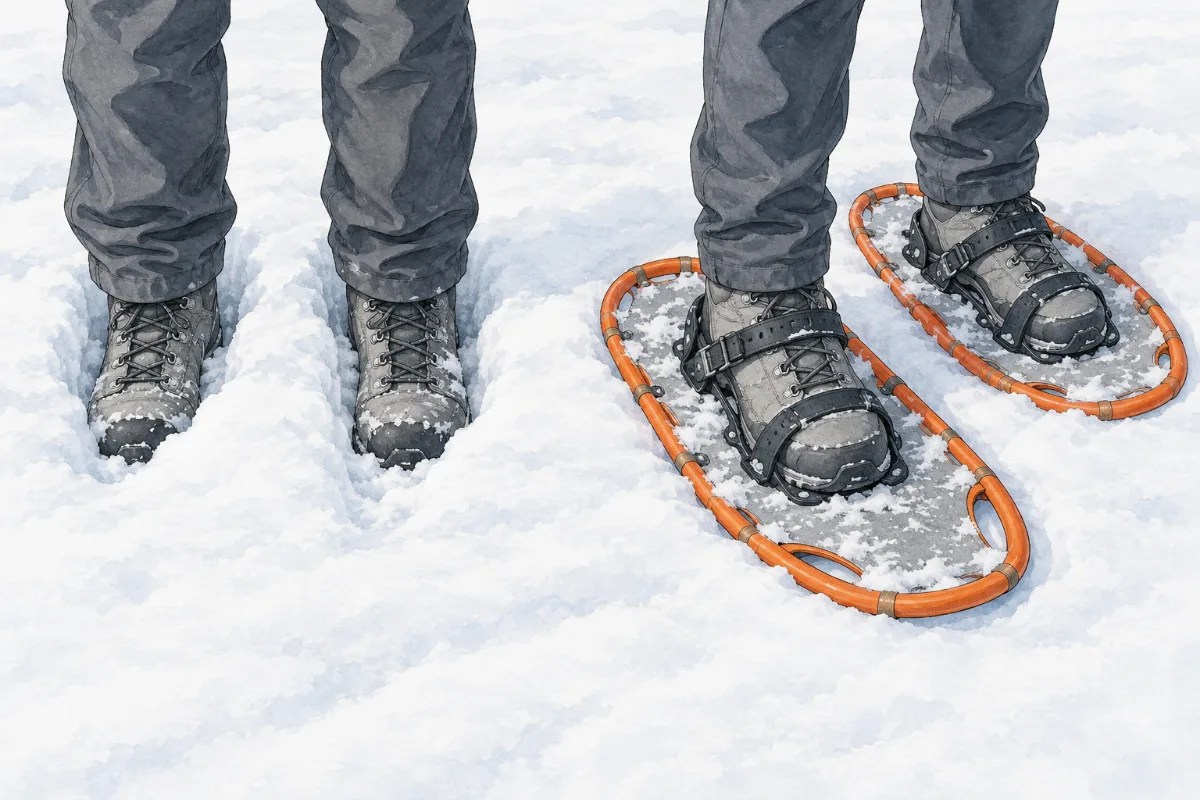
Two people of the same weight cross a field of deep, fresh snow. One wears ordinary boots and sinks in up to the ankles with every step. The other wears snowshoes and stays near the top. They push down on the snow with the same force, their weight, so why does only one of them sink? By the end of this part you can work out how hard each of them presses on the snow.
 (enlarge)
Same force, different area
The snow does not give way (sink or break) because of the force alone. It gives way when that force is crowded onto a small patch of snow. A boot sole is small, so all of the person's weight is pushed into a small area of snow, and the snow under it collapses. A snowshoe is wide, so the same weight is spread over a much bigger area. Each small patch of snow under the snowshoe carries only a small share of the weight, and the snow can hold that up.
What matters is how much force acts on each square metre of the surface. Physicists call this the pressure.
Pressure = force ÷ area
Pressure is the force per unit area: the force that acts on each square metre of a surface. As an equation:
p = F / A
where p is the pressure, F is the force in newtons, pushing straight onto the surface, and A is the area it acts on, in square metres. The unit of pressure is the newton per square metre, N/m², which is called the pascal, Pa. A pressure of 1 Pa is a force of 1 N on every square metre. That is a tiny pressure, so large pressures are often given in kilopascals: 1 kPa = 1000 Pa.
The equation shows both ways to change a pressure. A bigger force on the same area gives a bigger pressure. The same force on a smaller area also gives a bigger pressure.
Worked example
A crate on the floor
A crate of weight 600 N stands on a floor. Its base is 0.50 m wide and 0.60 m long. What pressure does it put on the floor?
The area of the base is 0.50 m × 0.60 m = 0.30 m². The force on the floor is the crate's weight, 600 N. So the pressure is p = F / A = 600 N ÷ 0.30 m² = 2000 Pa. Every square metre of floor under the crate carries 2000 N, although the crate covers less than one square metre.
Areas in square metres
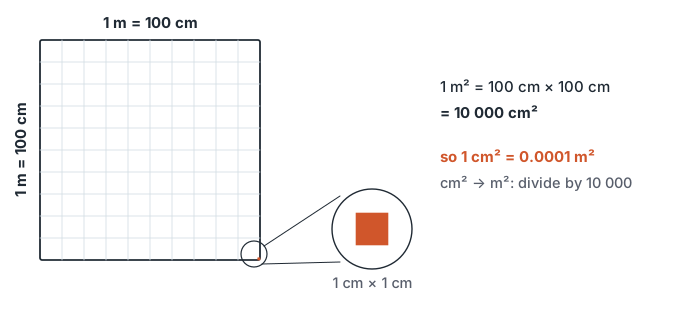
Small objects are usually measured in centimetres, so their areas come out in square centimetres, cm². The pascal needs square metres. A square 1 m by 1 m is also 100 cm by 100 cm, so it holds 100 × 100 = 10 000 squares of 1 cm². That means 1 m² = 10 000 cm², and to change cm² into m² you divide by 10 000.
 (enlarge)
Worked example
A book on a table
A closed book of weight 12 N lies flat on a table. It measures 25 cm by 20 cm. What pressure does it put on the table?
The area is 25 cm × 20 cm = 500 cm². In square metres, that is 500 ÷ 10 000 = 0.050 m². So p = F / A = 12 N ÷ 0.050 m² = 240 Pa.
Trap: “The area is 500, so the pressure is 12 ÷ 500 = 0.024 Pa.” That uses the area in cm², so the answer is in newtons per square centimetre, not pascals. Change the area into m² before you divide. It is easy to divide by 100 instead of 10 000: a square centimetre is a hundredth of a metre in each direction, so it is a ten-thousandth of a square metre.
Rearranging the equation
You can rearrange p = F / A when you know the pressure and want the force or the area:
- force = pressure × area, F = pA
- area = force ÷ pressure, A = F / p
Worked example
Tyres that don't sink
A farmer's tractor has a weight of 48 000 N. Wet soil gives way under a pressure of more than 80 000 Pa. What is the smallest total area of tyre that must touch the soil? The tractor stands on four tyres.
Rearrange the equation for the area: A = F / p = 48 000 N ÷ 80 000 Pa = 0.60 m². Shared between four tyres, each one must touch the soil over at least 0.60 ÷ 4 = 0.15 m². That is why tractors that work on soft fields have very wide tyres.
Small areas and large areas in everyday life
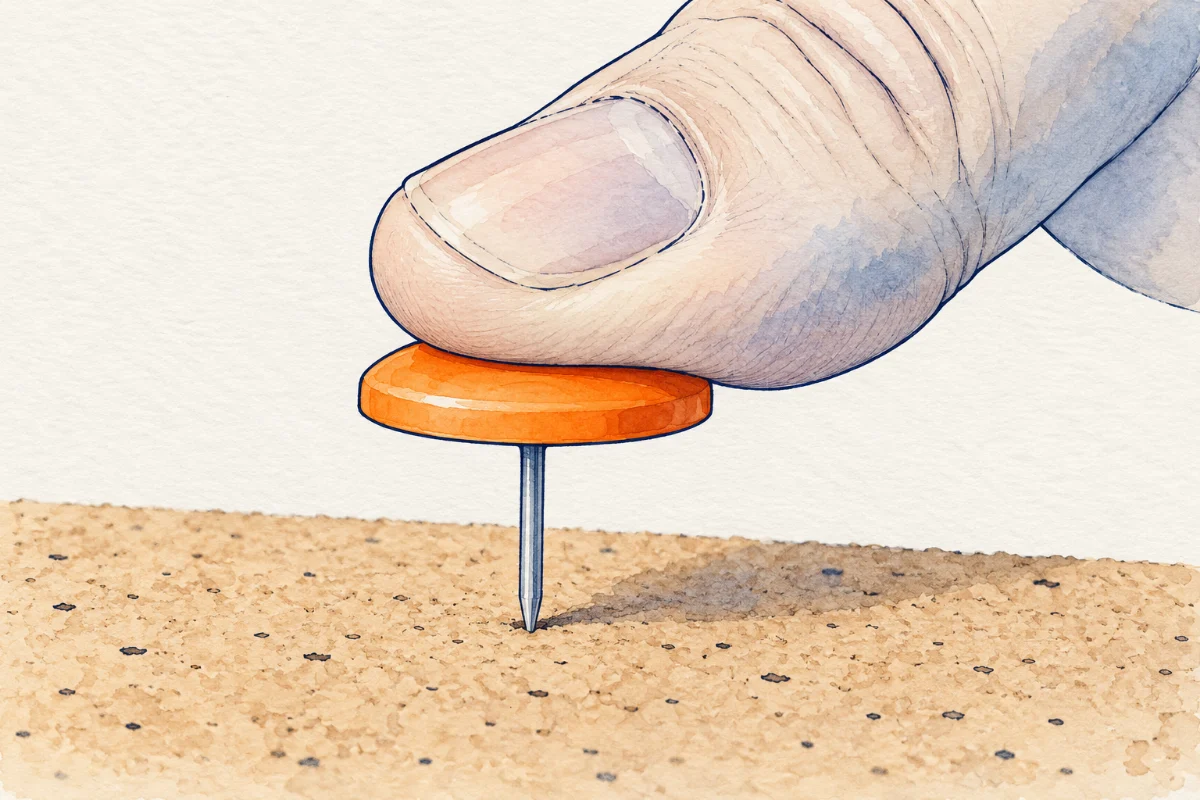
When we want a big pressure, we push a force onto a small area. A drawing pin is the clearest case. Your thumb pushes on the broad, flat head, and the pin pushes on the cork with the same force through its sharp point. The area of the head is about a thousand times the area of the point, so the pressure on the cork is about a thousand times bigger than the pressure on your thumb. The cork gives way and your thumb doesn't.
 (enlarge)
A sharp knife, a needle, an axe blade, a nail and the studs on football boots all work the same way: a small area of contact gives a large pressure, so the material under them gives way.
When we want a small pressure, we spread the force over a large area. Snowshoes, wide tractor tyres and the broad straps of a heavy rucksack all do this. A building stands on wide concrete foundations, so that its huge weight presses on the ground with a pressure the ground can carry. A camel's wide, flat feet keep it from sinking into sand.
Trap: “Snowshoes make you lighter.” Your weight, the force on the snow, is the same with or without snowshoes. Snowshoes change the area that the force acts on, and so they change the pressure.
Worked example
Two walkers on the same snowshoes
A 60 kg walker and a 90 kg walker wear the same pair of snowshoes, which touch the snow over 0.20 m² in all. Take g = 9.8 N/kg. What pressure does each walker put on the snow? And what pressure does the 60 kg walker put on the snow in boots, whose soles cover 0.050 m²?
The weights are 60 kg × 9.8 N/kg = 588 N and 90 kg × 9.8 N/kg = 882 N. On the snowshoes, the pressures are 588 N ÷ 0.20 m² = 2940 Pa and 882 N ÷ 0.20 m² = 4410 Pa. The area is the same, so the heavier walker, with 1.5 times the force, presses on the snow with 1.5 times the pressure. In boots, the 60 kg walker presses with 588 N ÷ 0.050 m² = 11 760 Pa: a quarter of the area gives four times the pressure.
Press a brick into foam
Now try both ways of changing a pressure on the bench.
What is on the bench. A brick 20 cm long, 10 cm wide and 5 cm deep, and a second brick just like it. A digital balance. Three blocks of soft foam of the kind that springs back slowly, so a dent stays long enough to compare. Each time the brick goes onto a new face, it goes onto a fresh block. The depth of a dent shows roughly how hard the brick presses, but it is not a measurement of the pressure.
What you do. Put the brick on the balance and work out its weight from its mass. Predict which face will sink deepest into the foam, then stand the brick on each of its three faces and work out the pressure under one of them. Last, decide how to make the brick lying flat press on the foam as hard as it did standing on its side.
What the experiment showed
Do the experiment before you read on. The balance read 2.00 kg, so the brick's weight is 2.00 kg × 9.8 N/kg = 19.6 N. That weight was the force on the foam whichever face it stood on, yet the dents were very different: the smallest face sank deepest.
| Face down | Force / N | Area / cm² | Area / m² | Pressure / Pa |
|---|---|---|---|---|
| largest, 20 cm × 10 cm | 19.6 | 200 | 0.020 | 980 |
| side, 20 cm × 5 cm | 19.6 | 100 | 0.010 | 1960 |
| end, 10 cm × 5 cm | 19.6 | 50 | 0.0050 | 3920 |
| two bricks, largest face | 39.2 | 200 | 0.020 | 1960 |
Each time the area halved, the pressure doubled, and the dent was about twice as deep. With a second brick on top, the force doubled on the same area, so the pressure doubled too: the two bricks lying flat pressed as hard as one brick on its side, and made a dent just as deep. Turning the brick over onto its other large face, or putting it on a bigger block of foam, would not have changed anything: the area that matters is the area of the brick that touches the foam.
Case closed
Both people in the snow pushed down with the same force, their weight. The boots crowded that force onto a small area, so the pressure was large and the snow collapsed. The snowshoes spread the same force over a much bigger area, so the pressure was small enough for the snow to hold. Pressure is force per unit area, p = F / A, measured in pascals. To raise a pressure, push harder or use a smaller area; to lower it, spread the force over a bigger area.
About this model
The brick, the balance and the foam are simulated. The brick's mass is exactly 2.00 kg and g is 9.8 N/kg. The foam is modelled so that the depth of a dent is in proportion to the pressure, which real foam only roughly does, and each dent stays in place while you compare them; real slow foam would creep back up over a minute or so. The brick always sits flat on the foam, so its weight acts straight down and spreads evenly over the face that touches.