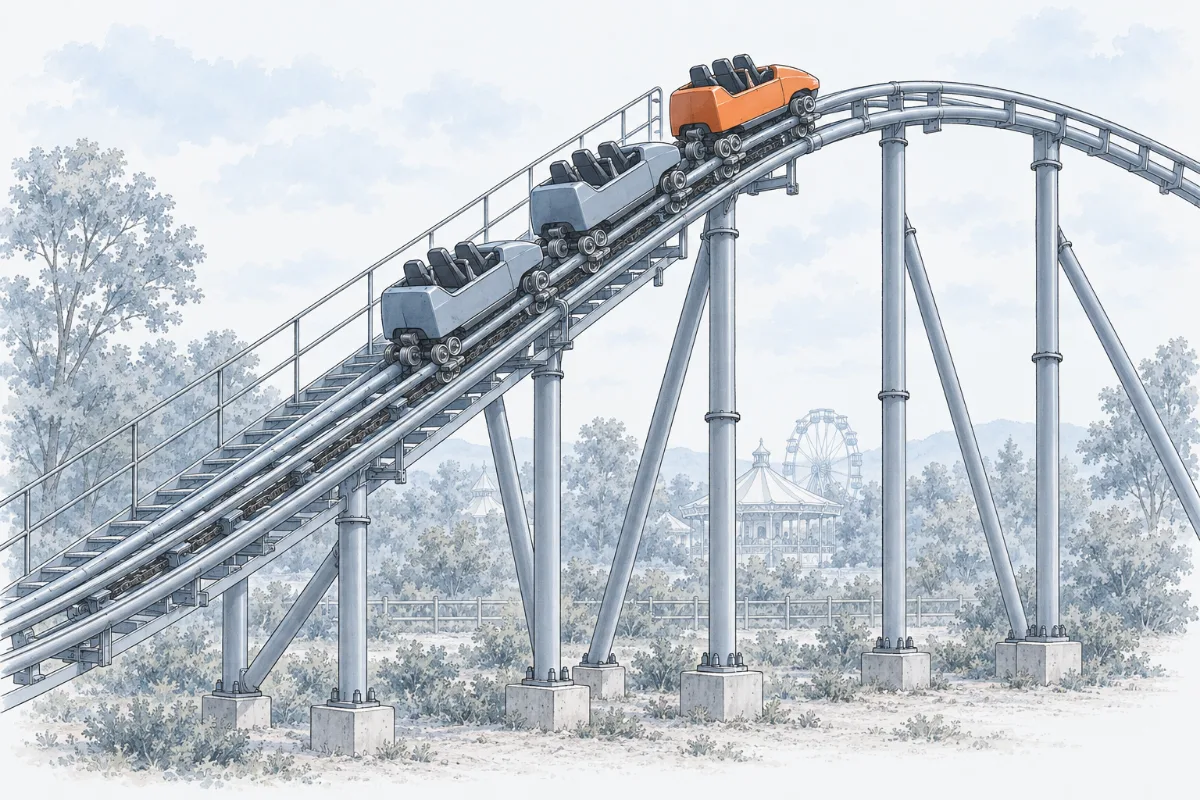
On a roller coaster, a chain pulls the car slowly up the first hill. At the top the chain lets go. From then on there is no motor and no engine: the car runs fast down into the dip, climbs a second hill, runs down again and is finally stopped by the brakes. Something kept the car going for the whole ride without any fuel. By the end of this module you can say where the energy for the ride comes from, where it goes and how much of it there is at each point. This part is about the places energy is stored and the ways it moves between them.
 (enlarge)
Where energy is stored
A stretched catapult, a battery, a hot cup of tea and a car at the top of a hill have something in common: each of them can make something happen later. The catapult can launch a stone, the battery can light a lamp, the tea can warm your hands and the car can roll down the hill. Physicists say that each of them has energy in a store. Energy is measured in joules (J); 1 kilojoule (kJ) is 1000 J.
There are seven energy stores to know:
| Energy store | What has energy in this store | Example |
|---|---|---|
| Kinetic | anything that is moving | the roller-coaster car racing through the dip |
| Gravitational potential | anything raised above the ground (or above where it could fall to) | the car at the top of the lift hill |
| Chemical | fuels, food and batteries, released by chemical reactions | the petrol in a car, the food you ate for breakfast |
| Elastic (strain) | anything stretched, squashed, bent or twisted that springs back | a stretched rubber band, a squashed spring, a bent diving board |
| Nuclear | the nuclei at the centres of atoms | the uranium fuel in a nuclear power station; the Sun's core |
| Electrostatic | electric charges that attract or repel each other | a balloon charged by rubbing it on your hair; a thundercloud |
| Internal (thermal) | the moving and vibrating particles of any material; the hotter it is, the more it has | a hot cup of tea; the brakes of the car after they have stopped it |
One object can have energy in several stores at once. A car halfway down the first drop is both moving and above the ground, so it has energy in its kinetic store and in its gravitational potential store at the same time.
Trap: “Heat is a store of energy.” Energy is stored as internal (thermal) energy, in the particles of a material. Heating is a way energy moves from a hotter object to a cooler one, not a place where it is kept.
Worked example
Stores on a camping trip
A camper lights a gas stove and boils a pan of water, while a stretched rope holds the tent up and a bag of food hangs from a branch. Name the energy store in each of: the gas in the cylinder, the boiling water, the rope and the hanging bag.
Gas is a fuel, and it releases energy when it burns, so the gas has energy in its chemical store. The boiling water is hot, so its particles move fast and it has a lot of energy in its internal (thermal) store. The rope is stretched and would spring back if it came loose, so it has energy in its elastic (strain) store. The bag hangs above the ground and could fall, so it has energy in its gravitational potential store. Each object's store follows from what it is doing: burning, hot, stretched or raised.
Moving energy between stores
Energy only does something useful when it moves from one store to another. There are four ways it can be transferred:
- By a force doing work (mechanical work done). When a force moves something, it transfers energy. The roller-coaster chain pulls the car up the hill and fills its gravitational potential store; a footballer's boot kicks a ball and fills its kinetic store.
- By an electric current (electrical work done). A current carries energy from a battery or the mains to whatever it flows through: a motor, a lamp or a kettle.
- By heating. Energy moves from a hotter object to a cooler one: a hot cooker ring heats a cold pan, and a hot drink heats the air around it.
- By waves. Light and infrared are electromagnetic waves that carry energy from the Sun to the Earth; a loudspeaker sends energy through the air by sound waves; water waves carry energy across the sea.
 (enlarge)
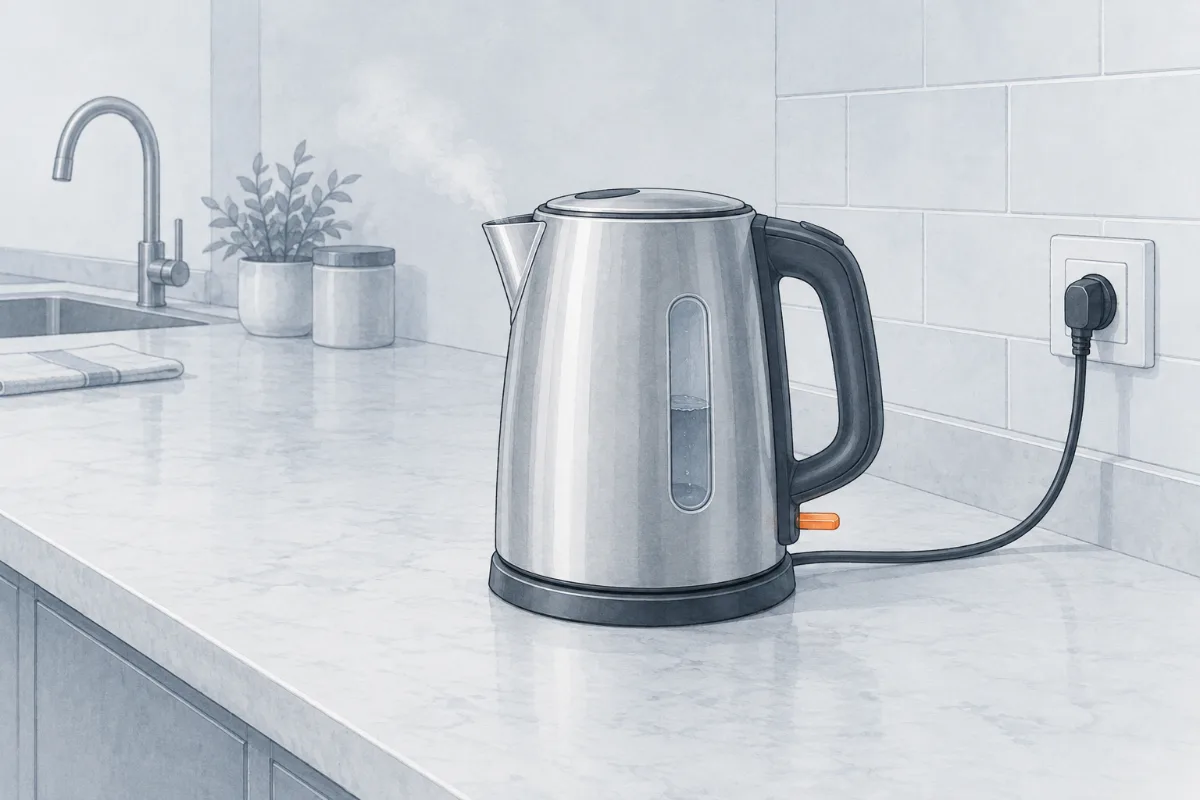
Take the kettle in the picture. The current in the kettle's element does electrical work, so energy is transferred from the mains to the element, which heats the water: the energy ends up in the water's internal store. Not all of it gets there, because the hot kettle also heats the air around it, and you can hear it rumble, so a little energy leaves by sound waves.
Worked example
Lifting a barbell
 (enlarge)
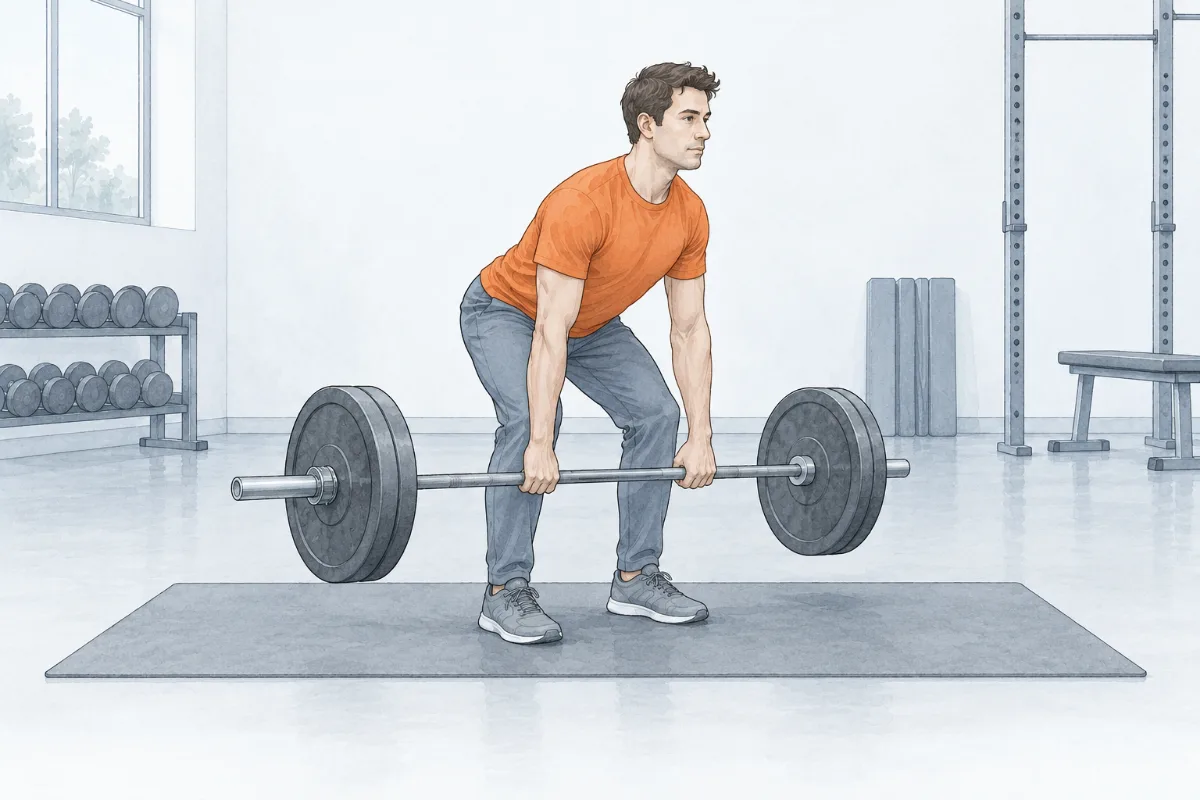
A weightlifter lifts a barbell from the floor and holds it still above her head. Then she lets it drop onto the rubber floor, where it lands with a thud and stops. Describe the energy stores and transfers during the lift and during the drop.
During the lift, her muscles get their energy from the food she has eaten, which is a chemical store. Her arms push the barbell upwards with a force that moves it, so a force does work: energy is transferred from the chemical store of her muscles to the gravitational potential store of the barbell (her muscles also warm up, so some goes to their internal store). While she holds it still, the barbell's store doesn't change. When she lets go, the weight of the barbell does work as it falls, so energy moves from its gravitational potential store to its kinetic store. When it hits the floor and stops, the barbell and the floor warm up very slightly and the thud carries some energy away as sound, so the energy ends up in the internal stores of the barbell, the floor and the air. In each stage, energy moves from one store to another by a force doing work, by heating or by sound waves.
Energy is never used up
Here is the most important idea in this module. Energy cannot be created or destroyed. It can only be transferred from one store to another, so the total amount of energy stays the same. This is the principle of the conservation of energy.
When people say that energy is “used up”, they mean that it has been transferred to a store where it is no longer useful, usually the internal store of the surroundings. The energy is still there, just spread thinly through warm brakes, warm air and a slightly warmer floor, where it can't easily be used again.
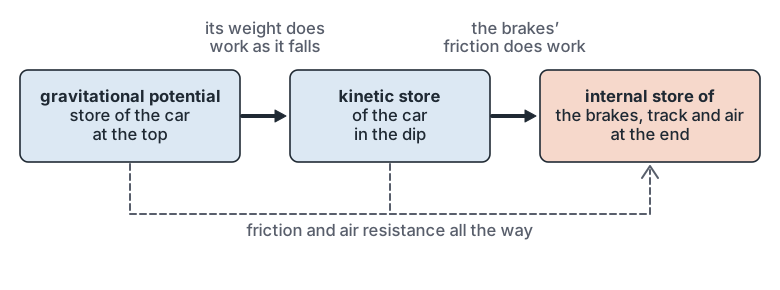
A flow diagram shows this with boxes for the stores and arrows for the transfers. For the roller coaster after the chain lets go, it looks like this:
 (enlarge)
Trap: “When the brakes stop the car, its kinetic energy is destroyed.” The friction in the brakes transfers that energy to the internal store of the brakes and the air around them, which is why brakes get hot. None of it disappears.
Worked example
A bouncing ball
 (enlarge)
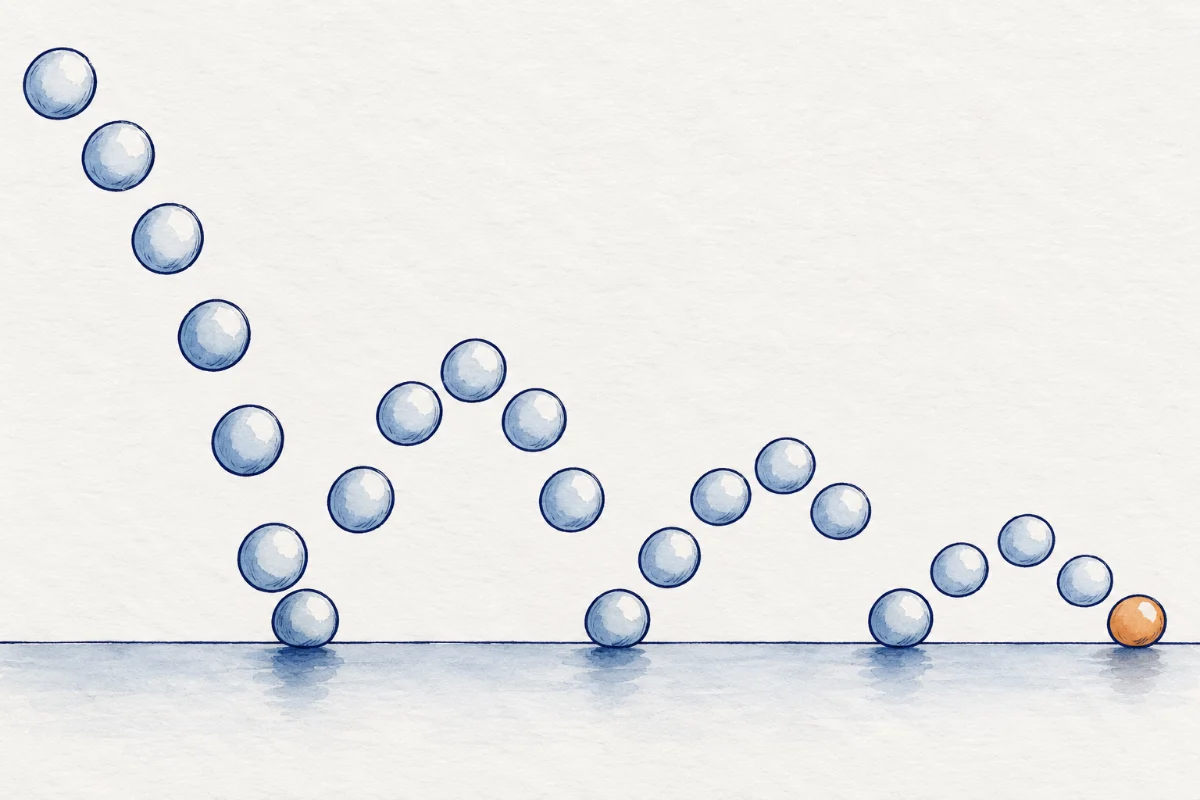
A ball is dropped and bounces several times, and each bounce is lower than the one before, as in the picture. At the top of its first bounce, the ball has 6.0 J in its gravitational potential store. At the top of the second bounce it has only 4.5 J there. Has the ball broken the conservation of energy? Where did the difference go?
The ball hasn't broken the principle, because energy is never destroyed. At each bounce the ball and the floor squash a little, so some energy goes to their internal stores and they warm up very slightly; the bounce also makes a sound, which carries some energy away, and air resistance warms the air as the ball moves. The difference is 6.0 J − 4.5 J = 1.5 J. So 1.5 J has been transferred to the internal store of the ball, the floor and the air (partly by sound), and the total energy is still 6.0 J.
Ride the coaster
Now ride the coaster yourself and watch the energy as it moves.
What is in the scene. A roller coaster at a fairground. Its car, with two riders, has a mass of 500 kg. The first hill, the lift hill, is a straight slope 20 m high, and an electric motor in a small motor house at its foot drives a chain that pulls the car up it. At the top the chain lets go. The track then drops into a dip, climbs a second hill 12 m high, drops again and ends in a row of brakes. A speed sensor can be fixed to the track. A small chart in the sky (on a phone, in the card beside the steps) shows three energy bars for the car: its gravitational potential store, its kinetic store and the thermal (internal) store of everything it rubs against, which is the car itself, the track, the air and the brakes. An orange line across the bars shows their total. Its title says which track the car rides: on the ideal track nothing rubs; on the real track friction and air resistance act on the car.
What you do. Predict which store the chain fills, then switch on the motor and watch the car climb. Decide where the speed sensor should go, release the car on the ideal track and watch the bars as it rides. Then ride again on the real track, with friction and air resistance. In the Supplement step, name the thin arrow of a Sankey diagram of the drop.
What the experiment showed
Do the experiment before you read on. As the chain pulled the car up the lift hill, its gravitational potential store filled and the orange total line rose with it, because the chain was doing work on the car and transferring energy to it from the motor. At the top the car had 98 kJ (98 000 J) in its gravitational potential store. After the chain let go, nothing else gave the car energy, and the total line stayed at 98 kJ for the rest of the ride.
These are the bars at four points on the ideal track and on the real track, with friction and air resistance (values from the model, see “About this model” at the end):
| Point on the ride | Ideal track: gravitational, kinetic, thermal (kJ) | Real track: gravitational, kinetic, thermal (kJ) |
|---|---|---|
| Top of the lift hill, at rest | 98, 0, 0 | 98, 0, 0 |
| Bottom of the dip | 0, 98, 0 | 0, 90, 8 |
| Top of the second hill | 58.8, 39.2, 0 | 58.8, 26.2, 13 |
| Stopped by the brakes | 0, 0, 98 | 0, 0, 98 |
On the ideal track, the gravitational potential store emptied into the kinetic store on the way down, and the car went fastest at the bottom of the dip, where it had the least gravitational potential energy and so the most kinetic energy. Climbing the second hill moved part of it back. At the end, the friction in the brakes moved all of it into the thermal store. On the real track, friction and air resistance moved a little energy to the thermal store all the way round, so at the bottom of the dip the car had less kinetic energy than on the ideal track, and it went more slowly. In every row the three numbers add up to 98 kJ: the energy moved from store to store, and the total never changed.
Key idea: At every point of the ride, gravitational + kinetic + thermal = 98 kJ, the energy that the chain gave the car.
Supplement: Sankey diagrams
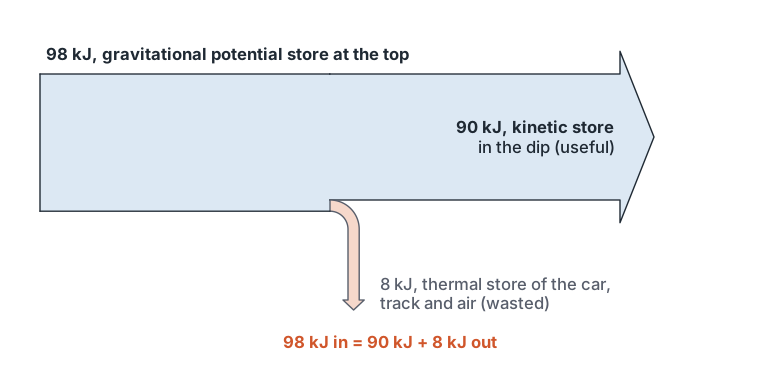
A Sankey diagram shows the energy transferred in a process by arrows whose widths are drawn to scale: the wider the arrow, the more energy. The energy going in enters on the left. The useful part carries straight on, and the wasted part bends away, usually downwards. Because energy is conserved, the widths of the arrows coming out add up to the width of the arrow going in.
Here is the drop of the real track, from the top of the lift hill to the bottom of the dip:
 (enlarge)
The thermal arrow is “wasted” because that energy can't make the car go any faster: it has spread out into the warm air and the warm track.
Worked example
The whole ride in one Sankey diagram
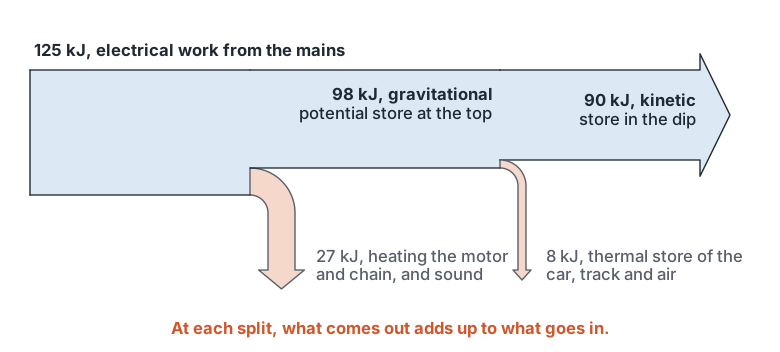
To lift the car, the motor at the foot of the lift hill takes 125 kJ from the mains by electrical work. The car gains 98 kJ of gravitational potential energy; the rest heats the motor and the chain and makes their noise. On the real track, 8 kJ more goes to the thermal store on the drop. How much energy is wasted in the motor and chain, how much kinetic energy does the car have in the dip, and what does the Sankey diagram for the two stages look like?
Energy is conserved at each stage, so the arrows out of a stage add up to the arrow into it. In the motor and chain: 125 kJ − 98 kJ = 27 kJ heats the motor and chain and leaves as sound. On the drop: 98 kJ − 8 kJ = 90 kJ is in the car's kinetic store in the dip. The Sankey diagram has two splits, one after the other:
 (enlarge)
Of the 125 kJ taken from the mains, 90 kJ reaches the car's kinetic store in the dip; the other 35 kJ (27 kJ + 8 kJ) has gone to thermal stores and sound, and none has been destroyed.
Case closed
The energy for the whole ride comes from the chain, which does work on the car and fills its gravitational potential store, using energy that the motor takes from the mains. After the chain lets go, the energy moves between the car's gravitational potential and kinetic stores, so the car is fastest where it is lowest. Friction, air resistance and finally the brakes transfer it to the thermal store of the car, the track and the air. At every moment the total is the same, because energy is never created or destroyed, only moved from store to store.
About this model
The experiment is a model of a real ride, not a recording. The car's mass (500 kg with its riders), the heights (20 m and 12 m) and g = 9.8 N/kg give the gravitational potential values; on the ideal track nothing rubs, so no energy goes to the thermal store until the brakes. On the real track, friction and air resistance are modelled as one steady 200 N force against the motion all the way round, so the thermal store grows by 200 J for every metre the car travels (40 m of track from the top to the bottom of the dip, 65 m to the top of the second hill). Real air resistance grows with speed, so it is larger in the dip than on the hills. The lift hill is modelled without friction, the car's tiny kinetic energy while the chain pulls it (0.25 kJ on the slow chain) is left out, and so is the energy of its spinning wheels. The motor's 125 kJ in the worked example is an example value.