On a still morning, a mountain lake shows you the mountains twice: once against the sky, and once more in the water, upside down and almost as sharp as the real ones. Light from the snow on the peak reaches your eye along two paths. Some of it comes straight across the air, and some of it goes down to the water and bounces up again. If the light bounced off at any angle it liked, the picture in the lake would be a blur. Instead it is sharp, so the light must follow a rule. This part is about that rule.
 (enlarge)
Light bouncing off a mirror
Light travels in straight lines. On a diagram, the path of light is drawn as a ray: a straight line with an arrow showing which way the light goes. In the laboratory, a ray box gives you a ray you can see: a lamp inside a box shines through a narrow slit, and the thin beam that comes out lights up a line across a sheet of paper.
Most surfaces, such as paper, skin or a wall, scatter the light that falls on them in all directions, which is why you can see them from anywhere in a room. A plane mirror is a flat, smooth, shiny surface. It does not scatter light: a narrow ray that hits it leaves in one direction only. Still water and polished metal reflect light in the same way.
The normal and the two angles
To describe a reflection, you need one more line, drawn where the ray hits the mirror.
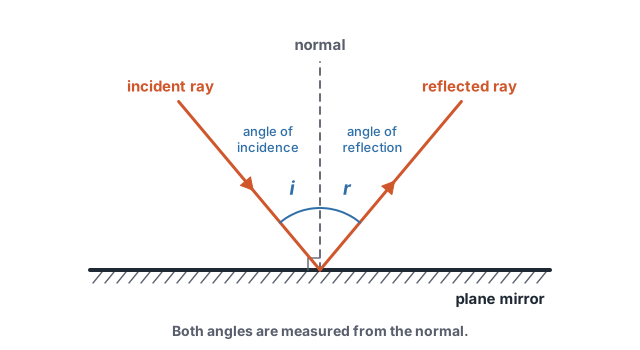
- The normal is a line at right angles (90°) to the surface of the mirror, at the point where the ray hits it. It is a construction line, not a ray, so it is drawn dashed.
- The ray arriving at the mirror is the incident ray, and the ray leaving it is the reflected ray.
- The angle of incidence, i, is the angle between the incident ray and the normal.
- The angle of reflection, r, is the angle between the reflected ray and the normal.
 (enlarge)
Trap: Measuring the angle between the ray and the mirror's surface. The angles of incidence and reflection are always measured from the normal. The normal is at 90° to the surface, so an angle to the surface and the angle to the normal add up to 90°.
Worked example
Measuring from the normal
A ray of light hits a plane mirror at 35° to the surface of the mirror. Find the angle of incidence.
The normal is at 90° to the surface, so the angle between the ray and the normal is 90° − 35° = 55°. The angle of incidence is 55°, not 35°: always change an angle to the surface into an angle to the normal.
Aim, measure, repeat
Now aim a ray at a mirror and measure the angles.
What is on the bench. A sheet of white paper with a pencil line across it, and a plane mirror 11 cm wide standing upright on the line, its reflecting surface along the line. A small cross marks the middle of the line. A ray box on the left of the paper sends a thin ray across it, and a clear protractor lies beside the paper.
What you do. Draw the normal at the cross. Aim the ray at the cross, predict where it will go after the mirror, then lay the protractor on the paper and read both angles. The protractor’s centre goes on the cross and its 90° mark on the normal, so the angle from the normal is the difference between the scale reading and 90° (a reading of 110° means 20°). Repeat at other angles of incidence, then send the ray along the normal.
What the experiment showed
Do the experiment before you read on. Every time, the reflected ray left the mirror on the other side of the normal from the incident ray. The protractor lay with its centre on the cross and its 90° mark on the normal, so each scale reading had to be turned into an angle from the normal. The incident ray crossed the scale at 110°, which is 110° − 90° = 20° from the normal, and the reflected ray crossed it at 70°, which is 90° − 70° = 20° from the normal (values from the model, see “About this model” at the end):
| Angle of incidence, i | Angle of reflection, r |
|---|---|
| 20° | 20° |
| 40° | 40° |
| 60° | 60° |
| 0° | 0° |
A ray sent along the normal came straight back along itself, so both angles were 0°. At every angle, the angle of reflection was equal to the angle of incidence.
In a real investigation on paper, the mirror line and the normal are drawn first and the mirror is stood on the line. The ray box is aimed so that its ray hits the mirror where the normal meets it, and the incident ray and the reflected ray are each marked with two pencil crosses, well apart. With the mirror and the ray box taken away, each pair of crosses is joined with a ruler, both angles are measured from the normal with a protractor, and the investigation is repeated for other angles of incidence.
The law of reflection
The results show the law of reflection:
angle of incidence = angle of reflection, i = r
The reflected ray is on the other side of the normal from the incident ray. The law holds for every ray at any plane mirror, and at any smooth, flat, shiny surface, such as still water.
Trap: “A ray that hits a mirror straight on has an angle of incidence of 90°.” Straight on means along the normal, so the angle of incidence is 0°. The angle of reflection is 0° too, and the ray goes straight back the way it came.
Worked example
Using the law
A ray hits a plane mirror with an angle of incidence of 35°. (a) State the angle of reflection. (b) Find the angle between the reflected ray and the surface of the mirror.
(a) By the law of reflection, r = i = 35°. (b) The normal is at 90° to the surface, so the angle between the reflected ray and the surface is 90° − 35° = 55°. The reflected ray leaves at 35° to the normal, which is 55° to the mirror.
Supplement: Calculating angles
Two facts let you work out any angle at a plane mirror from one measurement.
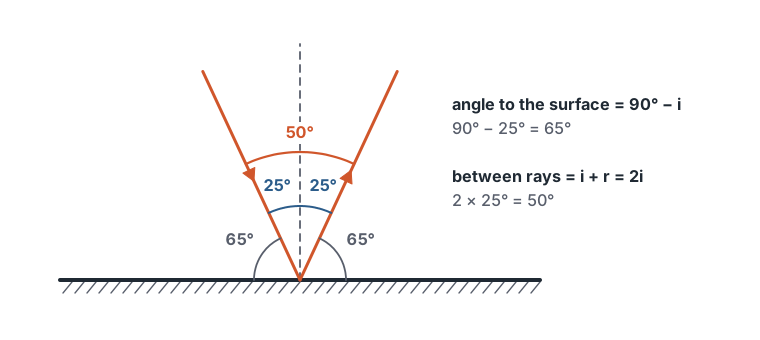
- You met the first in worked example W01: an angle to the normal and an angle to the surface add up to 90°, so angle to the surface = 90° − angle to the normal.
- The second is the Supplement one. The angle between the incident ray and the reflected ray is made of the two angles either side of the normal, i + r. Since r = i, angle between the rays = 2i. In the experiment, at an angle of incidence of 60° the two rays were 120° apart.
 (enlarge)
Worked example
The angle between the rays
Supplement. The incident ray and the reflected ray at a plane mirror are at 100° to each other. Find (a) the angle of incidence and (b) the angle between the incident ray and the surface of the mirror.
(a) The angle between the rays is 2i, so 2i = 100° and i = 100° ÷ 2 = 50°. (b) The angle to the surface is 90° − 50° = 40°. Halve the angle between the rays to get the angle of incidence.
Case closed
A still lake is a smooth, flat surface, so it reflects light as a plane mirror does. The normal to the water points straight up, and each ray from the mountain leaves the water at the same angle to the normal as it arrived. The rays from the peak that bounce off the water into your eye seem to come from a point below the far shore, as far below the water as the peak is above it, so you see a second mountain there, upside down. When a breeze ruffles the water, every little wave still obeys the law of reflection, but the little surfaces tilt in different directions, the reflected rays go off in many directions and the picture breaks up. In the next part, you find out where the picture in a mirror is.
About this model
The paper, mirror, ray box and protractor are simulated, and the rays are drawn exactly, so the angles of incidence and reflection come out exactly equal. The angles 20°, 40° and 60° are the model's settings. A real ray box gives a beam about a millimetre wide that spreads out a little, a real protractor can be read to about 1°, and the crosses marking a ray are never perfectly placed, so real readings of i and r often differ by a degree or two. Most real mirrors are glass with a silvered back, so the light reflects a few millimetres behind the front of the glass, and you draw the mirror line along the silvered back. Here the mirror reflects exactly on the line.