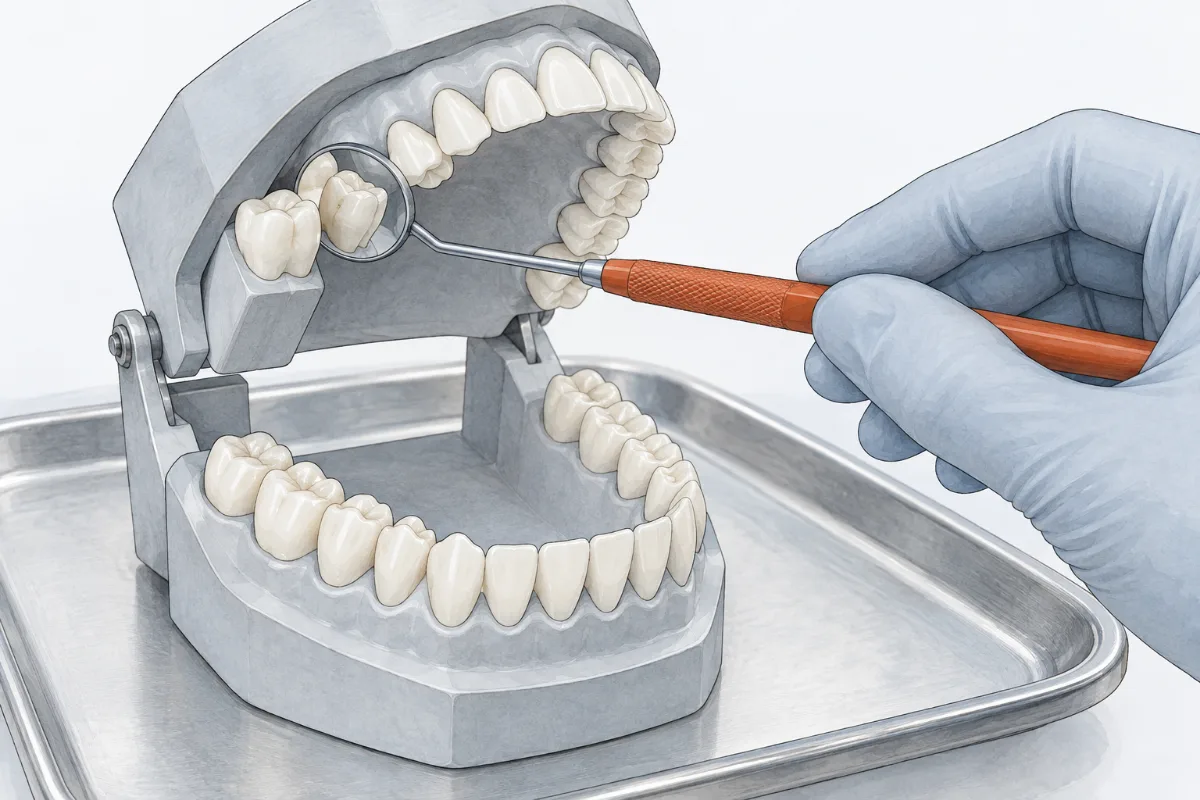
A dentist cannot put their head inside your mouth, so to see the back of your teeth they use a small round mirror on a long handle. Turn the mirror the right way, and the back of a tooth appears in it, as if the tooth were somewhere behind the little mirror. Yet behind the mirror there is nothing but its metal back and the handle. This part is about where that picture is and what it is like.
 (enlarge)
Where the light seems to come from
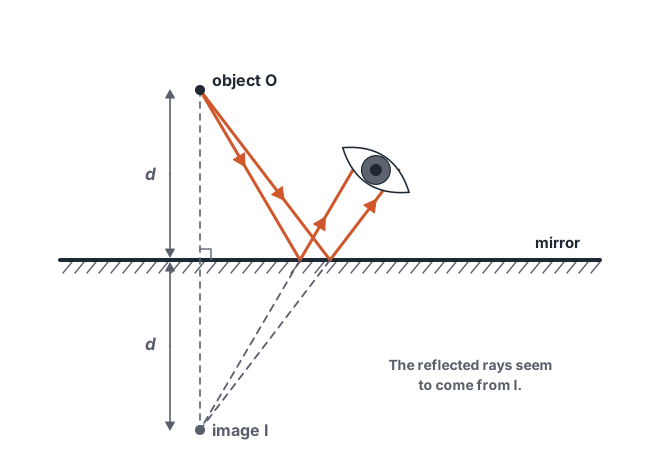
Light spreads out from each point of an object in all directions. Some of it hits a plane mirror, and each ray reflects with its angle of reflection equal to its angle of incidence. After reflection, the rays spread out from the mirror as if they all came from one point behind it.
Your eye cannot tell that the light has bounced. It takes each ray that enters it to have come in a straight line, so it sees the object at the point the reflected rays seem to come from. That point is the image of the object point. Each point of an object has its own image point, and together they make the image of the whole object.
In the diagram, the dashed line from O to I is the normal through O: the line from O at 90° to the mirror, like the normal drawn where a ray hits. Distances from a mirror are measured along such a normal.
 (enlarge)
A virtual image
No light ever goes behind the mirror. The reflected rays only seem to come from the image: the dashed lines behind the mirror show where your eye traces them back to, not where light travels. An image that light only seems to come from is called a virtual image. A virtual image cannot be formed on a screen: a sheet of paper held where the image is stays blank, because no light reaches it. (An image that light really does reach, like the picture a projector throws on a screen, is called a real image.)
Trap: “The image is on the surface of the mirror.” The image is behind the mirror, as far behind it as the object is in front. Your eye focuses on it there, which is why your own face in a bathroom mirror looks as far away as the mirror and back again.
Find the image
Now find an image with rays, then check it without any.
What is on the bench. The plane mirror and ray box from the first part, a fresh sheet of paper with a pencil line for the mirror, a ruler, a white card and two pins: a short object pin and a tall search pin, taller than the mirror.
What you do. Draw an arrow 6.0 cm in front of the mirror as the object. Aim the ray box so that its ray passes through the tip of the arrow, at two different angles, and predict where the two reflected rays seem to come from. Extend them back behind the mirror with the ruler, then do the same for the tail of the arrow and compare the image with the object. Hold the card where the image is. Finally, stand the object pin on the tip of the arrow and find its image with the search pin, with no rays at all. When two things that look lined up are at different distances from your eye, they seem to move apart as you move your head from side to side: this is called parallax. The search pin is in the right place when it and the image stay lined up, with no parallax.
What the experiment showed
Do the experiment before you read on. The two rays through the tip A of the arrow reflected at two different points of the mirror and spread apart. Extended back behind the mirror with dashed lines, they crossed at one point, A′: the image of A. Measured along the normal through A, A was 6.0 cm in front of the mirror line and A′ was 6.0 cm behind it. The tail B gave its image B′ in the same way, and the image of the arrow, from B′ to A′, was 3.0 cm long, as long as the arrow itself (values from the model, see “About this model” at the end):
| Distance from the mirror (cm) | Length of the arrow (cm) | |
|---|---|---|
| Object | 6.0 in front | 3.0 |
| Image | 6.0 behind | 3.0 |
The white card held behind the mirror where the image was stayed blank: no light reached it.
Then the pins. With the object pin standing at A, you looked at its image in the mirror and stood the tall search pin behind the mirror, where its top showed above the mirror. As you moved your head from side to side, the image and the search pin moved apart when the search pin was in the wrong place. They stayed lined up only when the search pin stood 6.0 cm behind the mirror, where the rays had crossed. When two things stay lined up as you move your eye, there is no parallax between them: they are in the same place. The image was as far behind the mirror as the object was in front, the same size as the object, and virtual.
The image in a plane mirror
The image of an object in a plane mirror is:
- the same size as the object;
- the same distance behind the mirror as the object is in front of it, on the normal through the object;
- virtual: light only seems to come from it, and it cannot be formed on a screen.
So an object 6.0 cm in front of a mirror and its image 6.0 cm behind it are 12.0 cm apart.
Trap: “My image is as far from me as the mirror is.” Your image is behind the mirror, so its distance from you is your distance to the mirror and the same again behind it: twice as far.
Worked example
Walking towards a mirror
Ana stands 2.0 m in front of a plane mirror. (a) How far is her image from her? (b) She walks 0.5 m towards the mirror. How far is her image from her now?
(a) Her image is 2.0 m behind the mirror, and she is 2.0 m in front of it, so the image is 2.0 m + 2.0 m = 4.0 m from her. (b) She is now 2.0 m − 0.5 m = 1.5 m from the mirror, and her image is 1.5 m behind it, so the image is 1.5 m + 1.5 m = 3.0 m from her. The distance to your image is twice your distance to the mirror, so when you walk 0.5 m closer, your image comes 1.0 m closer to you.
Supplement: Constructing an image
Supplement. On paper, you can find the image of a point object O in two ways, and they give the same point.
- With rays. Draw two rays from O to the mirror. At each point where a ray meets the mirror, draw the normal, measure the angle of incidence and draw the reflected ray at the same angle on the other side of the normal. Extend the two reflected rays back behind the mirror with dashed lines. The image I is where they cross.
- With a ruler. Draw a line from O at 90° to the mirror and continue it, dashed, behind the mirror. Measure the distance from O to the mirror and mark I the same distance behind it.
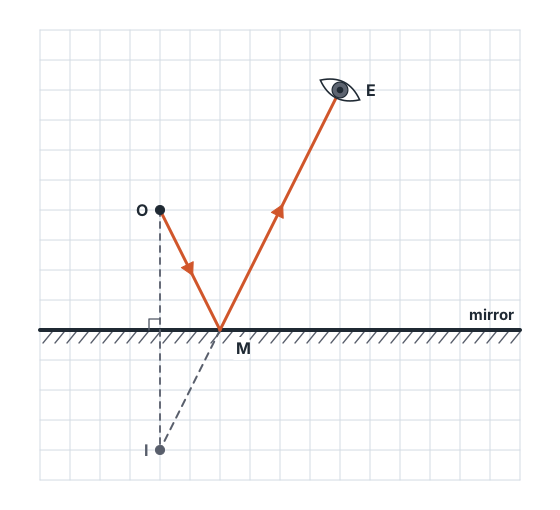
To draw the ray from O that reaches an eye E, first find the image I. The light enters the eye as if it came from I, so draw a straight line from E to I. Where it crosses the mirror, at M, is the point where the ray reflects. Draw the incident ray from O to M and the reflected ray from M to E, with arrows, and show the part from M to I dashed.
 (enlarge)
Worked example
The ray that reaches the eye
Supplement. On a scale drawing, a point object O is 4.0 cm in front of a plane mirror. An eye E is 8.0 cm in front of the mirror and 6.0 cm to the right of O. Find where the ray from O that reaches the eye hits the mirror.
The image I is 4.0 cm behind the mirror, on the normal through O. The ray reaches the eye as if from I, so it lies along the straight line from I to E. From I to E, that line covers 4.0 cm + 8.0 cm = 12.0 cm towards the eye and 6.0 cm to the right. It reaches the mirror after 4.0 cm of the 12.0 cm, one third of the way, so it has moved 6.0 cm ÷ 3 = 2.0 cm to the right. Join the eye to the image: the ray hits the mirror 2.0 cm to the right of the normal through O. Check: the incident ray goes 2.0 cm across in 4.0 cm towards the mirror, and the reflected ray 4.0 cm across in 8.0 cm away from it, so both make the same angle with the normal.
Supplement: Two mirrors in a periscope
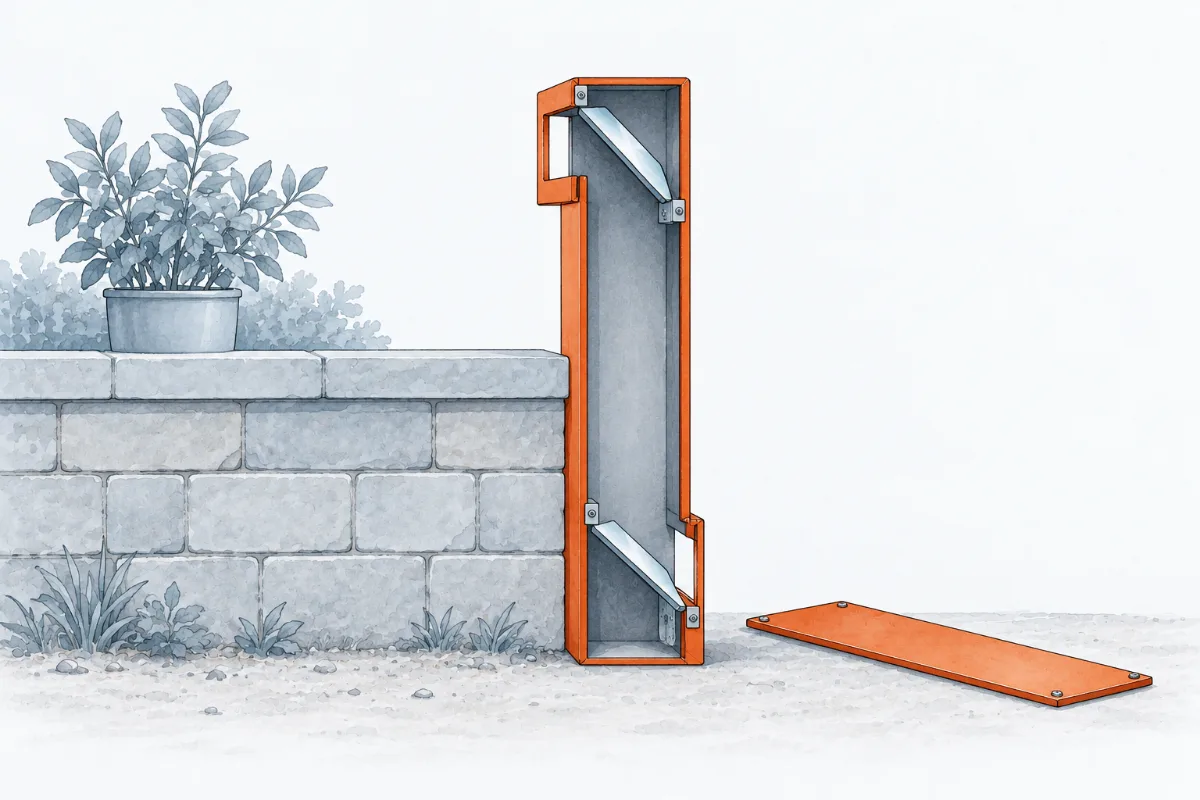
Supplement. A periscope lets you see over a wall or a crowd. It is a tall tube with a window near the top and another near the bottom, and two plane mirrors inside, parallel to each other and each at 45° across the tube. Light from the scene comes in through the top window, reflects off the top mirror and travels down the tube. The bottom mirror reflects it out through the bottom window to your eye.
 (enlarge)
Worked example
Turning through 90°
Supplement. In a periscope, light travelling horizontally hits the top mirror, which is at 45° to the horizontal. (a) Find the angle of incidence. (b) Find the angle between the incident ray and the reflected ray. (c) Explain why the light then travels straight down the tube.
(a) The ray is at 45° to the surface of the mirror, so the angle of incidence is 90° − 45° = 45°. (b) The angle of reflection is also 45°, so the angle between the rays is 2 × 45° = 90°. (c) The reflected ray leaves at 45° to the mirror, on the other side of the normal, and the mirror itself is at 45° to the horizontal, so the reflected ray is at 45° + 45° = 90° to the horizontal: straight down. A mirror at 45° turns a ray through a right angle, so two of them send the light down the tube and out to the eye.
Case closed
The dentist's mirror is a small plane mirror. Light from the back of the tooth reflects off it, each ray with its angle of reflection equal to its angle of incidence, and reaches the dentist's eye as if it came from an image behind the little mirror, as far behind it as the tooth is in front. The image is the same size as the tooth, and it is virtual: no light goes behind the mirror, which is just as well, because there is only metal there. By tilting the mirror, the dentist changes which rays reach their eye, and so which part of the tooth they can see.
About this model
The paper, mirror, ray box, card and pins are simulated, and the rays are drawn exactly, so the image comes out exactly 6.0 cm behind the mirror and exactly 3.0 cm long. On real paper, rays are about a millimetre wide and are marked with pencil crosses, so the dashed extensions cross over a small region rather than at a point, and the two distances usually agree to within a few millimetres. A real glass mirror reflects at its silvered back, so the mirror line is drawn along the back; here the mirror reflects exactly on the line. The search pin is 8 cm tall and the mirror 4.2 cm, so you can see the top of the search pin above the mirror and the image of the object pin in the mirror at the same time. The view in the mirror is worked out by the computer from the law of reflection.