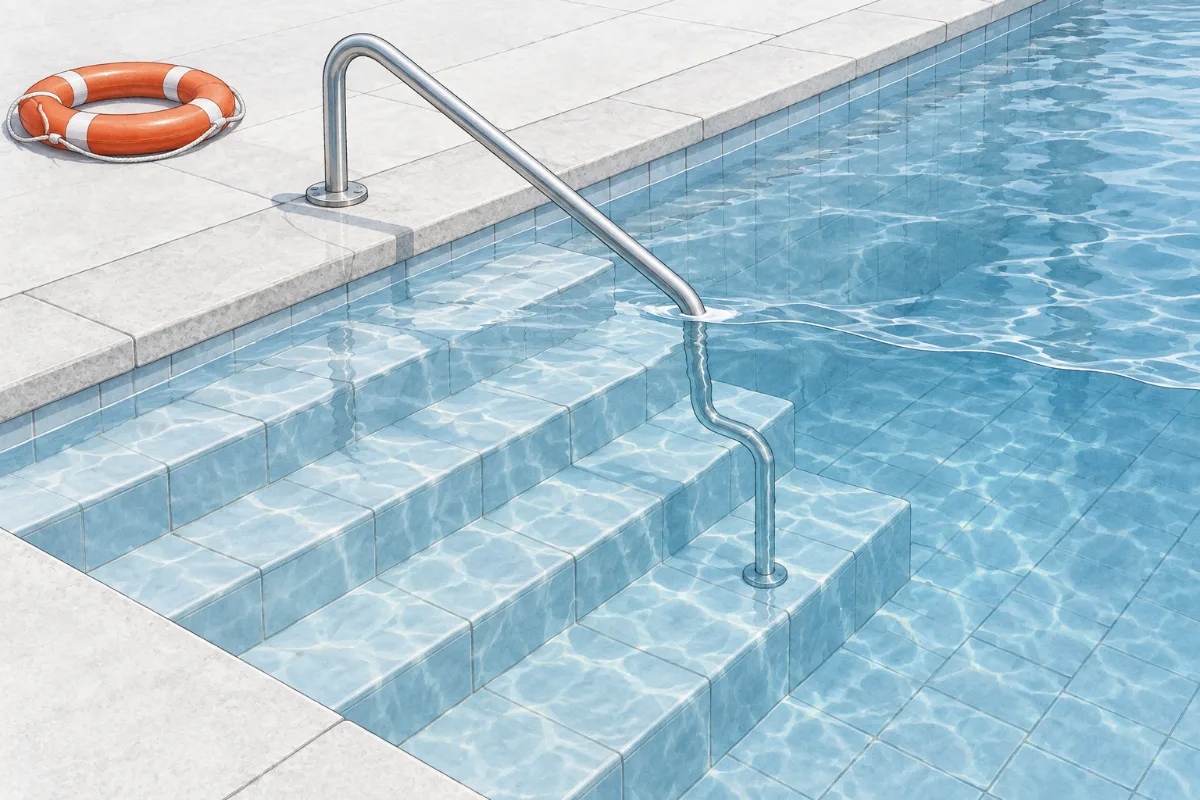
Stand at the edge of a swimming pool and look down at the steps. The water looks shallower than the depth marker says, and the steps under the water seem closer to the surface than they really are. Put a straight straw in a glass of water, look at it from above and to the side, and it seems to bend at the water’s surface, as if it had snapped. Nothing has happened to the pool or to the straw. What changes is the light coming from them: it changes direction as it leaves the water. This part is about that change of direction, and by the end of it you can explain the bent straw with two rays.
 (enlarge)
Light changes direction at a boundary
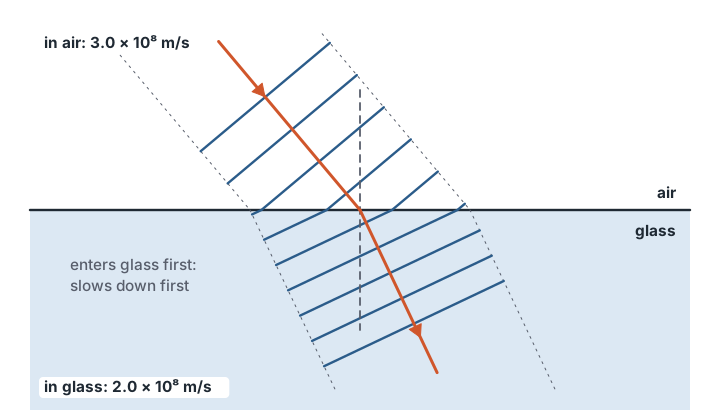
Light travels in straight lines while it stays in one material. A material that light passes through, such as air, water or glass, is called a medium, and the place where two mediums meet, such as the surface of the water in a pool, is a boundary. Light travels more slowly in water or glass than in air: about 3.0 × 10⁸ m/s in air, but only about 2.0 × 10⁸ m/s in glass. When a ray of light reaches a boundary at an angle, this change of speed makes it change direction. The change of direction of light as it passes from one medium into another is called refraction.
Why should a change of speed change the direction? Think of a toy car rolling at an angle off a smooth floor onto a thick carpet. One front wheel reaches the carpet first and slows down while the other is still rolling fast on the floor, so the car swings round until both wheels are on the carpet. A beam of light is not a car, and nothing in it has wheels, but in the same way the side of the beam that reaches the glass first slows down first, and the beam turns.
The normal and the two angles
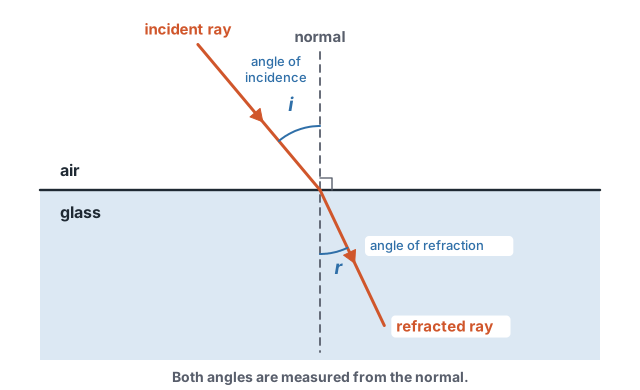
To describe refraction, you use the same construction line as for a mirror, drawn where the ray crosses the boundary.
- The normal is a line at right angles (90°) to the boundary, at the point where the ray crosses it. It is a construction line, not a ray, so it is drawn dashed.
- The ray arriving at the boundary is the incident ray, and the ray that has crossed into the new medium is the refracted ray.
- The angle of incidence, i, is the angle between the incident ray and the normal.
- The angle of refraction, r, is the angle between the refracted ray and the normal.
 (enlarge)
Trap: “The angle of refraction is the angle between the refracted ray and the surface of the glass.” Like every angle in ray diagrams, it is measured from the normal. The normal is at 90° to the surface, so an angle to the surface and the angle to the normal add up to 90°.
Worked example
Angles from the normal
A ray of light in air meets the flat surface of a glass block at 50° to the surface. Inside the glass, the refracted ray is at 65° to the surface. Find (a) the angle of incidence and (b) the angle of refraction.
(a) The normal is at 90° to the surface, so the angle of incidence is 90° − 50° = 40°. (b) In the same way, the angle of refraction is 90° − 65° = 25°. The angle of incidence is 40° and the angle of refraction is 25°: inside the glass, the ray is closer to the normal.
Free play: nothing here is marked or saved
Toy car onto the carpet
The reading’s toy car rolls at 1.00 m/s on the floor and more slowly on the carpet. Change the angle and the carpet’s speed: which way does it turn at the edge, and how much?
Still picture: your device asks for less motion.
Try: Make the carpet slower. Does the car turn more, or less?
- Incidence i
- 50°
- Refraction r
- 37.8°
- Turned through
- 12.2°
Slower on the carpet: it turns towards the normal, so r < i.
Supplementv floor ÷ v carpet = 1.00 ÷ 0.80 = 1.25
sin i ÷ sin r = 0.766 ÷ 0.613 ≈ 1.25
- One front wheel reaches the carpet first and slows down while the other still rolls fast on the floor, so the car swings round towards the normal. Once both wheels are on the carpet it goes straight again, more slowly.
- The teal arrows ahead of the front wheels show how fast each one rolls: the arrow of the wheel on the carpet is shorter.
- The slower the carpet, the bigger the difference between the two wheels, and the more the car turns: the angle of refraction gets smaller.
- Head-on, along the normal, both wheels reach the carpet together, so nothing swings it round: it goes straight on, only more slowly. On a carpet as fast as the floor nothing slows, and it does not turn either.
- The pencil marks across the trail show the front axle every 0.05 s: closer together on the carpet, where the car is slower.
- Light does the same: it slows down going into glass, so a ray that meets the glass at an angle bends towards the normal.
- Supplement The floor’s speed ÷ the carpet’s speed (m/s ÷ m/s, so the units cancel) equals sin i ÷ sin r at every angle. For light this ratio of speeds is the refractive index, later in this part.
About this model. An analogy: light has no wheels. Here the car’s two front wheels set its direction. Each rolls straight ahead at the speed of what it is on and never skids sideways; the back wheels just follow. A real toy car would also slow down and slip on a carpet. The car swings round along a short curve, about as long as its axle is wide, while a ray of light turns at one point; so the angles are drawn where each straight part of the trail meets the normal. The picture runs 4 times slower than real. The angle of refraction and the turn are rounded to 0.1° (so 50° means 50.0°), the sines to three figures; both ratios are worked out before rounding, so dividing the rounded sines yourself can differ in the last figure.
Through a glass block
Now send a ray through a glass block and measure what happens to it.
What is on the bench. A sheet of white paper with a rectangular glass block, 11 cm long and 6.5 cm wide, lying on its pencil outline. Point P is the middle of the block’s far side, and a dashed normal is drawn through it. An angle scale is printed on the paper around P: a circle marked in degrees, starting from 0° on the normal on each side. The glass is clear, so you can read the scale through it. A ray box sends a thin ray across the paper, always aimed at P.
What you do. Predict which way the ray bends as it enters the glass, then switch the ray box on. Compare the ray that comes out of the block with the ray that went in, read the angle of refraction off the scale, and repeat at bigger angles of incidence. Finally, send the ray along the normal.
What the experiment showed
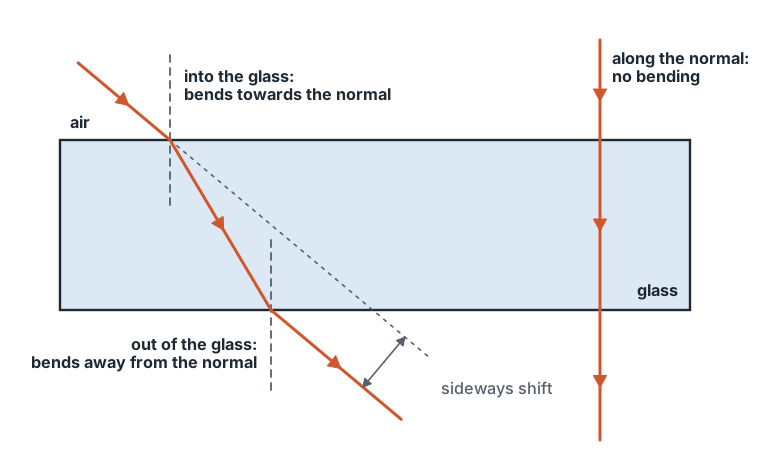
Do the experiment before you read on. At P, where the ray entered the glass, it bent towards the normal, so the angle of refraction was smaller than the angle of incidence. It went straight across the glass, and at the near side, where it left the block, it bent away from the normal again. The ray that came out was parallel to the ray that went in, but shifted sideways. These are the readings from the scale, to the nearest degree (values from the model, see “About this model” at the end):
| Angle of incidence, i | Angle of refraction, r |
|---|---|
| 20° | 13° |
| 40° | 25° |
| 60° | 35° |
| 0° | 0° |
The bigger the angle of incidence, the bigger the angle of refraction, but the angle of refraction was always the smaller of the two. The ray sent along the normal went straight through the block without changing direction.
In a real investigation on paper, the block is drawn around with a sharp pencil, and the normal is drawn at the point where the ray will enter. The ray box is aimed along a line drawn at a measured angle to the normal, and the ray coming out of the block is marked with two pencil crosses, well apart. With the block taken away, the crosses are joined and the line is continued back to the block’s outline, the point where the ray left the block is joined to the point where it entered, and the angle of refraction is measured from the normal with a protractor. Blocks of other shapes, such as a semicircular block or a triangular prism, show refraction in the same way, at every boundary the ray crosses. You use a semicircular block in the next part.
Into and out of a transparent material
The experiment shows three rules for light crossing the boundary between two mediums.
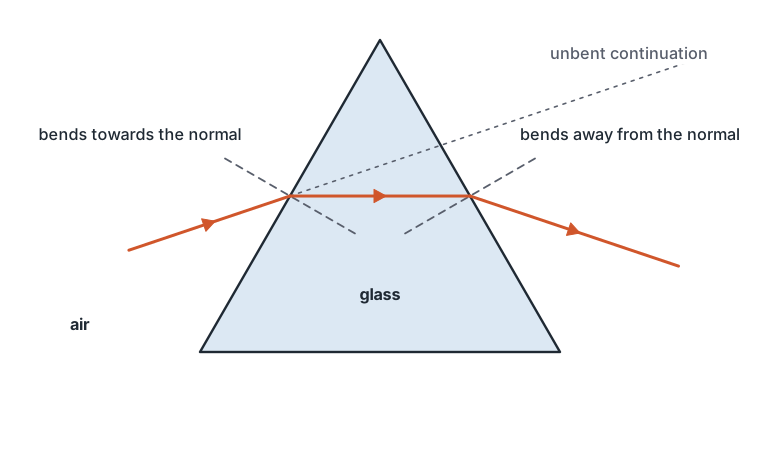
- Light passing into a medium in which it travels more slowly, such as from air into glass or water, bends towards the normal: the angle of refraction is smaller than the angle of incidence.
- Light passing into a medium in which it travels faster, such as from glass or water into air, bends away from the normal: the angle in the air is bigger than the angle in the glass.
- Light travelling along the normal crosses the boundary without changing direction, although it still slows down or speeds up.
Inside one medium, the ray is straight: it changes direction only at a boundary. A rectangular block has two parallel sides, so the ray bends one way going in and back by the same amount coming out, and the ray that comes out is parallel to the ray that went in. In a triangular prism the two sides the ray crosses are not parallel, so their normals point in different directions: the two bends do not cancel, and the ray leaves turned through an angle.
 (enlarge)
 (enlarge)
Trap: “The light curves gradually as it goes through the glass.” Inside one medium light travels in a straight line. It changes direction only at the boundaries, where its speed changes.
Trap: “Light always bends when it goes into glass.” A ray along the normal, at an angle of incidence of 0°, goes straight on. It slows down, but its direction does not change.
Worked example
The ray out of a block
A ray of light enters a rectangular glass block with an angle of incidence of 40°, and the angle of refraction is 25°. The ray leaves through the opposite side of the block, which is parallel to the first. Find the angle between the ray leaving the block and the normal.
The two sides are parallel, so the normals at the two sides are parallel too, and the ray inside the glass meets the far side at 25° to the normal. Leaving the glass, the light follows the same path as light entering at 40°, but backwards, so it leaves at 40° to the normal. The ray leaves at 40° to the normal: parallel to the ray that went in, but shifted sideways.
Supplement: Refractive index
How much a medium bends light depends on how much it slows the light down. The refractive index, n, of a medium is the ratio of the speeds of light in the two regions: the speed in air (strictly, in a vacuum, but air is almost the same) divided by the speed in the medium.
refractive index = speed of light in air ÷ speed of light in the medium
For glass, n = 3.0 × 10⁸ m/s ÷ 2.0 × 10⁸ m/s = 1.5. A refractive index has no unit, because it is one speed divided by another. For water, n = 1.33, so light in water travels at 3.0 × 10⁸ m/s ÷ 1.33 = 2.3 × 10⁸ m/s. The same idea works for any wave crossing from one region into another: the ratio of the two speeds tells you how much the wave turns.
 (enlarge)
The refractive index also links the two angles. For light passing from air into a medium:
refractive index = sin i ÷ sin r, or n = sin i / sin r
Your readings from the glass block show it. The angles change, but sin i ÷ sin r stays almost the same:
| i | r | sin i | sin r | sin i ÷ sin r |
|---|---|---|---|---|
| 20° | 13° | 0.342 | 0.225 | 1.52 |
| 40° | 25° | 0.643 | 0.423 | 1.52 |
| 60° | 35° | 0.866 | 0.574 | 1.51 |
The mean is 1.52, so the refractive index of the glass is about 1.5. The model’s glass has a refractive index of exactly 1.50: the small difference comes from reading the angles to the nearest degree. To find an angle of refraction from n, rearrange the equation to sin r = sin i ÷ n, then use the sin−1 key of your calculator.
Light going the other way, from the medium into air, follows the same path backwards. So the angle in the air always goes on top: n = sin(angle in air) ÷ sin(angle in the medium), whichever way the light travels.
Trap: “n = i ÷ r.” The ratio of the angles themselves changes from row to row (20 ÷ 13 = 1.54, but 60 ÷ 35 = 1.71). It is the ratio of their sines that stays the same.
Worked example
Calculating the refractive index
Supplement. A ray passes from air into a plastic block with an angle of incidence of 50° and an angle of refraction of 30°. (a) Calculate the refractive index of the plastic. (b) The speed of light in air is 3.0 × 10⁸ m/s. Calculate the speed of light in the plastic. (c) Calculate the angle of refraction for an angle of incidence of 30°.
(a) n = sin i ÷ sin r = sin 50° ÷ sin 30° = 0.766 ÷ 0.500 = 1.53. (b) The speed in the plastic is the speed in air ÷ n = 3.0 × 10⁸ m/s ÷ 1.53 = 2.0 × 10⁸ m/s. (c) sin r = sin 30° ÷ 1.53 = 0.500 ÷ 1.53 = 0.327, so r = sin−1 0.327 = 19°. Divide sin i by sin r for n, and divide the speed in air by n for the speed in the medium.
Case closed
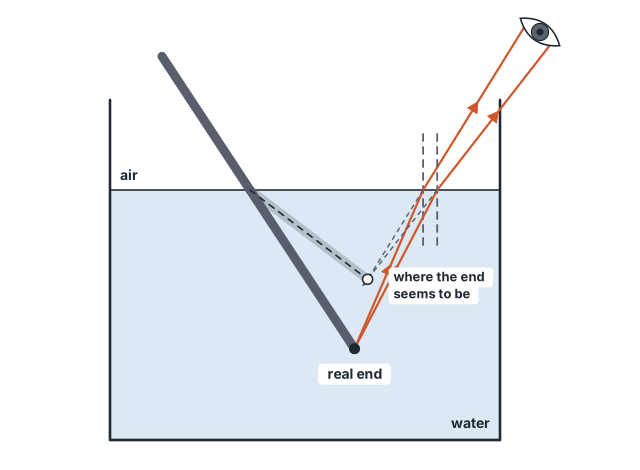
Back to the straw. Light from the part of the straw under the water travels up to the surface and passes out into the air. Light travels faster in air, so each ray bends away from the normal as it leaves the water. Your eye and brain take it for granted that light travels in straight lines, so they trace each ray straight back, and the rays seem to come from a point higher up than the straw really is. Every point of the straw under the water looks raised, so the straw seems to bend upwards where it enters the water. The steps and the floor of a swimming pool look raised in the same way, which is why the pool looks shallower than it is. In the next part, you find out what happens when light trying to leave glass meets the boundary at a large angle.
 (enlarge)
About this model
The paper, block, angle scale and ray box are simulated, and the rays are drawn exactly, for glass with a refractive index of 1.50. The angles of refraction come out at 13.2°, 25.4° and 35.3°, and you read them to the nearest degree, as you would on a real scale: 13°, 25° and 35°. The angles of incidence 20°, 40° and 60° are the model’s settings. A real ray box gives a beam about a millimetre wide that spreads out a little, a little light is reflected at every surface of a real block, and real glass has a refractive index between about 1.5 and 1.7, depending on the kind of glass.