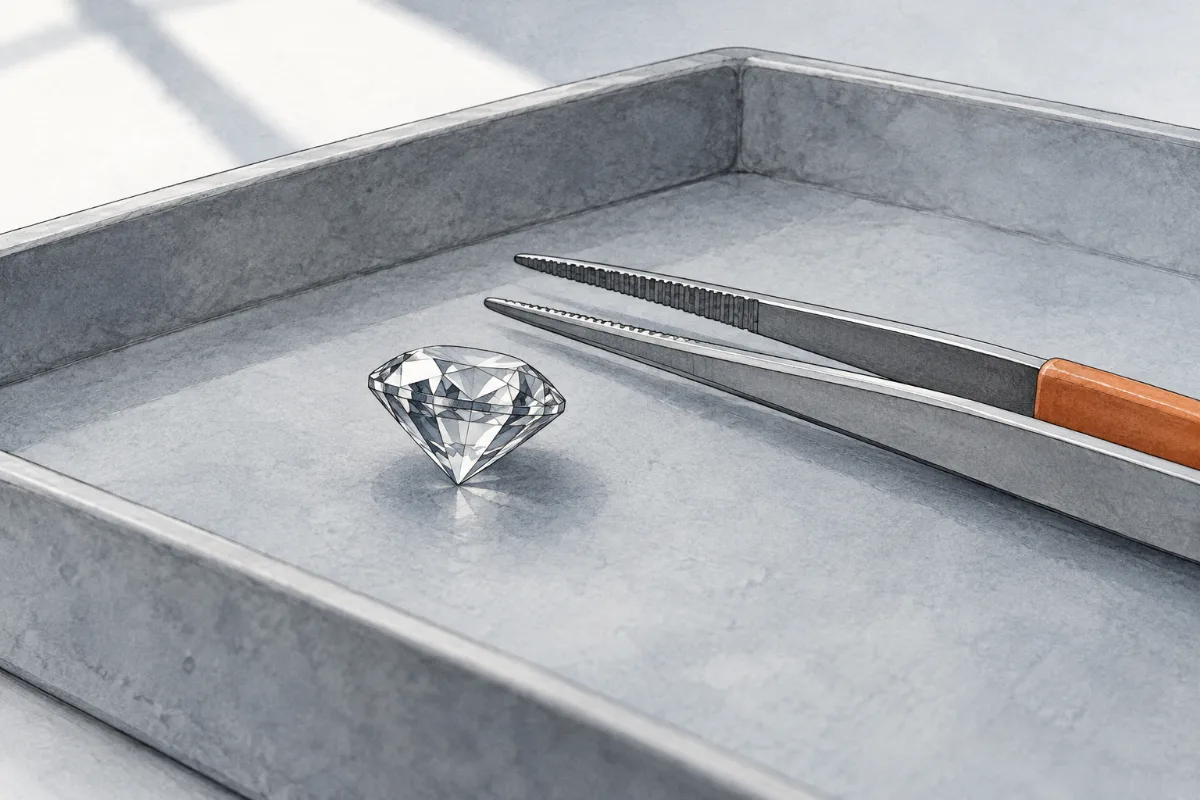
A cut diamond on a jeweller’s tray flashes with sharp points of light as it turns, far brighter than a piece of glass cut to the same shape. Light that gets into a well-cut diamond does not leak out of the back: it bounces around inside and comes out of the top, towards you. Yet a diamond has no silvered back like a mirror. The reflection happens at the boundary between the diamond and the air, when light trying to get out meets that boundary at a large angle to the normal. This part is about that reflection and the angle at which it starts.
 (enlarge)
Light leaving glass
In the first part, light leaving glass bent away from the normal, so the angle in the air was bigger than the angle in the glass. Not all of the light gets out, though. At the boundary, a little of it is reflected back into the glass, obeying the law of reflection. This is internal reflection: reflection inside a medium, at its boundary with a medium in which light travels faster. Most of the light gets out, so the reflected ray is weak.
Now think about what must happen as the angle in the glass grows. The ray in the air is always further from the normal than the ray in the glass, and it can never be more than 90° from the normal, because then it would be back inside the glass. So, at some angle in the glass, the ray in the air must run along the boundary, and beyond that angle something else must happen.
Turning the ray
Now find that angle.
What is on the bench. A fresh sheet of paper with a semicircular glass block lying on it, its flat side towards you. Point O is the middle of the flat side, and an angle scale is printed on the paper around O, marked in degrees from the dashed normal. A ray box can move around the curved side of the block, always aimed at O.
What you do. Predict what the ray does as it enters the curved side. Then move the ray box round, so that the ray meets the flat side from inside the glass at bigger and bigger angles, and watch both the ray that gets out into the air and the ray reflected inside. Find the angle at which the ray in the air runs along the flat side, and go beyond it. Finally, send light into a bent strip of clear plastic, a light pipe.
What the experiment showed
Do the experiment before you read on. The ray box was always aimed at O, the middle of the flat side. O is also the centre of the circle that the curved side is part of, so the ray entered the curved side along a radius, a line from the centre to the edge. A radius is at 90° to a circle, so the ray entered along the normal and did not bend. It reached O and met the flat side with the angle of incidence that the ray box was set to. These are the readings, to the nearest degree (values from the model, see “About this model” at the end):
| Angle of incidence in the glass | Ray in the air | Ray reflected inside |
|---|---|---|
| 20° | leaves at 31° to the normal | weak |
| 40° | leaves at 75° to the normal | brighter |
| 42° | runs along the flat side, at 90° | strong |
| 50° | no ray leaves | all of the light, at 50° |
As the angle in the glass grew, the ray in the air bent further from the normal and the reflected ray grew brighter. At 42°, the ray in the air ran along the flat side of the block. Beyond 42°, no light got out at all: all of it was reflected inside the glass, with the angle of reflection equal to the angle of incidence. In the light pipe, the light met the sides at more than 42° every time, so it was reflected from side to side all the way along the bend and came out of the far end.
The critical angle
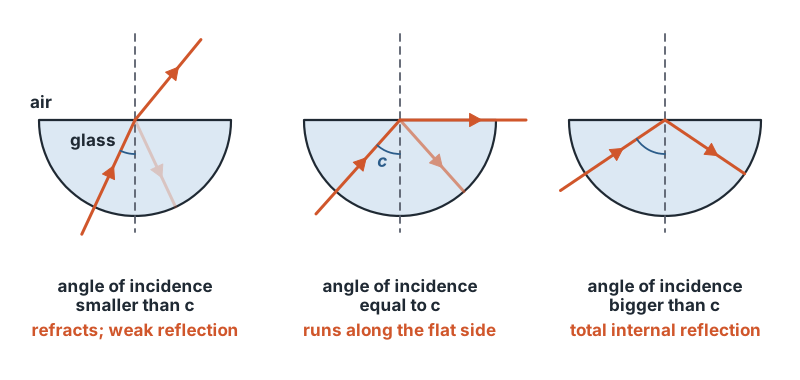
- The critical angle, c, is the angle of incidence, inside the medium, at which the angle of refraction is 90°, so that the refracted ray runs along the boundary. For the glass in the experiment, it is about 42°.
- When the angle of incidence is bigger than the critical angle, no light gets out: all of it is reflected inside the medium. This is total internal reflection.
Total internal reflection happens only when both of these are true:
- the light is inside the medium in which it travels more slowly (such as glass or water), meeting a boundary with a medium in which it travels faster (such as air);
- the angle of incidence is bigger than the critical angle.
The diagram shows the block turned the other way up from the experiment: its flat side is at the top, and the light comes up from below.
 (enlarge)
Trap: “Light going from air into glass can be totally internally reflected.” Going into glass, a ray bends towards the normal, so it always has an angle of refraction less than 90° and always gets in. Total internal reflection needs light inside the glass, trying to get out.
Trap: “The critical angle is the angle at which the light is totally reflected.” At the critical angle itself, the refracted ray just runs along the boundary. Total internal reflection happens at angles of incidence bigger than the critical angle.
Worked example
Will the light get out?
The critical angle of a glass is 42°. Two rays inside the glass meet its flat surface with angles of incidence of (a) 30° and (b) 60°. Describe what happens to each ray.
(a) 30° is smaller than the critical angle, so the ray refracts out into the air, bending away from the normal, and a weak ray is reflected back into the glass. (b) 60° is bigger than the critical angle, so the ray is totally internally reflected: all of it stays in the glass and leaves the surface at 60° to the normal. Compare the angle of incidence with the critical angle: smaller gets out, bigger is totally internally reflected.
Total internal reflection at work
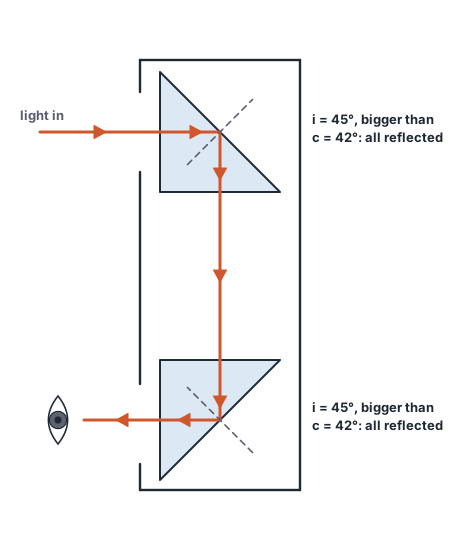
- Reflecting prisms. A glass prism with angles of 45°, 45° and 90° can turn light through 90°. Light entering one of the short faces along the normal goes straight in and meets the long face with an angle of incidence of 45°. That is more than the critical angle of glass, so all of it is reflected and it leaves through the other short face. Periscopes use prisms like this instead of mirrors: the reflection is total, so the image is bright, and there is no silver layer to tarnish (go dark). Binoculars use similar prisms that reflect the light twice, turning it back through 180°.
- Diamonds. A diamond’s critical angle is only about 24°, so light inside it meets most faces at more than the critical angle and is reflected again and again before it gets out. That is the sparkle.
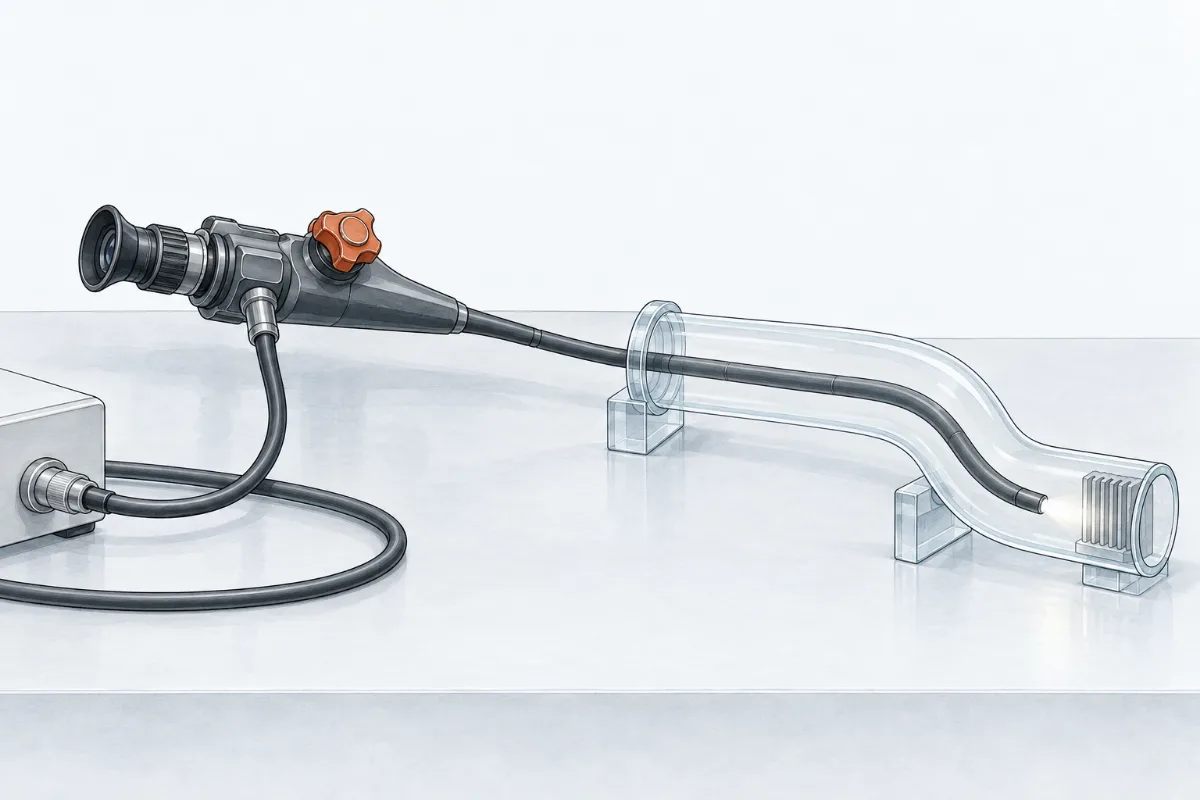
- Optical fibres. A very thin, flexible strand of glass traps light inside it by total internal reflection, even when it bends gently. Doctors use bundles of fibres in an endoscope to see inside the body, and fibres carry telephone calls and internet data.
 (enlarge)
Supplement: Critical angle and refractive index
The bigger the refractive index of a medium, the more it bends light, and the smaller its critical angle. The two are linked by:
refractive index = 1 ÷ sin c, or n = 1 / sin c, so sin c = 1 ÷ n
This comes from n = sin(angle in air) ÷ sin(angle in the medium). At the critical angle the angle in the air is 90°, and sin 90° = 1, so n = sin 90° ÷ sin c = 1 ÷ sin c. It holds for light going from the medium into air.
For glass with n = 1.50, sin c = 1 ÷ 1.50 = 0.667, so c = sin−1 0.667 = 41.8°. In the experiment you read the critical angle as 42°, which gives n = 1 ÷ sin 42° = 1 ÷ 0.669 = 1.49, about 1.5, as you found from sin i ÷ sin r in the first part (1.52). Both differ a little from the glass’s 1.50 because the angles are read to the nearest degree. For water, n = 1.33 and c = 48.8°. For diamond, n = 2.42 and c = 24.4°, which is why light is so easily trapped inside a diamond.
Worked example
Finding the critical angle
Supplement. (a) The refractive index of a clear plastic is 1.49. Calculate its critical angle. (b) A ray inside the plastic meets its surface with an angle of incidence of 45°. State what happens to it.
(a) sin c = 1 ÷ n = 1 ÷ 1.49 = 0.671, so c = sin−1 0.671 = 42.2°. (b) 45° is bigger than the critical angle, 42.2°, so the ray is totally internally reflected. Divide 1 by n, then take sin−1: the larger the refractive index, the smaller the critical angle.
Supplement: Optical fibres
An optical fibre is a very thin, flexible strand of very pure glass, about as thick as a hair. Light sent into one end meets the side of the fibre at an angle bigger than the critical angle, so it is totally internally reflected, again and again, and travels along the fibre even round gentle bends. Very little light is lost on the way. If the fibre is bent too sharply, the light meets the side at less than the critical angle and leaks out.
 (enlarge)
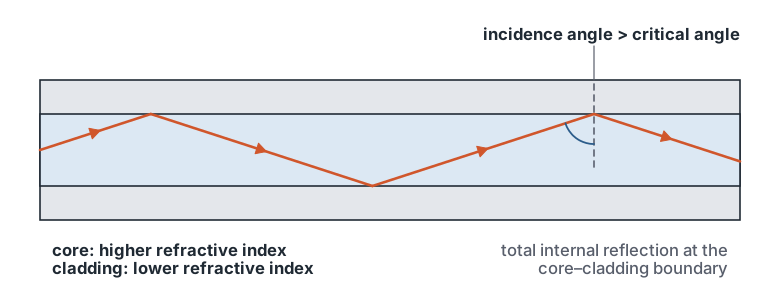
In telecommunications, telephone calls, television and internet data travel along optical fibres as very fast pulses of light, usually infrared, which code the information digitally (as a pattern of on and off pulses); at the far end, a detector changes the pulses back into an electrical signal. A fibre for telecommunications has a central core surrounded by a layer of glass called the cladding, which has a lower refractive index than the core. The total internal reflection happens at the boundary between the core and the cladding, so the light stays in the core even where the outside of the fibre touches something. Optical fibres carry far more information than copper wires of the same size, over long distances with little loss of signal, and the light inside is not affected by electrical interference from nearby cables or machines.
 (enlarge)
Trap: “Light stays in a fibre because the inside is coated with a mirror.” There is no mirror. The light is totally internally reflected at the boundary with a material of lower refractive index, and only because it meets that boundary at more than the critical angle.
Worked example
Why the cladding?
Supplement. A fibre made of a bare glass core works in air, but a fibre for a telephone cable always has a cladding. Explain why the cladding must have a lower refractive index than the core.
Total internal reflection happens only when light inside a medium meets a boundary with a medium in which it travels faster, and light travels faster in a medium of lower refractive index. With a cladding of lower refractive index, the boundary between the core and the cladding always reflects the light that meets it at more than the critical angle, whatever touches the outside of the fibre. A bare core touching another fibre, a support or a drop of grease would let light leak out where they touch. The cladding gives the core a boundary of its own, with a lower refractive index, so total internal reflection keeps the light in the core.
Case closed
Light enters a cut diamond through the large flat face on top. A diamond’s critical angle is only about 24° (Supplement: its refractive index is 2.42), and the back faces are cut at angles that make the light meet them at more than 24°. The light is totally internally reflected from one back face to another and comes out through the top, towards you, in bright flashes that change as the diamond turns. Glass has a critical angle of about 42°, so in a glass copy much more of the light meets the back faces at less than its critical angle and leaks out of the back, and the copy looks duller. In your experiment, the same total internal reflection kept the light inside the semicircular block beyond 42° and carried it round the bend of the light pipe.
About this model
The paper, semicircular block, angle scale, ray box and light pipe are simulated, and the rays are drawn exactly, for a refractive index of 1.50. The critical angle comes out at 41.8°, and you read it to the nearest degree, as you would on a real scale: 42°. The brightness of the reflected ray follows how much light a real glass surface reflects, but it is drawn brighter than that so that you can see it. The light pipe is a model of a fibre: a real optical fibre for telecommunications is about a tenth of a millimetre thick, with a core of glass and a cladding, so the light is reflected thousands of times in every metre.