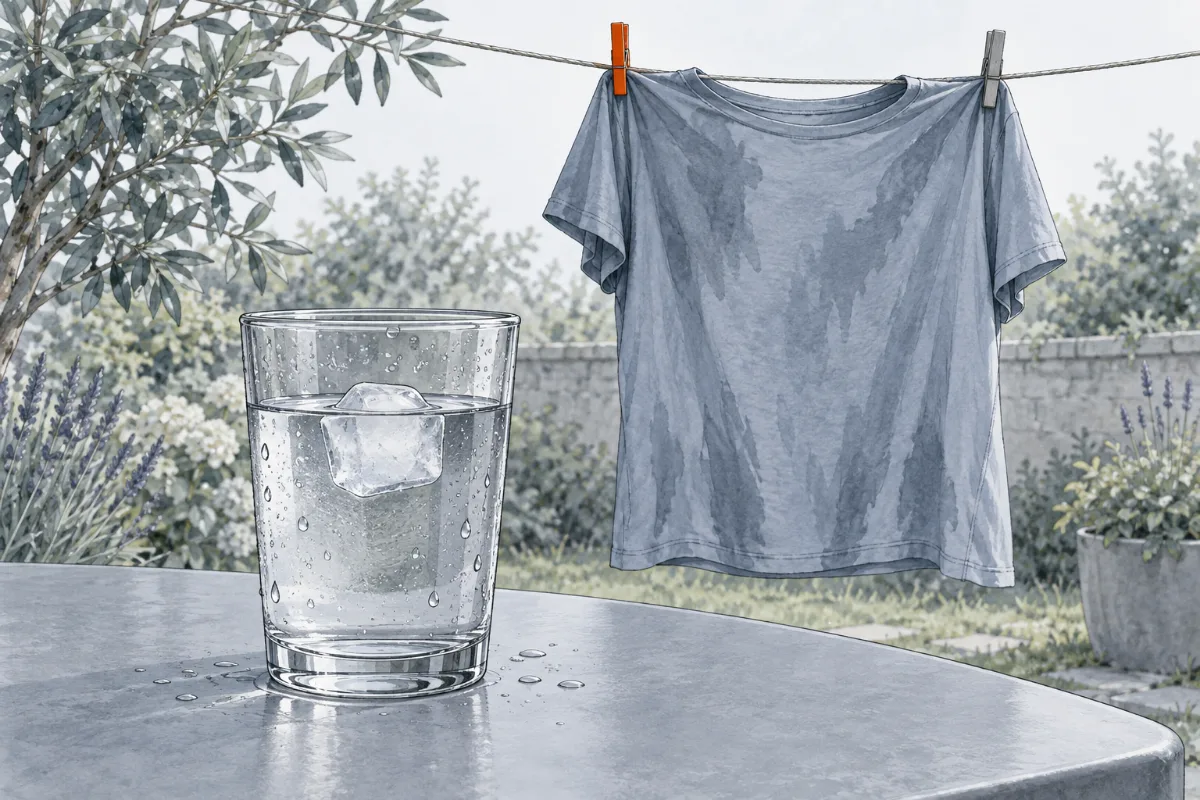
Pour juice from a carton into a glass. It flows, and it takes the shape of the glass, but there is no more and no less of it than there was in the carton. Drop an ice cube into it: the ice keeps its own shape and floats. Now take two plastic syringes, seal their nozzles, and push the plungers. The syringe full of air squashes to half its length with a firm push. The syringe full of water hardly moves at all, however hard you push. Ice, juice and air are a solid, a liquid and a gas. Why do they behave so differently? In this part you sort the three states of matter by what they do, name the changes between them, and then look inside them, at their particles, to find out why.
 (enlarge)
Three states, told apart
Everything around you is a solid, a liquid or a gas. You can tell them apart by four properties: whether they keep their shape, whether they keep their volume, whether they flow, and whether they can be squashed into a smaller space, which is called being compressed.
| shape | volume | flows? | can it be compressed? | |
|---|---|---|---|---|
| solid | fixed: keeps its own shape | fixed | no | no |
| liquid | not fixed: takes the shape of its container | fixed | yes | hardly at all |
| gas | not fixed: fills its whole container | not fixed: spreads out to fill the container | yes | yes, easily |
A solid has a fixed shape and a fixed volume. The ice cube keeps its shape whether it is in a glass, on a plate or in your hand, and you cannot squash it smaller.
A liquid has a fixed volume but no fixed shape. The juice took the shape of the glass, but 200 cm³ of juice in the carton is still 200 cm³ in the glass: only its shape changed. A liquid flows, and it settles in the bottom of its container with a level surface. You cannot compress it noticeably, which is why the syringe of water would not move.
A gas has no fixed shape and no fixed volume. It flows and spreads out to fill whatever container it is in, and it is easily compressed, which is why the syringe of air squashed.
Trap: “Sand can be poured, so sand is a liquid.” Each grain of sand is a tiny solid: it keeps its own shape and volume. A heap of grains pours only because the grains slide over one another, and it does not settle with a level surface. Look at one grain through a magnifier and it is a hard little lump.
Trap: “When a liquid changes shape, its volume changes too.” Pour 200 cm³ of water from a tall, thin glass into a wide bowl. It looks like less, because it is spread out, but it is still 200 cm³. A liquid's shape changes; its volume does not.
Changing state
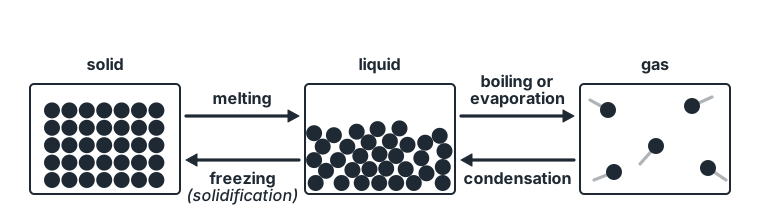
Heat a solid enough and it melts into a liquid. Heat the liquid more and it boils into a gas. Cool the gas and it condenses back into a liquid; cool the liquid more and it freezes back into a solid. Freezing is also called solidification. A liquid can also turn into a gas without boiling: a puddle dries up on a cool day. That is evaporation. The changes between the states have these names:
- melting: solid to liquid;
- freezing, or solidification: liquid to solid;
- boiling: liquid to gas, all through the liquid, with bubbles, at its boiling point;
- evaporation: liquid to gas, only from the surface of the liquid, below its boiling point;
- condensation: gas to liquid.
 (enlarge)
In the picture at the top, the ice cube in the glass is melting. The damp T-shirt is drying: its water is evaporating into the air as water vapour, an invisible gas. And the drops on the outside of the cold glass are condensation: water vapour in the air touched the cold glass and turned back into liquid water.
The module Melting, boiling and evaporation looks at where the energy goes in each change. You can heat a block of ice yourself, and watch it melt and boil, in the Chemistry course, in the module States and changes of state.
Trap: “The drops on the outside of a cold glass have leaked through the glass.” Glass does not let water through, and the drops form even on a sealed can. They come from the air: water vapour in the air touches the cold surface and condenses. Fill the glass with warm water instead and no drops form.
Worked example
An ice lolly on a hot day
A frozen juice lolly is left in the sun. It starts to drip, and the drips make a small puddle on the hot pavement. An hour later the puddle has gone, although the pavement never got anywhere near 100 °C. Name each change of state, and say what the ice lolly and the puddle show about the properties of a solid and a liquid.
The lolly dripping is melting: solid juice turns into liquid juice. The puddle disappearing is evaporation: the liquid turns into a gas from its surface, below its boiling point; it is not boiling, because the puddle never reached its boiling point and nothing bubbled. The frozen lolly kept its own shape, the shape of its mould, because it is a solid. The melted juice ran down and spread out over the pavement: a liquid flows and takes the shape of whatever it is on, but its volume does not change. If the drips had been caught in a cup and put back in the freezer, they would have frozen again: freezing, or solidification.
Particles in each state
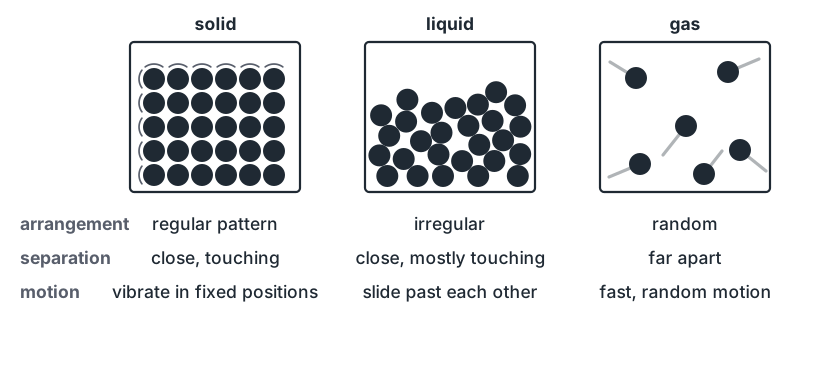
Everything is made of tiny particles, far too small to see, even with the best light microscope. Depending on the substance, the particles are atoms, molecules or ions. What makes a solid, a liquid or a gas different is not the particles themselves, but how they are arranged, how far apart they are (their separation) and how they move.
 (enlarge)
| arrangement | separation | motion | |
|---|---|---|---|
| solid | a regular pattern | close together, touching | vibrate about fixed positions |
| liquid | irregular | close together, mostly touching | move about at random, sliding past each other |
| gas | random | far apart | move fast in random directions |
In a solid, the particles are packed close together in a regular pattern, row after row. Each one stays in its own fixed position and vibrates about it. In a liquid, the particles are still close together, mostly touching, but they are not in a pattern. They move about, sliding past one another, so the arrangement keeps changing. In a gas, the particles are far apart, in no pattern at all. They move fast, in straight lines, in random directions, until they hit another particle or the wall of the container and bounce off.
To draw a particle diagram, use circles that are all the same size, because the particles are the same in each state. For a solid, draw the circles in neat rows, each touching its neighbours. For a liquid, draw about as many circles, touching, but in an untidy jumble in the bottom of the container. For a gas, draw just a few circles, far apart and scattered all through the container. You can add short lines to show motion: little arcs beside the solid's particles for vibrating, and a trail behind each gas particle for moving fast.
A particle diagram is a model, not a picture to scale. Each circle is one particle, and only a few are drawn: a real sample has billions upon billions of them. And a real gas is far more spread out than any diagram can show: in the air around you, the distance from one molecule to the next is about ten times the size of a molecule.
Water is an unusual exception. In ice, the water molecules are held in an open pattern, a little further apart than in liquid water. That is why ice floats, as it does in the glass. For almost every other substance, the particles are packed slightly closer in the solid than in the liquid.
Trap: “In a solid the particles do not move.” They vibrate about their fixed positions all the time. They cannot move from place to place, which is why a solid keeps its shape.
Trap: “Between the particles of a gas there is air.” Air is itself a gas, made of particles. Between the particles of any gas there is nothing at all: empty space.
Trap: “When ice melts, its particles get bigger, or turn into different particles.” The water molecules in ice, in liquid water and in steam are the same molecules, the same size. Only their arrangement, their separation and their motion change.
Worked example
Drawing the three states
A pupil draws a solid, a liquid and a gas, each in a box. Describe what each box should show, and explain what would be wrong with a liquid drawn as circles in neat rows with a gap between each circle and the next.
Solid: equal circles in neat rows, filling the box, each touching its neighbours, perhaps with small arcs to show that they vibrate. Liquid: about as many equal circles, still touching, but jumbled, in no pattern, filling the bottom part of the box with an uneven top. Gas: only a few equal circles, far apart and scattered through the whole box, with trails to show that they move fast in random directions. Neat rows with gaps would be wrong twice over for a liquid: the particles of a liquid are close together, touching, not spaced out, and they are not in a regular pattern, because they keep moving past each other. Neat rows belong to a solid, and big gaps belong to a gas.
Supplement: why the properties follow
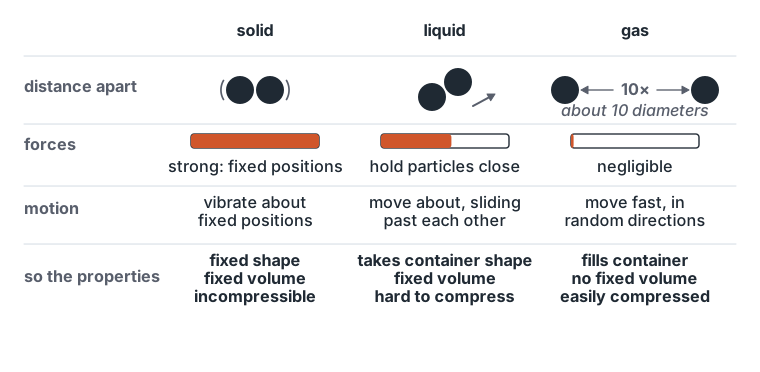
Why does a solid keep its shape while a liquid flows? The answer is in the forces between the particles and the distances between them, together with how the particles move.
 (enlarge)
In a solid, the particles are close together and the forces between them are strong. The forces hold each particle in its fixed position, so the solid keeps its shape. The particles are already touching, so the solid cannot be compressed. In a liquid, the particles are still close together, so a liquid cannot be compressed either, and the forces still hold them close, so a liquid keeps its volume. But the forces are not strong enough to hold the particles in fixed positions. The particles slide past each other, so the liquid flows and takes the shape of its container. In a gas, the particles are far apart and the forces between them are negligible: far too weak to hold them together. So the particles fly apart and the gas spreads out to fill its container. Most of a gas is empty space, so pushing the particles closer together is easy: a gas is easily compressed.
The particles may be atoms, molecules or ions, depending on the substance. In a metal there are also electrons that move freely between the ions. Whatever they are, the same rule holds: the forces and distances between the particles, and the way the particles move, decide whether the substance is a solid, a liquid or a gas, and so what its properties are.
Trap: “A gas can be compressed because its particles get squashed.” The particles do not change size. What shrinks is the empty space between them: they end up closer together.
Worked example
Squeezing two syringes
Supplement. Two syringes have their nozzles sealed. One holds 40 cm³ of air, the other 40 cm³ of water. Pushing the plunger squashes the air to 20 cm³, but the water stays at 40 cm³. Explain the difference in terms of the particles, their separation and the forces between them.
In the air, the particles (molecules) are far apart, with empty space between them, and the forces between them are negligible. Pushing the plunger moves them closer together, into less space, so the air is compressed to 20 cm³. In the water, the particles are already close together, touching, held close by the forces between them. There is no empty space to squeeze out, so the water cannot be compressed, and its volume stays 40 cm³. The water has no fixed shape, though: it took the shape of the inside of the syringe.
Case closed
Why do ice, juice and air behave so differently? A solid keeps its shape and volume, a liquid keeps its volume but flows and takes the shape of its container, and a gas flows, has no fixed volume and spreads out to fill its container, which is why only the gas could be compressed. Inside, it is the same kind of particles in each state. In a solid they are close together in a regular pattern, vibrating about fixed positions, held by strong forces. In a liquid they are close together but irregular, sliding past each other. In a gas they are far apart, with negligible forces between them, moving fast in random directions. The names of the changes are melting, freezing (solidification), boiling, evaporation and condensation. But how do we know that the particles move at all, when nobody can see them? The next part looks at the first evidence: smoke under a microscope.
About this model
This part has no experiment of its own. The particle diagrams are models: the circles are drawn far bigger than real particles, a few stand for billions, and the gas particles are drawn much closer together than they really are. Real particles are not little hard balls of one size, either: atoms, molecules and ions have different sizes and shapes. Drawing them as equal circles shows the three things that matter here: their arrangement, their separation and their motion.