You ring a friend in Cape Town, nearly 10 000 km from London, and say “hello”. Before you have finished the word, your friend is hearing it. Your voice cannot shout that far, and sound would take about eight hours to cover the distance even if it could. So what carries it? Under the sea, on the sea floor, lie cables that were laid by ships like the one below, and high above the Earth, satellites wait for signals. This part is about how a message crosses the world: by cable, by low-orbit satellites and by geostationary satellites, and (Supplement) which waves the devices in your home use, and why.
 (enlarge)
Carrying a message
A long-distance call passes through a chain of steps, and each step has its own job. A microphone turns the sound of your voice into an electrical signal: a voltage that rises and falls in the same pattern as the sound. A transmitter puts that signal onto a carrier, a wave that can travel a long way: light in a glass fibre under the sea, or microwaves through the air and space. A receiver at the far end takes the signal off the carrier, and a speaker turns it back into sound.
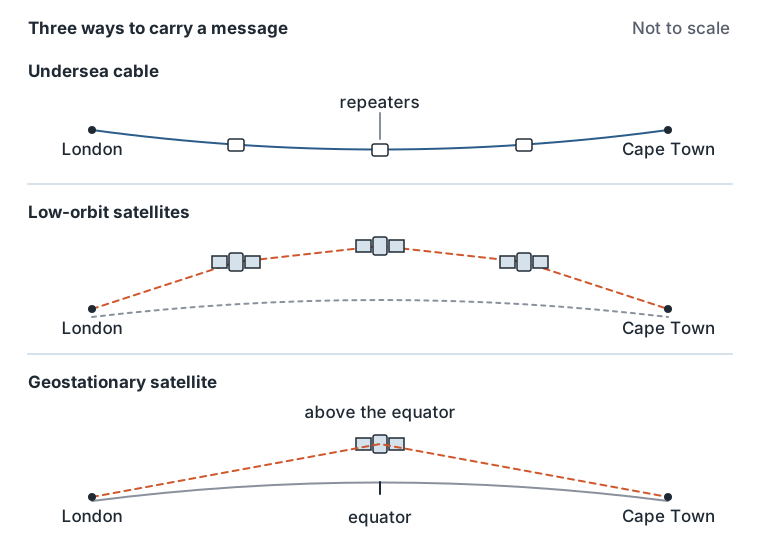
Long-distance carriers are electromagnetic waves, because they travel very fast and can cross the vacuum of space. A message can go three main ways from London to Cape Town:
- along an undersea cable on the sea floor, as light in glass fibres;
- by low-orbit satellites, passed from one satellite to the next;
- by a geostationary satellite, high above the equator.
 (enlarge)
Trap: “The satellite sends the sound of my voice down to Cape Town.” Sound cannot travel through space. The satellite receives microwaves that carry the signal, and sends microwaves down again. The sound only exists at the two ends: in the air in front of the microphone and in front of the speaker.
Satellites in orbit
An artificial satellite is a machine put into orbit round the Earth. Communication with artificial satellites is mainly by microwaves: microwaves pass through the atmosphere, even through most cloud, and a dish aerial can send them up to a satellite in a narrow beam. The satellite receives the signal, and sends it back down, or on to another satellite.
Low-orbit satellites go round the Earth only a few hundred kilometres up: the ones in the experiment are 550 km up. They go round the Earth in about an hour and a half, so, seen from the ground, each one crosses the sky in a few minutes. To keep a call going, a whole fleet of satellites is needed, and the call is passed from satellite to satellite as they move. Some satellite phones use low-orbit satellites. Because the satellites are close, the signal has a short way to go, and a hand-held phone is strong enough to reach them.
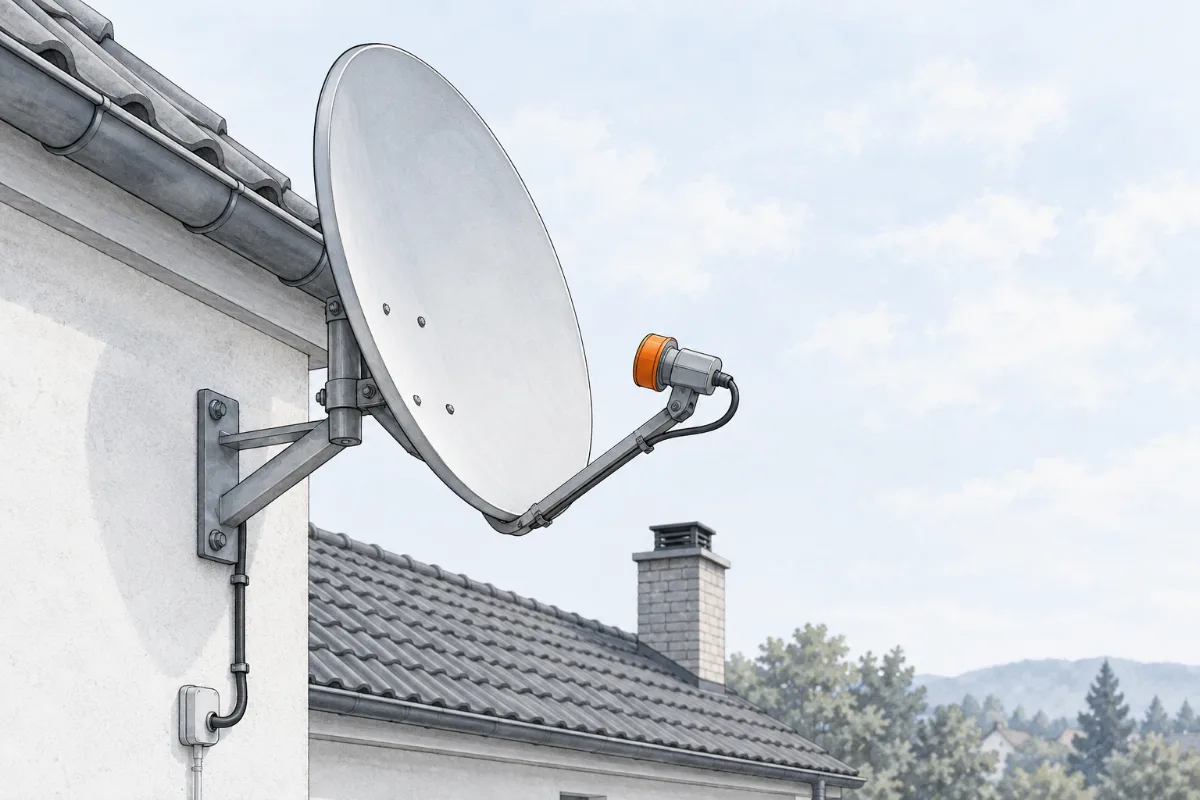
Geostationary satellites go round the Earth about 36 000 km above the equator. Up there, a satellite takes one day to go round, the same time that the Earth takes to turn once, so it stays above the same point on the equator. Seen from the ground, it never moves in the sky, and a dish fixed to a wall can point at it all the time. Direct broadcast satellite television uses geostationary satellites, and so do some satellite phones. Because these satellites are far away, the signal takes longer to get there and back.
 (enlarge)
Trap: “A geostationary satellite stands still above the Earth.” It moves fast, at about 3 km every second, but it goes round once a day, in step with the Earth turning beneath it. So it stays above the same place on the equator, and from the ground it looks still.
Worked example
Which satellite?
(a) A family fixes a satellite television dish to the wall of their house. Which kind of satellite does it point at, and why can the dish stay fixed? (b) A sailor on a small boat in the middle of the ocean calls home on a satellite phone. Name the two kinds of satellite that satellite phones can use. (c) Which of the two kinds gives the shorter delay before the other person hears the sailor?
(a) Direct broadcast satellite television uses a geostationary satellite. It goes round once a day, in step with the turning Earth, so it stays above the same point on the equator and the dish never has to move. (b) Some satellite phones use low-orbit satellites and some use geostationary satellites. (c) Low-orbit satellites are only a few hundred kilometres up, while a geostationary satellite is about 36 000 km up, so the signal has much less far to go by low orbit. (a) A geostationary satellite, which stays above one place on the equator; (b) low-orbit and geostationary satellites; (c) low-orbit satellites give the shorter delay.
Around the world from space
Now send a message from London to Cape Town yourself.
What is on the screen. The Earth seen from space, cut through along a line from London to Cape Town, with the north pole on the left and the equator at the top. A microphone stands in London, and a speaker in Cape Town. Between them, on the floor of the Atlantic Ocean, runs an undersea cable with three repeaters. Just above the Earth, a fleet of low-orbit satellites goes round, and one of them, satellite A, is marked. High above the equator is a geostationary satellite. A panel shows a clock that measures how long each signal takes to arrive.
What you do. First you predict which way the word “hello” reaches Cape Town last, and then you send it all three ways at once. Next you predict where the satellites will be an hour later, and you follow satellite A for that hour. Then you aim two dishes fixed to a roof in London, one at low-orbit satellite E and one at the geostationary satellite, and predict which one still has the signal 15 minutes later. Finally (Supplement), you match four devices from home to the waves they use, with the reason for each.
What the experiment showed
Do the experiment before you read on. The word set off all three ways at the same moment, but it did not arrive at the same time (values from the model, see “About this model” at the end):
| Route | Distance the signal travels | Speed of the signal | Time to reach Cape Town |
|---|---|---|---|
| undersea cable (light in glass) | 12 000 km | 2.0 × 10⁸ m/s | 0.060 s |
| low-orbit satellites (microwaves) | about 10 400 km | 3.0 × 10⁸ m/s | 0.035 s |
| geostationary satellite (microwaves) | about 75 600 km | 3.0 × 10⁸ m/s | 0.25 s |
The low-orbit satellites delivered the word first. The geostationary satellite delivered it last, after a quarter of a second, because its signal had to go up about 38 500 km and come down about 37 100 km. A quarter of a second is long enough to notice in a conversation: each person waits a moment before hearing the other answer. The cable’s light had a slightly longer way to go than the low-orbit route, along the sea floor round the coast of Africa, and light travels more slowly in glass than microwaves do in space.
An hour later, satellite A was on the far side of the Earth: it had gone more than half way round its orbit. Other satellites of the fleet had come up over the horizon and were now carrying calls between London and Cape Town. The geostationary satellite was exactly where it had been, above the same point on the equator. A dish fixed to a roof in London must therefore point at the geostationary satellite: a low-orbit satellite leaves a fixed dish’s narrow beam within seconds, and the picture goes with it.
Worked example
Waiting for an answer
Supplement. A reporter in Cape Town talks live to a studio in London through a geostationary satellite. The signal goes up 37 100 km and down 38 500 km, and microwaves travel at 3.0 × 10⁸ m/s. (a) Calculate how long the reporter’s words take to reach London. (b) The studio asks a question. Explain why the reporter seems to wait for about half a second before answering.
(a) Distance = 37 100 km + 38 500 km = 75 600 km = 7.56 × 10⁷ m. Time = distance ÷ speed = 7.56 × 10⁷ m ÷ 3.0 × 10⁸ m/s = 0.25 s. (b) The question takes 0.25 s to reach the reporter, and the answer takes another 0.25 s to come back, so the studio waits about 0.5 s, even if the reporter answers at once. (a) 0.25 s; (b) the signal makes the long trip twice, there and back: 2 × 0.25 s ≈ 0.5 s.
Supplement: Which wave for which job?
Many everyday systems of communication rely on electromagnetic waves, and each uses the region that suits its job.
Mobile phones and wireless internet (wi-fi) use microwaves. Microwaves can pass through some walls, so a phone or a laptop still works indoors. And because microwaves have a short wavelength, only a short aerial is needed to send and receive them: it fits inside the phone.
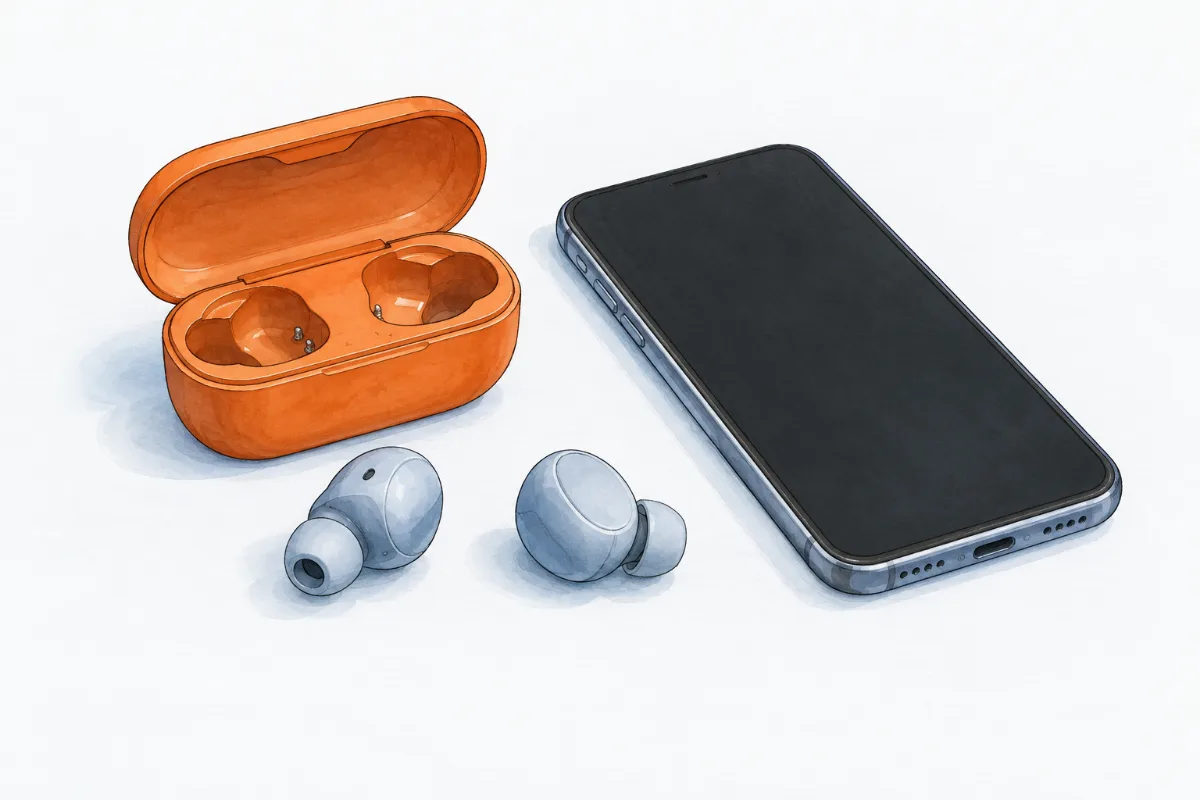
Bluetooth uses radio waves. Radio waves pass through walls, but the signal is weakened on doing so. That suits Bluetooth, which links devices close to each other: earphones to a phone in your pocket, or a speaker to a laptop in the same room. The signal reaches across the room and through a wall, but it is too weak to reach much further.
 (enlarge)
Optical fibres use visible light or infrared. Cable television and high-speed broadband reach many homes through optical fibres, thin strands of very clear glass. Glass is transparent to visible light and to some infrared, so the light travels a long way inside the fibre, kept in by total internal reflection, as you saw in Refraction and total internal reflection. Visible light and short-wavelength infrared have very high frequencies, so they can be switched on and off extremely quickly: they can carry high rates of data, a huge amount of information every second.
Trap: “An optical fibre carries electricity, like a copper wire.” A fibre carries light or infrared, not an electric current. The electrical signal is turned into light at one end and back into an electrical signal at the other.
The regions of the spectrum have no sharp edges. Bluetooth and many wi-fi routers in fact work at nearly the same frequency, close to where radio waves and microwaves meet. For your course, learn the regions named here: microwaves for mobile phones and wi-fi, radio waves for Bluetooth.
Worked example
Four devices, three kinds of wave
Supplement. For each device, name the region of the electromagnetic spectrum it uses and give the reason: (a) a mobile phone, (b) a wi-fi router, (c) Bluetooth earphones, (d) a broadband fibre.
(a) Microwaves: they pass through some walls, and they need only a short aerial, which fits inside the phone. (b) Microwaves, for the same reasons: the router’s signal reaches into the rooms, and the laptop’s aerial is short. (c) Radio waves: they pass through walls but are weakened, which is fine for a link to a phone a metre away. (d) Visible light or infrared: glass is transparent to them, and they can carry high rates of data. Phone and wi-fi: microwaves; Bluetooth: radio waves; broadband fibre: visible light or infrared.
Case closed
Back to your call to Cape Town. The microphone in your phone turns your voice into an electrical signal. From there, your “hello” most likely travelled as light in a glass fibre under the Atlantic Ocean, about 12 000 km, and arrived in about 0.06 s; it could also have gone by low-orbit satellites, even faster, or by a geostationary satellite, with a delay of a quarter of a second that you would notice. At the far end a receiver took the signal off its carrier, and a speaker turned it back into sound. All of that happened before you had finished saying the word.
About this model
The Earth, the cable and the satellites are simulated and drawn schematically, not to scale: the sea is drawn much deeper than it is, the low orbit higher, and the geostationary satellite at about 2.3 Earth radii from the centre of the Earth, when it is really 6.6. The cut runs from London to Cape Town, treated as if they lay on one line of longitude: Cape Town is really about 18° further east. The times are worked out from the model’s distances: a cable 12 000 km long, following the coast of Africa, carrying light at 2.0 × 10⁸ m/s in its glass; low-orbit satellites 550 km up; a geostationary satellite 36 000 km above the equator; microwaves at 3.0 × 10⁸ m/s. They count only the time the signal spends travelling; real calls also lose a little time in the electronics along the way. The model’s fleet has eleven satellites in one ring round the poles, and leaves out the Earth turning beneath it; real fleets have several rings, so that a satellite is always in view everywhere. In one hour a satellite 550 km up goes about 226° round its orbit, a little more than half way, and the model moves satellite A that far.