This whole part is Supplement. Fifty years ago a call to the other side of the world crackled and hissed, and the voice at the far end sounded thin and far away. Today a call to Cape Town sounds as clear as one to the house next door, though it crosses 12 000 km of sea floor. The cable is still long, and the signal still picks up noise on the way. What changed is the way the signal is sent: no longer as a copy of the sound, but as a stream of pulses, on and off. This part is about analogue and digital signals, and why digital signals arrive so clear.
 (enlarge)
Two kinds of signal
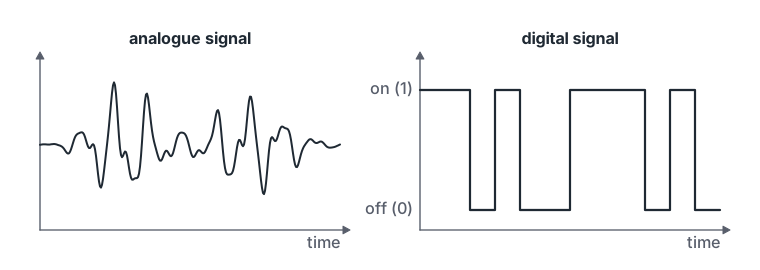
The microphone turns the sound of your voice into an electrical signal that rises and falls in the same pattern as the sound. This is an analogue signal: it varies continuously and can take any value within its range, like the sound it copies. The hands of a clock sweeping round, or the brightness of a lamp turned slowly up, vary in an analogue way.
A digital signal has only a few possible values, usually just two: on and off, often written 1 and 0. It is sent as a stream of pulses: in a wire, a voltage switched on and off; in an optical fibre, light flashing on and off. A light switch is on or off, with nothing in between: that is digital.
A sound can be sent either way. As an analogue signal, the electrical copy of the sound itself is sent. As a digital signal, the electrical copy is first measured many thousands of times a second, and each measurement is sent as a short code of on and off pulses. At the far end, the codes are turned back into a varying electrical signal, and the speaker turns that into sound.
 (enlarge)
Trap: “A digital signal travels faster than an analogue signal.” Both are carried by the same kind of wave: light in the same glass fibre, or microwaves through the same space, at the same speed. The benefits of digital signals lie elsewhere, as the experiment shows.
Worked example
Analogue or digital?
Say whether each of these is an analogue or a digital signal, and why. (a) The voltage from a microphone while someone sings. (b) Light in an optical fibre, flashed on and off in a code of 1s and 0s. (c) A ship’s lamp flashed on and off in Morse code. (d) The reading of a car’s fuel gauge needle as the tank empties. (e) Describe how the singing in (a) could be sent as a digital signal instead.
(a) Analogue: the voltage varies continuously, copying the sound. (b) Digital: the light has only two values, on and off. (c) Digital: the lamp is either on or off, and the message is in the pattern of flashes. (d) Analogue: the needle can point anywhere on the scale. (e) The microphone’s voltage is measured many thousands of times a second, each measurement is sent as a short code of on and off pulses, and at the far end the codes are turned back into a varying voltage for the speaker. (a) analogue, (b) digital, (c) digital, (d) analogue; a digital signal has only a few values, here just on and off; (e) the same sound can be sent as a digital signal, as codes of pulses.
Noise on the way
Every long cable is made of stretches. Along each stretch the signal gets weaker, and it picks up noise: small random changes from the cable and its surroundings that were not in the message. To carry the signal on, a repeater at the end of each stretch boosts it. What a repeater can do depends on the kind of signal.
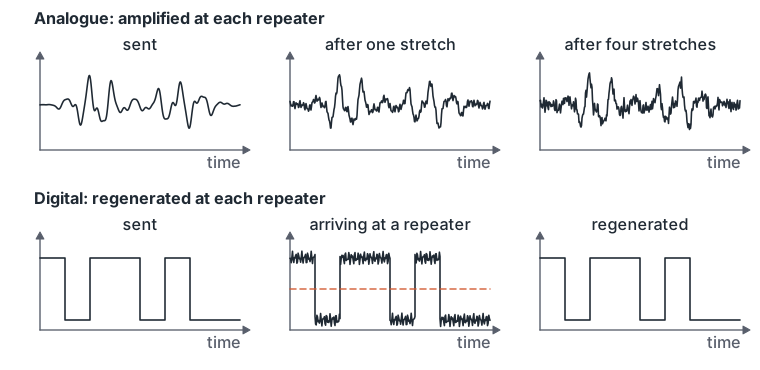
An analogue signal is amplified. The repeater makes the signal bigger, but it cannot tell which wiggles are the message and which are noise, so it amplifies both. The noise from every stretch is passed on and added to, so the further the signal goes, the noisier it gets: at the far end the voice comes with a hiss.
A digital signal is regenerated. The repeater only has to decide, for each pulse, whether it is on or off: above half height means on, below means off. Then it sends on a fresh, clean pulse of full height. The noise is left behind at every repeater, so the signal arrives exactly as it was sent, however many repeaters it passes. This works as long as the noise stays small enough that no pulse is pushed across the half-height line.
 (enlarge)
In the cable under the Atlantic
Now send a word through the undersea cable from London to Cape Town, first as an analogue signal and then as a digital one.
What is on the screen. The cut through the Earth from part 1, closer up: the microphone in London, the speaker in Cape Town, and the cable on the floor of the Atlantic Ocean, divided by three repeaters into four stretches. A panel shows the signal at five points: as it is sent from London, as it leaves each repeater, and as it is received in Cape Town. For the digital signal it shows 16 pulses, a short piece of the many thousands that carry the word, and a dashed line at half height.
What you do. Predict how the word “hello” will sound in Cape Town when it is sent as an analogue signal, then send it. Then predict how it will arrive as a digital signal, and send it. Next, repeater 2 is switched off, so the middle of the cable becomes one stretch twice as long: predict what happens to the digital signal, and send it again. Finally, decide what the experiment shows is the benefit of digital signals.
What the experiment showed
Do the experiment before you read on. The analogue “hello” got noisier with every stretch. Each repeater amplified the signal back to full size, and the noise with it, so the noise picked up in each stretch was added to the noise already there. In Cape Town the noise was about twice as big as after the first stretch, and the word arrived with a loud hiss.
The digital “hello” arrived exactly as it was sent: all 16 pulses right, with no hiss at all. Between the repeaters the pulses picked up noise just like the analogue signal, but each repeater decided whether each pulse was on or off, and sent fresh, clean pulses on. The noise never got the chance to add up.
With repeater 2 switched off, the middle stretch was twice as long. The signal arrived at repeater 3 much weaker, and with more noise picked up on the way, so after amplification the noise was much bigger compared with the pulses. In two places it pushed a pulse across the half-height line, and repeater 3 regenerated those two pulses wrongly: one on pulse became off and one off pulse became on. Repeater 3 had no way to know, so it sent on two wrong pulses, cleanly. In Cape Town 14 of the 16 pulses were right, and the word came with a click. Regeneration is accurate only while the noise stays within the margin: that is why the repeaters are placed close enough together.
| Signal | Repeaters working | Pulses right in Cape Town | How the word sounds |
|---|---|---|---|
| analogue | 3 | no pulses: a continuous signal | with a loud hiss: noise about twice that of one stretch |
| digital | 3 | 16 of 16 | exactly as sent |
| digital | 2 (repeater 2 off) | 14 of 16 | with a click |
Benefits of digital signals
Increased range, due to accurate signal regeneration. A digital signal can be regenerated at every repeater, exactly as it was sent, so it can cross any distance, even round the world, and arrive as clear as it set off. An analogue signal gets noisier at every repeater, so beyond a certain distance the noise drowns the message.
An increased rate of transmission of data. Digital signals can carry far more information every second. A receiver only has to tell on from off, so the pulses can be very short and sent very close together: one optical fibre flashes its light on and off thousands of millions of times a second. Computers can also squeeze digital data into fewer pulses by leaving out what repeats, and the pulses of thousands of calls can take turns along the same fibre. So one cable carries many calls, television programmes and internet connections at once.
The pulses do not travel faster than an analogue signal: more of them arrive each second. Digital signals also suit computers and phones, which store and work with information as 1s and 0s.
Trap: “With a digital signal there is no noise at all.” The pulses pick up noise in every stretch, just as an analogue signal does. Regeneration removes it at each repeater, but only while it is too small to push a pulse across the half-height line; when it is bigger, pulses are regenerated wrongly.
Worked example
Through ten repeaters
A signal is sent along a cable with ten repeaters. In each stretch the signal picks up the same small amount of noise. (a) It is sent as an analogue signal. Describe how the noise changes along the cable, and explain why. (b) It is sent as a digital signal. Describe what arrives at the far end, and explain why. (c) Explain why a digital signal can be sent further than an analogue signal.
(a) The noise grows along the cable. Each repeater amplifies the whole signal, noise and all, because it cannot tell the noise from the message, and each stretch adds more noise on top. (b) The pulses arrive exactly as they were sent. Each repeater decides whether each pulse is on or off, and sends a fresh, clean pulse, so the noise from each stretch is removed before it can add up. (c) Because the digital signal is regenerated accurately at every repeater, it does not get noisier with distance, so it can go much further; an analogue signal gets noisier at every repeater until the noise drowns the message.
Worked example
What went wrong?
A digital signal of eight pulses, on, off, on, on, off, on, off, off, is sent through a long stretch of cable. At the repeater the pulses arrive with these heights, as fractions of the full height: 0.9, 0.2, 0.8, 0.4, 0.1, 1.1, 0.6, 0.2. The repeater regenerates each pulse: above half height means on. (a) Write down the pulses the repeater sends on. (b) Which pulses are wrong, and why? (c) Suggest how the cable could be changed so that no pulses are wrong.
(a) Above 0.5 is on, below is off: on, off, on, off, off, on, on, off. (b) The fourth pulse was sent on but arrived at 0.4, below half height, so it was regenerated as off; the seventh was sent off but arrived at 0.6, above half height, so it was regenerated as on. In both, the noise was big enough to push the pulse across the half-height line. (c) Put the repeaters closer together, so that the signal is regenerated before the noise grows so big. (a) on, off, on, off, off, on, on, off; (b) the fourth and the seventh, pushed across the half-height line by noise; (c) shorter stretches between repeaters.
Case closed
Back to the clear call to Cape Town. Your phone turns your voice into an analogue electrical signal, then measures it thousands of times a second and sends the measurements as digital pulses. Along the 12 000 km of cable, the pulses pick up noise in every stretch, just as the old analogue signals did. But every repeater regenerates them, so in Cape Town the pulses are the ones your phone sent, and they are turned back into your voice, without a hiss. The cable now also carries many thousands of other calls, programmes and internet connections at the same time, because digital signals can carry so much data every second.
About this model
The cable, its repeaters and the signals are simulated. A real cable this long has a repeater every 50 to 100 km, about 150 of them; the model shows three, so each stretch stands for many. The noise is the model’s: the same small random wiggles in each stretch, from a fixed pattern so that every run gives the same result. The model’s digital repeaters work like those of the first glass-fibre cables under the sea, around 1990: each turned the light into an electrical signal, regenerated it and sent it on as fresh light. The analogue run shows how a signal like the word itself would fare, as on the older copper cables, whose repeaters amplified it. Today’s repeaters amplify the light directly, and the signal is regenerated, and its few errors are found and corrected, at the far end. The 16 pulses are a short piece of the signal: a real word needs many thousands. A click is how one wrong code can sound; the model does not play the word aloud.