Contents
Part 2 of 2
Analogue and digital signals
identify
Try it yourself
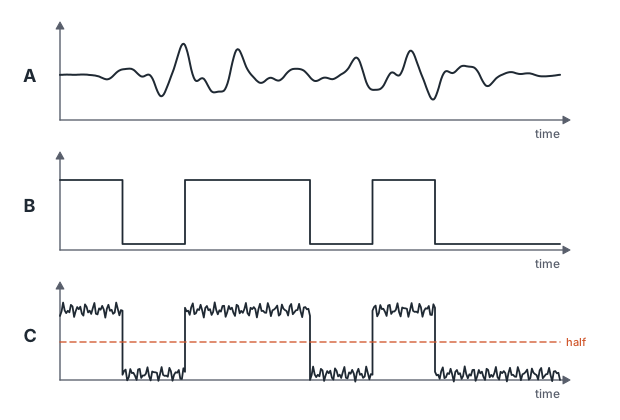
Supplement. The diagram shows three signals, A, B and C. Each graph shows the voltage of a signal against time. Match each signal to its description.
identify: name or select.
 (enlarge)
Your saved work
Answers, earlier attempts and your Pause and check notes stay in this browser. Export a copy to keep, to move to another device or to hand to your teacher. Importing a copy keeps your current answers and adds earlier attempts.
Scope and sources
Cambridge IGCSE Physics 0625 · 2026–2028 v2 · Original learning materials.
Communication with artificial satellites, mainly by microwaves: low-orbit satellites for some satellite phones, geostationary satellites for other satellite phones and for direct broadcast satellite television (3.3.5); Supplement: why mobile phones and wireless internet use microwaves, Bluetooth radio waves, and optical fibres visible light or infrared (3.3.7); digital and analogue signals (3.3.8); a sound sent as a digital or analogue signal (3.3.9); the benefits of digital signals, a higher rate of data and a greater range through accurate regeneration (3.3.10). The regions of the electromagnetic spectrum and their other uses are in Light and the electromagnetic spectrum; total internal reflection in optical fibres is in Refraction; orbits and their periods are in the Space physics modules; how a signal is put onto a carrier wave and how a sound is sampled are not covered.
Apparatus, amounts and times in the experiment are illustrative. Real practical work follows a teacher-approved safety method.
Official Cambridge syllabus