Sit a few metres from a campfire and your face soon feels hot. Yet the hot air and smoke from the fire go straight up into the sky, not sideways towards you, and the air between you and the flames isn't what warms your face. Something else carries energy from the fire to you, and it crosses the gap in a flash. In hot, sunny countries, houses like the ones in the picture are often painted white, and the same kind of energy transfer is the reason. By the end of this module you can say why. This part is about how objects give energy away without touching anything.
 (enlarge)
Warmth you can feel at a distance
Hold your hand beside a mug of hot tea, a few centimetres from it but not touching. You feel warmth on your palm. Warm air rises from the tea, but your hand is beside the mug, not above it, so the air isn't what warms your palm. The mug is giving out energy as thermal radiation.
Thermal radiation is infrared radiation: waves of the same family as light, just beyond the red end of the colours you can see. Your eyes can't see infrared, but your skin feels it as warmth when it is absorbed: taken in by your skin.
All objects emit (give out) infrared radiation, not just hot ones. The tea emits it, the mug emits it, your hand emits it, and so do the table, the walls and even an ice cube. The hotter an object is, the more infrared it gives out each second. Your hand feels the mug because the mug is hotter than your skin and sends more infrared towards your hand than your hand sends back.
Trap: “Only hot objects give out infrared.” Every object emits infrared, whatever its temperature. A cold object emits less than a hot one, but it still emits.
Radiation needs no particles
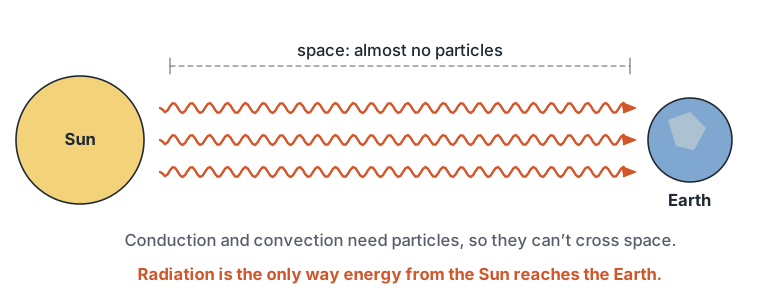
Conduction passes energy from particle to particle, and convection needs a liquid or gas to flow, so both need a material to travel through, called a medium. Thermal radiation doesn't. Infrared travels through empty space, where there are almost no particles at all. Thermal energy transfer by radiation does not need a medium.
 (enlarge)
Worked example
Sunlight across empty space
Between the Sun and the top of the Earth's atmosphere there are about 150 million kilometres of space, with almost no particles in it. How does energy from the Sun reach the Earth, and why can't it come in either of the other two ways?
Conduction needs particles to pass vibrations along, and convection needs a liquid or gas that can flow. Space has almost no particles, so neither can carry energy across it. The Sun's energy arrives as radiation, including infrared, which needs no medium. Energy from the Sun crosses space by radiation, the only one of the three that works in a vacuum (an empty space with almost no particles).
Dull, shiny, black and white
Two objects at the same temperature don't always emit infrared at the same rate. The surface matters.
- Dull (matt) surfaces are good emitters of infrared. Shiny surfaces are poor emitters. Polished metal gives out very little infrared for its temperature.
- Black surfaces are better emitters than white ones. A matt black surface is the best emitter of all.
The difference between dull and shiny is much bigger than the difference between black and white. A matt white wall still emits plenty of infrared. Bare metal emits much less than paint: dull metal emits more than polished metal, and polished metal emits very little.
Trap: “White surfaces hardly give out any infrared.” Matt white paint emits almost as well as matt black. The poor emitters are shiny surfaces, such as polished metal.
Worked example
Two teapots
Two teapots are the same size and are filled with tea at the same temperature. One is shiny polished steel, the other is dull black pottery. In which teapot does the tea stay hot longer?
Both teapots lose energy in several ways, but compare the radiation from their outsides. The dull black surface is a good emitter, so it radiates energy away quickly. The shiny steel surface is a poor emitter, so it radiates energy away more slowly. The tea stays hot longer in the shiny teapot, because a shiny surface is a poor emitter of infrared.
Supplement: Testing emitters fairly
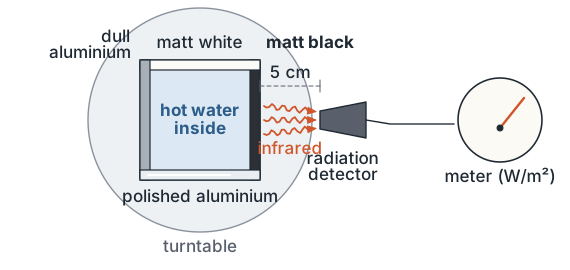
To compare surfaces fairly, they must all be at the same temperature, and the only thing that changes is the surface. A Leslie cube does this. It is a hollow metal cube with each of its four sides finished differently, for example matt black, matt white, dull metal and shiny metal. Fill it with hot water and all four sides are at the same temperature.
 (enlarge)
A radiation detector stands a fixed distance in front of one side and measures the infrared reaching it. Turn the cube so that each side faces the detector in turn, at the same distance, and note the reading each time. The higher the reading, the better that surface emits infrared. Instead of a detector, you can hold the back of your hand the same distance from each side and compare how warm each feels, but a detector gives numbers.
Worked example
Planning the emitter test
A pupil wants to show that a matt black surface is a better emitter of infrared than a shiny one, using a Leslie cube and a radiation detector. What must she keep the same, what does she measure, and what result does she expect?
She fills the cube with hot water so that every side is at the same temperature. She keeps the detector the same distance from each side and facing the middle of it, so that it sees the same area of each side. Only the surface changes. She measures the detector's reading for each side. She expects the reading for the matt black side to be much higher than for the shiny side, which shows that matt black emits infrared faster. If the detector were nearer the black side, its reading could be higher for the wrong reason, and the test would not be fair.
Turn the cube
Now test the four surfaces on the bench.
What is on the bench. A Leslie cube on a turntable with a handle. Its sides are matt black paint, matt white paint, dull aluminium and polished aluminium, and a thermometer goes through its lid. A radiation detector stands on a stand 5 cm in front of the cube, wired to a meter that reads in watts per square metre (W/m²): the infrared power reaching each square metre of the detector. Power is the energy transferred each second, measured in watts (W): 1 W is 1 joule every second. The detector, like everything else, gives out infrared itself, so the meter shows how much more infrared reaches it than it gives out. A jug of hot water at 60 °C and, for the Supplement steps, a jug at 90 °C.
What you do. Predict which side will give the highest reading, then check the empty cube first. Pour the hot water into the cube and turn it a quarter turn at a time, so that each side faces the detector in turn, and note each reading when it has settled. In the Supplement steps, refill the cube with hotter water and read every side again.
What the experiment showed
Do the experiment before you read on. The empty cube was at room temperature, the same as the detector, so the meter read zero. The cube was still emitting infrared, but the detector was giving out just as much, so there was no difference to show. Then, with water at 60 °C inside, every side was at the same temperature and the same distance from the detector, and the readings were (values from the model, see “About this model” at the end):
| Side of the cube | Reading at 60 °C (W/m²) | Supplement: reading at 90 °C (W/m²) |
|---|---|---|
| Matt black | 66 | 135 |
| Matt white | 63 | 128 |
| Dull aluminium | 14 | 28 |
| Polished aluminium | 3 | 7 |
The two painted sides gave by far the highest readings, with matt black just ahead of matt white. The two metal sides gave much lower readings, and the polished one gave the lowest of all. Dull aluminium and polished aluminium are the same metal and the same colour, so the difference between them comes from the texture alone: a dull surface emits more infrared than a shiny one of the same material, and matt black is the best emitter.
Supplement: Hotter and bigger
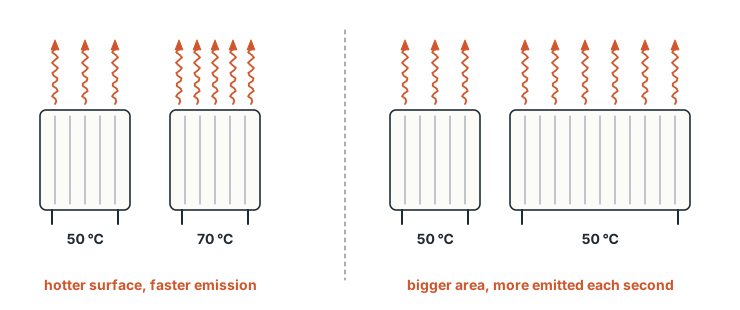
When the cube was refilled with water at 90 °C, every side gave a higher reading than at 60 °C: about twice as high. The higher the temperature of a surface, the faster it emits infrared.
The detector caught the infrared from the same area of each side. A bigger surface at the same temperature has more of itself giving out infrared, so it emits more energy each second in total: twice the area, twice the power. The rate at which a surface emits radiation depends on its temperature and on its surface area.
 (enlarge)
Worked example
Hotter and longer radiators
A room has two radiators painted the same white. Radiator A is 1 m long and radiator B is 2 m long, and both are at 50 °C. (a) Which radiates more energy each second? (b) Radiator A is then turned up to 70 °C. What happens to the rate at which it radiates?
(a) Both surfaces are at the same temperature and have the same paint, but B has twice the surface area, so B radiates about twice as much energy each second. (b) A's surface is now hotter, so it radiates energy faster than before. A bigger area and a higher surface temperature both make a surface emit radiation faster.
Case closed
Your face is warmed by the campfire because the fire emits infrared radiation, which crosses the gap to you directly, without needing the air. The hot air and smoke carry energy upwards by convection. Every surface emits infrared, and a dull black one emits it best, but a matt white wall emits almost as well as a black one. So the white paint on the houses isn't about giving out infrared. The difference between black and white shows up when surfaces take in radiation, which is the next part.
About this model
The cube, the detector and the water are simulated. The room and the detector are at 20 °C, and the water stays at the temperature it was poured in at while you take the readings: they take under a minute, and real water would cool by less than 1 °C. The reading is worked out from the temperature of the side and how well its surface emits, using values for these four finishes: matt black paint 0.95, matt white paint 0.90, dull aluminium 0.20 and polished aluminium 0.05 of the most a surface could emit at that temperature. The detector catches a quarter of the infrared that would reach it if the side filled its whole view. Real paints and metals vary, so a real Leslie cube gives different numbers, but the order is the same: matt paint far above bare metal, and dull metal above polished metal. The wavy arrows on the bench are a drawing of the infrared, which you can't see; the cube itself never glows.