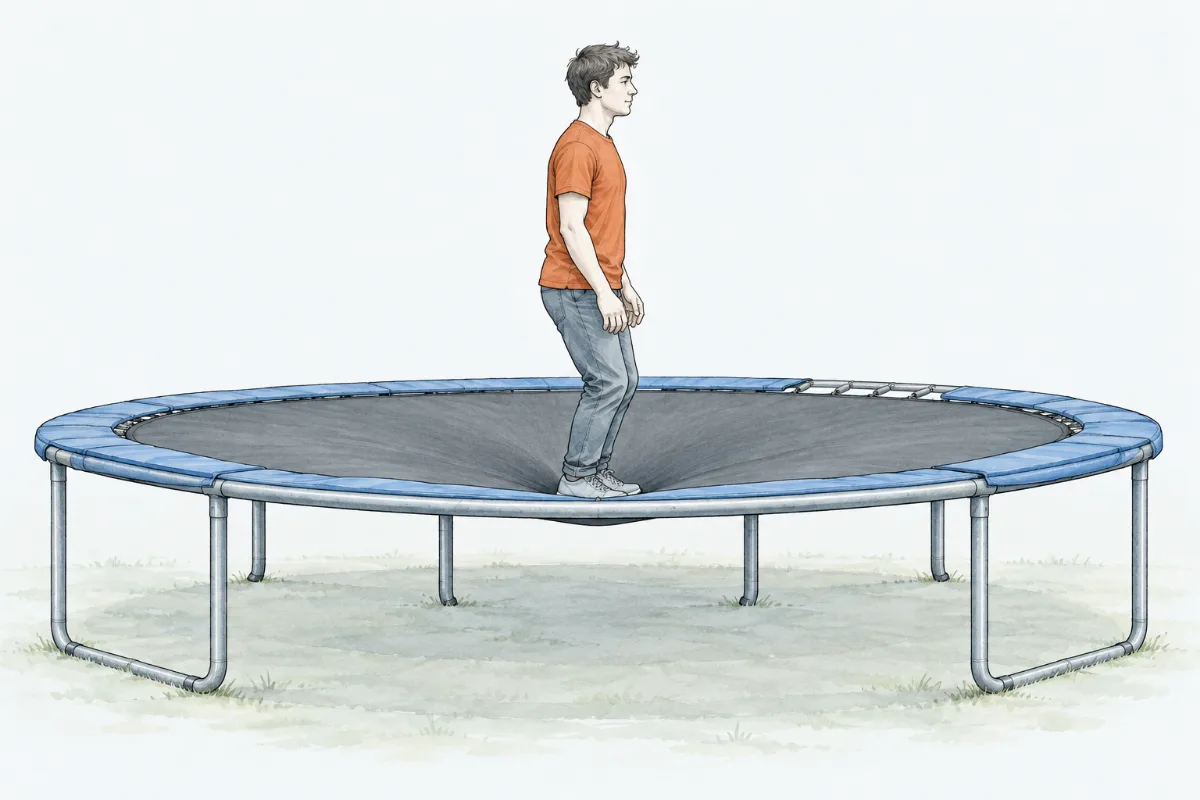
You land on a trampoline, and the mat dips under your feet. All round the edge, dozens of short springs stretch, and then they pull the mat back up. Now a puzzle for the lab. You have a stone, a spring, a metre rule and a box of 100 g masses, but no scales. Can you find out how heavy the stone is?
 (enlarge)
Forces change shape
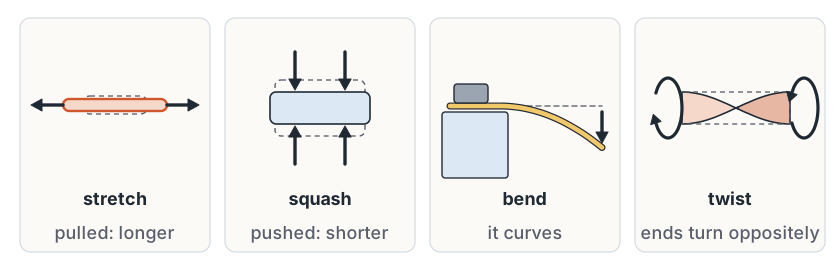
In Resultant force you saw that a force can change the way an object moves. A force can also change the size and the shape of an object. A pull can stretch it, so that it gets longer: a rubber band, a bungee cord, or a spring with a load hanging on it. A push can squash it, so that it gets shorter: a cushion you sit on, or the coil spring above each wheel of a car, which gets shorter when the wheel goes over a bump. Forces can also bend an object, like a diving board under a diver, or twist it, like a wet cloth that you wring out.
 (enlarge)
A spring, a rubber band and a trampoline mat are elastic: when the force is taken away, they go back to their original shape. In this module you load a steel spring, measure how much it stretches, and look for the rule that links the stretch to the force.
Trap: “Hard objects, like things made of steel, do not change shape.” Every solid changes shape a little when a force acts on it. A steel ruler bends when you press on its end over the edge of a desk, and a steel spring stretches. A steel bridge sags too when a lorry drives over it, by an amount far too small to see.
Load and extension
Hang a spring from a clamp and hang masses on it. The force that stretches the spring is the load. Here the load is the weight of the masses, so it is measured in newtons, not in grams: weight = mass × g, with g = 9.8 N/kg. One 100 g mass is 0.100 kg, so its weight is 0.100 kg × 9.8 N/kg = 0.98 N. Two 100 g masses give 1.96 N, and three give 2.94 N.
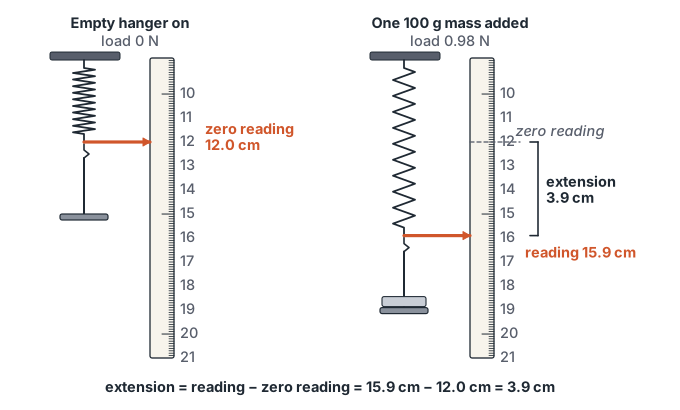
The masses sit on a hanger, and the hanger has a weight of its own. So the hanger goes on first, and you read where the bottom of the spring is with only the empty hanger on. That is the zero reading. By then the hanger has already stretched the spring a little, and that stretch is inside the zero reading. So the load is only the weight of the masses you add after the zero reading, not the hanger.
Some questions start instead from the spring’s original length, with nothing hanging on it at all. Then the extension includes the stretch made by the hanger, so the load must include the weight of the hanger too.
The extension is how much longer the spring gets: the increase in its length. You find it by subtracting: extension = reading − zero reading.
 (enlarge)
Trap: “The extension is the reading on the rule.” The reading, 15.9 cm, is where the bottom of the spring is. The spring was already at 12.0 cm before the mass went on, so it has stretched by only 15.9 − 12.0 = 3.9 cm. The extension is always a difference between two readings.
Worked example
From reading to extension
A spring hangs beside a metre rule. With the empty hanger on, the pointer reads 8.4 cm. A pupil adds 150 g of masses, and the pointer then reads 13.0 cm. Find the load and the extension.
The load is the weight of the masses added: 150 g = 0.150 kg, and 0.150 kg × 9.8 N/kg = 1.47 N. The hanger is not counted, because it was already on for the zero reading. The extension is the reading minus the zero reading: 13.0 cm − 8.4 cm = 4.6 cm. It is not 13.0 cm, which is only where the pointer is now. And the load is not 150: a load is a force, in newtons. The load has changed both the size of the spring, which is now 4.6 cm longer, and its shape: its coils are further apart.
Measuring the extension
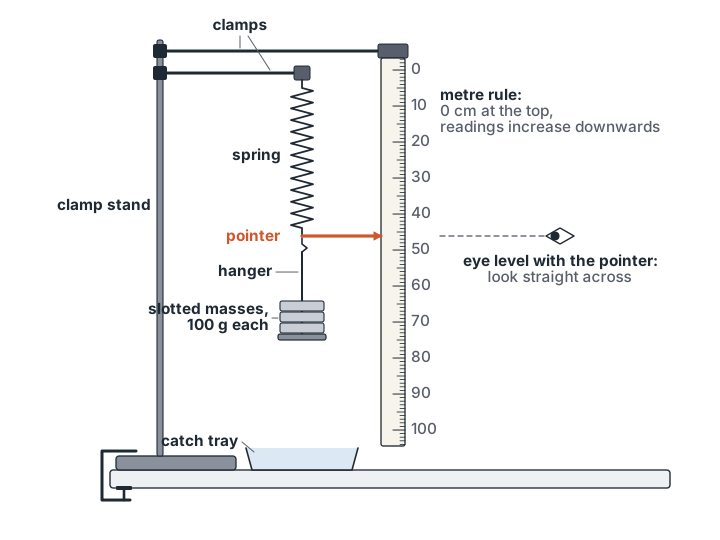
To measure extensions well, set up the apparatus like this.
 (enlarge)
- Set up. A clamp holds the top of the spring on a clamp stand. A second clamp holds a metre rule upright, close beside the spring. A light pointer is fixed to the bottom of the spring, so that it almost touches the rule.
- Zero reading. Hang the empty hanger on the spring, wait until it is still, and read the pointer.
- Load in steps. Add one 100 g mass at a time. Each time, wait until the spring stops bouncing, then read the pointer again.
- Read at eye level. Put your eye level with the pointer and look straight across at the rule. If you look from above or below, the pointer seems to sit against a different mark, and the reading is wrong. This is called parallax.
- Record. Write each result in a table with four columns: mass added in g, load in N, reading in cm, and extension in cm.
The masses make the stand top-heavy, so a stand that is not clamped to the bench, or held down by a heavy weight on its base, can tip over as they go on. The catch tray under the hanger is there because a mass that slips off falls straight down.
Plotting a load–extension graph
Plot the results as a load–extension graph. In this module the load in N goes up the side (the y-axis) and the extension in cm goes along the bottom (the x-axis), as on the bench. Plot the point (0, 0) as well: with no load there is no extension. Then draw a ruled best-fit line, with the points scattered evenly on either side of it. Do not join the points dot to dot. Real readings are never perfect, and the best-fit line shows the pattern that they all share.
For a spring like the ones in this module, the best-fit line is a straight line through the origin, the point (0, 0) where both axes start. That means the extension is proportional to the load: double the load and the extension doubles, triple it and it triples. Some books call this Hooke’s law. In this course, saying that the extension is proportional to the load is enough.
Trap: “Any straight-line graph shows that one thing is proportional to the other.” Only a straight line through the origin does. If you plot the load against the reading instead of the extension, you still get a straight line. But it crosses the reading axis at the zero reading, not at the origin. The reading is not proportional to the load, but the extension is. Always plot the extension.
Worked example
Weighing a parcel with a graph
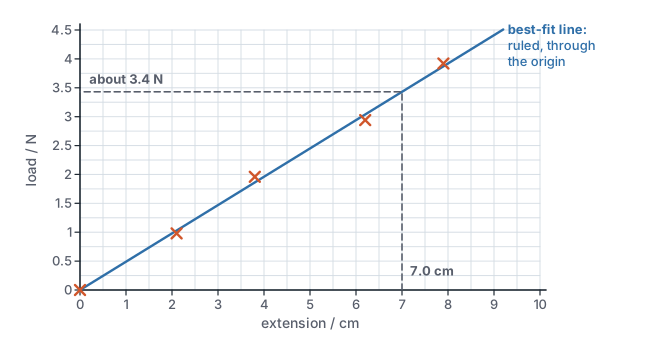
A pupil loads a spring in 100 g steps and plots the graph below. A small parcel hung on the same spring gives an extension of 7.0 cm. Find the weight of the parcel.
 (enlarge)
Start at 7.0 cm on the extension axis. Go straight up to the best-fit line, then straight across to the load axis. The line is met at about 3.4 N, so the parcel weighs about 3.4 N. Use the line, not the nearest point: the line averages out the small errors in every reading. The graph works the other way round as well. For a load of 2.0 N, go across from 2.0 N to the line and down: the extension is about 4.1 cm.
Load a spring and plot the graph
Now you can do it yourself, and solve the stone puzzle.
What is on the bench. A clamp stand, clamped to the bench, holds a steel spring, spring A, from a clamp at the top. A metre rule is clamped upright beside it, with 0 cm at the top, so the readings get bigger lower down. An orange pointer is fixed to the bottom of the spring and just touches the rule. The empty hanger already hangs on the spring. Beside the stand are a stack of 100 g slotted masses, some 50 g masses for later, and a stone. A catch tray sits on the bench under the hanger. You read the pointer through a magnifying lens held level with it, so that you read at eye level and can see the millimetre marks. Your points appear on a graph of load against extension.
What you do. First decide what every extension is measured from, and read the zero reading. Add one 100 g mass and work out the extension yourself. Predict the extension with 200 g on the spring, then add three more 100 g masses, one at a time, and watch the points on the graph. Last, take the masses off, hang the stone on the hanger instead, and use the graph to find its weight.
What the experiment showed
Do the experiment before you read on. With the empty hanger on, the pointer read 12.0 cm. That is the zero reading, and every extension is measured from it. Measuring from the 0 cm mark would count the 12.0 cm the pointer was already down the rule before any mass went on, and the masses you add did not make that.
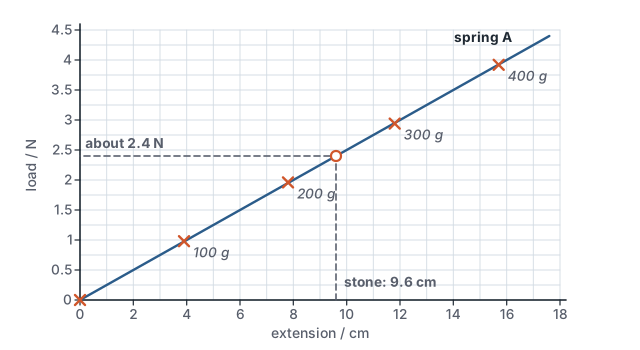
With one 100 g mass, a load of 0.98 N, the pointer read 15.9 cm, so the extension was 15.9 − 12.0 = 3.9 cm. With 200 g, the extension was 7.8 cm: double the load gave double the extension. Each extra 100 g moved the pointer down by the same amount, 3.9 or 4.0 cm. The difference is only the rounding to the nearest millimetre.
| Masses added | Load / N | Reading / cm | Extension / cm |
|---|---|---|---|
| none | 0 | 12.0 | 0 |
| 100 g | 0.98 | 15.9 | 3.9 |
| 200 g | 1.96 | 19.8 | 7.8 |
| 300 g | 2.94 | 23.8 | 11.8 |
| 400 g | 3.92 | 27.7 | 15.7 |
On the graph, the points lay on a straight line through the origin, so the extension of spring A was proportional to the load. Then the stone went on in place of the masses. The pointer read 21.6 cm, so the extension was 21.6 − 12.0 = 9.6 cm. Going up from 9.6 cm to the line and across gives a load of about 2.4 N. That is the weight of the stone. Its point sits between the 200 g and 300 g points, and its mass is about 2.4 N ÷ 9.8 N/kg ≈ 0.24 kg.
 (enlarge)
Case closed
The stone puzzle needed no scales. The weight of the stone stretched the spring, a force changing its size. Loading the spring with known masses, 0.98 N for every 100 g, and measuring each extension from the zero reading gave a straight-line graph through the origin. The stone’s extension, 9.6 cm, then read off the graph as a weight of about 2.4 N.
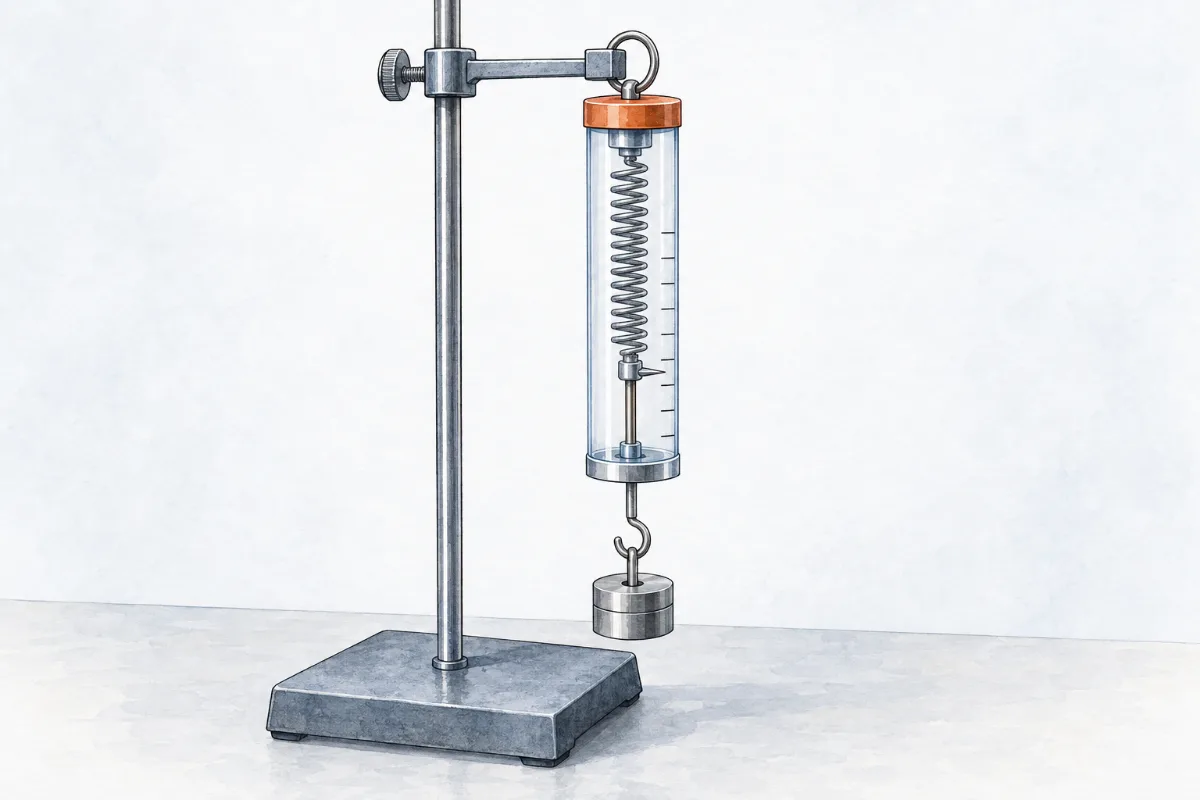
A spring balance is the same idea, built into a tube. A spring hangs inside, with a pointer on its lower end beside a scale. The marks on the scale are equally spaced, because each extra newton stretches the spring by the same amount. The scale is marked in newtons, so the graph has already been drawn for you.
 (enlarge)
About this model
The stand, the spring, the masses, the stone and the lens are simulated. The spring and the pointer have no mass that matters, and every mass is exactly 100 g or 50 g. Each reading is worked out by the model from the load and written to the nearest 0.1 cm, the smallest step you can read on a metre rule. Real readings wobble a little, so real points scatter slightly about the line. The model uses g = 9.8 N/kg. Spring A stays proportional for every load used here. Part 2, which is Supplement content, loads a softer spring further and shows that a spring does not stay proportional for ever.