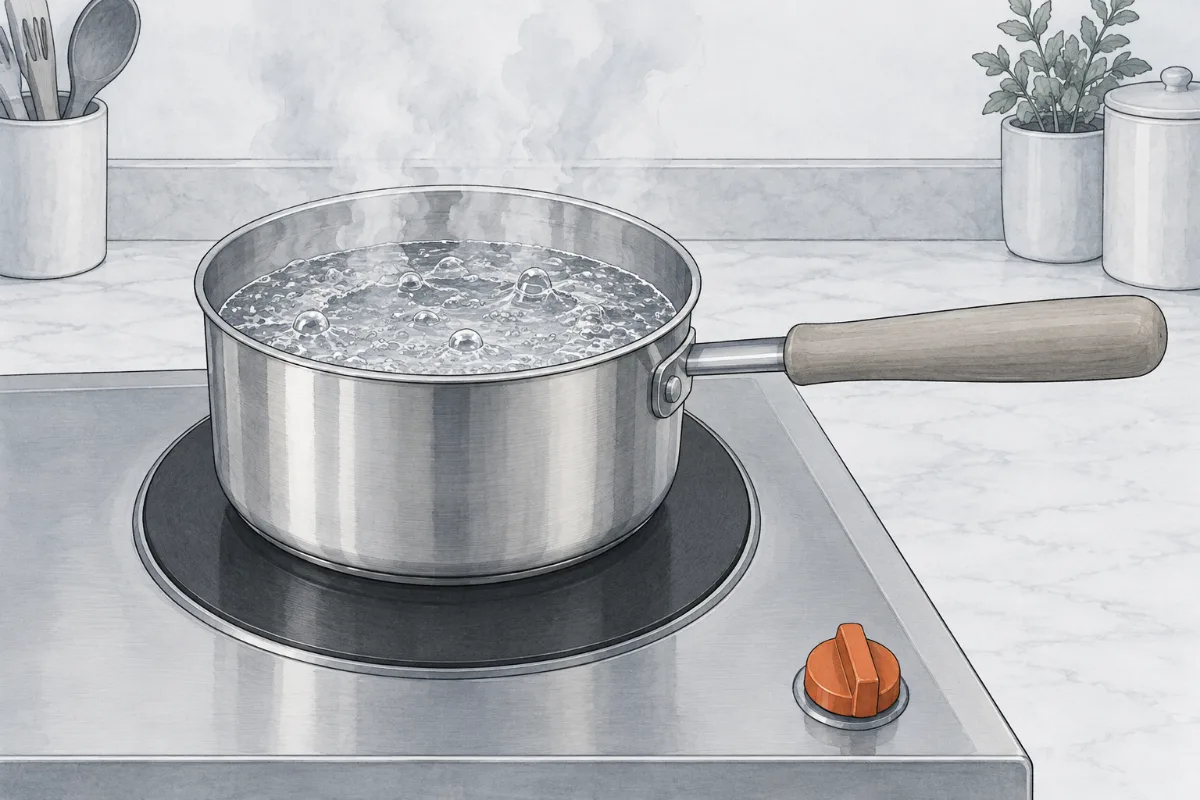
Leave a metal spoon standing in a pan of hot soup for a couple of minutes, and the end of its handle gets too hot to hold. A wooden spoon left in the same soup for just as long stays comfortable. The saucepan in the picture uses the same idea: its body is metal, but you hold it by a wooden grip. By the end of this part you can say which materials let thermal energy through quickly, how to test them fairly, and why a wooden handle stays so much cooler than the water boiling in the pan.
 (enlarge)
Energy on the move
Thermal energy always moves from a hotter place to a colder one. When the spoon stands in hot soup, the part in the soup gets hot first, and energy then travels up the handle to the cooler end in the air. The spoon itself doesn't move, and none of the metal flows anywhere, yet the energy gets from one end to the other: it is conducted along the handle. This way of passing thermal energy through a material is called thermal conduction.
Every solid conducts thermal energy, but some do it far faster than others. That is why the metal spoon's handle gets hot in a minute or two, while the wooden spoon's handle is still cool after the soup is eaten.
Good conductors and insulators
A good thermal conductor is a material that lets thermal energy pass through it quickly. Metals are good thermal conductors: copper and aluminium are among the best, and steel is good too, although less good than those two.
A bad thermal conductor, also called a thermal insulator, lets thermal energy pass through it only slowly. Wood, plastic, rubber, cork, wool and air are thermal insulators, and so are glass and water when you compare them with metals. That is why pans are made of metal, so that energy from the hob reaches the food quickly, while their handles are wrapped in wood or plastic, so that the end you hold warms up only slowly.
Trap: “An insulator stops thermal energy from getting through.” An insulator slows the energy down; it does not stop it. Leave a wooden spoon in boiling soup for long enough and its handle gets warm too.
Worked example
Metal and wood on a cold morning
A park has a metal bench and a wooden bench side by side. After a cold night, both have been outside at 5 °C for hours, so they are at the same temperature. Why does the metal bench feel much colder when you sit on it?
Your skin is at about 33 °C, so energy flows from you into whichever bench you touch. Metal is a good conductor: it carries energy away from your skin quickly, so your skin cools fast and the bench feels icy. Wood is an insulator: energy leaves your skin only slowly, so your skin stays warm and the wood feels much less cold. Both benches are at 5 °C; the metal feels colder because it conducts energy away from you faster.
Trap: “The metal bench is colder than the wooden one.” Things left in the same place for long enough end up at the same temperature. Touch tells you how fast your skin is losing energy, not the temperature of what you touch.
Testing conductors fairly
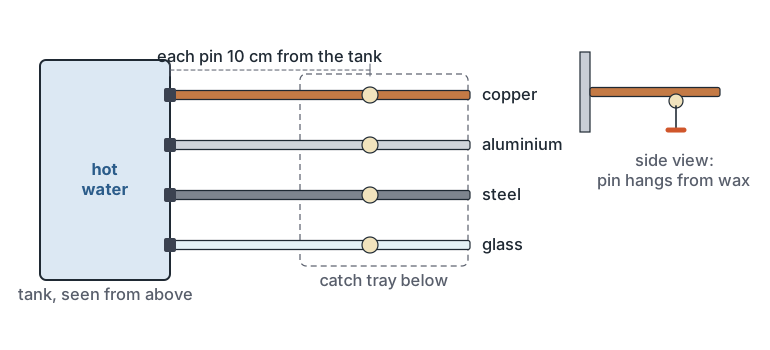
To find out which material conducts best, you have to compare them in a fair test, where the material is the only thing that changes. One classic way uses rods of different materials that stick out of a small tank of hot water.
 (enlarge)
The rods are all the same length and thickness, they all dip into the same hot water, and each has a drawing pin stuck to it with the same wax at the same distance from the tank. Energy is conducted along each rod from the hot end. When the rod under a blob of wax reaches the melting point of the wax, the wax melts and the pin drops. A stop-clock measures the time each pin takes to drop. The sooner a pin drops, the better that rod conducts.
Water can be tested too. Wrap a piece of ice in a little wire gauze so that it sinks, push it to the bottom of a boiling tube of cold water, and heat the tube near the top with a small flame. The water at the top boils, yet the ice at the bottom, only a few centimetres away, takes a long time to melt. Very little energy is conducted down through the water, so water is a bad conductor.
Worked example
Planning a fair test
A pupil wants to show that copper is a better thermal conductor than steel, using the rods and pins. Which things must she keep the same, what does she measure, and what result does she expect?
She keeps the same: the length and thickness of the two rods, how far they dip into the water, the temperature of the water, the distance from the tank to each pin and the wax that holds it. She changes only the material of the rod. She measures the time from pouring in the hot water until each pin drops. She expects the pin on the copper rod to drop first, which shows that copper conducts thermal energy faster than steel. If the copper rod were thicker, or its pin nearer the tank, its pin could drop first for the wrong reason, and the test would not be fair.
Race four rods
Now run the race on the bench.
What is on the bench. A small metal tank on short legs with four rods sticking out of its side: copper, aluminium, steel and glass, each 15 cm long and 6 mm thick. A drawing pin hangs from a blob of wax on each rod, 10 cm from the tank; the wax melts at 55 °C. One copper rod is still lying on the bench, next to a thicker copper rod. A jug of water at 80 °C, a catch tray under the rods, and a stop-clock.
What you do. Choose which copper rod to fit so that the race is fair, and predict which pin will drop first. Pour the hot water into the tank, which starts the clock, and watch the pins. The clock runs 40 times faster than real time, so the race fits into well under a minute. Then think about what the glass rod shows, and in the Supplement steps look inside the copper and the glass with the magnifier.
What the experiment showed
Do the experiment before you read on. You fitted the thin copper rod: a thicker rod carries more energy at a time, so it would have won for the wrong reason. Then all four pins hung at the same distance from the same hot water, and they dropped in this order (times from the model, see “About this model” at the end):
| Rod | Pin dropped after |
|---|---|
| copper | 2 min 23 s |
| aluminium | 2 min 50 s |
| steel | 21 min 18 s |
| glass | still hanging at 25 min |
Copper conducted best, aluminium nearly as well, and steel much more slowly. The glass pin had not dropped when the run ended, but that does not mean glass conducts no energy at all: the glass near the tank did warm up, only very slowly. Glass is a bad conductor, and the three metals are good conductors, copper the best of them.
Supplement: Vibrations pass energy along
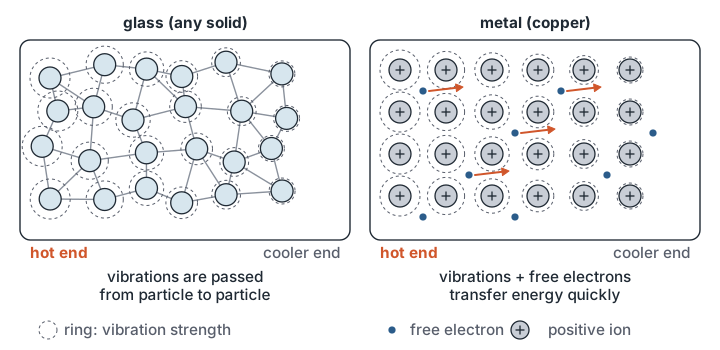
To see why some materials conduct so much better than others, look at their particles. In a solid, the particles (atoms, ions or molecules; an ion is an atom that has lost or gained electrons) are held close together in fixed positions, and each one vibrates about its place. This fixed arrangement of particles is called a lattice. They are joined to their neighbours by forces that act like springs.
At the hot end of a rod, the particles vibrate more strongly. Each one pushes against its neighbours, so they vibrate more strongly too, and they in turn pass the extra vibration on to the particles beyond them. In this way energy passes along the rod from particle to particle by lattice vibrations, the vibrations of the whole lattice. This happens in every solid, metals and non-metals alike. On its own it is slow, because the energy has to be handed on from each particle to the next.
 (enlarge)
Supplement: Free electrons in metals
Metals have something extra. In a metal, some electrons are not tied to any one atom. These free electrons, also called delocalised electrons, move about all through the metal, between the positive ions of the lattice (the atoms that have lost those free electrons). At the hot end they gain kinetic energy, so they move faster, and because they are free they travel a long way through the metal before they collide with ions in cooler parts and hand that energy on. The free electrons carry energy much faster than the lattice vibrations can pass it on. So metals conduct in both ways, by lattice vibrations and by free electrons, and that is why they are such good conductors.
Worked example
Why copper beats glass
The copper pin dropped after 2 min 23 s, but the glass pin was still hanging after 25 minutes. Explain the difference in terms of particles.
In both rods, the particles at the hot end vibrate more strongly and pass the vibration on to their neighbours, so energy travels along both rods by lattice vibrations. Copper is a metal, so it also has free electrons. They gain energy at the hot end, move quickly through the copper and pass the energy to ions further along. Glass has no free electrons, so it can only pass energy on by the slower vibrations. Copper conducts by free electrons as well as by vibrations, so energy reaches the wax much sooner.
Trap: “The hot copper particles travel along the rod to the pin.” The ions of the copper stay in their places and only vibrate. What travels is energy: passed on by the vibrations, and carried by the free electrons.
Supplement: Why liquids and gases conduct badly
In a gas, the particles are far apart, with a lot of empty space between them. A fast particle at the hot side passes on energy only when it hits another particle, and in a gas that does not happen often, so energy spreads through a still gas very slowly. Gases are very bad conductors. That is why trapped air is a good insulator: wool, fur, feathers, plastic foam and the gap between the two panes of a double-glazed window all work by holding air still.
In a liquid, the particles are close together, but they are not held in a fixed lattice: they slide past each other, so vibrations are not passed on as well as in a solid. Most liquids also have no free electrons. So most liquids, water among them, are bad conductors too. Mercury and other liquid metals are the exception: they have free electrons and conduct well.
Worked example
Ice that doesn't melt
In the boiling-tube experiment, the water at the top of the tube boils while the ice at the bottom stays frozen for a long time. Explain this in terms of particles, and explain why the tube is heated at the top rather than at the bottom.
The particles of water are close together but not held in a lattice, and water has no free electrons, so energy is passed down through it only slowly by collisions between neighbouring particles. Almost none of the energy reaches the ice, so it does not melt. The tube is heated at the top on purpose. Warmed water expands and floats upwards, so heating the bottom would make the warm water rise and carry energy all through the tube, which is convection, the subject of the next part. Heating the top keeps the warm water at the top, so the only way for energy to reach the ice is by conduction.
Supplement: Conductors, insulators and the solids in between
Materials don't fall neatly into two groups. Many solids conduct thermal energy better than thermal insulators, but less well than good conductors.
| Good conductors | In between | Thermal insulators |
|---|---|---|
| copper, aluminium, steel and other metals | glass, brick, concrete, stone, ice | wood, plastic, rubber, cork, wool, plastic foam, still air |
Earlier in this lesson, glass counted as an insulator because it was compared with metals. Compared with wood and foam it conducts much better, so with three groups it goes in between: what a material is called depends on what you compare it with. Glass, brick and stone are bad conductors next to a metal, but they still conduct several times better than wood and many times better than plastic foam or air. That is why a stone wall loses more energy than a wall with a layer of foam inside it.
Worked example
Stone, wood and carpet
In a house, a stone floor, a wooden floor and a thick carpet have all been at the same temperature, 18 °C, all night. In bare feet, the stone feels coldest and the carpet warmest. Explain why.
Your feet are warmer than 18 °C, so energy flows from them into the floor. Stone is one of the in-between solids: it conducts energy away from your feet faster than wood does, so it feels colder. Wood is an insulator and feels less cold. The carpet is made of fibres with a lot of trapped air between them, and still air is a very bad conductor, so the carpet takes energy from your feet slowest of all and feels warmest. All three floors are at 18 °C; they feel different because they conduct energy away at different rates.
Case closed
Energy reaches the end of a metal spoon quickly because metal is a good thermal conductor: in the Supplement picture, both its vibrating lattice and its free electrons carry energy along. Wood is a thermal insulator. Energy passes along a wooden handle only slowly, by vibrations from particle to particle, so the end you hold warms up much more slowly. A wooden grip still gets warm if the pan stays on the heat for long enough, but it stays much cooler than the metal and the boiling water. That is why the saucepan's body is metal and its grip is wood.
About this model
The tank, the rods and the pins are simulated. The water stays at exactly 80 °C, the room is at 20 °C and the wax melts at 55 °C. Each pin's release time is worked out from a simple model of energy flowing along a long rod from its hot end, using real values for copper, aluminium, steel and glass, with no energy lost to the air from the sides of the rod. Real rods lose energy to the air from their sides, and real water cools a little, so real pins take longer to drop. A pin far out on a poor conductor may never drop at all: on real steel and glass rods in water at 80 °C, the wax 10 cm out may never get as hot as 55 °C. The copper and aluminium pins still drop first, in that order. How soon a pin drops depends mostly on how well the rod conducts, and partly on how much energy the rod needs to warm up; for these four rods, the order is the order of how well they conduct. The magnifier's particles are a model too: real atoms and electrons are far too small to see, and they move far faster.