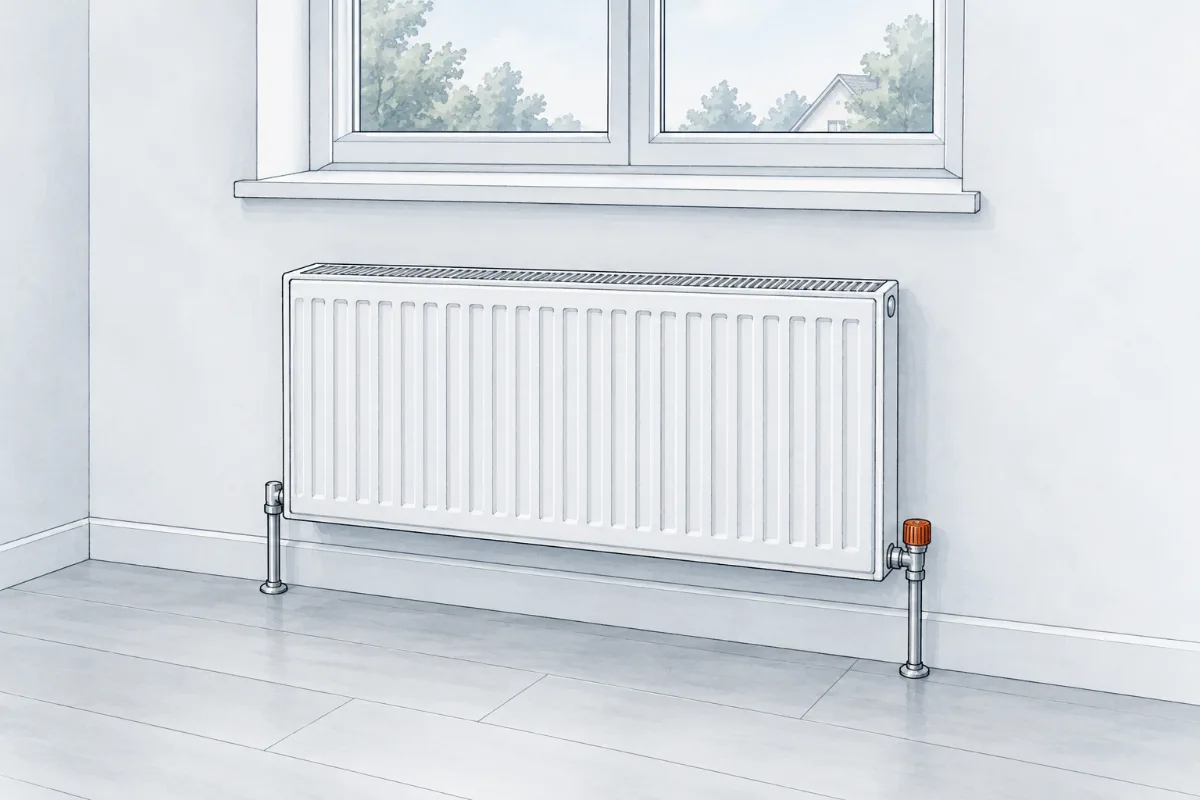
A room has one radiator, low on the wall under the window. Switch it on on a cold morning, and within half an hour the whole room is warm, even the far corner by the door, five metres away. In part 1 you saw that air is a very bad conductor, so conduction could never carry the energy across the room that fast. Something else does the job: the air itself moves. By the end of this part you can explain how, and say why radiators go low down, why a cooler goes high up and why a pan is heated from below.
 (enlarge)
Warm fluid floats up
Liquids and gases are fluids: they can flow, because their particles are free to move from place to place. That lets them carry energy in a way a solid can't.
When part of a fluid is heated, its particles move faster and push further apart, so that part of the fluid expands. Its mass stays the same but it takes up more volume, so its density falls. A less dense fluid floats up through a denser one, as a cork floats up through water, because the denser fluid around it pushes it upwards. Cooler, denser fluid sinks and flows in to take its place, gets heated in turn and rises too. The result is a continuous flow called a convection current.
Convection is the transfer of thermal energy by the movement of the fluid itself: the warm fluid carries its energy with it as it moves. It is an important way for thermal energy to travel through liquids and gases, which are such bad conductors. It cannot happen in a solid, because the particles of a solid stay in their places.
Trap: “Heat rises.” Heat is energy, and energy does not rise by itself: in a solid it is conducted downwards just as easily as upwards. What rises is warm fluid, and only because it is less dense than the cooler fluid around it.
Worked example
Warm air is less dense
1.00 m³ of air at 20 °C has a mass of 1.20 kg. Heated to 50 °C, the same air expands to 1.10 m³. Calculate the density of the air before and after heating, and say what the warm air does.
Before heating, density = mass ÷ volume = 1.20 kg ÷ 1.00 m³ = 1.20 kg/m³. After heating, the mass is still 1.20 kg, so density = 1.20 kg ÷ 1.10 m³ = 1.09 kg/m³. The warm air is less dense than the cool air around it, so the cool air pushes it upwards and it rises.
Trap: “Warm air rises because its particles get lighter.” Each particle keeps its mass. The same particles spread out into a bigger volume, so each cubic metre holds less mass.
Seeing convection
Water and air are clear, so a convection current can't be seen directly. Experiments make it visible by colouring the moving fluid.
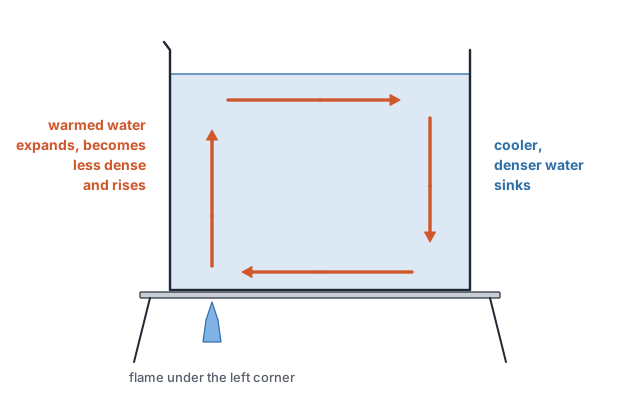
In water, drop a single crystal of potassium manganate(VII), a purple dye, into a beaker of cold water, next to one corner of the bottom. Warm the beaker gently with a small flame under that corner only. A thin purple stream rises from the crystal straight up above the flame, spreads across under the surface, and sinks down the far, cooler side: the dye traces out the convection current.
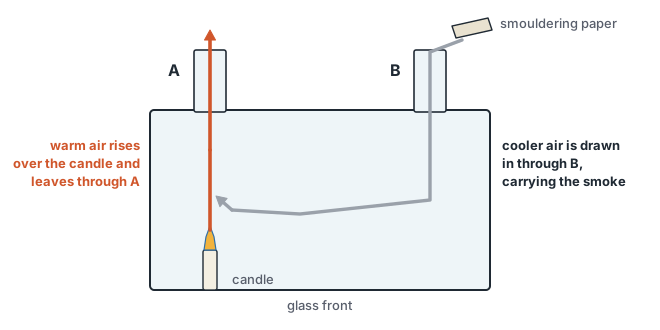
In air, use smoke. A box with a glass front has two chimneys in its lid. A lit candle stands under one chimney, and smouldering paper (paper that burns slowly with smoke but no flame) is held over the other.
 (enlarge)
Worked example
Smoke and two chimneys
In the smoke box, the smoke goes down chimney B, across the box and up out of chimney A, above the candle. Explain why it moves this way.
The candle heats the air above it. That air expands, becomes less dense and rises out through chimney A. Cooler, denser air from outside sinks in through chimney B to take its place and flows across to the candle. The smoke from the paper is carried along by that air, so it shows the convection current: down B, across, and up A. The current always rises above the heat source and is fed by cooler air drawn in from elsewhere.
Trace the dye
Now watch a convection current form in water on the bench.
What is on the bench. A beaker of cold water, 600 cm³, on a tripod and wire gauze, which stands on a heat-proof mat. A small Bunsen burner sits under the left corner of the beaker, not under the middle. A jar of purple dye crystals with a pair of tweezers, and a second beaker of cold water standing ready.
What you do. Drop a crystal into the water by the left corner and predict where the dye will go once that corner is heated. Light the burner and watch the dye. Explain why the warm water moves the way it does. Then decide where the flame has to go to make the current turn the other way, and try it in a fresh beaker.
What the experiment showed
Do the experiment before you read on. Before the flame was lit, the dye barely spread: a faint purple haze stayed round the crystal. Once the corner was heated, a purple stream rose straight up above the flame, spread across under the surface, sank down the far side and flowed back along the bottom towards the flame: one loop, turning all the time, which slowly spread the colour through the whole beaker.
 (enlarge)
With the flame under the right corner of a fresh beaker, the loop turned the other way: up on the right, across, down on the left. The warm water always rises above the place that is heated, and the cooler water always sinks somewhere else, so where you put the heat decides which way the current turns. A flame under the middle would have sent the dye up the middle and down both sides.
Heating a room
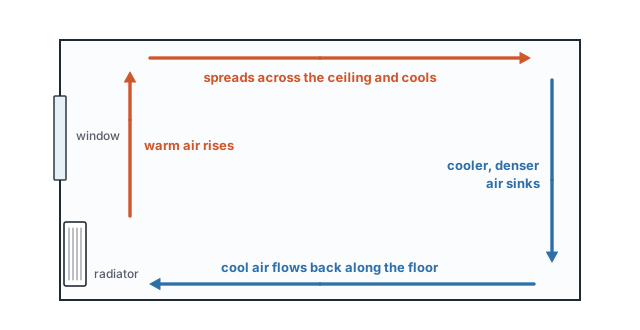
A room radiator heats the air that touches it, partly by conduction from its hot metal surface. That warm air expands, becomes less dense and rises to the ceiling. It spreads across the ceiling, cools as it goes, becomes denser and sinks down the far side of the room, then flows back along the floor to the radiator, where it is warmed again. The convection current carries energy to every part of the room.
 (enlarge)
That is why a radiator is fixed low down: the warm air rises from it and the current sweeps through the whole room. A radiator near the ceiling would leave a layer of warm air at the top and the cold air near the floor, where people are. Cooling works the other way round. An air conditioner is fixed high on the wall, because the cold air it gives out is denser and sinks, and the freezer box in an old-style fridge is at the top, so that cold air sinks over the food.
Worked example
Where to put a heater and a cooler
A workshop is heated in winter by one heater and cooled in summer by one cooling unit. Should each go near the floor or near the ceiling? Explain.
The heater goes near the floor. Air warmed by it expands, becomes less dense and rises, and cooler air flows in along the floor to be heated, so a convection current carries energy round the whole room. The cooler goes near the ceiling. Air cooled by it contracts (gets smaller, the opposite of expands), becomes denser and sinks, and warmer air rises to take its place and is cooled in turn. Heat at the bottom, cool at the top, so that the convection current runs through the whole room.
A breeze from the sea
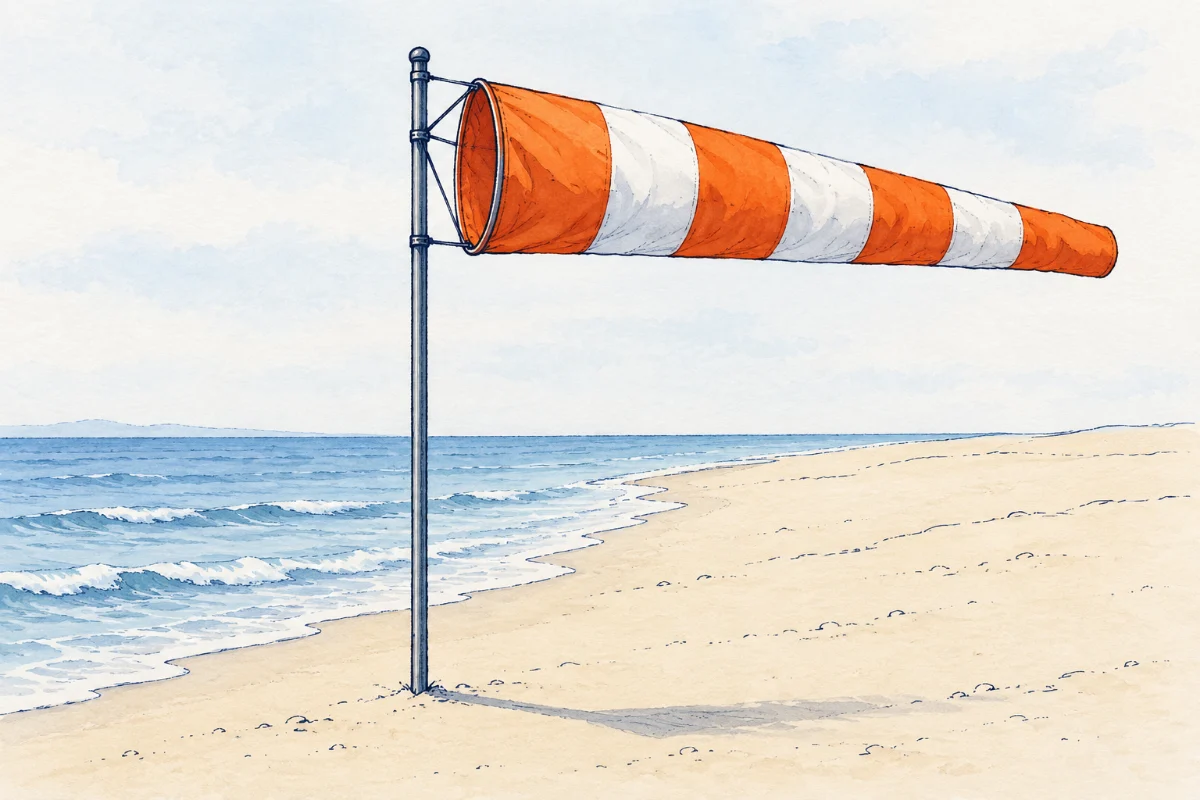
On a sunny day at the beach, a steady breeze often blows from the sea onto the land.
 (enlarge)
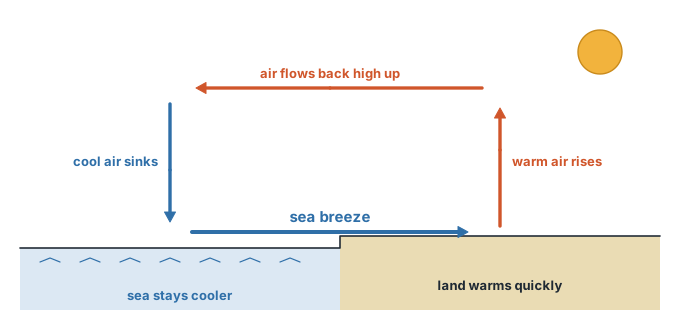
The land warms up in the sunshine much faster than the sea, because water needs far more energy to warm by each degree (you met this in Specific heat capacity). The air above the land is warmed by the hot ground, so it expands, becomes less dense and rises. Cooler, denser air from over the sea flows in along the ground to take its place: that is the sea breeze. High above, air flows back out over the sea, cools and sinks, which completes a giant convection current. At night the land cools faster than the sea, and the breeze can turn round and blow out to sea.
 (enlarge)
Heating a pan
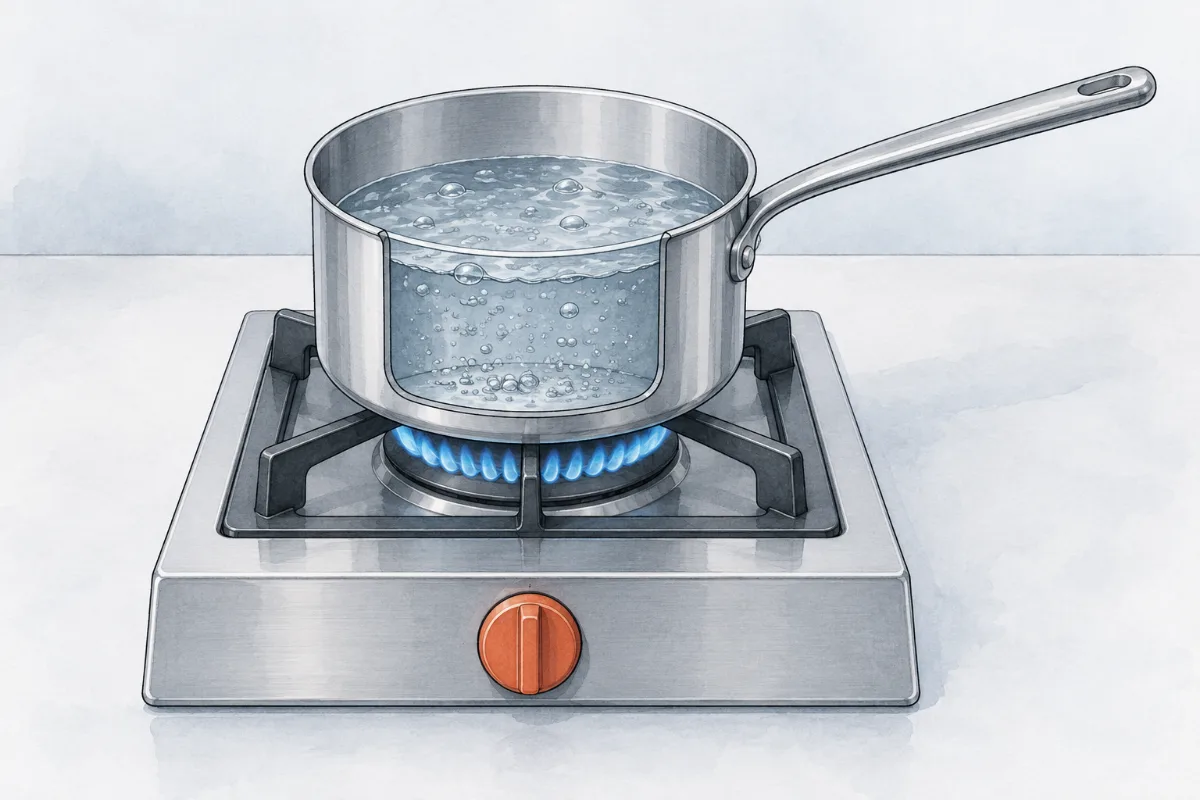
A pan of water on a gas hob uses conduction and convection one after the other.
 (enlarge)
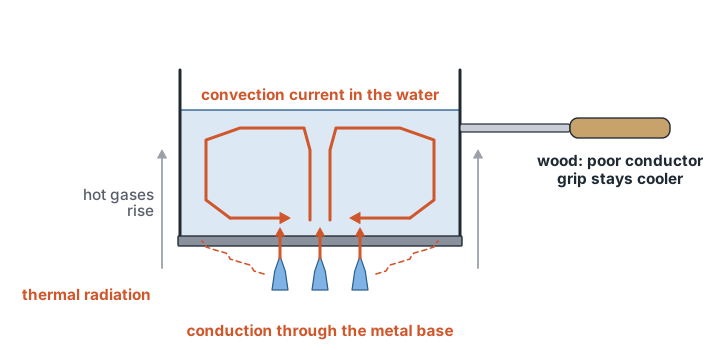
The flame's hot gases touch the base of the pan, and energy passes through the metal base by conduction: metal is a good conductor, so the energy gets through quickly. The water touching the base is warmed, expands, becomes less dense and rises, while cooler water sinks to the bottom to be heated in turn. This convection current carries the energy through all the water, until the whole pan boils. That is why a pan is heated from below: heat it from the top and the warm water would stay at the top.
The hot gases from the flame also rise around the pan by convection, which is one reason why a handle sticks out sideways instead of over the flame. The flame, or the glowing ring of an electric hob, also gives out thermal radiation, which needs no material at all to travel through: it is the warmth you feel on your hand held at the side of the flame, and the way the Sun's energy crosses empty space to reach the Earth. Thermal radiation is the subject of the next module.
 (enlarge)
Worked example
A saucepan from base to handle
A saucepan has a copper base, a steel body and a handle with a wooden grip. Explain how energy from the flame heats all the water, and why the grip stays much cooler.
Energy from the flame passes through the copper base by conduction; copper is an excellent conductor, so the energy gets into the water quickly. The water at the bottom is warmed, expands, becomes less dense and rises, and cooler water sinks to the base, so a convection current carries energy through all the water. The handle sticks out sideways, away from the flame and the rising hot gases, and its grip is wood, a thermal insulator: energy is conducted along it only slowly. Conduction through the base, convection in the water, and an insulating grip that stays cooler.
Case closed
The radiator warms the air beside it, the warm air expands, becomes less dense and rises, and cooler air flows in along the floor to take its place: a convection current carries the energy round the whole room. A pan works the same way inside: energy is conducted through the metal base, and a convection current carries it through the water until the water boils. The grip stays much cooler because it sticks out away from the flame and is made of wood or plastic, which conduct thermal energy only slowly. Fluids carry energy by moving, by convection; solids pass it on by conduction, and metals do that best.
About this model
The beaker, the burner and the dye are simulated. The dye is shown following a single smooth loop and spreading out as it goes; real dye wanders and swirls, and the current speeds up as the water near the flame gets hotter. The flame heats the beaker gently and the water never gets near boiling. The loop runs faster than a real one, which takes a minute or two to go round a beaker.