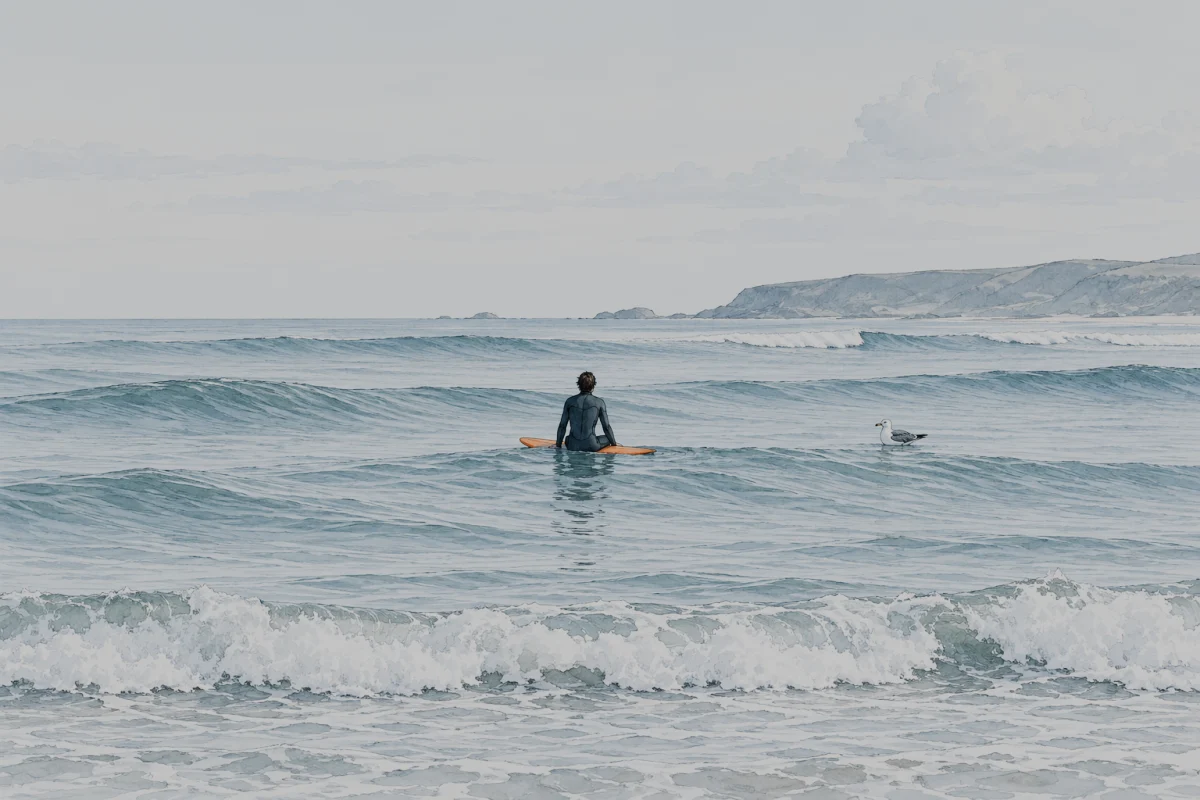
Out beyond the line where the waves break, a surfer sits on a board and waits, with a gull floating a few metres away. Swell after swell (long, smooth waves from far out at sea) rolls in from the open sea. Each one lifts the surfer and the gull, then lowers them again, but neither of them is carried towards the beach. Yet the same waves, when they reach the shore, can knock you off your feet and drag pebbles up the beach. Something travels across the sea with the waves, and it isn't the water. This part is about what a wave carries and how to describe it.
 (enlarge)
Energy on the move
At a big match, the crowd sometimes makes a stadium wave. Each person stands up with their arms raised and then sits down again, a moment after the person beside them. The wave races round the stadium, yet nobody leaves their seat: each person only moves up and down in their own place. What travels round the stadium is the pattern of movement.
 (enlarge)
In the stadium, each person stands up using their own muscles, so the crowd only shows how a wave moves. In a real wave, on water, on a rope or in the air, each bit of the material pushes or pulls on the bit next to it. The movement is passed on from bit to bit, and energy is passed on with it, while the material itself only moves to and fro about where it started. Waves transfer energy from one place to another without transferring matter. Sea waves carry energy across an ocean to the beach, sound carries energy through the air to your ear, and light carries energy from the Sun to the Earth.
Trap: “A wave carries the water along with it.” The water moves to and fro and ends up where it started. It is the energy that travels with the wave.
Waves on a spring
A long, soft spring such as a slinky shows wave motion clearly. Stretch it out, fix the far end and move the near end.
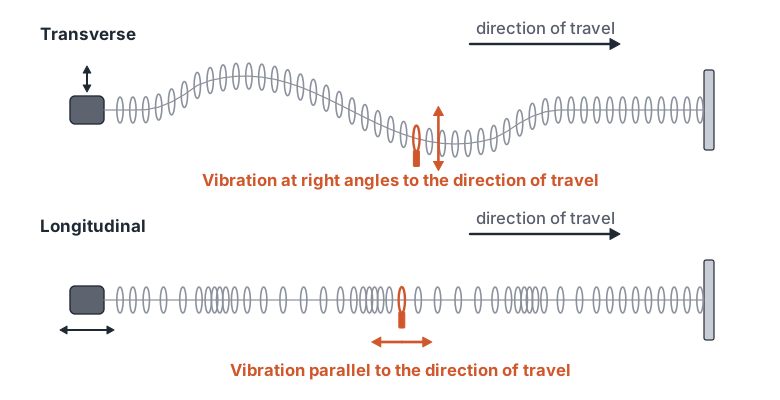
- Move the end up and down (or from side to side), and a wave travels along the spring. Each coil moves up and down, at right angles to the direction in which the wave travels.
- Push the end forwards and pull it back along the length of the spring, and a different wave travels along it: places where the coils are bunched up, with places where they are spread out between them. Each coil moves to and fro along the spring, in the same direction as the wave travels, and back.
Tie a ribbon to one coil and watch it. In both waves the ribbon moves to and fro about its own place and ends up where it started, while the wave travels on to the far end. The wave carries energy along the spring, and the coils stay where they are.
The direction in which a wave travels is called its direction of propagation. The first kind of wave is called transverse and the second longitudinal:
- in a transverse wave, the direction of vibration is at right angles to the direction of propagation;
- in a longitudinal wave, the direction of vibration is parallel to the direction of propagation.
 (enlarge)
Worked example
A ribbon on a rope
A long rope lies on the floor with its far end tied to a post, and a ribbon is tied round it halfway along. Sam flicks the near end up and down once, and a hump travels along the rope to the post. (a) Describe how the ribbon moves. (b) What has travelled from Sam to the post?
(a) As the hump passes, the ribbon moves up and then back down to where it was. It moves at right angles to the direction in which the hump travels, and it is not carried along the rope. (b) Energy has travelled along the rope: when the hump arrives, it shakes the post. No part of the rope has travelled from Sam to the post. The rope moves up and down in place, and the wave carries energy along it. This is a transverse wave.
Water waves in a ripple tank
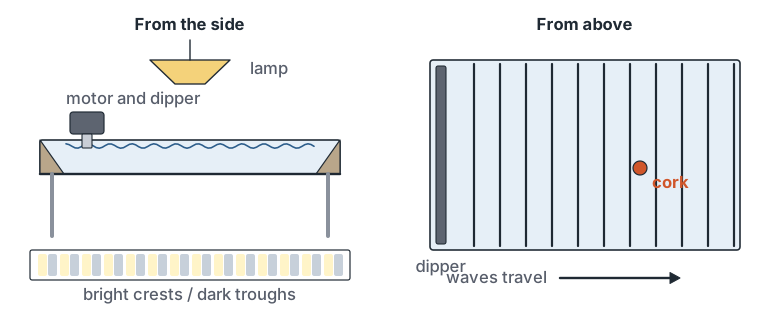
Water waves are hard to measure at sea, so in the laboratory they are made small in a ripple tank: a shallow tray of water with a glass bottom. A straight bar called a dipper rests on the water along one edge. A small motor makes the dipper move up and down, and each time it dips it sends out a straight ripple. The waves travel across the tank, and sloping edges round the tank soak them up so that they don't bounce back.
A lamp shines down through the water. Each crest of a wave focuses the light a little, like a weak lens, so the waves show up below the tank as bright lines (the crests) with darker lines between them (the troughs). Each bright line is a wavefront: a line along one crest. Waves move too quickly to measure by eye, so you take a still picture of them, for example with a camera, and measure that.
 (enlarge)
A cork floating on the water bobs up and down as the waves pass under it, but it isn't carried across the tank. As each wave passes, the surface of the water moves up and down, at right angles to the direction in which the wave travels across the tank, so water waves can be modelled as transverse.
Describing a wave
 (enlarge)
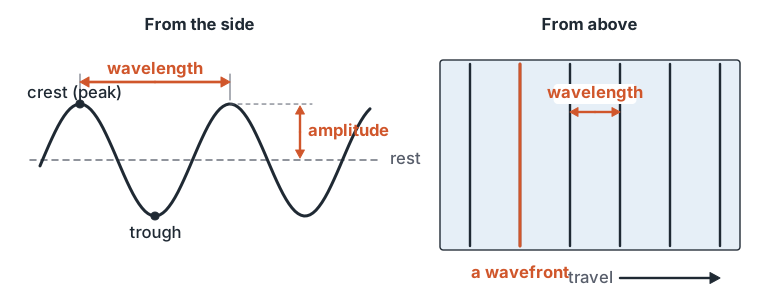
- A crest (or peak) is a highest point of a wave, and a trough is a lowest point.
- The amplitude is the greatest distance a point moves from its rest position: from the rest position up to a crest, or down to a trough. It is not the distance from a crest to a trough, which is twice the amplitude. A wave with a bigger amplitude carries more energy.
- The wavelength, λ (the Greek letter lambda), is the distance from one crest to the next, or from any point on one wave to the same point on the next wave. It is measured in metres (m).
- A wavefront is a line along one crest. Neighbouring wavefronts are one wavelength apart, and a wave travels at right angles to its wavefronts.
- The frequency, f, is the number of waves that pass a point each second. It is measured in hertz (Hz): 1 Hz is one wave each second. The source sets the frequency: a dipper that dips 10 times each second makes waves with a frequency of 10 Hz.
- The wave speed, v, is the distance a crest travels each second, in metres per second (m/s).
Trap: “The amplitude is the height from a trough to a crest.” That height is twice the amplitude. The amplitude is measured from the rest position to a crest.
Worked example
Reading a wave diagram
A diagram of a wave on a rope shows four crests in a row. The distance from the first crest to the fourth crest is 1.8 m, and the height from a trough up to a crest is 0.40 m. Find the wavelength and the amplitude.
From the first crest to the fourth there are three wavelengths, not four: first to second, second to third and third to fourth. So λ = 1.8 m ÷ 3 = 0.60 m. The height from a trough to a crest is twice the amplitude, so the amplitude is 0.40 m ÷ 2 = 0.20 m. Count the gaps between the crests, not the crests, and halve the height from trough to crest.
The wave equation
Suppose a dipper makes 10 waves each second, and each wave is 2 cm long. In one second, 10 new waves leave the dipper, one behind another, so the first of them has travelled 10 × 2 cm = 20 cm. The wave speed is 20 cm/s, or 0.20 m/s. In general:
wave speed = frequency × wavelength, v = fλ
with v in m/s, f in Hz and λ in m. Rearranged, f = v ÷ λ and λ = v ÷ f. The speed of a wave depends on what it travels through. For water waves it depends on the depth of the water. In the same water, waves of a higher frequency have a shorter wavelength, so fλ stays the same.
Trap: Putting a wavelength in centimetres into v = fλ and calling the answer m/s. Change the wavelength to metres first: 2.0 cm = 0.020 m.
Free play: nothing here is marked or saved
An earthquake wave on its way to a town 500 km away
What sets how fast the wave travels, and so when it reaches the town: the frequency, the amplitude, or the rock and the kind of wave? Try each one.
Still picture: your device asks for less motion.
Try: Double the frequency. What happens to λ and to v?
- Frequency f
- 1.0 Hz
- Wavelength λ
- 6.0 km
- Wave speed v
- 6.0 km/s
- Amplitude A
- 3.0 mm
- Time to town t
- ≈ 83 s
λ = v ÷ f = 6.0 km/s ÷ 1.0 Hz = 6.0 km
t = s ÷ v = 500 km ÷ 6.0 km/s ≈ 83 s
- No wavelength slider: the earthquake sets f and the rock sets v, so λ = v ÷ f follows.
- A bigger amplitude: the rock moves further and the wave carries more energy.
- Typical speeds in the Earth’s crust: P about 6 km/s, S about 3.5 km/s.
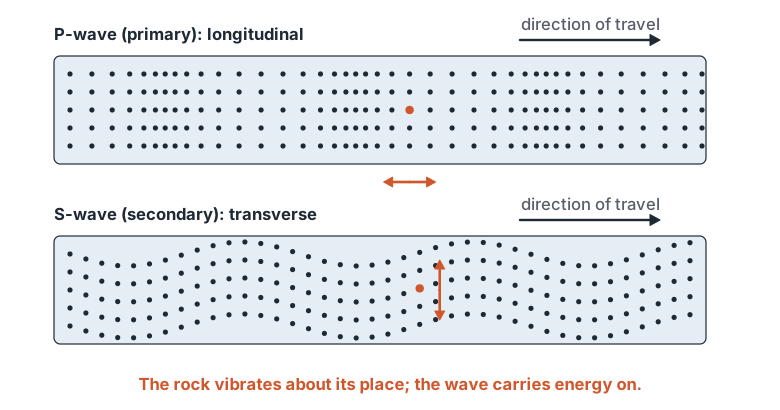
- P-wave (primary), longitudinal: the rock is pushed and pulled along the way the wave goes, so it bunches up and spreads out.
- S-wave (secondary), transverse: the rock moves at right angles to the way the wave goes (here across the strip).
Which wave reaches the town first?
The P-wave reaches the town first, about 60 s before the S-wave. The frequency and the amplitude make no difference to when a wave arrives.
About this model. Not to scale: the band of dots is a short stretch of the rock on the path, magnified. Next to 500 km, a wavelength of a few kilometres would be too short to see, and the rock really moves only a few millimetres. The model gives the rock one speed all the way; real waves also dip into deeper rock, where they travel faster. Each bit of rock shakes at the real frequency, but the wave crosses this picture in a few seconds, not in a minute or more.
Worked example
Ripples in a tank
A dipper vibrates at 10 Hz, and the ripples it makes have a wavelength of 2.0 cm. Calculate the speed of the ripples.
λ = 2.0 cm = 0.020 m, so v = fλ = 10 Hz × 0.020 m = 0.20 m/s. The ripples travel at 0.20 m/s.
Worked example
Finding a wavelength
A buoy at sea bobs up and down 15 times in one minute as waves pass it. The waves travel at 4.0 m/s. (a) Find the frequency of the waves. (b) Find their wavelength.
(a) 15 waves pass in 60 s, so f = 15 ÷ 60 s = 0.25 Hz. (b) λ = v ÷ f = 4.0 m/s ÷ 0.25 Hz = 16 m. The waves have a frequency of 0.25 Hz and a wavelength of 16 m.
Shake, then measure
Now send both kinds of wave along a spring on the bench, then measure water waves.
What is on the bench. A slinky spring stretched 80 cm between a handle on a rest and a clamp, with an orange ribbon tied to its middle coil and a small bell hanging from the far end. Beside it is a ripple tank: a tray of water 50 cm by 30 cm with sloping edges, a straight dipper along its left edge and a lamp above. A motor drives the dipper, and a controller on the bench sets its frequency. A mirror under the tank, tilted at 45°, sends the light onto an upright screen in front, so the screen shows the waves as if you were looking down on the water: each bright line is a crest. An orange cork floats on the water, and a ruler is fixed across the screen.
What you do. Predict what the ribbon will do, then send a wave along the slinky, first moving the handle up and down and then pushing and pulling it. Switch on the dipper and watch the cork. Freeze the picture on the screen, measure across ten wavelengths with the ruler and work out the wave speed. Then turn the frequency down and measure again.
What the experiment showed
Do the experiment before you read on. In both slinky waves, the wave reached the far end and the bell swung, so energy travelled along the spring. The ribbon only moved about its own place: up and down in the first wave, at right angles to the direction of travel, and to and fro along the spring in the second, parallel to it. In the ripple tank, the cork bobbed up and down where it was while the waves travelled on under it.
With the picture frozen at 10 Hz, eleven bright lines lay along the ruler from 3.0 cm to 23.0 cm. Eleven crests have ten gaps between them, so ten wavelengths measured 20.0 cm (values from the model, see “About this model” at the end):
| Frequency (Hz) | Ten wavelengths (cm) | Wavelength (cm) | Wave speed v = fλ (m/s) |
|---|---|---|---|
| 10 | 20.0 | 2.0 | 0.20 |
| 8 | 25.0 | 2.5 | 0.20 |
Measuring across ten waves is more accurate than measuring one. Each reading on the ruler can be out by a millimetre or so, which is a large part of a 2 cm wavelength but only a small part of 20 cm. At the lower frequency the wavelength was longer, but the speed was the same, because the speed of water waves depends on the water, not on the dipper.
Transverse and longitudinal waves around us
Many waves can be modelled as one of the two kinds you saw on the slinky.
- Transverse: water waves; electromagnetic radiation, such as light, radio waves and the infrared that hot objects give out; and seismic S-waves (secondary waves), which travel through the Earth after an earthquake.
- Longitudinal: sound and seismic P-waves (primary waves). When sound travels through air, the air particles vibrate to and fro along the direction in which the sound travels, so the air is bunched up in some places and spread out in others, like the coils of the slinky.
An earthquake sends both kinds of seismic wave through the Earth. P-waves travel faster, so they are the first (primary) waves to reach a seismometer (an instrument that records the shaking of the ground) far away, and S-waves arrive second (secondary).
 (enlarge)
Worked example
Two kinds of earthquake wave
After an earthquake, a seismometer 500 km away records two kinds of wave. In the first to arrive, the rock vibrates along the direction in which the wave travels. In the second, the rock vibrates at right angles to that direction. Name each wave, say whether it is transverse or longitudinal, and say which slinky wave is like it.
The first wave is the P-wave (primary). Its vibration is parallel to the direction of travel, so it is longitudinal, like the push-and-pull wave on the slinky. The second is the S-wave (secondary). Its vibration is at right angles to the direction of travel, so it is transverse, like the up-and-down wave. P-waves are longitudinal and arrive first; S-waves are transverse.
Case closed
The surfer and the gull rise and fall as each swell passes, but they stay where they are, like the cork in the tank and the ribbon on the slinky. The water under them moves up and down and comes back to where it started, while the swell carries energy across the sea to the beach. Only where a wave breaks, close to the shore, does the water tumble forwards, and that is the part of the wave a surfer rides. In the next part, waves meet walls, shallow water and gaps.
About this model
The slinky, the tank and the waves are simulated. The slinky waves have a frequency of 1 Hz and travel at 0.35 m/s, so each wave is 35 cm long. On a real slinky a wave bounces back from the fixed end; here the far end soaks it up, so you see each wave only once. The water waves travel at 0.20 m/s at every frequency. Real ripples do this only roughly: their speed also changes a little with the frequency. The waves are shown three times slower than they really move, so that you can follow them, and the cork's bobbing is drawn larger than it would be. In a real ripple tank, the lamp makes the pattern on the screen bigger than the waves themselves, so you would measure on the water or allow for the difference; here the screen shows the waves at their real size. Real water does not move only up and down as a wave passes: each bit of the surface goes round in a small loop and comes back to where it started. Water waves are modelled as transverse because the up-and-down movement is the part you see.