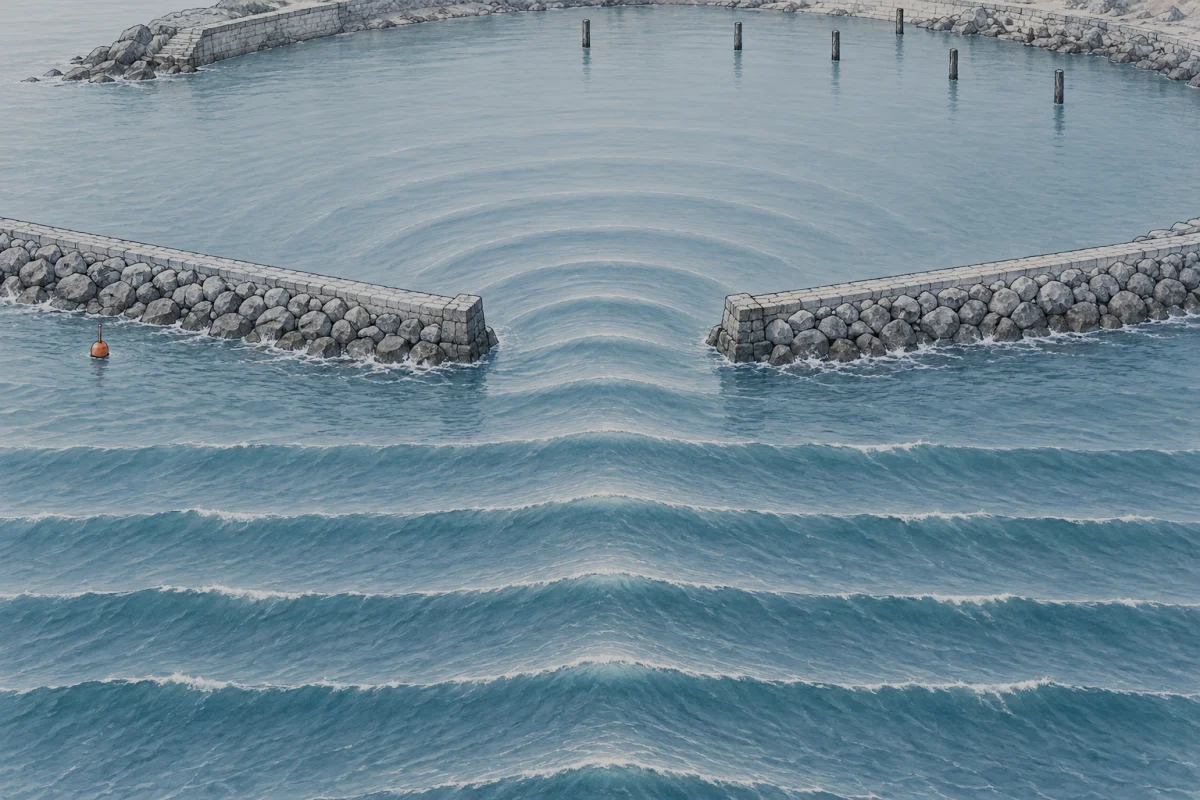
Straight waves roll in from the open sea towards a harbour. The stone walls stop most of them, but some pass through the entrance, and inside the harbour they no longer travel in straight lines: they spread out in curves, even towards the water behind the walls. Waves change direction when they meet a wall, when the water gets shallower and when they pass through a gap or round an edge. This part is about all of these, and about what stays the same when a wave changes direction.
 (enlarge)
Reflection at a plane surface
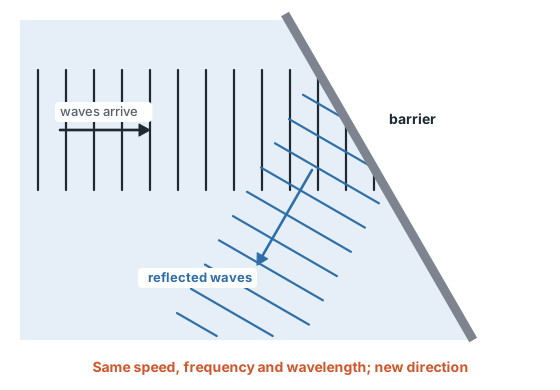
When waves meet a flat barrier, they bounce off it: they are reflected. A flat surface is called a plane surface. The reflected waves are still in the same water, so their speed, frequency and wavelength don't change; only their direction changes. Waves that arrive at an angle to the barrier leave it at the same angle, on the other side, much as a ball bounces off a wall. Waves that meet the barrier head-on go straight back the way they came.
 (enlarge)
Refraction: a change of speed
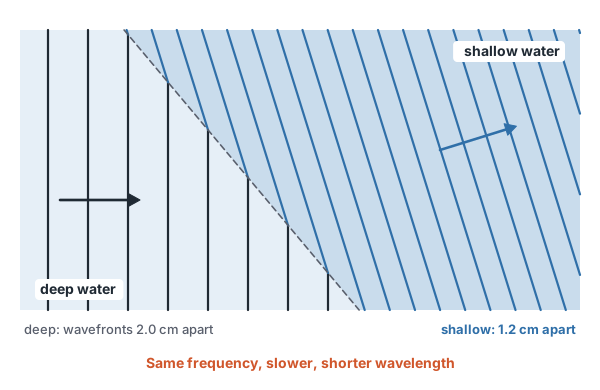
Water waves travel more slowly in shallow water than in deep water. In a ripple tank, a glass plate laid on the bottom makes the water shallower over part of the tank. When the waves cross from the deep water onto the plate:
- their frequency stays the same, because every wave that arrives at the edge of the plate carries on across it, so as many waves cross the edge each second as arrive there;
- their speed falls;
- so their wavelength gets shorter, because λ = v ÷ f: the waves bunch closer together.
If the wavefronts arrive at an angle to the edge of the plate, one end of each wavefront reaches the shallow water first and slows down first, while the other end is still moving fast in the deep water. The wavefront swings round, and the waves change direction. A change of direction caused by a change of speed is called refraction. Waves that arrive head-on, with their wavefronts parallel to the edge, slow down and bunch up but carry straight on.
 (enlarge)
Trap: “The frequency drops in shallow water.” The source sets the frequency, and it stays the same. It is the speed and the wavelength that change.
Worked example
Waves over a shallow plate
In a ripple tank, a dipper makes waves of 10 Hz that travel at 0.20 m/s in the deep water, with a wavelength of 2.0 cm. Over a glass plate, the waves slow down to 0.12 m/s. Find their frequency and their wavelength over the plate.
The frequency doesn't change: it is still 10 Hz. The wavelength is λ = v ÷ f = 0.12 m/s ÷ 10 Hz = 0.012 m = 1.2 cm. Over the plate the waves still have a frequency of 10 Hz, but their wavelength falls from 2.0 cm to 1.2 cm.
Diffraction
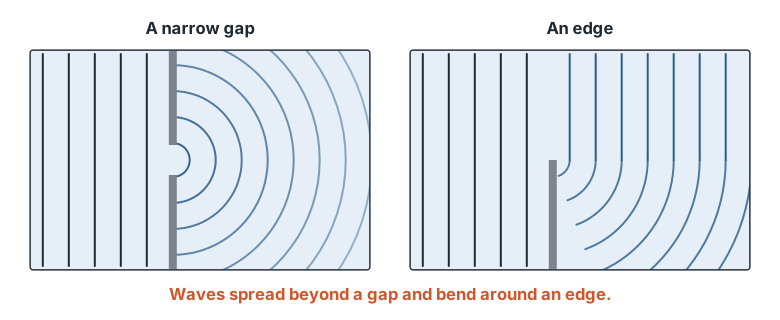
When waves pass through a gap in a barrier, or past the edge of a barrier, they spread out into the space beyond. This spreading is called diffraction. Diffracted waves have the same speed, frequency and wavelength as before; their wavefronts become curved, and they travel in new directions.
- Through a narrow gap, the waves spread out a lot, in curved wavefronts, into the water on both sides beyond the gap.
- Past an edge, the waves bend round the end of the barrier into the water behind it, which they could not reach if they travelled only in straight lines.
 (enlarge)
Worked example
Round the harbour wall
In the harbour at the start of this part, how do the waves reach the water behind the walls, out of line with the entrance?
The entrance is a gap between the two walls. The waves that pass through it are diffracted: they spread out into the harbour in curved wavefronts, including into the water behind the walls. Diffraction at the entrance spreads the waves into the harbour, so boats tied up behind the walls still rock.
Barriers, a plate and a gap
Now make each of these happen in the ripple tank.
What is on the bench. The same ripple tank, screen and dipper as in the first part, with the controller still at 8 Hz from the first part (laying in the barrier turns it back to 10 Hz), and a set of things to lay in the water: a straight metal barrier, a glass plate that makes the water shallower over part of the tank, two barriers with a narrow gap of 2 cm between them, and a single barrier with an open end. The Supplement steps also use a wide gap of 8 cm and a frequency of 5 Hz.
What you do. For each one, predict what the waves will do, then lay it in the water, start the waves and watch the screen.
What the experiment showed
Do the experiment before you read on (values from the model, see “About this model” at the end).
- Barrier: a short burst of waves met the barrier with its wavefronts at 30° to it and was reflected. The reflected wavefronts left at 30° to the barrier, travelling in a new direction, with the same wavelength, 2.0 cm.
- Plate: over the plate the wavelength fell from 2.0 cm to 1.2 cm while the frequency stayed at 10 Hz, so the waves had slowed from 0.20 m/s to 0.12 m/s. The wavefronts met the edge of the plate at 40° to it and left at about 23° to it: they had changed direction.
- Narrow gap: beyond the 2 cm gap, about one wavelength wide, the waves spread out in semicircles into the water on both sides.
- Edge: the waves bent round the open end of the barrier into the water behind it.
In every case the frequency stayed the same. Reflection, refraction and diffraction all change the direction of waves; refraction also changes their speed and wavelength.
Supplement: Gap size and wavelength
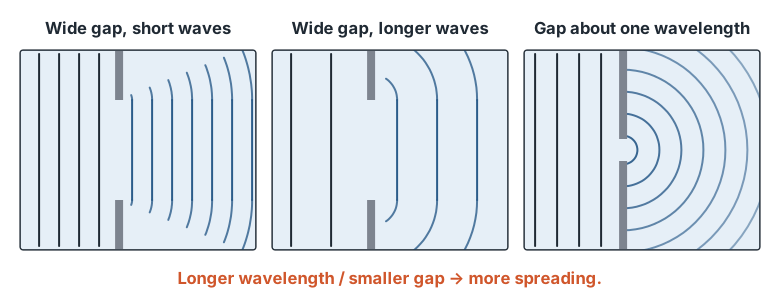
How much the waves spread out beyond a gap depends on the width of the gap compared with the wavelength.
- Through the 2 cm gap, about one wavelength wide, the 2.0 cm waves spread out in semicircles.
- Through the 8 cm gap, four wavelengths wide, the same waves went mostly straight on and curved only at the sides.
- With the dipper at 5 Hz, the wavelength was 4.0 cm. Through the same 8 cm gap, now only two wavelengths wide, the waves spread out much more than at 10 Hz.
Diffraction through a gap is greatest when the gap is about the same size as the wavelength. The narrower the gap, or the longer the wavelength, the more the waves spread out. When a gap is many wavelengths wide, the waves pass through with very little spreading.
 (enlarge)
Supplement: Bending round an edge
At an edge, too, the wavelength matters. At 10 Hz, with a wavelength of 2.0 cm, the waves bent a little way round the end of the barrier into the water behind it. At 5 Hz, with a wavelength of 4.0 cm, they bent further round, and the water further behind the barrier moved up and down. The longer the wavelength, the further waves bend round an edge.
Worked example
Sound round a doorway
Supplement. You can hear someone talking in the corridor through an open classroom door, even when you can't see them. Explain why sound reaches you round the edge of the doorway but light from the person does not.
A doorway is about 1 m wide, and the sound of speech has wavelengths of around a metre, about the same as the doorway. So sound diffracts a lot at the doorway and spreads round its edges into the room. Light has wavelengths of less than a thousandth of a millimetre, far smaller than the doorway, so it hardly diffracts at all and travels on in straight lines. Sound bends round the doorway because its wavelength is about the size of the gap; light's wavelength is far too small.
Worked example
Choosing a gap
Supplement. In a ripple tank, waves with a wavelength of 1.5 cm must spread out as much as possible beyond a gap. (a) Which gap should be used: 1.5 cm, 6 cm or 12 cm? (b) With the 6 cm gap in place, should the frequency of the dipper be raised or lowered to make the waves spread out more?
(a) The 1.5 cm gap, because it is about the same size as the wavelength. (b) Lowered. The speed stays the same, so a lower frequency gives a longer wavelength (λ = v ÷ f), and longer waves spread out more through the same gap. Waves spread most when the gap is about one wavelength wide; to spread them more through a fixed gap, make the wavelength longer.
Case closed
The harbour walls stop most of the waves and reflect them back out to sea. The waves that pass through the entrance are diffracted: they spread out in curves into the harbour, which is how ripples reach the water behind the walls. Closer to a beach, the water gets shallower, so the waves slow down, bunch closer together and refract, turning to arrive almost parallel to the shore. All through, each wave keeps the frequency it had out at sea; only its direction, and in shallow water its speed and wavelength, change.
About this model
The waves are worked out, not filmed, and are shown three times slower than real time. The barrier is met by a short burst of three waves, so that the reflected waves don't get mixed up with the waves still arriving; the reflected waves are worked out as if they came from a mirror image of the dipper behind the barrier. Over the plate, the waves travel at 0.12 m/s. In a real tank a little of each wave would also be reflected at the edge of the plate, and that is left out. Waves beyond a gap or an edge are worked out by adding up small waves spreading out from every point of the opening; the waves reflected back from the front of the barriers are left out, so you see only the waves that pass. The speeds are taken as fixed: real ripples also change speed a little with frequency.