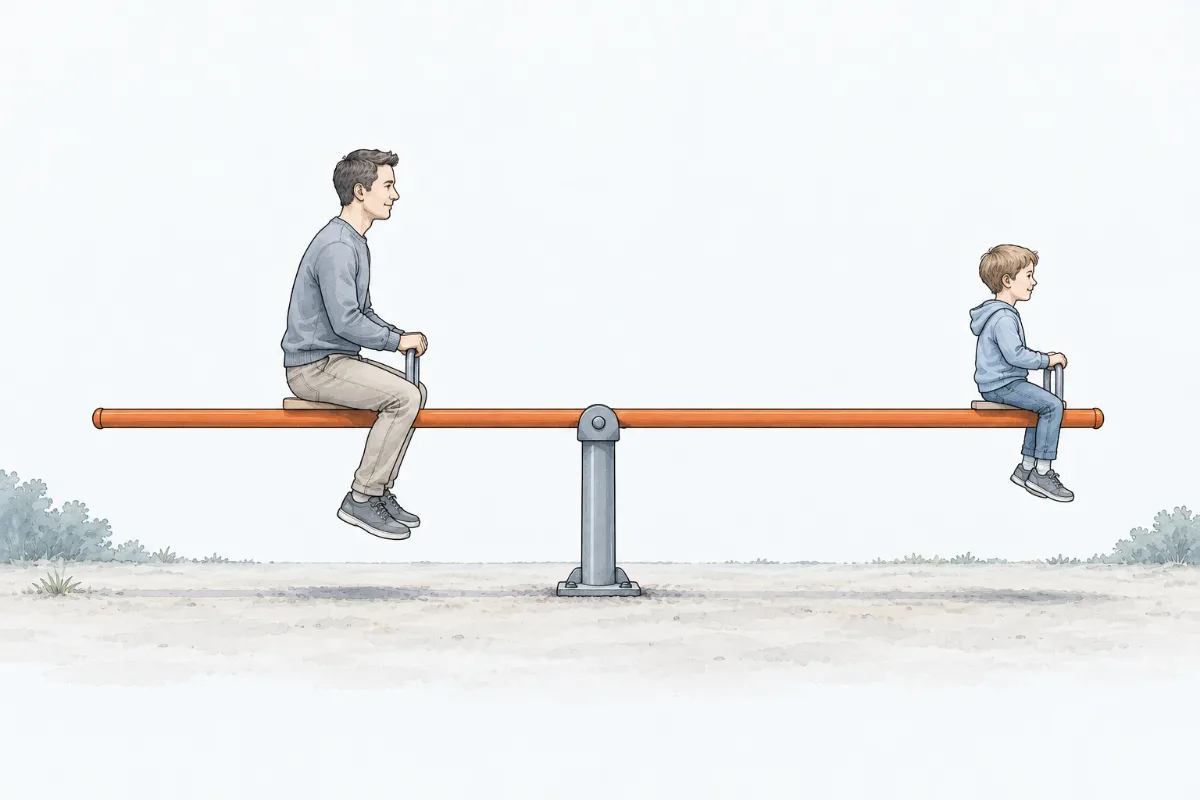
An adult and a small child climb onto a seesaw. The adult is about twice as heavy, so you'd expect their end to drop to the ground and stay there. Yet when the adult slides in towards the middle, the seesaw rests level, with both of them off the ground. A big weight is balanced by a small one. By the end of this part you can say exactly where each of them has to sit, and why.
 (enlarge)
The turning effect of a force
Push a door near its handle, and it swings open easily. Push just as hard close to the hinges, and it hardly moves. The door turns about the hinge, a fixed point called the pivot. A force can make an object turn about a pivot, and how well it turns depends on two things: how big the force is, and how far from the pivot it acts.
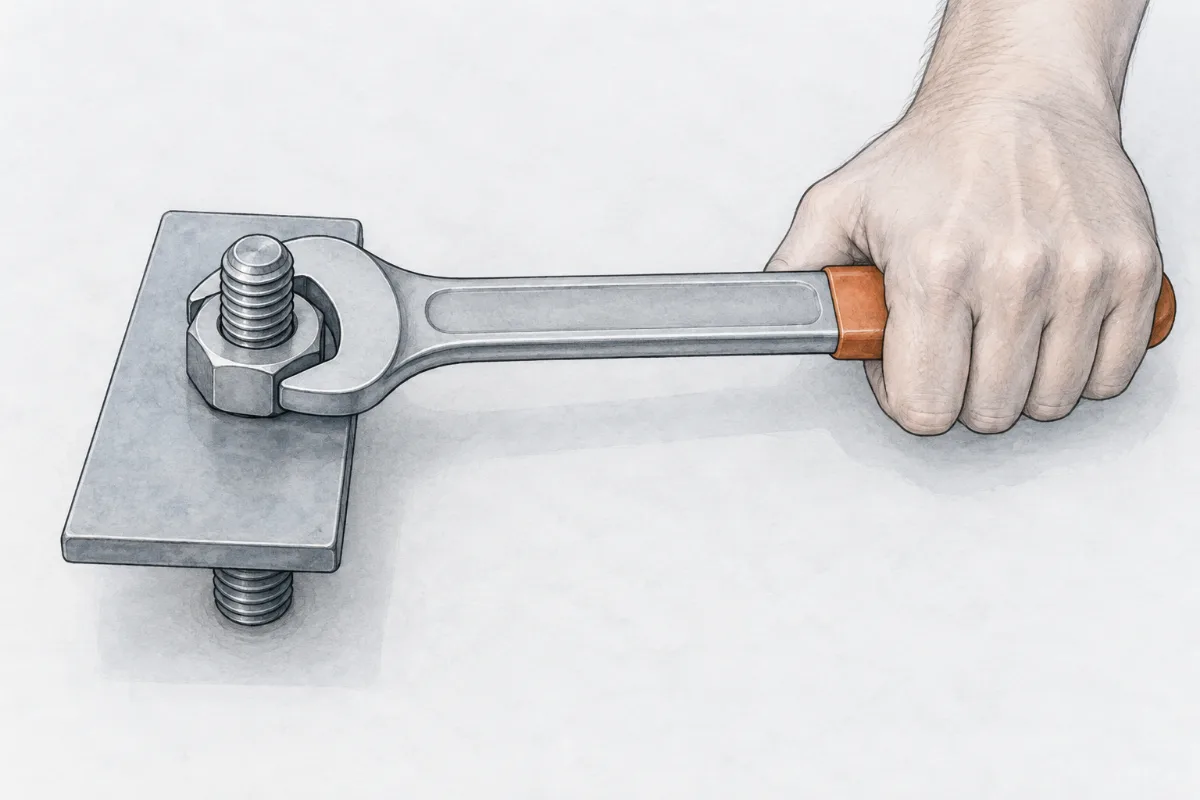
The moment of a force is a measure of its turning effect. You use moments every day. A spanner turns a nut, and a long handle turns it more easily than a short one. A bottle opener lifts a cap, and a wheelbarrow lets you lift a heavy load by its handles. Opening a door, turning a tap and pedalling a bicycle all depend on moments too.
 (enlarge)
Trap: “A bigger force always turns an object more.” A huge push on a door right at the hinge doesn't turn it at all, because the push acts through the pivot. A small push far from the pivot can turn more than a big push close to it. The turning effect depends on the force and on its distance from the pivot.
Moment = force × perpendicular distance
To work out a moment, multiply the force by its distance from the pivot:
moment = force × perpendicular distance from the pivot
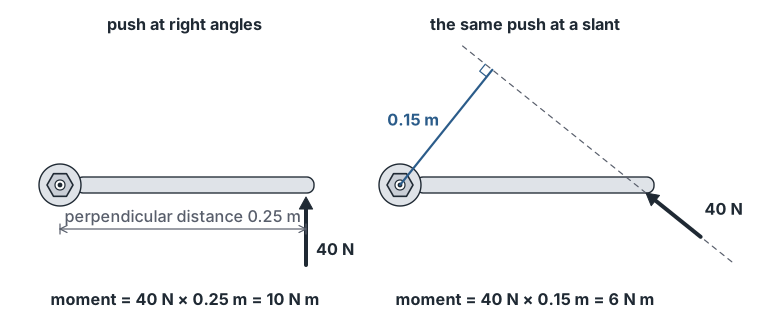
The distance must be the perpendicular distance: the shortest distance from the pivot to the line along which the force acts, its line of action, measured at right angles to that line. When you push at right angles to a spanner, this is simply the distance from the nut to your hand. When you push at a slant, it is shorter. Force is in newtons and distance in metres, so a moment is measured in newton metres, N m.
 (enlarge)
Trap: “The distance is always measured along the spanner to where the force acts.” That is only true when the force is at right angles to the spanner. For a slanted push, draw the force's line of action, and measure from the pivot to that line at right angles. In the picture the push still acts 0.25 m along the handle, but its perpendicular distance is only 0.15 m.
Worked example
Undoing a tight nut
A nut needs a moment of 10 N m to undo it. You push at right angles on the end of a spanner, 0.25 m from the nut. How hard must you push? And how hard if you hold the spanner only 0.15 m from the nut?
Rearrange the equation: force = moment ÷ perpendicular distance. At the end of the handle, force = 10 N m ÷ 0.25 m = 40 N. Holding the spanner closer, force = 10 N m ÷ 0.15 m = 67 N. The moment needed is the same, so a shorter distance needs a bigger force. That's why you hold a spanner at the end of its handle. If the distance is given in centimetres, change it to metres first: 25 cm = 0.25 m. Otherwise you get the moment in N cm, a hundred times bigger as a number.
Balancing: the principle of moments
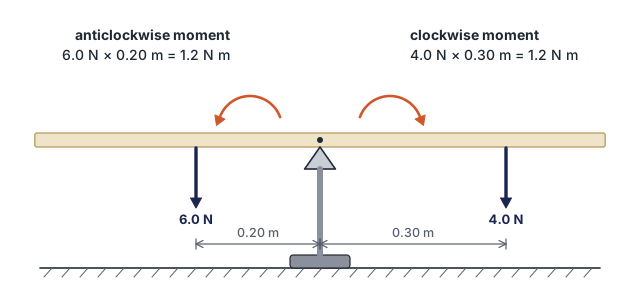
On a seesaw, the weight of the person on the left turns it one way and the weight of the person on the right turns it the other way. Looking from the front, the left weight turns the beam anticlockwise and the right weight turns it clockwise. The way a force turns an object depends on which way the force acts as well as on its side of the pivot: a push up on the left end would turn the beam clockwise. If one moment is bigger, the beam turns that way. If the two are equal, their turning effects cancel, and the beam balances.
This is the principle of moments: when an object is balanced, the clockwise moment about the pivot equals the anticlockwise moment about the pivot.
 (enlarge)
The bigger weight balances the smaller one because it is closer to the pivot. Here the 6.0 N weight is 1.5 times the 4.0 N weight, and it hangs two-thirds as far from the pivot (0.20 m against 0.30 m), so the two moments come out equal.
Trap: “The heavier side always goes down.” The side with the bigger moment goes down. A heavy weight close to the pivot can be balanced, or even beaten, by a light weight far from it.
Worked example
Where should the child sit?
The adult on the seesaw weighs 600 N and sits 1.0 m from the pivot. The child weighs 300 N. Where must the child sit for the seesaw to balance?
The adult's anticlockwise moment is 600 N × 1.0 m = 600 N m. For balance, the child's clockwise moment must also be 600 N m, so 300 N × distance = 600 N m, and the distance is 600 N m ÷ 300 N = 2.0 m. The child is half as heavy, so they sit twice as far from the pivot.
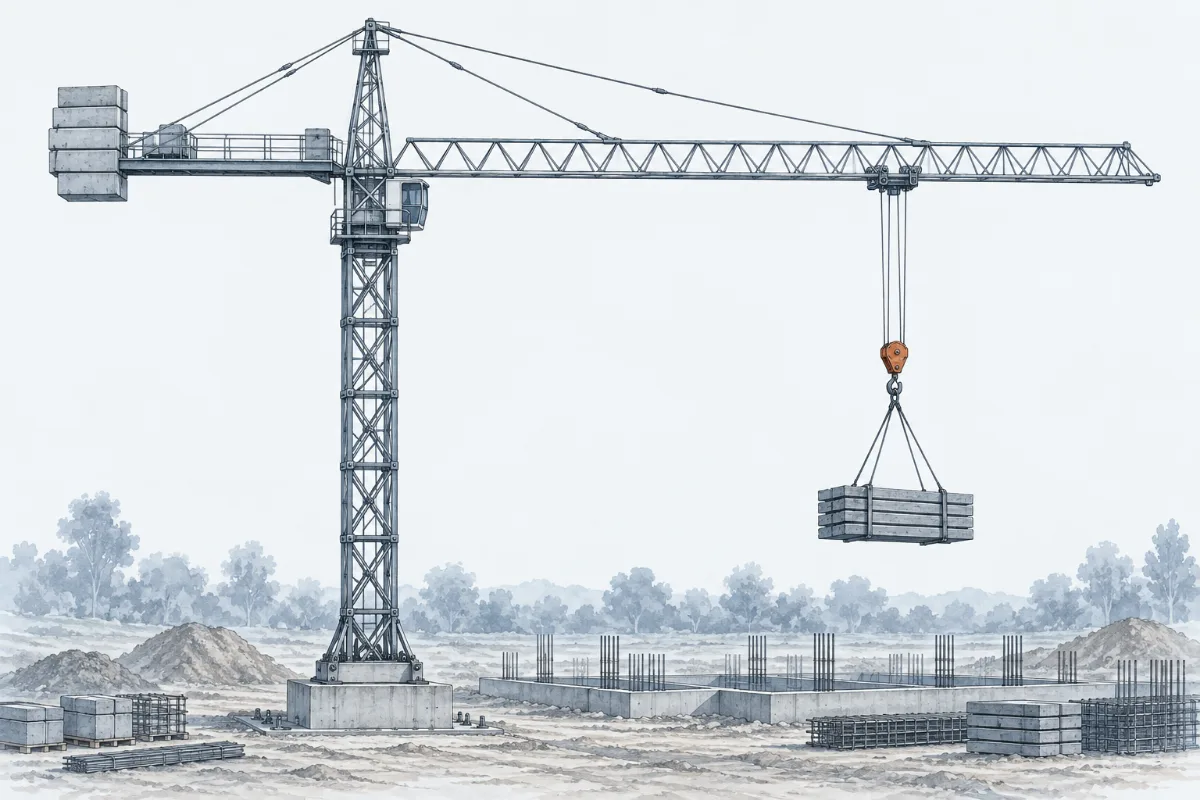
A tower crane balances in the same way. Its long arm carries the load, and a short arm on the other side carries heavy concrete blocks, the counterweight. The counterweight is close to the tower, but it is so heavy that its moment balances the moment of the load far out on the long arm, so the crane doesn't tip over.
 (enlarge)
Equilibrium: no resultant force, no resultant moment
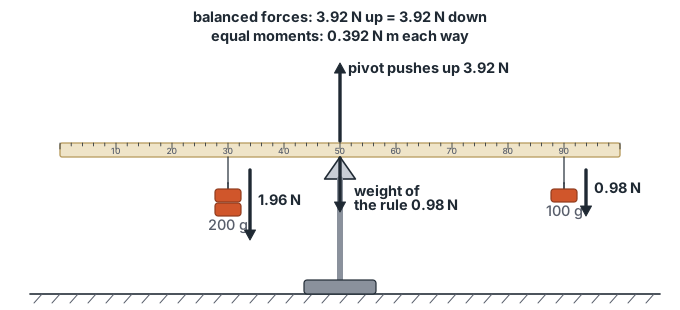
A balanced beam is not free of forces. The weights pull it down, and the beam's own weight pulls it down too. It doesn't fall, because the pivot pushes up on it. For the beam to stay still, two things must be true. The upward push of the pivot must equal the total of the downward forces, so there is no resultant force. And the clockwise and anticlockwise moments must be equal, so there is no resultant moment. An object with no resultant force and no resultant moment on it is in equilibrium.
 (enlarge)
Trap: “A balanced object has no forces on it.” The balanced rule has four forces on it: three down and one up. They balance each other. Equilibrium means the forces and their moments cancel, not that there are no forces.
Trap: “If the forces are equal and opposite, the object can't move.” Turn a steering wheel with one hand pushing up on one side and the other hand pulling down on the other side. The two forces are equal and opposite, so there is no resultant force, yet the wheel turns. Both forces turn it the same way, so there is a resultant moment, and the wheel is not in equilibrium.
Worked example
How hard does the post push?
The seesaw from “Where should the child sit?” balances: the 600 N adult sits 1.0 m to the left of the post, the pivot, and the 300 N child sits 2.0 m to the right. The plank weighs 200 N, and its weight acts at its middle, right over the post. How hard does the post push up on the plank, and is the seesaw in equilibrium?
The moments first: 600 N × 1.0 m = 600 N m anticlockwise and 300 N × 2.0 m = 600 N m clockwise. The plank's own weight acts through the post, so it has no moment. The moments are equal, so there is no resultant moment. Then the forces: three weights pull down, 600 N + 300 N + 200 N = 1100 N, so the post must push up with 1100 N for there to be no resultant force. No resultant force and no resultant moment: the seesaw is in equilibrium. Don't forget the plank: the post holds up its weight as well as the people's.
Supplement: More than one force on each side
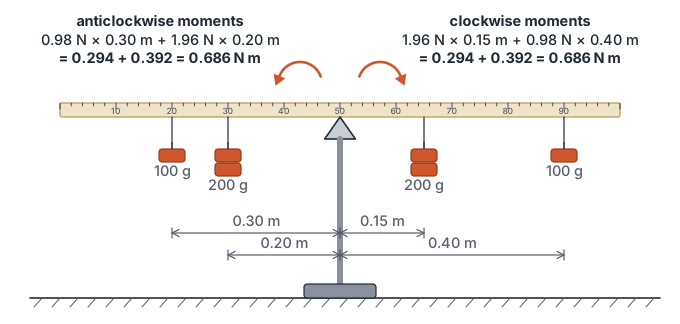
Often there are several forces on each side of the pivot: two children on one end of a seesaw, or several masses on a beam. Each force has its own moment about the pivot. The principle of moments then compares the totals: when an object is balanced, the sum of the clockwise moments about the pivot equals the sum of the anticlockwise moments about the pivot.
 (enlarge)
Worked example
Two children against one
Two children sit on the left of a seesaw: one weighs 300 N and sits 1.5 m from the pivot, the other weighs 200 N and sits 0.5 m from the pivot. Their friend weighs 500 N. Where must the friend sit on the right to balance them?
Add up the anticlockwise moments: 300 N × 1.5 m + 200 N × 0.5 m = 450 N m + 100 N m = 550 N m. The friend's clockwise moment must equal this total: 500 N × distance = 550 N m, so the distance is 550 N m ÷ 500 N = 1.1 m. Don't add the forces and the distances separately: (300 + 200) N × (1.5 + 0.5) m = 1000 N m is wrong, because each force has its own distance.
Supplement: Showing there is no resultant moment
You can test the principle of moments with a metre rule, a pivot and some masses.
 (enlarge)
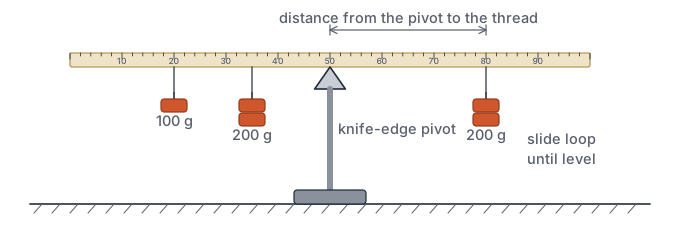
First balance the rule on its own on a knife-edge pivot. When it balances, the pivot is right under the rule's middle, the point where its whole weight acts: its centre of gravity. So the rule's own weight acts through the pivot and has no moment about it. Then hang masses on loops of thread on both sides, and slide one loop along until the rule rests level. The rule must be level, because only then is each distance along the rule at right angles to the vertical weights.
Worked example
Describe the experiment
A question asks: “Describe an experiment to show that there is no resultant moment on an object in equilibrium.” A good answer gives the steps in order, with the reasons:
- Balance a metre rule on its own on a knife-edge pivot, so that its weight acts through the pivot and has no moment.
- Hang masses on loops of thread on both sides of the pivot, for example two on one side and one on the other.
- Slide one loop along until the rule rests level, so that each distance along the rule is at right angles to the weights.
- Read the distance from the pivot to each thread on the rule's scale, and change it into metres.
- Change each mass into a weight with weight = mass × g, and work out each moment: weight × distance.
- Add up the clockwise moments and the anticlockwise moments. The two sums are equal, so there is no resultant moment.
- Repeat with other masses and other positions, to show that it is always true.
Balance a metre rule
Now try it on the bench, and find out where the child really has to sit.
What is on the bench. A stand holds a knife-edge pivot, and a metre rule rests on it. The rule is uniform, so its mass of 100 g is spread evenly along it. Beside the stand is a row of masses with hooks: two of 200 g, two of 100 g and one of 50 g. Each mass hangs from a loop of thread that can slide along the rule. An arrow at the pivot shows how hard the pivot pushes up on the rule. Weights use g = 9.8 N/kg.
What you do. First predict where the rule balances on its own, then slide it along the pivot to find out. Hang a 200 g mass on the left, predict where a 100 g mass must hang to balance it, and slide the 100 g mass along the rule until the rule rests level. Work out its moment, and then the upward force of the pivot. In the Supplement step, add one more mass on each side and balance the rule again.
What the experiment showed
Do the experiment before you read on. On its own, the rule balanced only when the pivot was under the 50.0 cm mark, its middle. Anywhere else, the longer side went down. The rule's weight acts at its middle, so with the pivot there, its weight has no moment.
With 200 g hung at the 30.0 cm mark, 0.200 m to the left of the pivot, the 100 g mass balanced it at the 90.0 cm mark, 0.400 m to the right. Half the weight needed twice the distance. The moments were equal:
| Side | Mass | Weight / N | Distance from pivot / m | Moment / N m |
|---|---|---|---|---|
| left (anticlockwise) | 200 g | 1.96 | 0.200 | 0.392 |
| right (clockwise) | 100 g | 0.98 | 0.400 | 0.392 |
The pivot pushed up with 3.92 N. That is the total of everything pulling down: 1.96 N + 0.98 N for the masses, and 0.98 N for the rule itself. So there was no resultant force and no resultant moment: the rule was in equilibrium.
In the Supplement step, a 100 g mass went on at the 20.0 cm mark, 0.300 m to the left, so the anticlockwise moments added up to 0.392 + 0.294 = 0.686 N m. A second 200 g mass on the right balanced the rule at the 65.0 cm mark, 0.150 m from the pivot: 1.96 N × 0.150 m = 0.294 N m, and 0.294 + 0.392 = 0.686 N m clockwise. The two sums were equal, and the pivot then pushed up with 6.86 N, the weight of the rule and all four masses.
Case closed
The adult and the child balanced because their moments were equal, not their weights. The child, half as heavy, had to sit twice as far from the pivot. A moment is force × perpendicular distance, and when an object is in equilibrium, the clockwise and anticlockwise moments about the pivot are equal and the pivot's push balances the total weight. Spanners, doors, seesaws and cranes all work this way.
About this model
The pivot, the rule, the masses and the threads are simulated. The rule is exactly uniform, with a mass of 100 g, and every mass is exact. The threads and their loops have no mass that matters, and the knife edge has no friction. The model uses g = 9.8 N/kg and puts each loop on a whole centimetre mark, written to 0.1 cm as you would read a real rule. When the moments are not equal, the model tips the rule only a few degrees, so you can still read it; a real rule would tip until one end hit the bench. It rests level only when the clockwise and anticlockwise moments are equal.