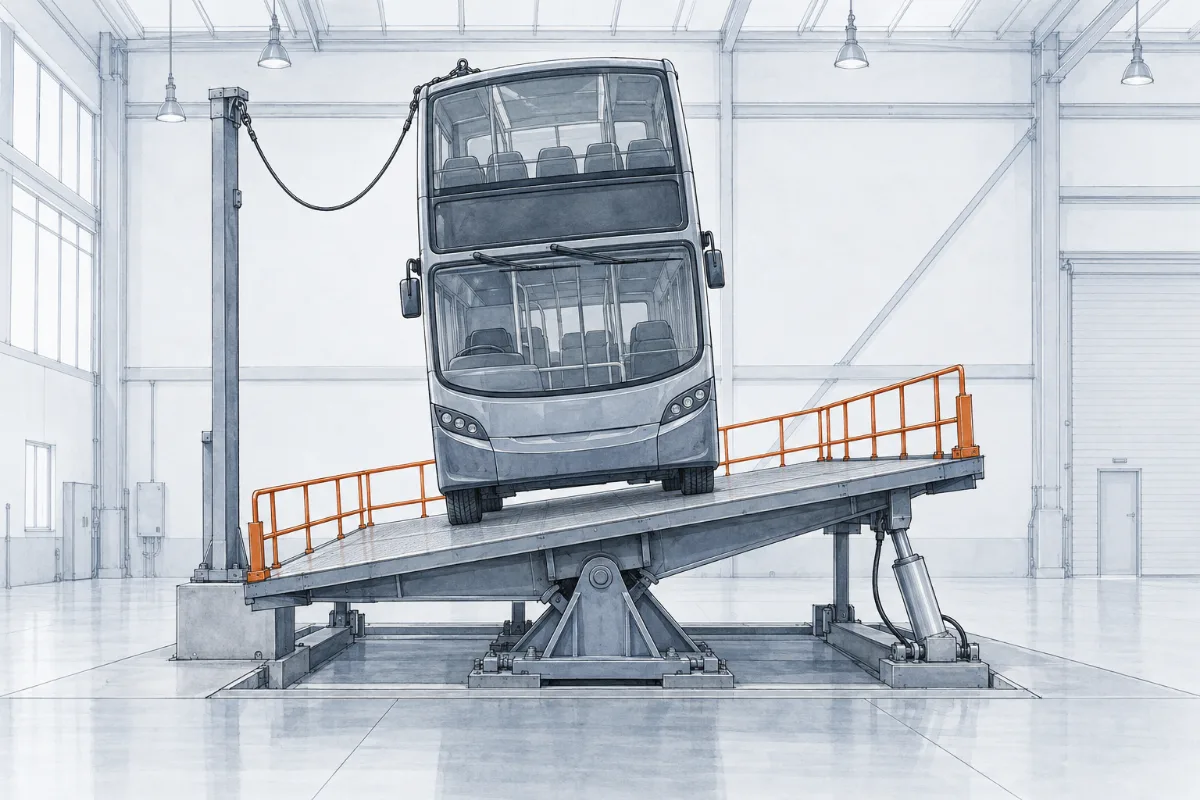
Before a new double-decker bus can carry passengers, it is driven onto a platform that tilts. Heavy weights on the top deck stand in for the people upstairs, and the testers tip the platform further and further. The bus must not fall over before the platform reaches a set angle. Why does a full top deck make a bus easier to tip, and which point in the bus decides when it goes over?
 (enlarge)
One point for the whole weight
Every part of the metre rule from Part 1 has weight: the Earth pulls on every centimetre of it. Yet the rule balanced on a single knife edge, under its 50 cm mark. It behaves as if all its weight acted at that one point. That point is the centre of gravity: the point through which the whole weight of an object seems to act.
For a uniform rule, the centre of gravity is at its middle. For other objects it can be somewhere else. A hammer's centre of gravity is close to its heavy head, which is why it balances on your finger near the head, not halfway along the handle.
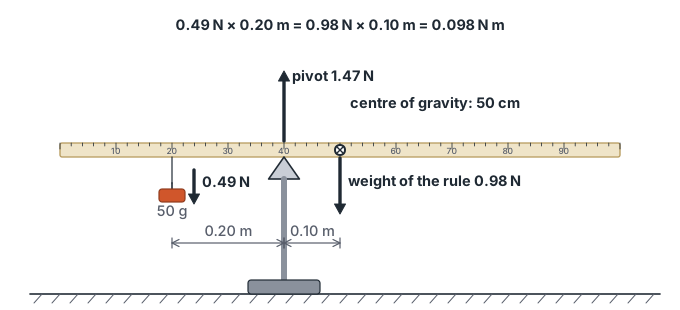
Knowing where the weight acts lets you use it in moments. Put the pivot under the 40 cm mark, and the rule's weight acts 0.10 m to the right of the pivot, at the 50 cm mark. It now has a clockwise moment, so the long side goes down. A small mass on the short side can balance it.
 (enlarge)
Trap: “The rule's own weight doesn't count, because nothing is hanging there.” The rule's weight acts at its centre of gravity. When the pivot is not under it, that weight has a moment, and you must include it.
Worked example
Weighing a rule with a mass
A uniform metre rule balances on a pivot at its 35 cm mark when a 1.2 N weight hangs at its 5 cm mark. Find the weight of the rule.
The rule's centre of gravity is at its 50 cm mark, 15 cm = 0.15 m to the right of the pivot. The 1.2 N weight is 35 − 5 = 30 cm = 0.30 m to the left. Balanced, so the moments are equal: 1.2 N × 0.30 m = W × 0.15 m. The left side is 0.36 N m, so W = 0.36 N m ÷ 0.15 m = 2.4 N. The distance for the rule's weight is from the pivot to the 50 cm mark, not to the end of the rule.
Finding the centre of gravity of a flat card
A flat sheet of card is a plane lamina. If its shape is irregular, you can't see where its centre of gravity is, but you can find it by hanging the card up.
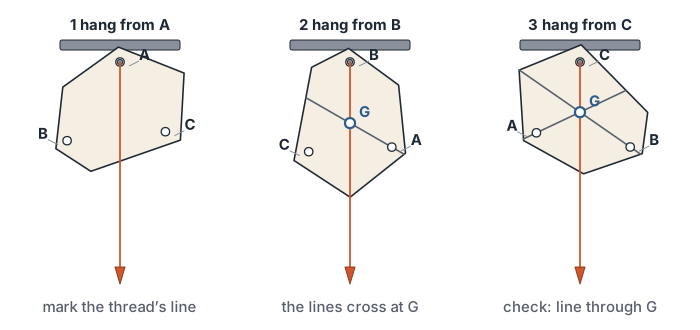
Make three small holes near the edge of the card, well apart. Push a pin through one hole and hold it in a clamp, so the card hangs and can swing freely. It swings and then stops with its centre of gravity straight below the pin. That isn't luck. If the centre of gravity were to one side, the card's weight would have a moment about the pin and would turn the card. It stops only when the weight's line of action passes through the pin, so the weight has no moment.
Hang a plumb line, a thread with a small weight on its end, from the same pin. It hangs straight down, through the centre of gravity. Mark the thread's position on the card with a pencil line. Then hang the card from the second hole and draw a second line in the same way. The centre of gravity is on both lines, so it is where they cross. Hang the card from the third hole as a check: its line passes through the same point.
 (enlarge)
To get a good result, wait until the card and the thread are completely still before you mark the line, and make sure the card swings freely on the pin and doesn't rub against the stand. Use holes far apart, so the lines cross at a wide angle. If the holes are close together, the lines are nearly parallel, and a small error in one line moves the crossing a long way.
Trap: “The first line already shows the centre of gravity: it's in the middle of the line.” One line only tells you that the centre of gravity is somewhere on it. You need a second line from a different hole to find the point.
Worked example
Describe the experiment
A question asks: “Describe an experiment to find the centre of gravity of an irregularly shaped plane lamina.” A good answer gives the steps in order and says how to make the result accurate:
- Make three small holes near the edge of the lamina, far apart.
- Hang the lamina from a pin through one hole, held in a clamp, so that it can swing freely.
- Hang a plumb line from the same pin. When the lamina and the thread are still, the centre of gravity is straight below the pin: draw a line on the lamina along the thread.
- Hang the lamina from the second hole and draw a second line in the same way.
- The centre of gravity is where the two lines cross.
- Check: hang the lamina from the third hole. Its line passes through the same point.
To make it accurate, wait until the lamina and the thread are completely still, make sure the lamina doesn't rub against the stand, and use holes far apart so that the lines cross at a wide angle.
Stability
Tip a full mug a little and let go, and it rocks back onto its base. Tip a tall, thin vase the same amount, and it falls over. An object is stable if it goes back to where it was after it is tipped a little.
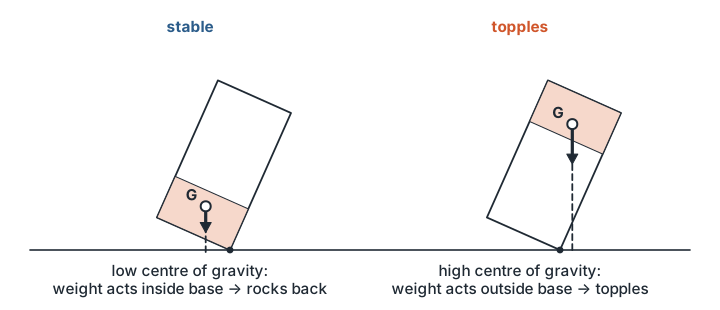
What decides it is the line of action of the weight, the vertical line down from the centre of gravity. As an object tips, it turns about the edge of its base. While the vertical line from the centre of gravity still passes inside the base, the weight has a moment that turns the object back onto its base. Once the line passes outside the base, the weight's moment turns the object further over, and it topples.
 (enlarge)
So an object is more stable when its centre of gravity is low and its base is wide. Then it can be tipped further before the line from its centre of gravity passes outside the base. Racing cars are built low and wide. A table lamp has a heavy, wide base, and a ship carries heavy ballast low in its hull.
Trap: “A heavier object is always harder to topple.” What matters is where the centre of gravity is and how wide the base is. A tall, heavy wardrobe with heavy things on its top shelf topples more easily than a low, light box.
Free play: nothing here is marked or saved
Bus on the tilt platform
A new double-decker is tipped on a platform, with sandbags on its top deck. Its weight acts at its centre of gravity, G. Tilt the platform and load the bus: where does the line of action of the weight fall, and when does the bus topple?
Try: Tilt until the bus topples. Where does the line of action fall then?
- Weight W
- 120 kN
- Height of G h
- 1.29 m
- From pivot d
- 0.54 m inside
moment = W × d = 120 kN × 0.54 m ≈ 65 kN m
Inside the lower wheels: the moment turns the bus back. Empty, it topples at 39°.
- The bus turns about its lower wheels, the pivot. The weight’s moment is W × d, where d is the perpendicular distance from the pivot to the line of action. While that line falls inside the wheels, the moment turns the bus back onto its wheels; once it falls outside, the moment turns it further over, and it topples.
- Just at the tipping angle the line of action passes through the pivot, so the weight has no moment. A degree further, the bus rolls over onto the strap, and d jumps to the outside.
- Sandbags on the top deck make the bus heavier, but they raise G, so the line of action passes outside the wheels at a smaller tilt: empty, the bus topples at 39°, full at 32°.
- Low and wide, as in the reading: with a lower G or wheels further apart, the bus could be tipped further before it topples.
About this model. The bus is rigid: its tyres and springs do not squash, and a kerb stops its lower wheels sliding. Its wheels are 2.08 m apart; empty, it weighs 120 kN with G 1.29 m above the platform. Each sandbag is 5 kN and acts 2.85 m up; 40 kN is roughly the weight of a full top deck of passengers. Real tests have their own loads and angles, and none is quoted here. Once the bus topples it turns 6° further onto the strap; a real bus would stay there until the platform came down a few degrees. d is drawn at G’s height, from the dotted vertical through the lower wheels to the line of action, and the orange arrow is longer for a bigger moment.
Worked example
A full bottle and a nearly empty one
Two identical plastic bottles stand on a table: one is full of water, the other only a quarter full. Which one can you tip further before it topples, and why?
The bottles have the same base, so what decides it is the height of the centre of gravity. In the full bottle the water fills it to the top, so its centre of gravity is about halfway up. In the quarter-full bottle all the water is at the bottom and the plastic weighs very little, so its centre of gravity is much lower. As a bottle tips, it turns about the edge of its base. The vertical line from a low centre of gravity stays inside the base until the bottle is tipped much further. So the quarter-full bottle can be tipped further: it is more stable, although it is lighter. A good answer names both things: where the centre of gravity is, and whether the vertical line from it passes inside the base.
Weigh the rule and find the card's centre
Now use the centre of gravity in two experiments: weigh the metre rule using only a 50 g mass, then find the centre of gravity of an irregular card.
What is on the bench. The same stand, knife-edge pivot and uniform metre rule as in Part 1, with the 50 g mass on its loop of thread. A clamp stand at the right holds a pin and a plumb line. An irregular piece of card with three holes, A, B and C, lies on the bench beside it, and a pencil is ready to mark lines on it.
What you do. First predict what the rule does when the pivot is under its 40 cm mark, and move the rule to see. Hang the 50 g mass on the short side and slide it until the rule rests level, then work out the weight of the rule from the moments. Then hang the card on the pin from hole A, wait until it is still, and mark the plumb line. Decide where the centre of gravity can be, hang the card from hole B and mark again, then predict where the line from hole C will go, and check.
What the experiment showed
Do the experiment before you read on. With the pivot under the 40 cm mark, the rule tipped clockwise, and its long side went down. Its weight acts at its centre of gravity, the 50 cm mark, 0.100 m to the right of the pivot, and nothing on the left balanced that moment.
The 50 g mass balanced the rule at the 20.0 cm mark, 0.200 m to the left of the pivot. Its anticlockwise moment was 0.49 N × 0.200 m = 0.098 N m. The rule's weight W had the clockwise moment W × 0.100 m, so W = 0.098 N m ÷ 0.100 m = 0.98 N, which is the weight of a 100 g rule. The pivot then pushed up with 0.98 N + 0.49 N = 1.47 N.
The card hung from hole A swung and settled with its centre of gravity under the pin, and the first pencil line followed the plumb line. Hung from hole B, the card turned, and the first line turned with it, but the new plumb line still hung straight down. The two lines crossed at one point, the centre of gravity. The line from hole C passed through the same point. In a real lab you can check it another way: the card balances on a pencil point placed there.
Case closed
The weights on the top deck of the bus raise its centre of gravity. When the platform tilts, the bus turns about the wheels on the lower side, and the higher the centre of gravity, the sooner the vertical line from it passes outside those wheels. Then the weight's moment turns the bus over instead of back. So the bus must keep its centre of gravity low enough to pass the test with a full top deck. The centre of gravity is the point where the whole weight acts, and its position decides how a rule balances, how a card hangs and when an object topples.
About this model
The pivot, the rule, the masses, the pin, the plumb line and the card are simulated. The rule is exactly uniform with a mass of 100 g, the 50 g mass is exact, the threads have no mass that matters and nothing has friction. The model uses g = 9.8 N/kg and puts the loop on whole centimetre marks. The card is a flat, uniform sheet, so its centre of gravity depends only on its shape; the model works it out from the shape and lets the card swing a little before it settles. In a real lab the card swings for longer, and you wait until it is still.