A hiker lays a map and a compass on a picnic table by a lake and waits for the needle to settle on north. It settles, but it points at the rucksack beside the map, where a metal clasp holds the flap shut. Nothing touches the needle, yet something reaches out from the clasp and turns it. What is that something, and what shape does it have? Predict what the needle would do if the hiker slid the compass slowly all the way round the clasp. In this part you will find out how a magnet pushes and pulls, and you will map the invisible region round it with a compass and with iron filings (tiny pieces of iron).
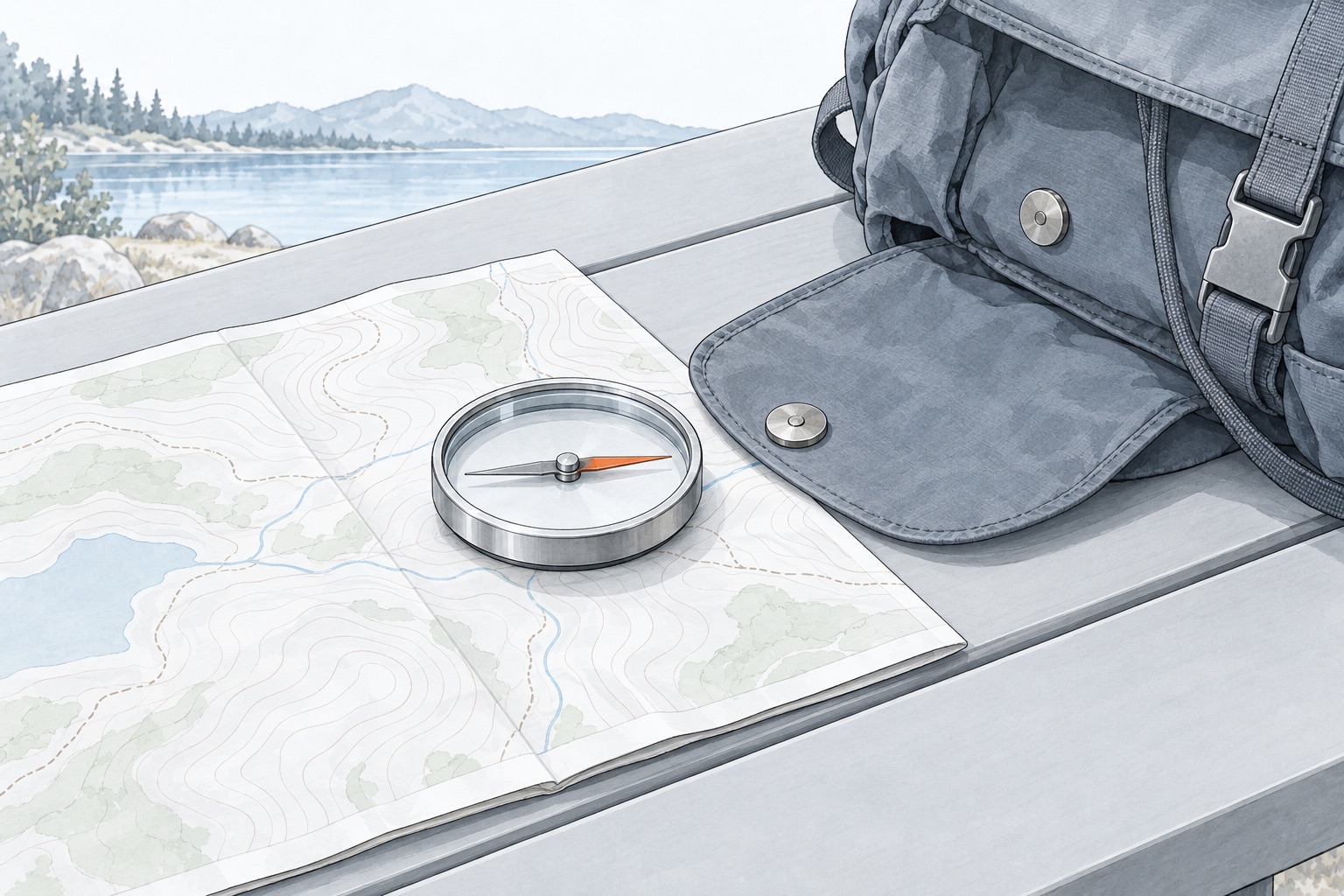 (enlarge)
Two kinds of pole
Dip a bar magnet into a box of pins and lift it out. Most pins cling to its two ends and hardly any to the middle, because a magnet's pull is strongest at its ends. These ends are its poles. Hang the magnet from a thread so that it can turn freely, and it comes to rest pointing roughly north–south. The end that points north is the north-seeking pole, or N pole; the other end is the south-seeking pole, or S pole.
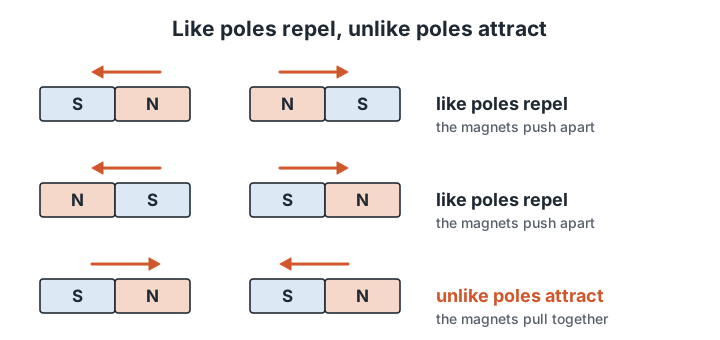
Now bring two magnets together, end to end. Two N poles push each other away, and so do two S poles: this push is called repulsion. An N pole and an S pole pull towards each other: this pull is attraction. The rule is short, so learn it exactly: like poles repel, unlike poles attract. The forces act across a gap without the magnets touching, and they grow stronger as the poles come closer.
 (enlarge)
Trap: “The N pole of one magnet attracts the N pole of another, because they are the same kind.” Same kind means repulsion. Two N poles always push apart; only an N pole and an S pole pull together.
Worked example
Which end is N?
A bar magnet has lost its painted labels. Its ends are marked X and Y. When end X is brought near the N pole of a labelled magnet, the two push apart. Which end is X?
Like poles repel, so X must be the same kind as the pole that pushed it away: X is an N pole, and Y, the other end, is an S pole. Check it the other way: Y should be pulled towards that same N pole, because unlike poles attract. Notice that the push gave the answer. In part 2 you will see why a pull on its own is not enough to tell you that something is a magnet at all.
The field round a magnet
Back at the picnic table, the clasp turned the compass needle from a few centimetres away. The space round a magnet where this happens is its magnetic field. The exact definition is: a magnetic field is a region in which a magnetic pole experiences a force. You cannot see a field, but you can test any point in it by putting a small magnet there and watching how it is pushed.
A plotting compass is just such a test magnet: its needle is itself a tiny magnet, on a pivot inside a small clear case. The needle's north-seeking end is an N pole, so wherever you place the compass, that end is pushed one way and the other end the opposite way, and the needle swings round until it lines up. The direction of a magnetic field at a point is the direction of the force on the N pole of a magnet at that point, so the north-seeking end of the needle points along the field.
That is why a compass just beyond the N pole of a bar magnet points away from it: its N end is repelled by the magnet's N pole and attracted towards the S pole at the far end. Near the S pole the needle's N end points towards the magnet.
Plotting the field with a compass
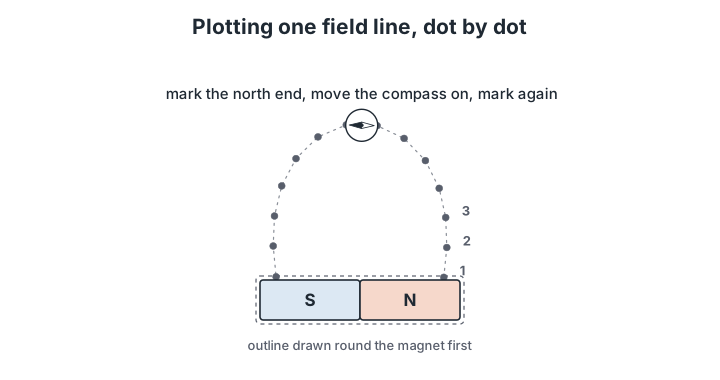
One compass shows the field at one point. To map the whole field, you join up many points:
- Lay a bar magnet in the middle of a sheet of paper, draw round it and mark its N and S ends.
- Put a plotting compass near the N pole and mark a small dot on the paper at the north-seeking end of its needle.
- Move the compass along so that the south end of its needle is exactly over that dot. Mark a new dot at the north end.
- Keep going, dot by dot, until you reach the S pole or the edge of the paper.
- Join the dots with a smooth curve. Put an arrow on it, pointing the way the north-seeking end pointed.
- Start again from other points near the N pole to draw more lines.
 (enlarge)
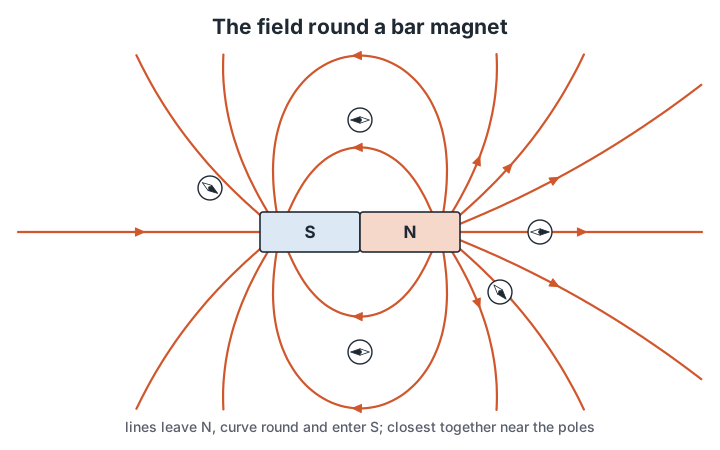
Each curve is a magnetic field line: at every point along it, a compass would point along the line. Drawn together, the lines show the pattern and direction of the field round a bar magnet. Learn the pattern as a drawing you can reproduce:
- the lines come out of the N pole, curve round and go into the S pole, so outside the magnet the field points from N to S;
- the lines never cross, because at any point the field has only one direction, and a compass there can point only one way;
- the lines spread out from each pole like the ribs of a fan, and they crowd together close to the poles.
 (enlarge)
Worked example
Which way at P?
Point P lies above the middle of a bar magnet, a few centimetres from it. A compass is placed at P. Which way does its north-seeking end point?
The field line through P comes out of the N pole, arches over the middle of the magnet and goes down into the S pole. At the top of the arch the line runs parallel to the magnet, so the needle lies parallel to the magnet too. Outside the magnet the field points from N to S, so the north-seeking end points along the magnet towards the S end. A common slip is to point the needle at the nearer pole: at P neither pole is nearer, and the needle follows the line, not the nearest end.
Trap: “The field goes from S to N, because the compass's S end points that way.” The field direction is the direction of the force on an N pole, so it is always the way the north-seeking end points. Outside a magnet that is from N to S.
Iron filings show the whole pattern
Plotting with a compass is slow: each line takes many dots. A faster way is to lay a sheet of paper over the magnet, sprinkle iron filings (tiny pieces of iron, like coarse dust) thinly over it and tap the paper gently. Each filing becomes a tiny magnet in the field (part 2 explains how), and the tapping lets it swing until it lies along the field. In a second the whole pattern appears: curves from pole to pole, thickest near the poles where the filings crowd together.
The filings show the shape of the field, but not its direction. A filing has no marked north end, so a filing lying along a line looks the same whichever way the field points. To put arrows on a filings pattern you still need a compass. Filings also show little far from the magnet, where the field is too weak to turn them against friction with the paper.
Trap: “The filings show that the field goes from N to S.” Filings show only the pattern of the lines. The direction comes from a compass, whose north-seeking end points along the field.
Worked example
Compass or filings?
A pupil needs to show, on one sheet, both the shape of the field round a magnet and the direction of the field at three points. Which method should the pupil use for each, and why?
Iron filings give the shape of the whole field at once, because every filing lines up along the field. They cannot give the direction, because a filing’s north end is not marked: each filing becomes a tiny magnet with N and S poles, but you cannot tell which end is which. A plotting compass placed at each of the three points gives the direction there, because its north-seeking end points along the field. So: filings for the shape, then a compass at each point for the direction, with an arrow drawn the way its north-seeking end points.
Supplement: Two magnets, two fields
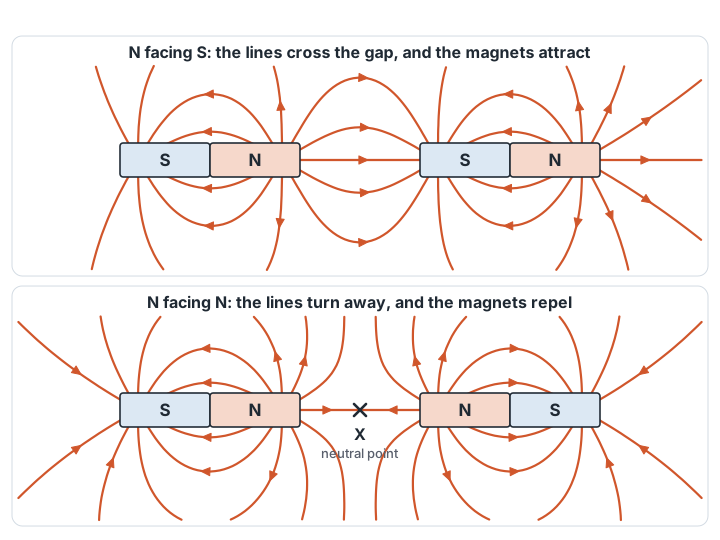
Put two bar magnets end to end with a gap between them, under one sheet, and sprinkle filings again. The two fields combine into one pattern, and the pattern explains the force.
With an N pole facing an S pole, lines run straight across the gap from the N pole into the S pole, as if the field pulled the two poles together, and the magnets attract.
With an N pole facing an N pole, the lines from each pole bend away from the gap, and midway between equal poles there is a spot where the two fields are equal and opposite and cancel out. These magnets repel.
The spot where the fields cancel is a neutral point: a compass there has no field to line it up, so (leaving out the Earth's weak field) it points no particular way.
 (enlarge)
Each magnet sits in the field of the other, and the force on it comes from that field. That is the meaning of the statement that magnetic forces are due to interactions between magnetic fields: the force does not travel along a string between the magnets; each pole is pushed by the field it is in.
Worked example
Where is the neutral point?
Two identical bar magnets lie on a line with their N poles facing, 8.0 cm apart. Where is the neutral point? Then one magnet is replaced by a stronger one. Which way does the neutral point move?
With identical magnets the pattern is the same on each side, so the fields cancel midway, 4.0 cm from each pole. A stronger magnet's field is still large further from it, so the point where the two fields are equal moves nearer the weaker magnet's pole.
Supplement: Close lines, strong field
The field lines also show how strong the field is. Where the lines are close together the field is strong; where they are far apart it is weaker. Look back at the bar magnet's pattern: the lines are crowded at the poles, where a compass swings round most firmly, and they spread out far from the magnet, where its pull fades. So the relative strength of a magnetic field is represented by the spacing of the field lines. This is a comparison within one drawing: the number of lines you choose to draw is up to you, but you draw them closer where the field is stronger.
Worked example
Which point has the stronger field?
On a drawing of a bar magnet's field, point A lies where the lines are about 2 mm apart, and point B lies where they are about 10 mm apart. At which point is the magnetic field stronger?
Closer lines mean a stronger field, so A has the stronger field. A is probably near a pole and B further away, but the spacing alone answers the question.
Trap: “The field exists only along the lines you drew.” Field lines are a picture of the field. The field fills the whole region round the magnet, including the gaps between the lines, and you could draw a line through any point.
Try it in the experiment
In the experiment a bar magnet lies on a sheet of paper, drawn round in pencil. Predict which way a compass needle points just past its N end, then plot one field line yourself, dot by dot, and decide which way its arrow goes. Lay a clean sheet over the magnet and sprinkle iron filings on it to see the whole pattern, then bring in a second magnet, like poles first and then unlike poles, and hunt for the point where the compass is not lined up at all.
Case closed
The invisible pattern round a magnet is its magnetic field: the region where a magnetic pole feels a force. Like poles repel and unlike poles attract. A compass maps the field point by point, because its north-seeking end points along the field; joining the points gives field lines from N to S, which never cross. Iron filings show the same pattern at once, but without direction. (Supplement: the lines are closest where the field is strongest, and two magnets push or pull because each is in the other's field.)
About this model
The experiment's field is calculated as if each pole were a single point a little inside each end of the magnet. A real compass also feels the Earth's field, which is weak beside a bar magnet but makes the needle at a neutral point turn north; the experiment leaves the Earth's field out, so the needle there has no preferred direction and stays pointing whichever way it is left. The filings are drawn as a few thousand short marks, many fewer than a real sprinkle.
Returning to these ideas
Try the return questions at the next lesson without rereading first, then mix them with earlier questions after one or two weeks and again several weeks later. These are suggested review intervals, adjustable by your teacher. An immediate correct retry is useful practice; it does not show that you remembered the idea days later. The final check uses new cases, and its self-check criteria are teaching points, not official Cambridge marks.