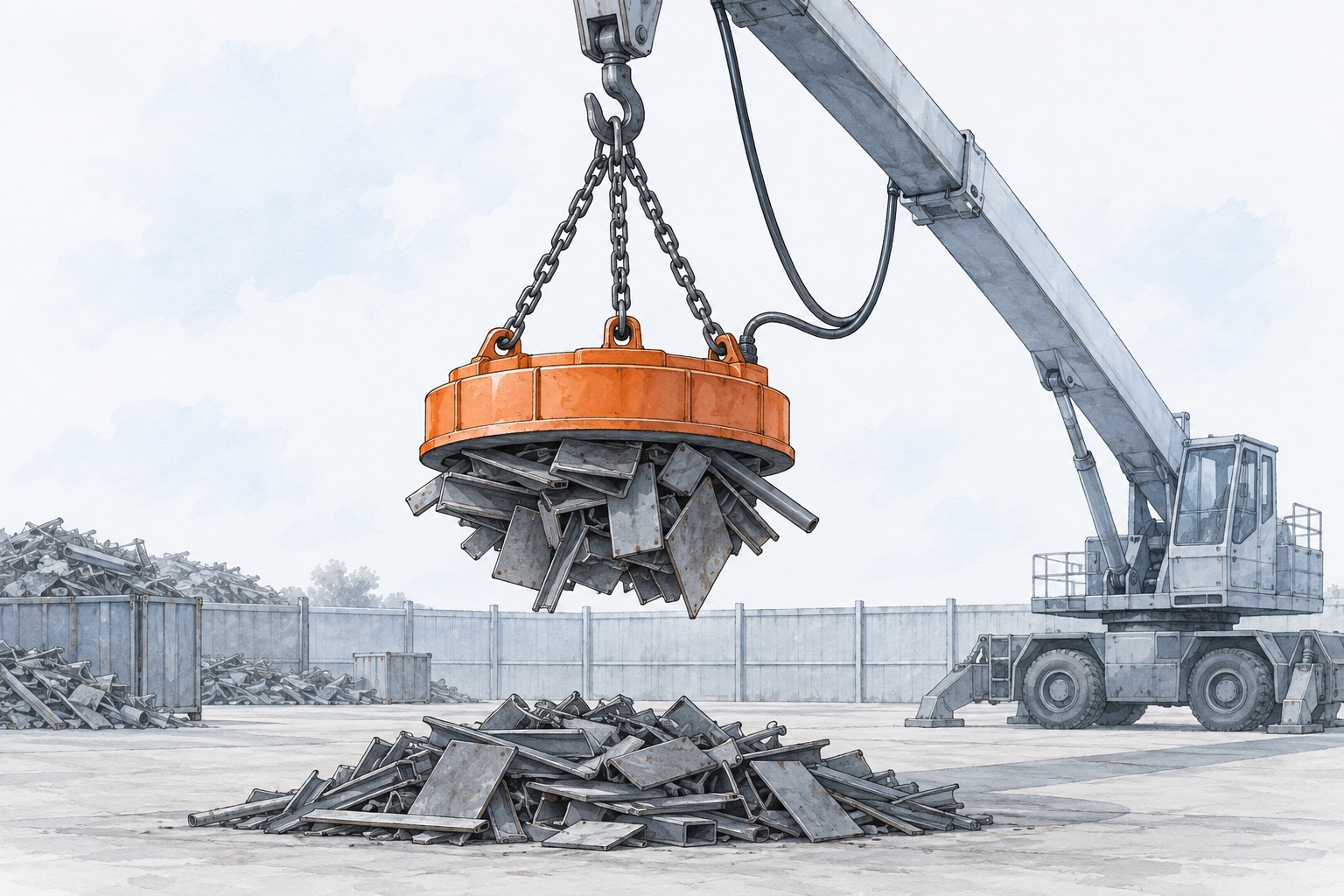
At a scrapyard a crane swings a heavy round disc over a heap of metal. The disc drops onto the heap and rises again with a tangle of steel bars hanging under it, although no hook or claw holds them. Over a skip the driver flicks a switch and the bars fall. Aluminium window frames in the same heap stay where they were. Why does the disc pick up the steel and not the aluminium, and how can a magnet let go at the flick of a switch? Predict which would stick to an ordinary magnet: a steel food can or an aluminium drinks can. In this part you will sort materials with a magnet, see how a piece of iron becomes a magnet itself, and find out why some magnets are made of steel and others of iron.
 (enlarge)
Magnetic and non-magnetic materials
Touch a magnet to a row of objects and you sort them into two groups. An iron nail, a steel spoon, a strip of nickel and a disc of cobalt all jump to the magnet. A copper pipe, an aluminium can, a brass key, a plastic button and a wooden peg do not move at all. The first group are magnetic materials: they are attracted by a magnet, and they can be made into magnets themselves. The second group are non-magnetic materials: a magnet does not attract them, and they cannot be magnetised. Iron, steel (which is mostly iron), nickel and cobalt are the magnetic materials you need to know; most other substances, including most metals, are non-magnetic.
That is the answer at the scrapyard: steel is magnetic and aluminium is not. It is also how recycling plants separate steel food cans from aluminium drinks cans, and how a magnet pulls iron filings out of sand.
 (enlarge)
A magnet attracts a piece of unmagnetised iron or steel with either pole. Bring the N pole near an iron nail and the nail is pulled; turn the magnet round and bring the S pole near, and the nail is pulled just the same. There is never a push between a magnet and an unmagnetised piece of a magnetic material.
Trap: “All metals stick to magnets.” Only a few metals are magnetic: iron, steel, nickel and cobalt. Copper, aluminium, brass, gold and silver are metals, but a magnet does not attract them.
Worked example
Sorting the scrap
A box of scrap holds a steel bolt, a copper wire, an aluminium foil tray, an iron hinge and a brass tap. Which items would the crane's magnet lift?
The magnet lifts magnetic materials only. Steel and iron are magnetic, so it lifts the steel bolt and the iron hinge. Copper, aluminium and brass are metals, but they are non-magnetic, so the wire, the tray and the tap stay behind.
Magnetised or unmagnetised?
A piece of steel looks the same whether or not it is a magnet. A magnetised piece has its own N and S poles; an unmagnetised piece has none, although it is still attracted to a magnet. How can you tell which one you have?
Attraction does not tell you, because a magnet attracts an unmagnetised piece of iron or steel too. Repulsion does: only two magnets can push each other apart, when like poles meet. So test both ends of the unknown bar against one pole of a known magnet. If one end is repelled, the bar is a magnet. If both ends are attracted, the bar is unmagnetised iron or steel. If neither end moves, it is not a magnetic material at all.
Worked example
Three grey bars
Three grey bars, P, Q and R, look alike. Each end of each bar is brought near the N pole of a labelled magnet. Both ends of P are attracted. One end of Q is attracted and the other end is repelled. Neither end of R moves. Which bar is a magnet?
Only a magnet can be repelled, so Q is the magnet: its repelled end is an N pole. P is attracted at both ends, so it is a magnetic material but unmagnetised. R is not attracted at all, so it is non-magnetic.
Induced magnetism
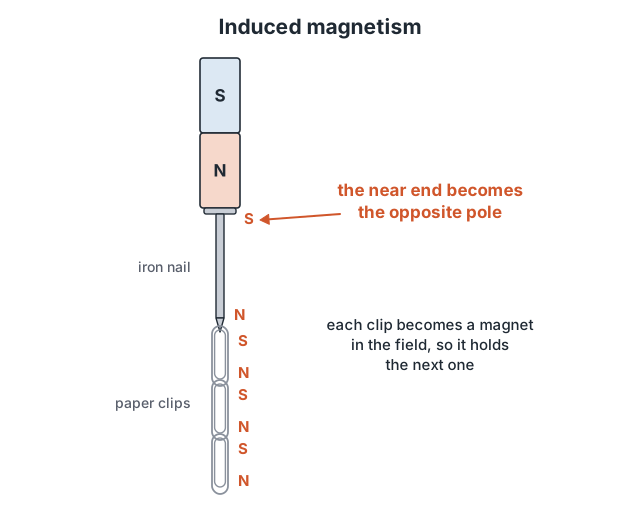
Why is an unmagnetised nail pulled by either pole? Hold the N pole of a magnet just above the head of an iron nail. The nail becomes a magnet while it is there: its head, the end nearest the magnet, becomes an S pole, and its point becomes an N pole. The magnet's N pole and the nail's S pole are unlike poles, so they attract. Turn the magnet round and the nail's poles turn round too, so the near end is again the opposite pole and is again attracted. A magnet that is made in a magnetic material by another magnet's field, without touching or stroking, is called induced magnetism. The near end always becomes the opposite pole.
Induced magnetism passes along a chain. A paper clip hanging from the magnet becomes a magnet, so it can hold a second clip below it, which becomes a magnet and holds a third, and so on. The chain is held together by induced poles. Iron filings line up in a magnet's field for the same reason: each filing becomes a tiny induced magnet and turns along the field.
 (enlarge)
Worked example
Which end is which?
A chain of two iron clips hangs from the S pole of a magnet. Which pole is the top end of the first clip, and which is the bottom end of the second clip?
The top of the first clip is nearest the magnet's S pole, so it becomes the opposite pole: N. Its bottom end is then S, so the top of the second clip, which touches it, becomes N, and the bottom of the second clip is S. Each clip has its N end at the top, pointing up the chain.
Trap: “The magnet's N pole attracts the nail because the nail's N pole is nearest.” The near end of the nail becomes the opposite pole, an S pole. That is why it is attracted.
Soft iron and steel: temporary and permanent
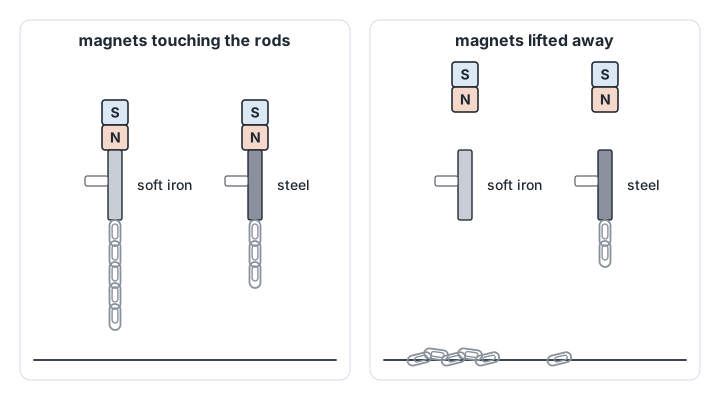
Not every magnetic material behaves the same once the magnet is taken away. Hang a soft-iron rod and a steel rod of the same size from two identical magnets, and dip each rod into a dish of light paper clips. The soft iron picks up more clips: it is easily magnetised. Now lift the magnets away, holding the rods still. The clips drop off the soft iron, which keeps almost none of its magnetism, but most of the clips stay on the steel, which is now a magnet in its own right.
 (enlarge)
Soft iron makes a temporary magnet: it magnetises easily and loses most of its magnetism as soon as the magnet is removed. Steel makes a permanent magnet: it is harder to magnetise, but once magnetised it keeps its magnetism. That is why bar magnets and compass needles are made of steel, and why the core inside a magnet that must switch off is made of soft iron.
| Property | Soft iron (temporary magnet) | Steel (permanent magnet) |
|---|---|---|
| How easily it is magnetised | easily | less easily |
| When the magnet is removed | loses most of its magnetism | keeps its magnetism |
Worked example
Two rods
In an experiment like the one above, rod 1 holds 7 clips while it touches the magnet and none after the magnet is lifted away. Rod 2 holds 5 clips while touching and 4 afterwards. Which rod is soft iron?
Rod 1 picked up more clips, so it magnetised more easily, and it lost its magnetism when the magnet was removed. That is how soft iron behaves, so rod 1 is soft iron. Rod 2 kept most of its clips, so it is steel, now a permanent magnet. The test is fair only if both rods are the same size and touch identical magnets.
Trap: “Soft iron makes a weak magnet.” While the magnet is near, soft iron is magnetised strongly; here it held more clips than the steel. It is temporary, not weak: it does not keep its magnetism.
Permanent magnets and electromagnets at work
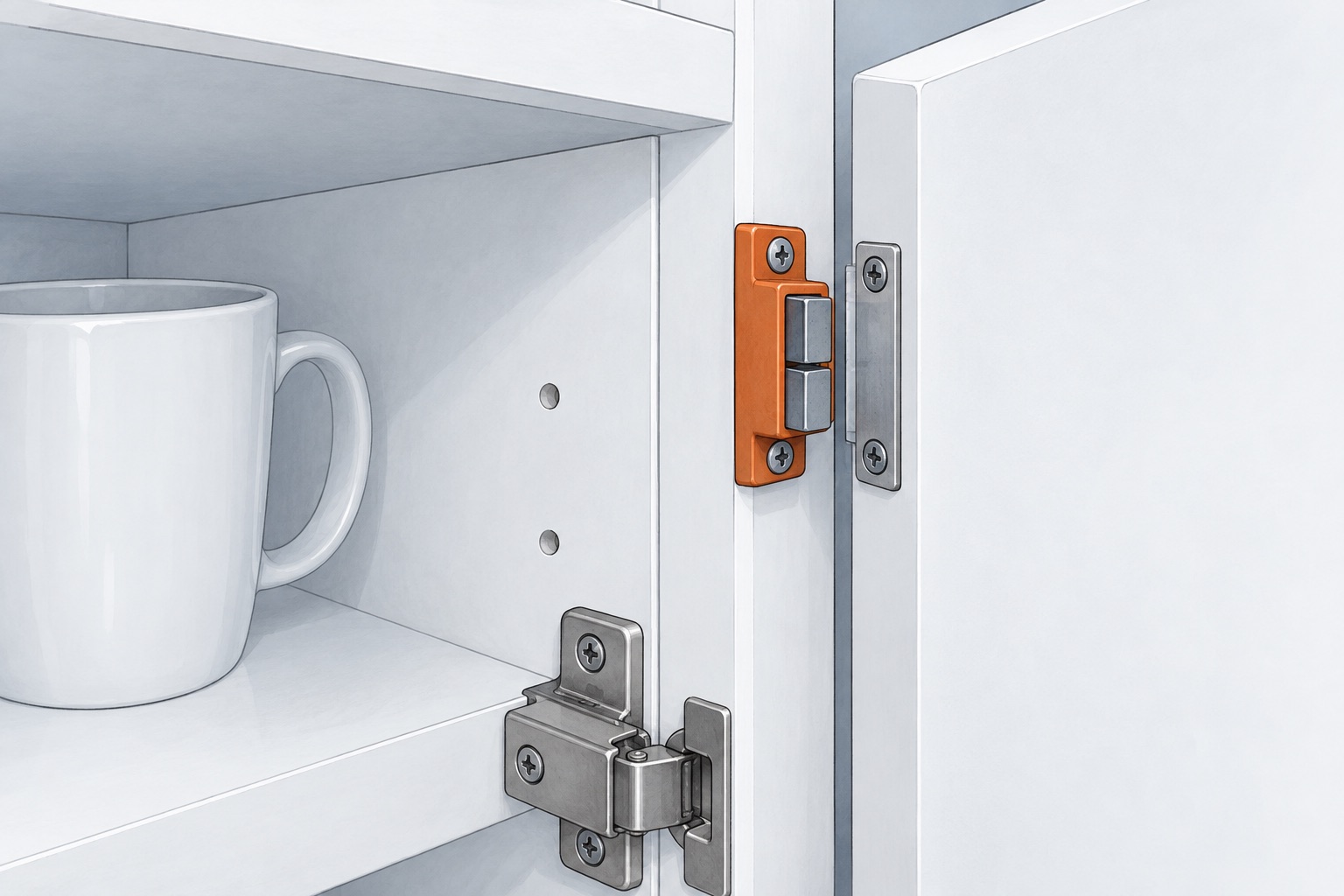
Permanent magnets are used wherever a magnet must work all the time with no power supply. A cupboard door stays shut because a permanent magnet in the catch attracts a steel plate on the door. Compass needles, fridge door seals, the magnets inside loudspeakers and electric motors, and the magnets that pull iron out of sand or out of a recycling line are permanent magnets.
 (enlarge)
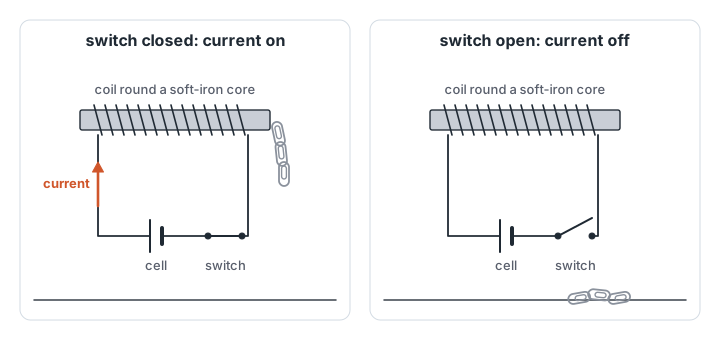
An electromagnet is a magnet you can switch on and off. In its simplest form it is a coil of insulated wire wound round a soft-iron core. When a current flows in the coil, the core becomes a strong magnet; when the current is switched off, the soft iron loses its magnetism. The core is soft iron, not steel, precisely so that the magnet lets go when the current stops: a steel core would stay magnetised. The scrapyard disc is a large electromagnet, and electromagnets also work electric bells, relays and circuit breakers, which you will meet in a later module.
 (enlarge)
Worked example
Which magnet for the job?
A kitchen designer needs a catch to hold a pantry door shut. A factory needs a magnet to lift steel sheets from one stack and lay them on another. Which kind of magnet suits each job?
The pantry door must be held shut all day with no power supply, so the catch needs a permanent magnet, made of steel or a magnetic alloy. The factory magnet must let go of each sheet when it is in place, so it needs an electromagnet with a soft-iron core: switch the current off and the soft iron loses its magnetism, and the sheet drops.
Try it in the experiment
In the experiment you predict which of eight objects the magnet will pick up, then test them one by one. Next you decide what must stay the same for a fair test of a soft-iron rod and a steel rod, hang clips from each rod under two identical magnets, and predict which rod keeps its clips when the magnets are lifted away.
Case closed
The scrapyard magnet lifts steel because steel is a magnetic material and aluminium is not; only iron, steel, nickel and cobalt are attracted. A magnet attracts unmagnetised iron or steel by induced magnetism: the near end becomes the opposite pole. Only repulsion proves that something is a magnet. Soft iron is easily magnetised but keeps almost none of its magnetism, so it makes temporary magnets and the cores of electromagnets; steel keeps its magnetism and makes permanent magnets.
About this model
The experiment's clip counts come from the model, not from a measurement: soft iron is given more clips than steel while touching, none after, and steel keeps three of its four, to show the two behaviours clearly. Real counts depend on the magnet, the rods and the clips. The eight objects are pure samples; a real coin or can may be made of a different metal from its name or only plated with it, so test before you trust a label.
Returning to these ideas
Try the return questions at the next lesson without rereading first, then mix them with earlier questions after one or two weeks and again several weeks later. These are suggested review intervals, adjustable by your teacher. An immediate correct retry is useful practice; it does not show that you remembered the idea days later. The final check uses new cases, and its self-check criteria are teaching points, not official Cambridge marks.