On a sunny afternoon, walk barefoot across a road and you will find that the black tarmac is painfully hot, while the white stripe painted across it is only warm. Both have had the same sunshine all day. The difference is in how much of the Sun's radiation each surface takes in. This part answers the module's question: why houses in hot countries are so often painted white.
Absorbing and reflecting
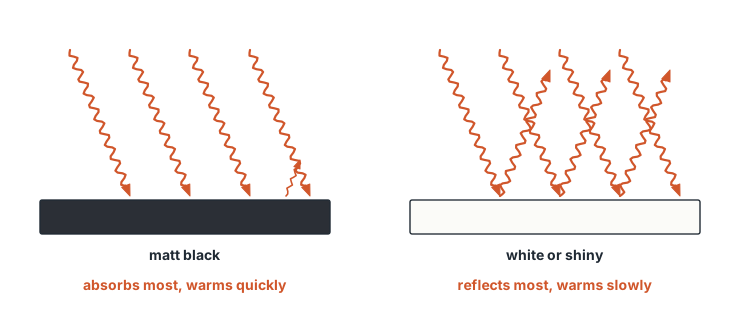
When infrared or light falls on a surface, some of it is absorbed: it goes into the surface and warms it. The rest is reflected: it bounces off and the surface doesn't keep its energy.
- Dull black surfaces are good absorbers and poor reflectors. They take in most of the radiation that falls on them, so they warm up quickly.
- White surfaces and shiny surfaces are poor absorbers and good reflectors. They send most of the radiation back, so they warm up more slowly.
A good emitter is also a good absorber: matt black is the best emitter and the best absorber. A shiny metal surface is poor at both, and it is a good reflector. White paint is the odd one. It reflects most of the sunlight that falls on it, and most of the radiation from a hot lamp filament, so it absorbs little of them. Yet when it is only warm, like a wall, it gives out infrared almost as well as black paint, as the Leslie cube showed. The radiation from something very hot, like the Sun or a lamp filament, is not the same as the infrared given out by something only warm, like a wall or your hand, and white paint treats them differently.
 (enlarge)
Trap: “A white surface reflects all the radiation, so it doesn't warm up at all.” A white surface still absorbs some of the radiation that falls on it, so it does warm up, only more slowly and not as far as a black one.
Worked example
A black car and a white car
A black car and a white car are parked side by side in the sun all afternoon. Which one is hotter inside by the evening, and why?
Both cars get the same sunlight. The black paint is a good absorber, so it takes in most of the radiation that falls on it and warms up. The white paint is a good reflector, so it sends most of the sunlight back and takes in less. The black car is hotter, because its dull black surface absorbs more of the Sun's radiation.
Good absorbers at work
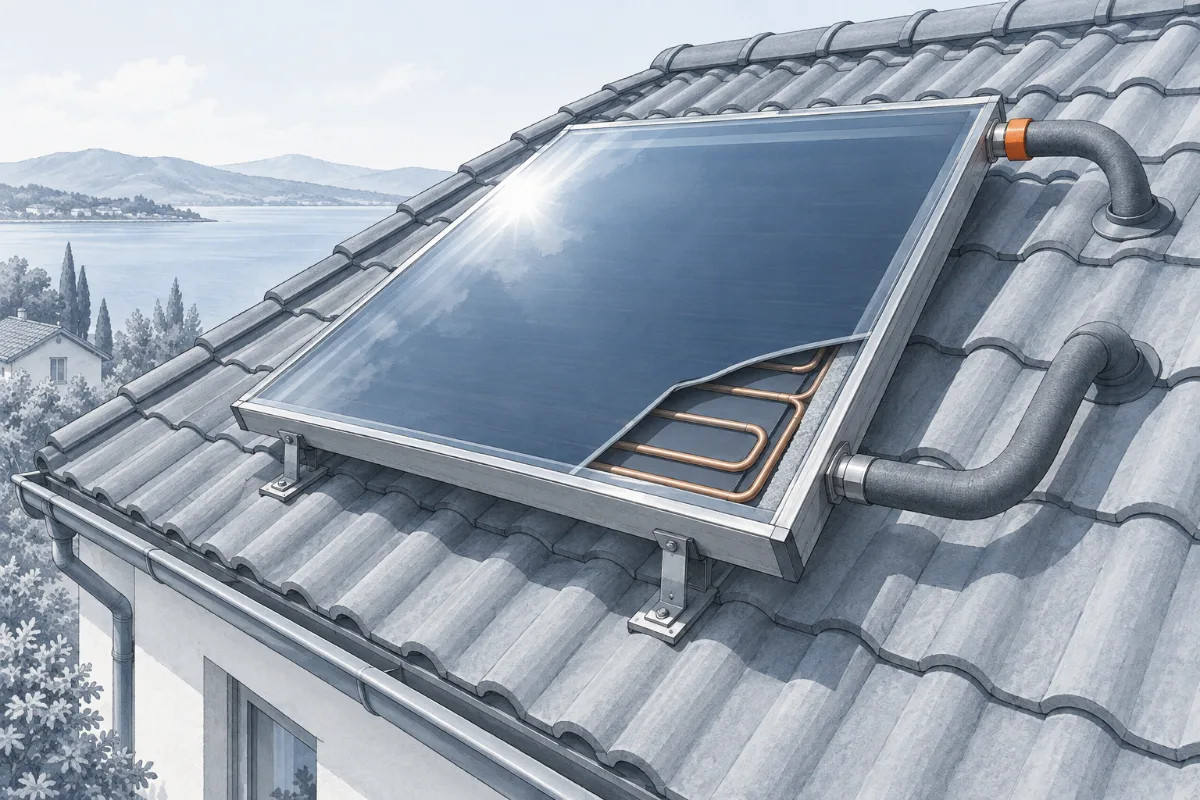
A solar water heater on a roof uses a good absorber on purpose. Its absorber plate is dark, so it takes in most of the sunlight that falls on it. Water flows through copper pipes fixed to the back of the plate and carries the energy away to the house. A sheet of glass in front stops the warm air above the plate from blowing away.
 (enlarge)
Shiny surfaces are used the other way round. A sheet of shiny foil behind a radiator reflects infrared back into the room instead of letting the wall absorb it, and a shiny emergency blanket wrapped round a runner reflects the runner's own infrared back to the body.
Supplement: Testing absorbers fairly
To compare absorbers fairly, two surfaces must receive the same radiation, and the only thing that changes is the surface. One way is to stand two identical cans of water, one painted matt black and one shiny or white, the same distance from a lamp or heater. Each can holds the same volume of water at the same starting temperature, with a thermometer in each. Switch on the lamp and read both thermometers every few minutes. The can whose temperature rises faster has the better absorbing surface. To check that the lamp isn't brighter on one side, swap the cans round and repeat.
Worked example
Coins on two plates
A heater stands exactly halfway between two metal plates. One plate is painted matt black on the side facing the heater; the other is shiny. A coin is stuck to the back of each plate with a blob of wax. Which coin falls first, and what does it show?
Both plates are the same distance from the heater, so they receive the same radiation. The black plate absorbs more of it, so it warms up faster, and the wax behind it melts first. The coin on the black plate falls first, which shows that matt black is a better absorber of infrared than a shiny surface. If the heater were nearer one plate, that plate could win for the wrong reason.
Warm two cans
Now test two absorbers on the bench.
What is on the bench. Two identical metal cans, one painted matt black and one painted matt white. Each holds 150 cm³ of water at room temperature, 20 °C, with a thermometer through its lid. A lamp with a filament bulb, which gives out mostly infrared and some light. A graph in the card plots both temperatures as the minutes pass.
What you do. Decide where the lamp must stand for a fair test, and predict which can warms faster. Switch the lamp on and watch both thermometers and the graph. The clock runs 300 times faster than real time, so two hours pass in under half a minute. In the Supplement steps, think about why the temperatures stop rising, and then switch the lamp off.
What the experiment showed
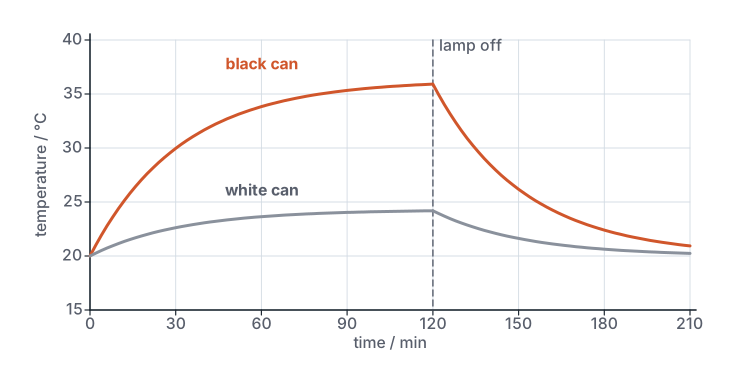
Do the experiment before you read on. You stood the lamp halfway, so that both cans received the same radiation. Both started at 20 °C. The black can warmed much faster at first, about four times as fast as the white can. After about an hour and a half, both temperatures had almost stopped rising, although the lamp was still on, and by two hours they had almost levelled off: the black can at about 36 °C and the white can at about 24 °C (values from the model, see “About this model” at the end). When the lamp was switched off, both cans cooled back down towards room temperature.
 (enlarge)
The matt black can absorbed more of the lamp's radiation than the matt white can, so it warmed faster and ended up hotter. The white paint reflected most of the radiation instead.
Supplement: Energy in, energy out
Why did the temperatures stop rising while the lamp was still on? As soon as a can is warmer than the room, it transfers energy away to its surroundings: it emits infrared, and the air around it carries energy off. The hotter the can gets, the faster it transfers energy away. At first, a can receives energy faster than it loses it, so its temperature rises. Eventually it loses energy just as fast as it receives it, and its temperature stays the same. The energy hasn't stopped flowing: it is still pouring in from the lamp, and it is pouring out just as fast.
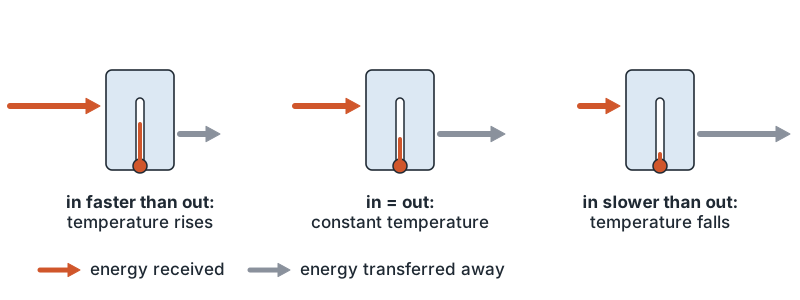
- For an object to stay at a constant temperature, it must transfer energy away at the same rate as it receives energy.
- If it receives energy faster than it transfers energy away, its temperature rises.
- If it receives energy more slowly than it transfers energy away, its temperature falls. That happened when the lamp was switched off: the cans were still losing energy, but receiving much less.
 (enlarge)
Trap: “The can stopped warming because it was full of energy and couldn't take in any more.” The can keeps absorbing energy at the same rate; it stops warming because it now transfers energy away just as fast.
Worked example
A pan that stays at 60 °C
A pan of soup sits on a hob that is turned to low, and the soup's temperature has stayed at 60 °C for ten minutes. (a) What does this tell you about the energy flowing in and out of the soup? (b) The hob is turned up. Describe what happens to the soup's temperature.
(a) The soup is receiving energy from the hob and transferring energy away to the room at the same rate, so its temperature stays the same. (b) The soup now receives energy faster than it transfers it away, so its temperature rises. As it gets hotter it transfers energy away faster, until the two rates are equal again and the temperature settles at a new, higher value. Constant temperature means equal rates in and out; a temperature changes only while the rates are unequal.
Supplement: The Earth's temperature
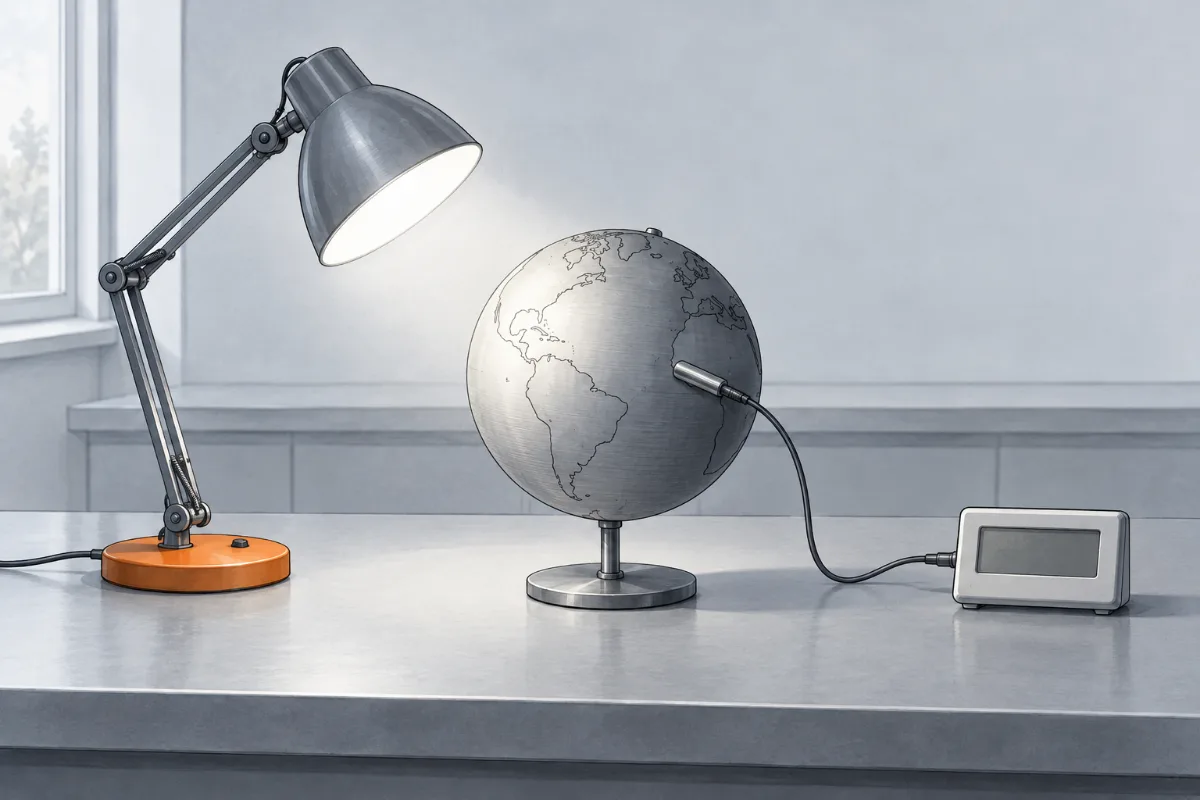
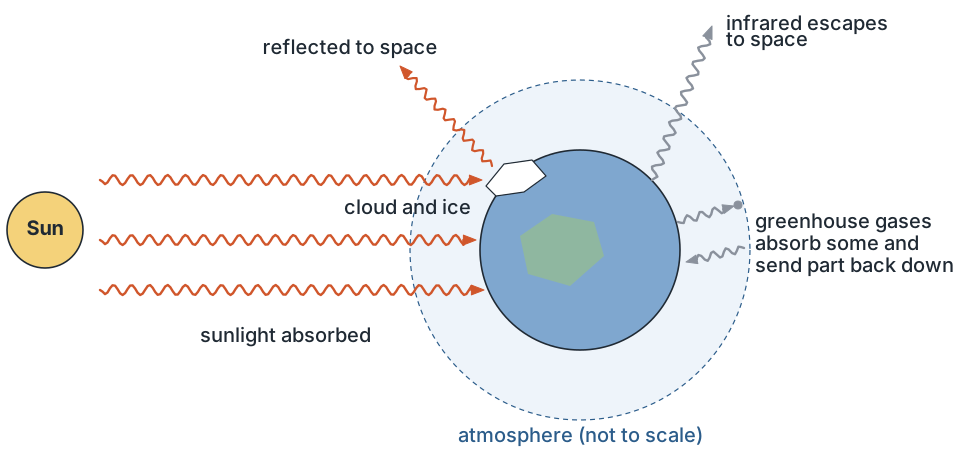
The whole Earth works like the cans. It receives radiation from the Sun, and it emits infrared radiation from its surface out into space. Its average temperature stays about the same when the two rates are equal.
 (enlarge)
Anything that changes either rate changes the Earth's temperature.
- How much sunlight is reflected. Clouds, snow and ice reflect much of the sunlight back into space; dark oceans and forests absorb most of it. If ice melts and uncovers dark sea or land, the Earth absorbs more sunlight, so it warms.
- How much infrared escapes. Some gases in the atmosphere, such as carbon dioxide, water vapour and methane, absorb some of the infrared emitted by the surface and send part of it back down. More of these greenhouse gases means less infrared escapes into space, so the Earth warms until it emits as fast as it absorbs again.
 (enlarge)
Worked example
More greenhouse gas, less ice
Explain how each change affects the Earth's average temperature: (a) more carbon dioxide in the atmosphere; (b) less ice covering the Arctic sea in summer.
(a) Carbon dioxide absorbs some of the infrared emitted by the Earth's surface and sends part of it back down, so less infrared escapes into space. The Earth now transfers energy away more slowly than it receives it, so it warms until the rates are equal again. (b) Ice reflects most of the sunlight that falls on it, but dark sea water absorbs most of it. With less ice, the Earth absorbs more sunlight, receives energy faster than it emits it, and warms. Both changes upset the balance between radiation in and radiation out, and the Earth warms until the balance is restored at a higher temperature.
Supplement: More than one transfer
In many real situations, conduction, convection and radiation all matter at once.
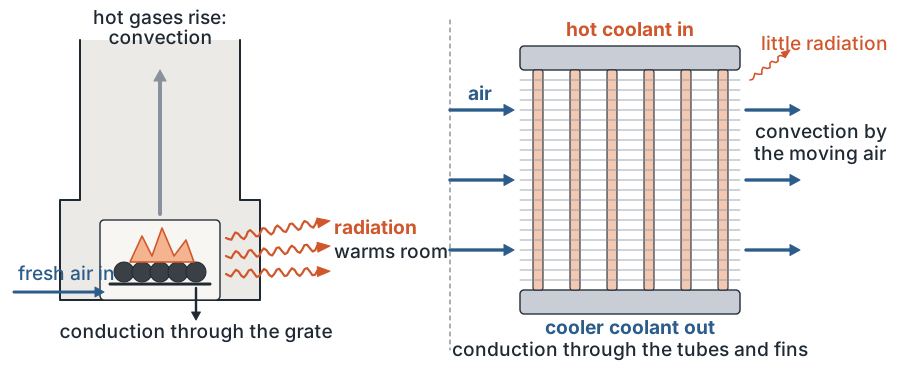
A fire burning wood or coal. The glowing fuel and the flames emit a lot of radiation, which crosses the room and warms the people in front of the fire. The hot gases above the fire are less dense than the room air, so they rise up the chimney by convection, and fresh air is drawn in at the bottom, which keeps the fire burning. Energy is also conducted through the metal grate and into the hearth and walls around it.
A radiator in a car. The engine heats the liquid coolant that flows round it. A pump pushes the hot coolant through thin metal tubes in the radiator at the front of the car. Energy is conducted through the metal walls of the tubes and into thin metal fins attached to them, which give a large surface area. Air flowing through the gaps between the fins, pushed by a fan or by the car's motion, carries the energy away by convection. The radiator also emits some infrared, but most of its energy goes to the moving air.
 (enlarge)
Worked example
A car radiator
A car radiator is made of thin copper or aluminium tubes with many thin metal fins between them. Explain how each feature helps the radiator transfer energy from the hot coolant to the air.
Copper and aluminium are good thermal conductors, so energy is conducted quickly from the coolant through the tube walls and into the fins. The thin fins give the radiator a very large surface area, so more air touches the hot metal at once and more energy is transferred each second, by convection in the air flowing between the fins, and a little by radiation, which also increases with surface area. The metal conducts the energy out, and the large surface area lets the moving air carry it away quickly.
Supplement: A vacuum flask
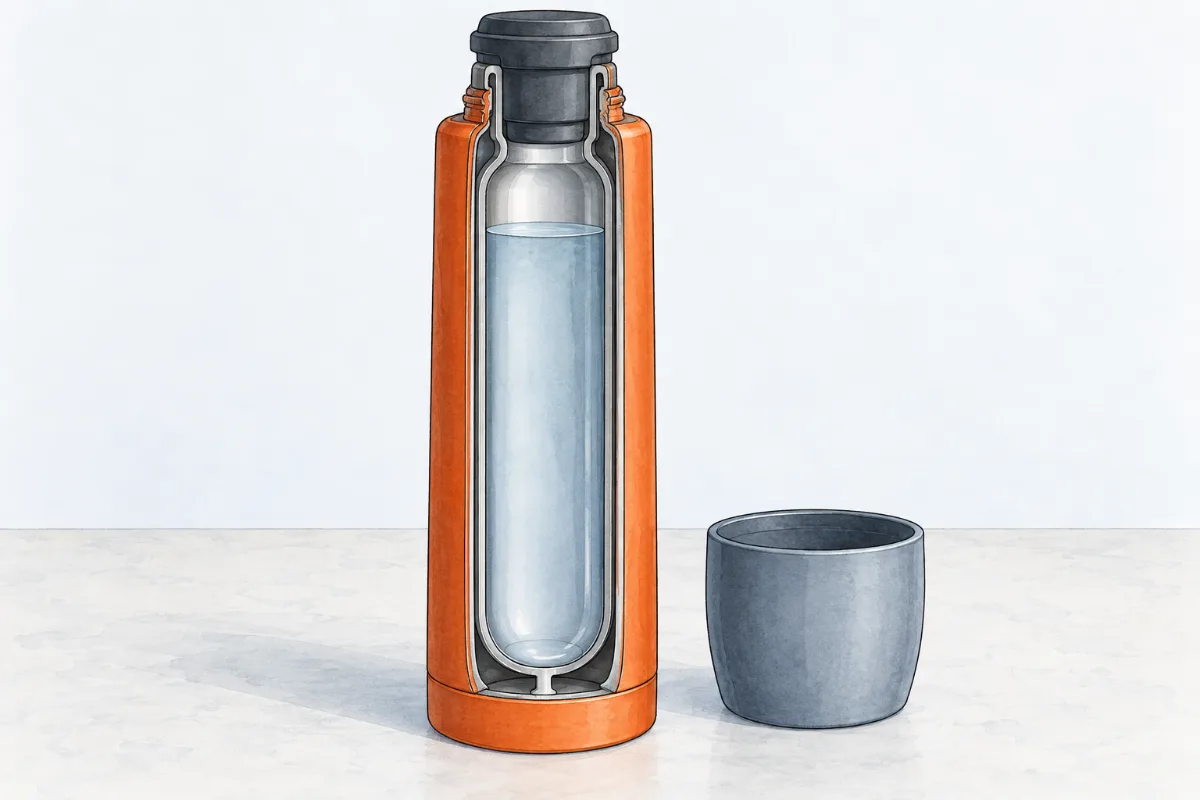
A vacuum flask keeps hot drinks hot, and cold drinks cold, by slowing down all three transfers at once.
 (enlarge)
The flask has two walls with a vacuum between them. With almost no particles in the gap, almost no energy can cross it by conduction or convection. The walls facing the gap are silvered: a shiny surface is a poor emitter, so the hot inner wall radiates very little, and a shiny surface is a good reflector, so most of the infrared it does emit is reflected back. The stopper is a thermal insulator, and it stops warm air leaving the top by convection. The inner bottle touches the outer case only at the neck and a small support, so very little energy is conducted through the joins.
Case closed
Houses in hot countries are often painted white because white paint reflects most of the sunlight that falls on it. Like the white can, a white wall absorbs less of the Sun's radiation, so it receives energy more slowly. It warms only until it transfers energy away as fast as it receives it, and that happens at a lower temperature than for a dark wall. The rooms inside stay cooler. It isn't because white walls emit better: matt white emits almost as well as black, which helps the walls cool down at night.
 (enlarge)
About this model
The cans, the lamp and the water are simulated. Each can holds 150 cm³ of water in a 40 g aluminium can, and the room is at 20 °C. With the lamp halfway, each can receives 6.0 watts of the lamp's radiation. The black paint absorbs 95 % of it and the white paint 25 %, values for these two paints under a filament lamp. For the infrared that the warm cans give out themselves, the two paints are almost equally good emitters, as the Leslie cube showed (0.95 and 0.90). Each can transfers energy away at 0.35 watts for every degree it is above the room, by infrared and by the air around it, the same for both. With these numbers, the black can would settle at 36.3 °C and the white can at 24.3 °C; two hours with the lamp on brings them to within half a degree of that. Real cans lose some energy through their lids and bases, and real lamps are not perfectly even, so real cans settle at different temperatures, but the black can always warms faster and settles higher. The arrows of light and infrared on the bench are drawings of radiation you can't see.