Contents
Independent final check
Explain without the key
identify / state / describe / explain
Final check
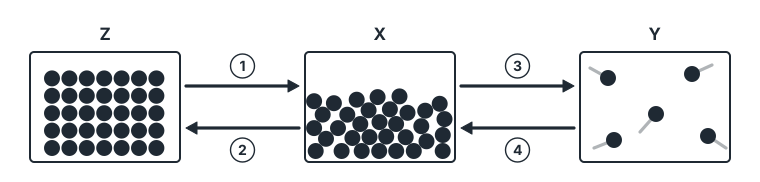
The diagram shows the particles of one substance in three states, Z, X and Y, and four changes of state between them, numbered 1 to 4. (a) Identify the state shown by Z, by X and by Y. (b) Identify changes 1, 2 and 4. (c) Change 3 can happen in two different ways. Identify both, and state one difference between them. (d) Describe the motion of the particles in Z and in Y. (e) Supplement. State which of Z, X and Y can be compressed easily, and explain why, in terms of the particles. (f) Supplement. A pupil says: “The forces between the particles are strongest in Y, because its particles move fastest.” Explain why the pupil is incorrect. (g) A pupil says that in change 1 the particles get bigger. Explain why this is incorrect.
identify: name or select. state: give a concise answer. describe: give the features or what happens. explain: give reasons and connect them to evidence.
 (enlarge)
Your saved work
Answers, earlier attempts and your Pause and check notes stay in this browser. Export a copy to keep, to move to another device or to hand to your teacher. Importing a copy keeps your current answers and adds earlier attempts.
Scope and sources
Cambridge IGCSE Physics 0625 · 2026–2028 v2 · Original learning materials.
The distinguishing properties of solids, liquids and gases and the terms for the changes of state (2.1.1.1, 2.1.1.2); the arrangement, separation and motion of particles in each state, with simple particle diagrams (2.1.2.1); the motion of particles and temperature, with absolute zero, −273 °C, where the particles have least kinetic energy (2.1.2.2); the random motion of microscopic particles in a suspension as evidence for the kinetic particle model (2.1.2.4) and its explanation by random collisions (2.1.2.5); how forces and distances between particles and their motion affect the properties of solids, liquids and gases (2.1.2.6); microscopic particles moved by collisions with light, fast-moving molecules, and the terms atoms or molecules as distinct from microscopic particles (2.1.2.8). Gas pressure and the kelvin scale are in the module on gas pressure; melting, boiling and evaporation in their own module.
Apparatus, amounts and times in the experiment are illustrative. Real practical work follows a teacher-approved safety method.
Official Cambridge syllabus