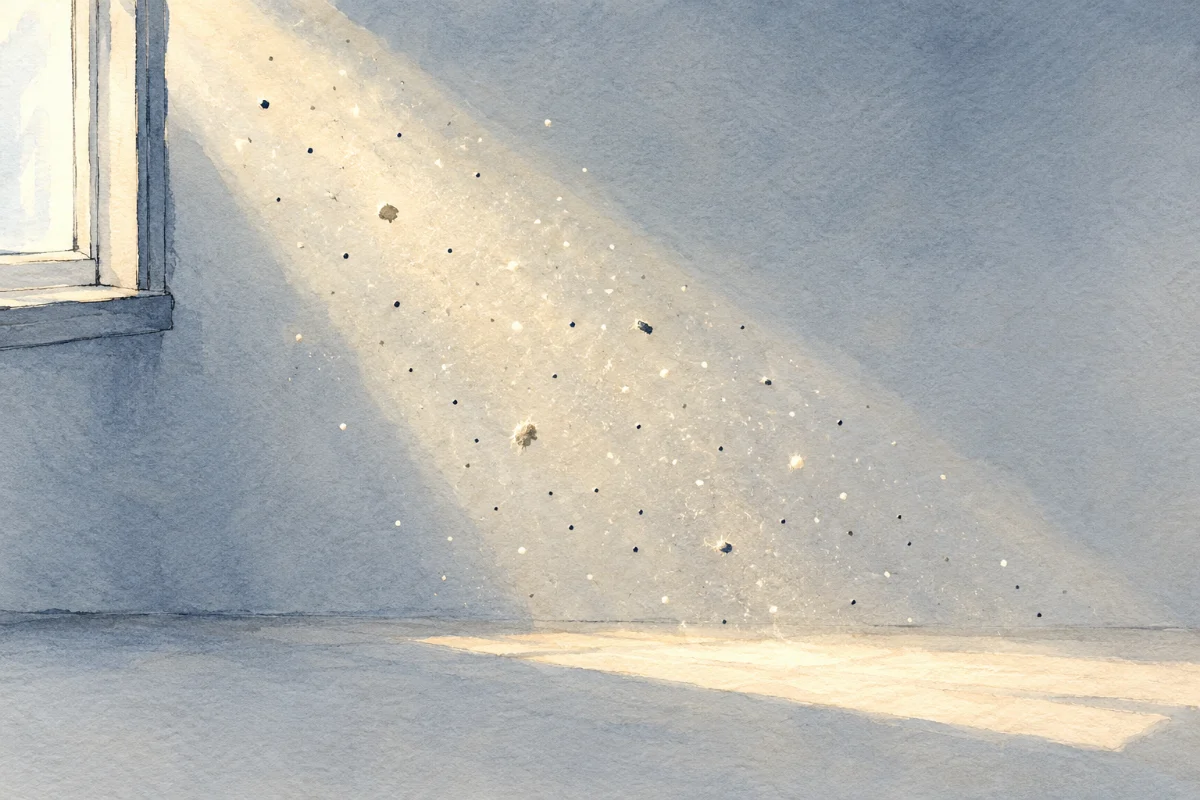
On a sunny morning, a shaft of sunlight comes through a window into a quiet room. In the beam, tiny specks of dust glint and drift, although the room seems perfectly still. The air itself is invisible, and the last part said that it is made of particles moving fast in random directions. But nobody can see a particle of air. Is there any way to see the particles' motion, or at least its effects? In this part you trap some smoke in a tiny glass cell, look at it through a microscope, and follow one speck of smoke.
 (enlarge)
Dust in a sunbeam is not the evidence, though. The specks you see are carried mostly by slow currents of air in the room, from a draught or from warm air rising, so neighbouring specks drift along together. To see what the air's particles do, you need much smaller specks, in air that cannot flow anywhere, and a microscope.
Smoke under a microscope
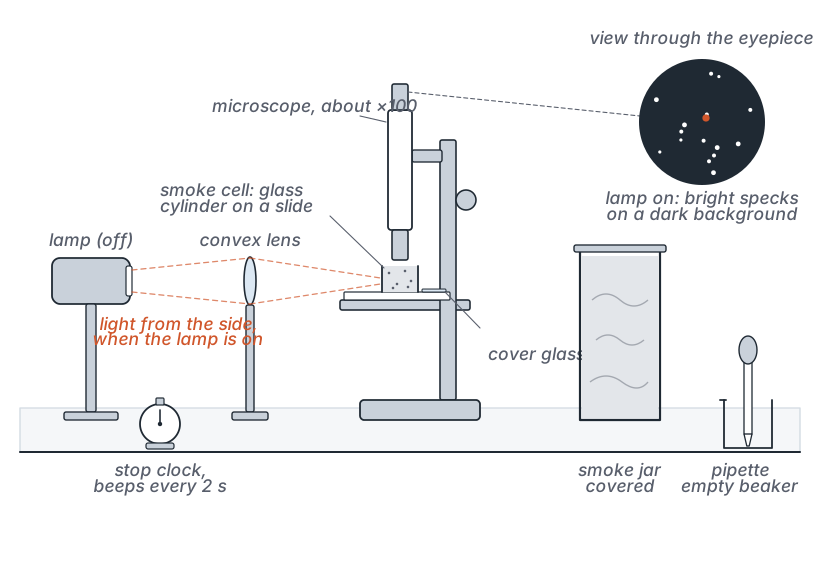
What is on the bench. A microscope in the middle, which magnifies about 100 times. On its stage is a smoke cell: a small glass cylinder standing on a microscope slide. A cover glass to close it waits at the right-hand end of the slide. On the left, a lamp shines through a convex lens to light the cell from the side, so that each tiny particle of smoke shows up as a bright point of scattered light on a dark background. At the back on the right is a gas jar of smoke with a cover plate on top, and at the front on the right a teat pipette for moving the smoke stands upright in a small, empty glass beaker. The smoke was collected beforehand by the teacher from a smouldering splint, so nothing is burning on the bench. At the front on the left, a stop clock beeps every 2 s. The view through the eyepiece is simulated.
What you do. Use the teat pipette to fill the cell with smoke from the jar, and put the cover glass on. Predict what the specks of smoke will do: stay still, drift one way, or jiggle about at random. Then light the lamp and look. One speck near the centre is shown orange, so that you can follow it. Mark the orange speck's position: your first mark starts the stop clock, and at each beep, every 2 s, the view pauses for your next mark; straight lines join your marks. After three beeps, predict which way it will jump next, then carry on for five more marks. Finally, decide what makes the specks move, look at a model of what is happening, and compare the speck with the particles of the air.
 (enlarge)
What the experiment showed
Do the experiment before you read on. With the lamp on, the view through the eyepiece was dark, scattered with many bright specks. Each speck is a tiny particle of smoke, far too small to see with the naked eye, which shows up only because it scatters the lamp's light into the microscope. None of the specks was still. Each one jiggled about on its own: a small jump one way, then another way, then another. Neighbouring specks did not move together; at any moment they jumped in different directions. The cell was closed, and the specks did not all drift one way.
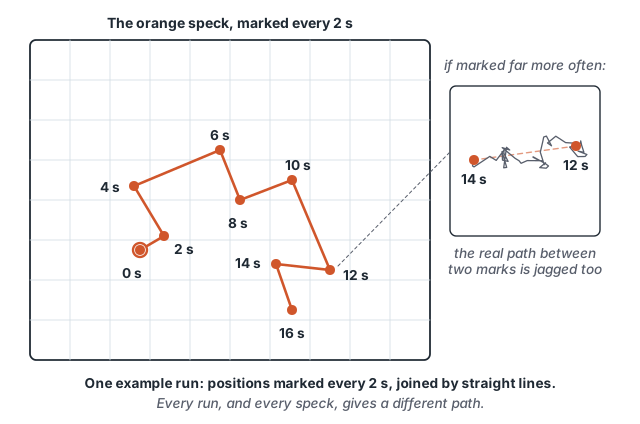
The orange speck was marked at 0 s and at each beep after that, every 2 s, and straight lines joined the marks. After the mark at 6 s, you predicted which way it would jump next. Whatever you predicted, you could only be right by chance: with four directions to choose from, a guess is right only about one time in four. After five more marks, at 8, 10, 12, 14 and 16 s, the lines made a zig-zag: jumps of different lengths, in directions that changed at random, with no pattern that tells you the next jump.
 (enlarge)
Three honest points about what you recorded. First, the straight lines only join positions recorded every 2 s. The speck did not travel along them: between two marks its real path was itself a jagged zig-zag, too quick and too small to follow. Second, you saw the speck, never the particles of the air: they are far too small to see with any light microscope. Third, the motion is random, so another run, or another speck, gives a completely different path. Only the kind of motion is always the same.
Why the specks jiggle
What makes the specks jump about? There are three ideas to test.
A draught, or a current in the air, would carry the specks along, like the dust in the sunbeam. But then neighbouring specks would drift the same way at the same time. They did not: each speck jiggled on its own, in its own directions. So a draught is not the cause.
Perhaps the specks are alive, swimming about? Smoke is tiny bits of ash and tar from a smouldering splint. Nothing in it is alive. The same jiggling is seen in specks of dust from rock or glass in water. So life is not the cause either.
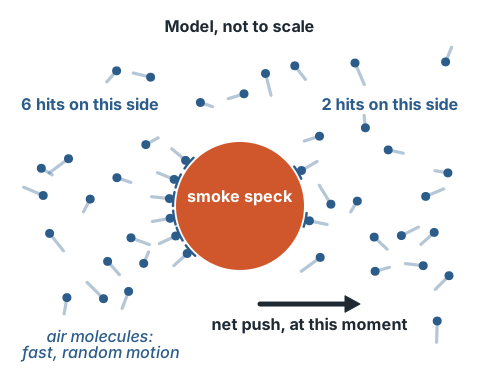
The explanation that fits is that the specks are being hit by particles too small to see: the particles of the air. Air molecules move fast, in random directions, and they hit each speck from all sides, all the time. At any moment, just by chance, more molecules hit one side of a speck than the other, or hit it harder, so the speck is pushed one way. A moment later, by chance, a different side gets more hits, and the speck is pushed another way. The pushes are uneven and random, so the speck's motion is random too: a zig-zag. This random motion of tiny particles in a gas or a liquid, caused by random collisions with the particles of the gas or liquid, is called Brownian motion.
 (enlarge)
Trap: “The smoke specks move because they are hot and rise.” Rising would carry all the specks the same way, upwards. The specks jiggle in every direction, each on its own, and keep doing so after the cell has settled. The jiggling comes from the uneven hits of the air molecules.
Trap: “The molecules hit the speck only from one side.” They hit it from all sides, millions of millions of times a second. The speck moves because the hits are not perfectly even: at each moment one side gets a few more, and which side that is changes at random.
Evidence for the particle model
A suspension is tiny bits of a solid or a liquid spread through a gas or a liquid, not dissolved in it, and small and light enough not to settle quickly. The smoke in the cell is one: tiny solid particles spread through air. Fat droplets in milk, and tiny grains of colour in paint, are suspensions in a liquid.
The random motion of tiny particles in a suspension is evidence for the kinetic particle model of matter: the model that says that matter is made of tiny particles in constant, random motion. The particles of the air cannot be seen. But the specks can, and their random jiggle is just what the model predicts: a speck hit unevenly, from all sides, by moving particles too small to see. If the air were a smooth, still substance with no particles, nothing would push the specks about.
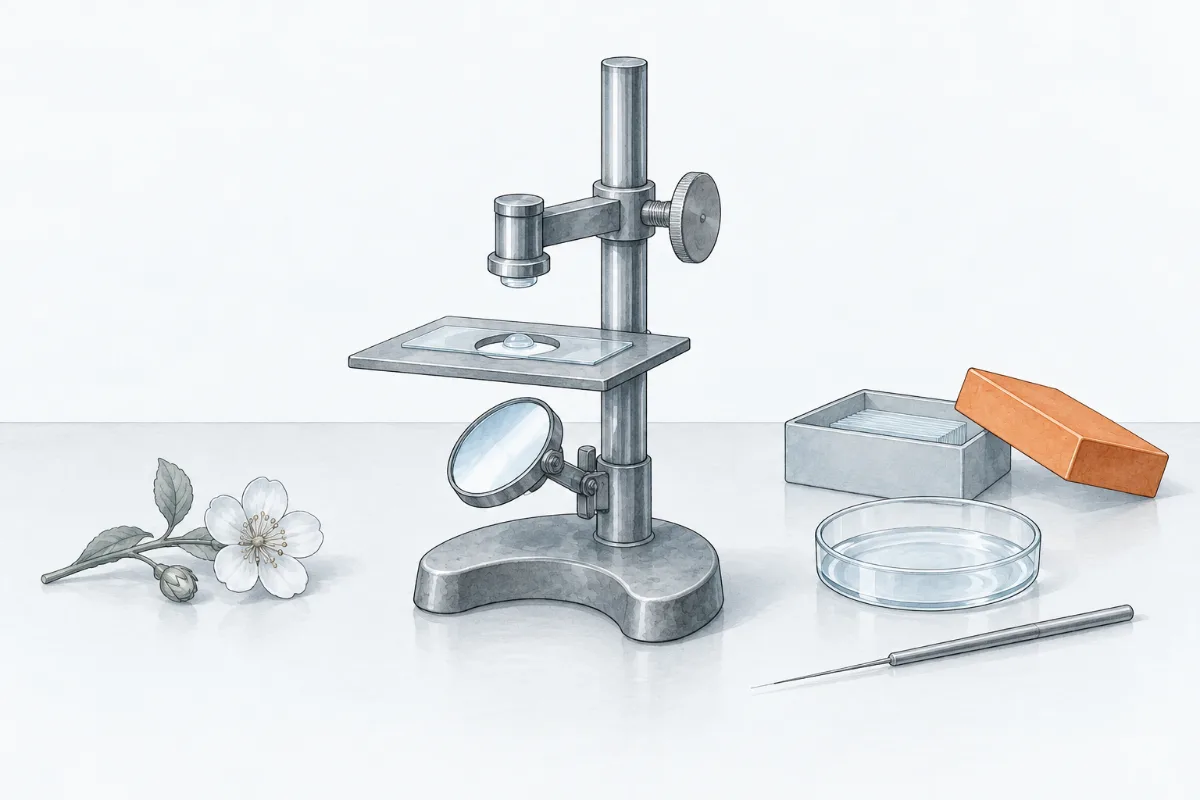
The motion is named after Robert Brown, a Scottish botanist. In 1827 he was looking, with a simple microscope like the one in the picture, at tiny particles that had come out of grains of pollen into a drop of water. They jiggled about without stopping. He wondered at first whether they were alive. Then he saw the same motion in specks of dust from rock and from glass, which could not be alive. The same thing happens in a liquid as in a gas: the specks are hit, unevenly, by the molecules of the water.
 (enlarge)
For almost eighty years nobody could prove what caused it. In 1905 Albert Einstein worked out how far a speck should wander if it were being hit by molecules, and a few years later Jean Perrin measured the wandering of tiny particles in water and found that Einstein was right. That convinced the last doubters that atoms and molecules are real.
Trap: “Brownian motion shows that pollen is alive.” Brown thought of that, and ruled it out: specks of rock and glass, which have never been alive, jiggle in exactly the same way. The jiggling comes from collisions with the molecules of the water.
Worked example
Reading a speck's path
Look at the recorded path of the orange speck above. (a) Between which two marks did the speck make its longest jumps? (b) A pupil says that the speck travelled along the straight lines. Explain why this is not right. (c) Explain why nobody could have predicted the jump after the mark at 6 s. (d) Another pupil follows a second speck in the same cell at the same time. Will its path look the same? Explain.
(a) From 4 s to 6 s, and from 10 s to 12 s: those two lines are the longest. (b) The marks are only the speck's positions every 2 s, joined by straight lines. Between marks it kept being hit, so its real path was a much more jagged zig-zag, too small and too quick to follow. (c) The direction of each jump depends on which side of the speck happens to get more hits from air molecules in the next 2 s. That is random, so no one can predict it. (d) No. The second speck is hit by different molecules, at random, so it jiggles in its own way. Its path would be a zig-zag too, but a different one. If both specks moved the same way, that would point to a draught, not to collisions.
Supplement: specks and molecules
What is a speck of smoke, compared with a molecule of air? A speck is a microscopic particle: a tiny bit of ash and tar, about 1 μm (a thousandth of a millimetre) across. That is small enough to need a microscope, but it is huge compared with an atom: a speck that size is made of about 10¹¹ atoms, a hundred thousand million of them. The air molecules that hit it are mostly molecules of nitrogen and oxygen, about 0.3 nm across, thousands of times narrower than the speck and far lighter. They are also very fast: at 20 °C a typical air molecule moves at about 500 m/s, faster than a passenger jet.
To picture the sizes: if an air molecule were a grain of sand, the speck would be about a metre across, a boulder hit from every side by flying grains of sand. One grain hitting a boulder barely moves it, and one molecule hitting the speck barely moves it either. But the speck is hit about 1016 times every second. At each moment the hits on one side do not quite balance the hits on the other, and the uneven part is enough to push the speck about. A bigger speck jiggles less: it is heavier, and it is hit by so many molecules at once that the hits on opposite sides balance out more closely.
So use the words carefully. The particles of the air, or of the water, are atoms or molecules: far too small to see. The speck of smoke, or the bit of pollen, is a microscopic particle: big enough to see through a microscope, and made of a vast number of atoms. The speck is moved by collisions with light, fast-moving molecules. It is not a molecule itself, and you never see the molecules, only what their hits do to the speck.
Trap: “Under the microscope you can see the air molecules jiggling.” The bright points are specks of smoke, each made of about 10¹¹ atoms. The molecules are thousands of times smaller, and no light microscope can show them. You see their effect, not the molecules.
Trap: “The smoke molecules are hit by the air.” A speck of smoke is not a molecule: it is a microscopic particle, made of a vast number of atoms. Say instead: the smoke particles are hit by air molecules.
Worked example
Molecule or microscopic particle?
Supplement. Sort these into atoms or molecules, and microscopic particles: a speck of smoke; a molecule of water; an oxygen molecule in the air; a tiny particle from inside a pollen grain; a droplet of fat in milk. Then correct this sentence: “In Brownian motion, the water particles are pushed about by collisions with the pollen.”
Atoms or molecules: the water molecule and the oxygen molecule. They are far too small to see. Microscopic particles: the speck of smoke, the particle from the pollen grain and the droplet of fat. They are big enough to see through a microscope, and each is made of a huge number of atoms or molecules. The sentence has it the wrong way round: it is the pollen particles that are pushed about, by collisions with the water molecules. Corrected: “In Brownian motion, the microscopic particles from the pollen are pushed about by collisions with light, fast-moving water molecules.”
Case closed
What makes smoke specks jiggle? Under the microscope, every speck in the closed cell jiggled about on its own, in a random zig-zag that no one could predict. It was not a draught, because neighbouring specks moved independently, and it was not life, because ash, rock and glass jiggle too. The specks are microscopic particles hit from all sides by the air molecules, which are far smaller, lighter and very fast. At each moment the hits on one side outweigh those on the other, and which side changes at random. This Brownian motion is evidence that matter is made of tiny particles in constant random motion. The next part asks what happens to that motion when the air gets colder, and how cold anything can get.
About this model
The microscope, smoke cell and stop clock are simulated, and so is the view through the eyepiece. Each speck follows a random walk: many tiny random steps, each one the result of uneven hits, so that no two runs give the same path. The computer keeps the orange speck inside the view, so its path leans a little towards the middle of the view; a bigger speck is given smaller jumps. The jumps are scaled to look like real smoke under a microscope that magnifies about 100 times: a real speck wanders only about 0.01 mm in 2 s. In a real cell, specks also drift slowly as the lamp warms the air inside, and they move out of focus from time to time, because they jiggle up and down too; the simulation leaves both out. The model view of the speck among air molecules is not to scale: the molecules are drawn far bigger, far fewer and far slower than real ones, so that you can see them hit the speck.