Contents
Part 1 of 2
Refraction of light
identify
Try it yourself
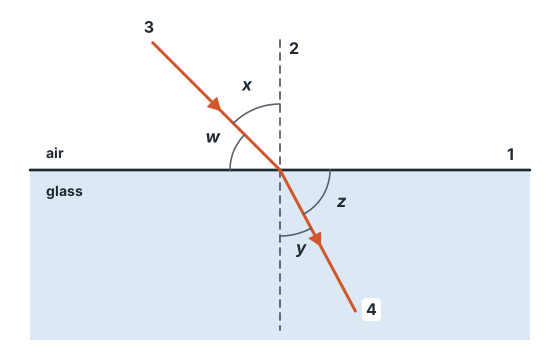
The diagram shows a ray of light passing from air into glass. Match each numbered line to what it is.
identify: name or select.
 (enlarge)
Your saved work
Answers, earlier attempts and your Pause and check notes stay in this browser. Export a copy to keep, to move to another device or to hand to your teacher. Importing a copy keeps your current answers and adds earlier attempts.
Scope and sources
Cambridge IGCSE Physics 0625 · 2026–2028 v2 · Original learning materials.
The normal, the angle of incidence and the angle of refraction (3.2.2.1); refraction by a rectangular and a semicircular glass block (3.2.2.2); the passage of light through a transparent material, at a boundary between two mediums (3.2.2.3); the critical angle (3.2.2.4); internal reflection and total internal reflection, with experimental and everyday examples (3.2.2.5); Supplement: refractive index as the ratio of the speeds of light (3.2.2.6), n = sin i ÷ sin r (3.2.2.7), n = 1 ÷ sin c (3.2.2.8) and optical fibres, particularly in telecommunications (3.2.2.9). Refraction of water waves is in Waves in a ripple tank, lenses in Lenses and images, and dispersion in Light and the electromagnetic spectrum.
Apparatus, amounts and times in the experiment are illustrative. Real practical work follows a teacher-approved safety method.
Official Cambridge syllabus