On a quiet morning the ride operator runs the lift chain slowly, and the car takes 40 s to reach the top of the first hill. On a busy afternoon the chain runs twice as fast and the car is up in 20 s. Does the faster chain give the car more energy, so that the ride is faster? This part is about how to measure the energy a force transfers, and how quickly it transfers it.
Work done is energy transferred
Push a heavy suitcase across the floor and you get tired; push against a solid wall that doesn't move and you get tired too, but nothing has been moved. Physicists say that a force does work when it moves an object in the direction of the force. The work done is the energy the force transfers:
work done = force × distance moved in the direction of the force, or W = F d = ΔE
where W is the work done in joules (J), F is the force in newtons (N), d is the distance moved in the direction of the force in metres (m), and ΔE (“delta E”) is the energy transferred, also in joules. One joule is the work done when a force of 1 N moves something 1 m, so 1 J = 1 N m.
The work done equals the energy transferred, whatever the force is doing. When the roller-coaster chain pulls the car up the hill, the work it does is the energy that goes into the car's gravitational potential store. When the brakes stop the car, the work done by their friction is the energy that goes into the thermal store of the brakes.
An electric current does work too. A battery pushes a current round a circuit, and the electrical work done is the energy transferred by the current, from the battery's chemical store to the lamp, motor or heater in the circuit. Mechanical or electrical, work done is always equal to the energy transferred.
 (enlarge)
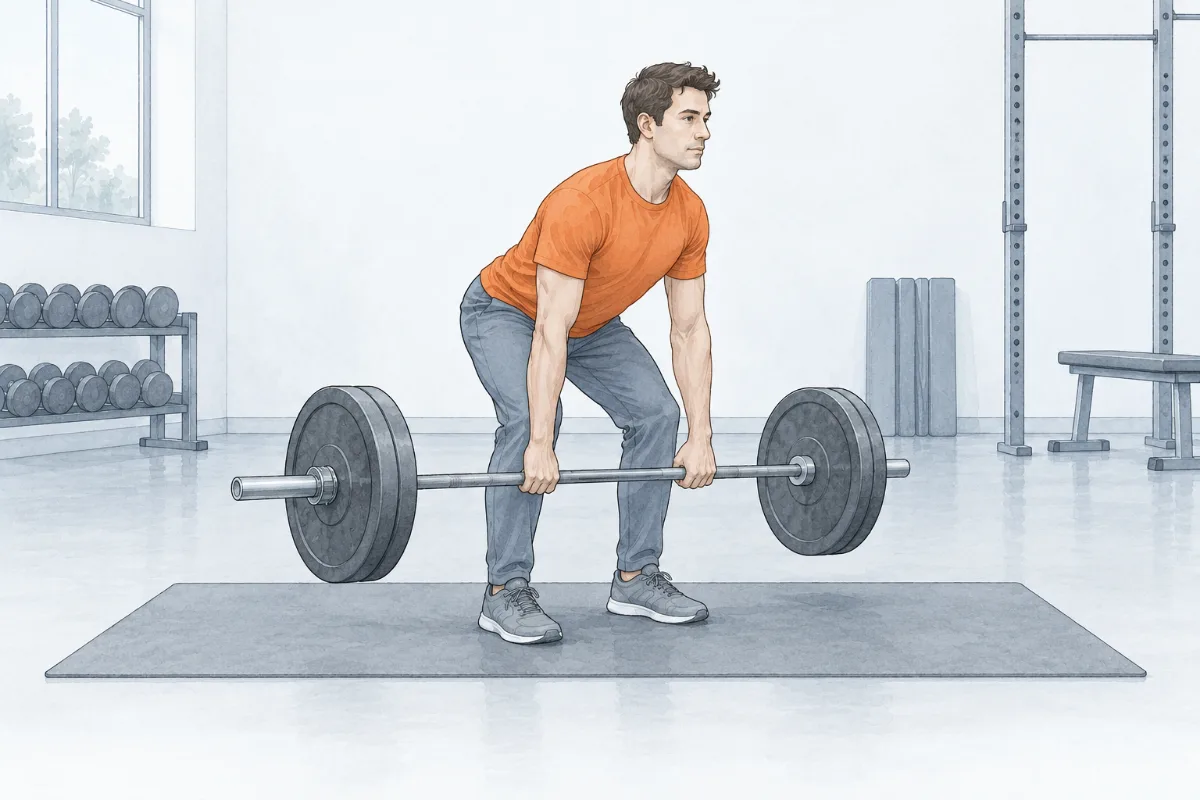
Trap: “Holding a heavy barbell still above your head is hard work, so you are doing work on it.” The barbell isn't moving, so the distance is zero and the force on it does no work: its energy doesn't change. Your arms get tired because energy is transferred inside your muscles, not to the barbell.
Worked example
Pushing a crate
A worker pushes a crate 4.0 m across a floor with a steady horizontal force of 150 N. How much work does she do, and how much energy does she transfer?
The force is horizontal and the crate moves 4.0 m horizontally, so the distance moved in the direction of the force is 4.0 m. W = F d = 150 N × 4.0 m = 600 J. Work done equals energy transferred, so she does 600 J of work and transfers 600 J of energy (here, by friction, to the thermal store of the crate and the floor).
Worked example
The chain on the lift hill
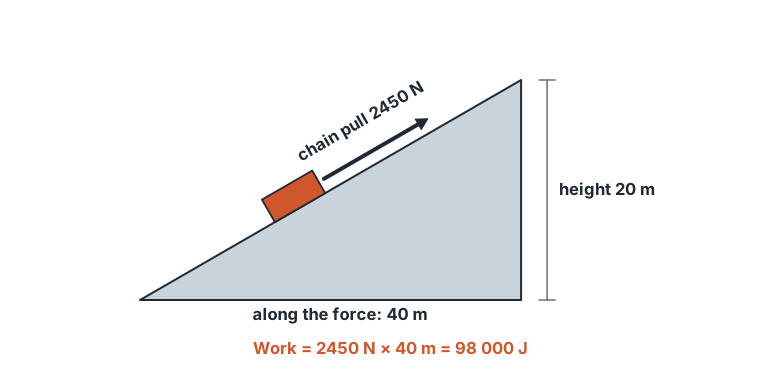
The lift hill of the roller coaster is a straight slope. The chain pulls the 500 kg car with a steady force of 2450 N along the slope, and the car moves 40 m along the slope while it rises 20 m. How much work does the chain do on the car?
The chain pulls along the slope, and the car moves 40 m along the slope, so that is the distance moved in the direction of the force. W = F d = 2450 N × 40 m = 98 000 J. The 20 m is the height gained, which is not in the direction of the chain's pull. The chain does 98 000 J (98 kJ) of work, and on a track without friction all of it goes into the car's gravitational potential store.
 (enlarge)
Power
Two chains that lift the same car to the top of the same hill do the same work, 98 000 J. But one does it in 40 s and the other in 20 s. The faster chain transfers energy at a greater rate: it has a greater power.
Power is the work done per unit time, and also the energy transferred per unit time:
P = W / t and P = ΔE / t
where P is the power in watts (W), W is the work done in joules (J), ΔE is the energy transferred in joules (J) and t is the time in seconds (s). A power of 1 watt means 1 joule transferred every second; 1 kilowatt (kW) is 1000 W.
A 2000 W kettle transfers 2000 J of energy to the water and its surroundings every second. A 1000 W kettle transfers the same energy to the same water, but it takes twice as long.
Trap: “A more powerful motor does more work.” A more powerful motor does work faster. Lifting the same car to the same height takes the same work, 98 000 J, whichever motor does it; the more powerful one just finishes sooner.
Worked example
Two ways up the stairs
A pupil whose weight is 500 N walks up a staircase 3.0 m high in 10 s. Next day she runs up the same stairs in 4.0 s. How much work does she do against her weight each time, and what is her power?
She lifts her weight, 500 N, through 3.0 m, which is the distance moved in the direction of the upward force, so W = F d = 500 N × 3.0 m = 1500 J both times. Walking, P = W / t = 1500 J ÷ 10 s = 150 W. Running, P = 1500 J ÷ 4.0 s = 375 W. The work is the same, 1500 J, but running up in less time needs more power: 375 W instead of 150 W.
Lift the car again
Back to the roller coaster for the second part of the experiment.
What is in the scene. The same coaster, car and energy bars. The motor's display shows the chain's pull in newtons, and a stop-clock times each lift. The readings table under the steps keeps, for each lift, the chain's speed, the time the lift took and the speed at the speed sensor.
What you do. Decide which distance to use for the work the chain did on the first lift, then predict what changes when the chain runs twice as fast and lift the car again. Work out the power of each lift. In the Supplement step, release the car on the ideal track once more and use the speed sensor's reading to work out its kinetic energy in the dip.
What the experiment showed
Do the experiment before you read on. The chain pulled with the same force, 2450 N, on both lifts, and both times the car moved 40 m along the slope, so the chain did the same work, 98 000 J, and the car's gravitational potential store filled to the same 98 kJ. Only the time changed (values from the model):
| Lift | Pull (N) | Distance along the slope (m) | Work done (J) | Time (s) | Power (W) |
|---|---|---|---|---|---|
| Slow chain | 2450 | 40 | 98 000 | 40 | 2450 |
| Fast chain | 2450 | 40 | 98 000 | 20 | 4900 |
The same work done in half the time means twice the power. The faster chain doesn't give the car any more energy, so the ride after the top isn't any faster: on the ideal track the speed sensor in the dip read 19.8 m/s after both lifts.
Supplement: Kinetic energy
The faster an object moves and the greater its mass, the more energy it has in its kinetic store:
kinetic energy = ½ × mass × speed², or Ek = ½ m v²
with Ek in joules (J), m in kilograms (kg) and v in metres per second (m/s). The speed is squared, so doubling the speed makes the kinetic energy four times as big. At the bottom of the dip, the speed sensor read 19.8 m/s, so the 500 kg car had Ek = ½ × 500 kg × (19.8 m/s)² = 98 000 J (to 2 significant figures), the same as the gravitational potential energy it had at the top.
Trap: “Doubling the speed doubles the kinetic energy.” The speed is squared: 2² = 4, so twice the speed means four times the kinetic energy. A car at 20 m/s has four times the kinetic energy it has at 10 m/s.
Supplement: Gravitational potential energy
When an object moves up or down, the change in its gravitational potential energy depends on its mass, the strength of gravity and the change in height:
change in gravitational potential energy = mass × g × change in height, or ΔEp = m g Δh
with ΔEp in joules (J), m in kilograms (kg), g = 9.8 N/kg (the gravitational field strength) and Δh in metres (m). Δh is the vertical change in height, however long or curved the path. Raising the car to the top of the lift hill gives ΔEp = 500 kg × 9.8 N/kg × 20 m = 98 000 J, the same as the work the chain did. Here m g is the car's weight, 4900 N, so ΔEp is also weight × height.
Worked example
Speed at the bottom of the dip
On the ideal track, nothing rubs, so all the car's gravitational potential energy from the 20 m drop goes into its kinetic store. How fast is the 500 kg car going at the bottom of the dip?
Energy is conserved, so the kinetic energy gained equals the gravitational potential energy lost. ΔEp = m g Δh = 500 kg × 9.8 N/kg × 20 m = 98 000 J, so Ek = ½ m v² = 98 000 J. Then v² = 2 × 98 000 J ÷ 500 kg = 392 m²/s², and v = √392 = 19.8 m/s. The car reaches 19.8 m/s, which is what the speed sensor read. The mass cancels if you write ½ m v² = m g Δh: v = √(2 g Δh), so a lighter car would reach the same speed.
Worked example
The real track
On the real track, the speed sensor in the dip reads 19.0 m/s. How much kinetic energy does the 500 kg car have there, and how much energy has gone to the thermal store on the way down from the 20 m top?
Ek = ½ m v² = ½ × 500 kg × (19.0 m/s)² = 90 250 J, or about 90 000 J to 2 significant figures. (The sensor rounds the speed to 0.1 m/s, so 90 000 J is the better value here: the simulation's kinetic energy in the dip is exactly 90 000 J.) The car had 98 000 J of gravitational potential energy at the top and has none left at the bottom of the dip. By the conservation of energy, the rest has gone to the thermal store: 98 000 J − 90 000 J = 8000 J, transferred by friction and air resistance to the thermal store of the car, the track and the air.
Case closed
The chain does the same work on the car whether it runs fast or slow, 2450 N × 40 m = 98 000 J, because the work depends only on the force and the distance moved in its direction. The faster chain just does that work in less time, so its power is greater. With the same 98 kJ in its gravitational potential store at the top, the car reaches the same speed in the dip, 19.8 m/s on the ideal track, where ½ m v² equals m g Δh.
About this model
The experiment's numbers come from a model: a 500 kg car, a straight lift hill 40 m long and 20 m high, g = 9.8 N/kg, and a chain that pulls with a steady 2450 N (the part of the car's weight along the slope) at 1.0 m/s or 2.0 m/s. The lift is modelled without friction, so the chain's work all goes into the gravitational potential store, and the car's small kinetic energy on the moving chain (0.25 kJ or 1 kJ) is left out; it starts and stops at rest. The power is the chain's average power on the car; the motor itself takes more from the mains, because it also heats up. The lift is played four times faster than real time, and the free ride slowed to 0.7 times real speed so that you can watch the bars.