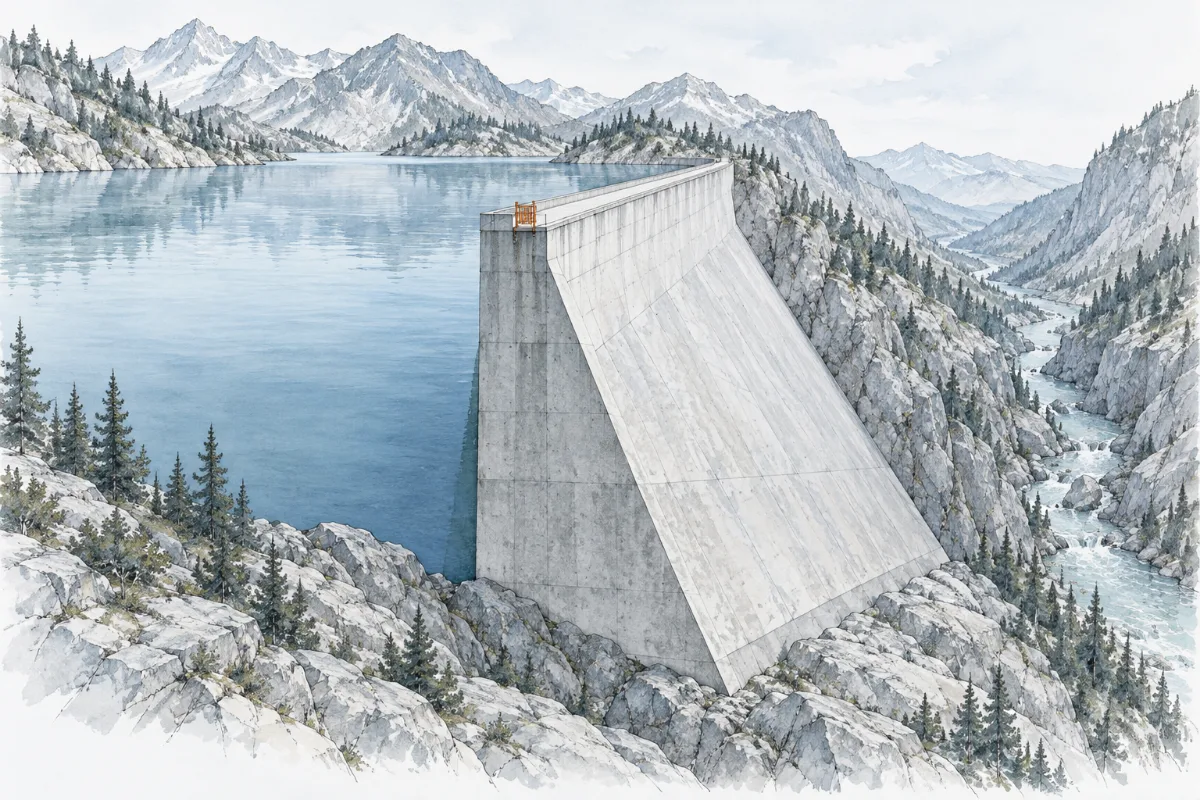
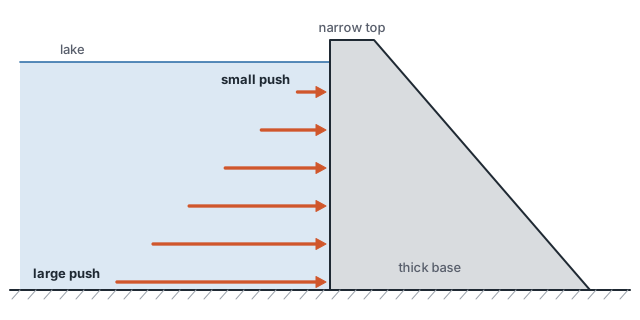
A concrete dam holds back a deep lake in the mountains. Seen from the side, it is not a plain wall: it is narrow at the top, where a road runs along it, and enormously thick at the bottom. The builders poured thousands of tonnes of extra concrete into the bottom of the wall. Why spend all that concrete down there, and not at the top? By the end of this part you can explain it, and work out how hard the water pushes at the bottom.
 (enlarge)
Water pushes on everything in it
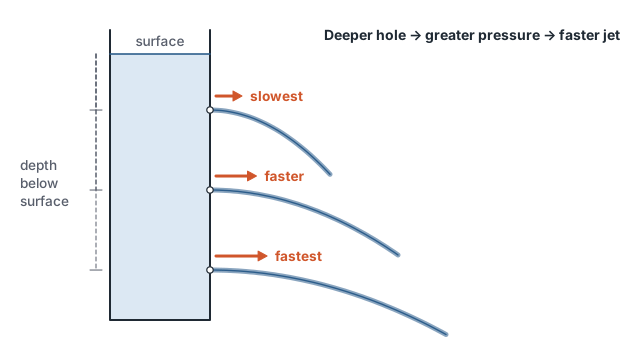
A liquid presses on every surface it touches: on the bottom of its container, on the sides, and on anything dipped into it. Swim down to the bottom of a deep pool and you feel it on your ears. Make a few holes in the side of a tall plastic bottle full of water, and water squirts out of every hole, sideways. The water inside pushes outwards on the walls, so where there is a hole, it pushes water out.
At any point in a liquid, the pressure pushes equally in all directions: down, up and sideways. That is why a liquid pushes on the walls of its container as well as on the bottom.
 (enlarge)
Deeper means more pressure
The water squirts out fastest from the lowest hole, because the pressure there is greatest. Think of a point deep in the water: all the water above it is pressing down on it, because of the water's weight. The deeper the point, the taller the column of water above it, so the greater the weight pressing on each square metre, and the greater the pressure. The pressure beneath the surface of a liquid increases with depth.
Depth is measured straight down from the surface of the liquid to the point, not up from the bottom of the container.
Trap: “A wide tank of water has more pressure at the bottom than a narrow tube of water, because it holds much more water.” At the same depth, the pressure is the same. The wide tank has more water, but that water also presses on a bigger area of bottom, so each square metre carries the same weight as in the narrow tube. Only the depth and the liquid matter, not the shape or the amount.
Denser liquid, more pressure
Now compare two liquids at the same depth. Sea water is denser than fresh water: each cubic metre has more mass and so more weight. A column of sea water presses down harder than a column of fresh water of the same height. At the same depth, the pressure is greater in a denser liquid.
Worked example
Wide tank, narrow tube
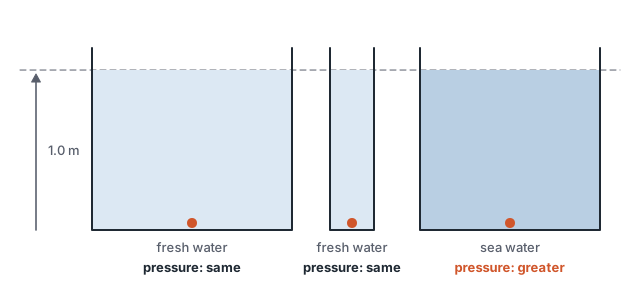
Three containers stand on a bench. A wide tank and a narrow tube both hold fresh water 1.0 m deep. A third tank holds sea water, also 1.0 m deep. How do the pressures at their bottoms compare?
 (enlarge)
The wide tank and the narrow tube have the same depth of the same liquid, so the pressure at the bottom is the same in both, even though the tank holds far more water. The sea water is denser, so at the same depth the pressure at the bottom of its tank is greater.
Supplement: The change in pressure, ∆p = ρg∆h
The weight of the liquid above gives an equation for the extra pressure. When you go down a depth ∆h (say “delta h”, the change in depth) into a liquid of density ρ (the Greek letter rho), the pressure increases by
∆p = ρg∆h
where ∆p is the change in pressure in pascals, ρ is the density in kg/m³, g is the gravitational field strength, 9.8 N/kg, and ∆h is the change in depth in metres. Going down from the surface, ∆h is simply the depth, and ∆p is the pressure of the liquid, in addition to the pressure of the air above it.
The equation says the same as the last two sections, in numbers: twice as deep, twice the extra pressure; a liquid twice as dense, twice the extra pressure.
Free play: nothing here is marked or saved
The dam and its lake
Water presses on the wall of a dam. Does a longer lake, with far more water in it, press harder? Change the lake, the water’s depth and the point on the wall.Supplement
Try: Make the lake ten times longer. Does ∆p change?
- Depth below surface ∆h
- 20 m
- Extra pressure ∆p
- 196 000 Pa
- Water in the lake
- 2.25 million t
∆h = water depth − height = 30 m − 10 m = 20 m
∆p = 1000 kg/m³ × 9.8 N/kg × 20 m = 196 000 Pa
- Ten times the lake, ten times the water, and the same pressure on the wall: only the depth below the surface counts, as with W05’s wide tank and narrow tube.
- ∆h is measured down from the surface. Raise the water and the same point on the wall is deeper.
- Twice as deep, twice the extra pressure: the arrows grow evenly down the wall.
About this model. The picture squeezes the lake’s length: a lake 5 km long is more than a hundred times as long as this dam is tall. The amount of water is a rough one, half the depth at the wall × the length × a valley 300 m wide, and 1 m³ of water has a mass of 1 tonne. ∆p is the water’s pressure only, on top of the air’s, with ρ = 1000 kg/m³ and g = 9.8 N/kg.
Worked example
The bottom of a swimming pool
A swimming pool is 2.0 m deep. The density of water is 1000 kg/m³. By how much is the pressure at the bottom greater than the pressure at the surface?
∆p = ρg∆h = 1000 kg/m³ × 9.8 N/kg × 2.0 m = 19 600 Pa, or 19.6 kPa. At the shallow end, 1.0 m deep, it is only half as much: 9800 Pa.
Worked example
A diver going deeper
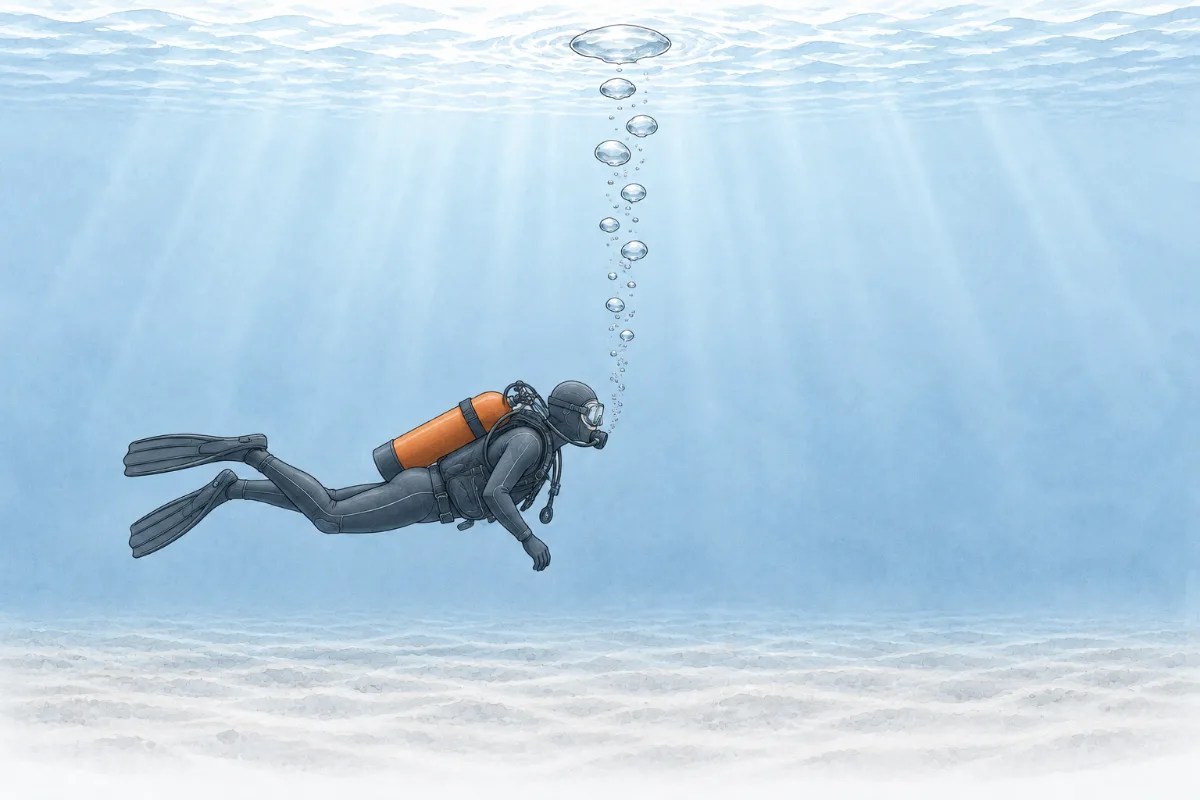
A diver swims down from 5.0 m to 15 m below the surface of the sea. Sea water has a density of 1030 kg/m³. By how much does the pressure on the diver increase?
 (enlarge)
The change in depth is ∆h = 15 m − 5.0 m = 10 m. So ∆p = ρg∆h = 1030 kg/m³ × 9.8 N/kg × 10 m = 100 940 Pa ≈ 101 000 Pa. Every 10 m of sea water adds about as much pressure as the whole of the air above us. The bubbles the diver breathes out get bigger as they rise because the pressure of the water around them gets smaller.
Trap: “∆h is the height of the water, measured up from the sea bed.” ∆h is a change in depth, measured down from the surface. For a diver who goes from 5.0 m to 15 m, ∆h is 10 m, whatever the depth of the sea below.
Worked example
Finding a density
A pressure sensor is lowered into a tank of an unknown liquid. Moving it 0.30 m deeper raises its reading by 2.35 kPa. What is the density of the liquid?
Change kPa into Pa first: ∆p = 2.35 kPa = 2350 Pa. Rearrange ∆p = ρg∆h for the density: ρ = ∆p ÷ (g∆h) = 2350 Pa ÷ (9.8 N/kg × 0.30 m) = 799 kg/m³ ≈ 800 kg/m³. That matches paraffin, which is less dense than water.
Lower a pressure sensor
Now measure how the pressure in a liquid changes, and what it depends on.
What is on the bench. Three tall tubes held upright by clamps, filled to the same level with water, brine (salty water, 1200 kg/m³) and oil (900 kg/m³). A scale beside each tube gives the depth, measured down from the liquid's surface. A pressure sensor, the small orange disc, sits on the end of a rigid rod, and a gauge shows its reading in kPa. The gauge reads the pressure of the liquid only: it reads zero at the surface, where only the air presses.
What you do. Predict how the reading will change as the sensor goes deeper. Lower it into the water, 0.10 m at a time, and watch the graph of pressure against depth. Turn the sensor to face the side of the tube and see whether the water pushes sideways. Then predict which liquid gives the steepest line, and try the brine and the oil.
What the experiment showed
Do the experiment before you read on. In the water, the reading rose by the same amount, 0.98 kPa, for every 0.10 m, so the graph of pressure against depth was a straight line through the origin: the pressure is proportional to the depth. When the sensor turned to face the side, the reading did not change, because at any depth the water pushes sideways just as hard as it pushes down.
| Depth / m | Water / kPa | Brine / kPa | Oil / kPa |
|---|---|---|---|
| 0.20 | 1.96 | 2.35 | 1.76 |
| 0.40 | 3.92 | 4.70 | 3.53 |
| 0.60 | 5.88 | 7.06 | 5.29 |
| 0.80 | 7.84 | 9.41 | 7.06 |
The densest liquid, brine, gave the steepest line and the least dense, oil, the shallowest. At every depth, the pressure was greatest in brine and smallest in oil. In the Supplement, the gradient of each line is ρg: for the oil, 7.06 kPa at 0.80 m gives ρ = 7060 ÷ (9.8 × 0.80) ≈ 900 kg/m³.
Case closed
The water behind a dam pushes sideways on the wall, because at every point it pushes equally in all directions. The deeper the point, the greater the pressure, so the push on each square metre of the wall grows steadily from the surface down to the bottom. Near the top, the wall only has to hold back a small pressure. At the bottom, it has to hold back the greatest pressure of all, so it has to be strongest and thickest there. In numbers: 10 m below the surface, water pushes on the wall with an extra 98 000 Pa; 40 m down, with 392 000 Pa, four times as much.
 (enlarge)
The pressure beneath the surface of a liquid increases with depth and is greater in a denser liquid. In the Supplement, the change in pressure is ∆p = ρg∆h.
About this model
The tubes, the liquids and the sensor are simulated. The densities are exact (water 1000, brine 1200 and oil 900 kg/m³), g is 9.8 N/kg and the liquids do not move, so the reading is exactly ρgh for the depth h of the sensor's face below the surface. The level in each tube stays the same as the sensor goes in; in a real narrow tube, the rod and the sensor would push the level up a little. The gauge leaves out the pressure of the air on the surface, which is the same for all three liquids, and a real sensor's readings would wander by a few hundredths of a kilopascal.