Contents
Part 1 of 2
Where electricity comes from
identify / describe
Try it yourself
The diagram shows the main parts of a gas-fired power station, labelled A to D. Match each part to what it does.
identify: name or select. describe: give the features or what happens.
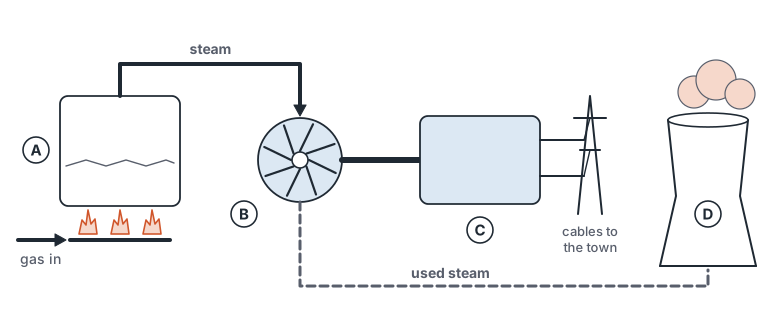 (enlarge)
Your saved work
Answers, earlier attempts and your Pause and check notes stay in this browser. Export a copy to keep, to move to another device or to hand to your teacher. Importing a copy keeps your current answers and adds earlier attempts.
Scope and sources
Cambridge IGCSE Physics 0625 · 2026–2028 v2 · Original learning materials.
Useful energy and electrical power obtained from chemical energy in fossil fuels and biofuels, water (waves, tides and water behind hydroelectric dams), geothermal resources, nuclear fuel, light from the Sun with solar cells, infrared and other radiation from the Sun heating water in solar panels, and wind, including the boiler, turbine and generator where they are used (1.7.3.1); the advantages and disadvantages of each method in terms of renewability, availability, reliability, scale and environmental impact (1.7.3.2); efficiency in qualitative terms (1.7.3.3). Supplement: the Sun’s radiation as the main source of energy for all our energy resources except geothermal, nuclear and tidal (1.7.3.4); energy released by nuclear fusion in the Sun (1.7.3.5); research into nuclear fusion for large-scale electricity (1.7.3.6); (%) efficiency = useful energy output ÷ total energy input (× 100 %) and the same with power (1.7.3.7). How a generator works (4.5), nuclear fission and fusion in detail (5.1) and the National Grid are left to later modules.
Apparatus, amounts and times in the experiment are illustrative. Real practical work follows a teacher-approved safety method.
Official Cambridge syllabus