Contents
Part 1 of 2
Light split into colours
identify
Try it yourself
A narrow beam of white light passes through a glass prism. The diagram shows three of the coloured rays that leave it, A, B and C, landing on a screen. One is red, one is green and one is violet. Match each ray to its colour.
identify: name or select.
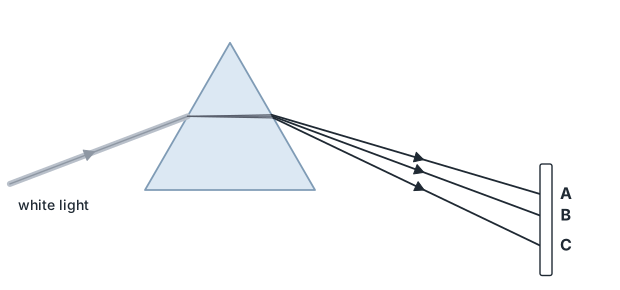 (enlarge)
Your saved work
Answers, earlier attempts and your Pause and check notes stay in this browser. Export a copy to keep, to move to another device or to hand to your teacher. Importing a copy keeps your current answers and adds earlier attempts.
Scope and sources
Cambridge IGCSE Physics 0625 · 2026–2028 v2 · Original learning materials.
The dispersion of white light by a glass prism (3.2.4.1); the seven colours of the visible spectrum in order of frequency and of wavelength (3.2.4.2); Supplement: monochromatic light, of a single frequency (3.2.4.3); the main regions of the electromagnetic spectrum in order of frequency and of wavelength (3.3.1); all electromagnetic waves travelling at the same high speed in a vacuum (3.3.2); typical uses of each region (3.3.3) and the harmful effects of too much of some of them (3.3.4); Supplement: the speed of electromagnetic waves, 3.0 × 10⁸ m/s in a vacuum and approximately the same in air (3.3.6). Communication with electromagnetic waves (3.3.5 and 3.3.7–3.3.10) is in its own module; v = fλ is in Waves in a ripple tank; the wavelength of each region, the photon and how the eye sees colour are not covered here.
Apparatus, amounts and times in the experiment are illustrative. Real practical work follows a teacher-approved safety method.
Official Cambridge syllabus