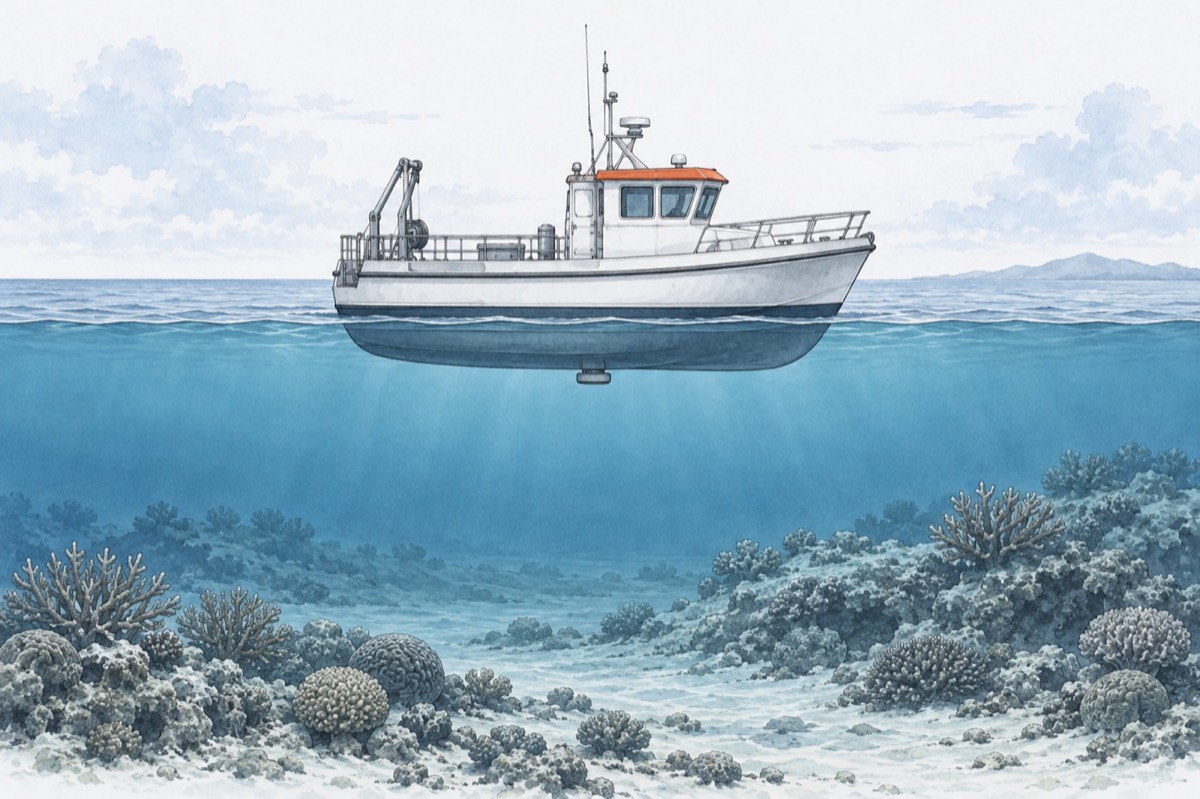
A small survey ship crosses a coral reef. Its chart needs the depth of the water every few metres, yet nobody lowers a rope with a weight on the end. Instead, a device under the hull sends sound down into the sea and listens. How can a sound measure depth, and why can nobody on deck hear it? Predict what the device would notice when the ship passes over a sandbank that rises towards the surface. In this part you will meet ultrasound and see how its echoes measure depths and find hidden flaws.
 (enlarge)
Sound too high to hear
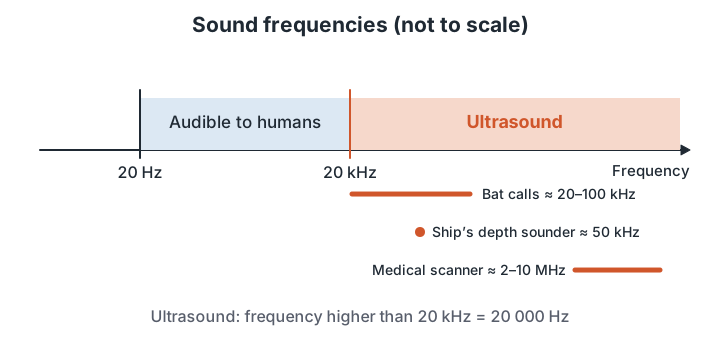
Human ears detect sound with frequencies from about 20 Hz to about 20 000 Hz. Sound can also vibrate faster than any ear can follow. Ultrasound is sound with a frequency higher than 20 kHz, that is, higher than 20 000 Hz.
Ultrasound is still sound. It is a longitudinal wave made by a vibrating source, and like all sound it needs a medium: it travels through air, water, soft tissue and steel, but not through a vacuum. Only its frequency is too high for us to hear. Bats and dolphins make and hear ultrasound. Machines make it with a transducer, a device that vibrates to send out a pulse and also detects the returning echo.
Frequencies of ultrasound are usually written in kilohertz or megahertz:
- 1 kHz = 1000 Hz, so 20 kHz = 20 000 Hz;
- 1 MHz = 1 000 000 Hz, so a 3 MHz scanner vibrates 3 000 000 times each second.
 (enlarge)
Worked example
Can you hear it?
Classify each sound as audible to a young person or as ultrasound: a 15 kHz whistle, a 40 000 Hz cleaning bath, a 3 MHz scanner.
Put each in hertz first. The whistle is 15 kHz = 15 000 Hz, which is below 20 000 Hz, so it is audible (though many adults can no longer hear it). The cleaning bath is 40 000 Hz = 40 kHz, higher than 20 kHz, so it is ultrasound. The scanner is 3 MHz = 3 000 000 Hz, far higher than 20 000 Hz, so it is ultrasound. A sound at exactly 20 kHz sits on the boundary; the definition needs “higher than” 20 kHz.
Trap: “Ultrasound travels faster because its frequency is higher.” The speed of sound is set by the medium, not by the frequency. In the same sea water, a 50 kHz pulse and a 500 Hz hum both travel at about 1500 m/s.
Supplement: Sonar measures depth
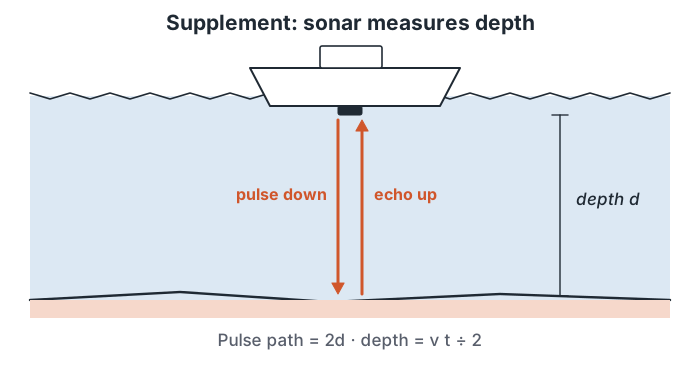
Supplement. Sonar uses echoes of ultrasound to find depths and distances under water. The transducer under the ship sends a short pulse of ultrasound straight down. The pulse travels through the water, reflects from the seabed and returns as an echo, which the transducer detects. Anything in the path reflects part of the pulse: the seabed, a wreck or a shoal of fish. A timer records the time t from sending the pulse to receiving its echo. In that time the pulse has travelled down to the seabed and back up again, a distance of twice the depth. So
depth = (speed × time) ÷ 2 = v t ÷ 2
The speed of sound in sea water is about 1500 m/s; it changes a little with temperature and saltiness. Each pulse is short, so its echo returns and is timed before the next pulse is sent. As the ship sails, the sonar repeats this many times each second and draws the depth as a line: a profile of the seabed.
 (enlarge)
Worked example
How deep is it here?
Supplement. A ship's sonar receives the echo from the seabed 0.12 s after the pulse is sent. Sea water carries sound at 1500 m/s. Calculate the depth.
In 0.12 s the pulse travels 1500 m/s × 0.12 s = 180 m. That is the path down and back up, so the depth is half of it: 180 m ÷ 2 = 90 m. Check: a seabed 90 m down gives a path of 180 m, and 180 m ÷ 1500 m/s = 0.12 s.
If a shoal of fish swims under the ship, part of the pulse reflects from the fish before it reaches the seabed. That echo returns sooner, so the screen shows something shallower than the floor. Fishing boats use sonar in this way to find fish. A shorter echo time always means a nearer reflecting surface.
Supplement: Seeing inside without cutting
Supplement. The same echo timing works inside the human body and inside solid materials.
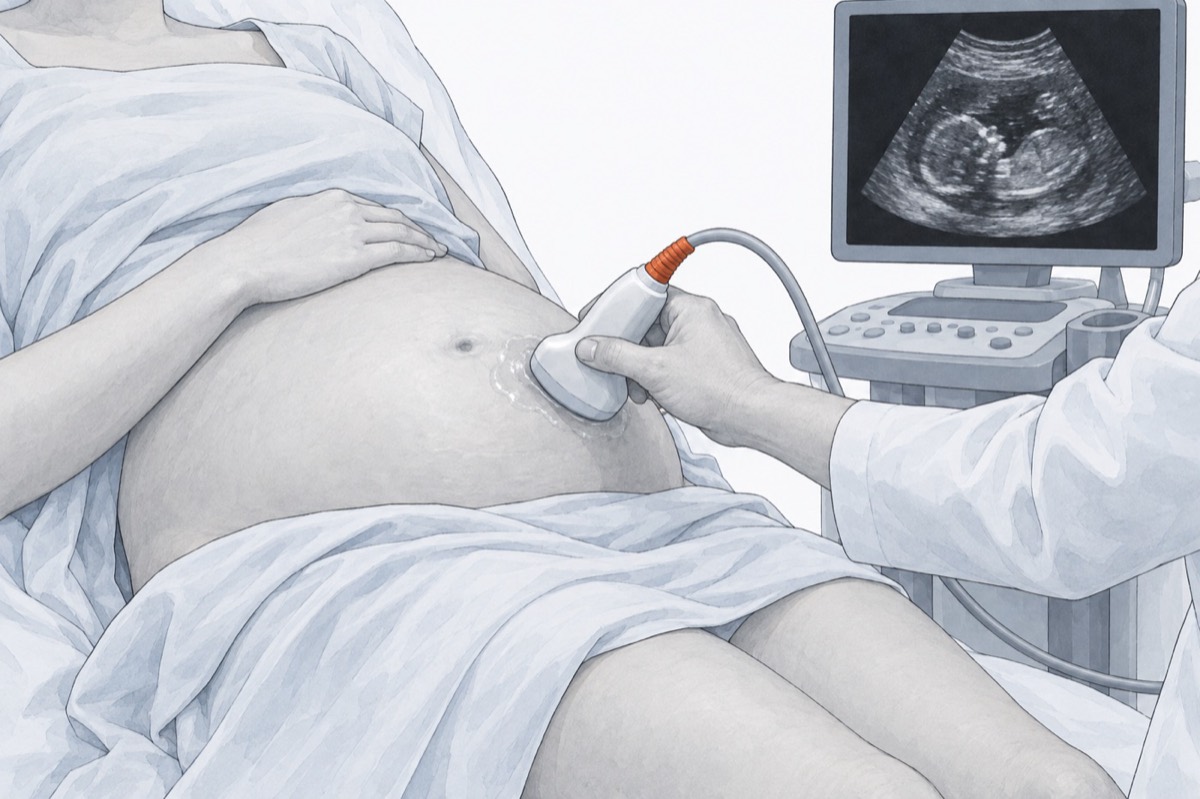
Medical scanning of soft tissue. A probe pressed on the skin sends short pulses of ultrasound into the body. At each boundary between different tissues, for example between the fluid around an unborn baby and the baby's skin, part of each pulse is reflected. The time of each echo tells how deep that boundary is, and a computer builds a picture from many echoes.
Before the scan, a layer of gel is spread on the skin. It removes the air between the probe and the skin, because an air gap would reflect most of the ultrasound before it entered the body.
Hospitals use ultrasound to scan unborn babies and soft organs such as the liver and the heart. X-rays are ionising radiation: they carry enough energy to knock electrons out of atoms, and this can damage cells. Ultrasound is a sound wave, so it is not ionising, and at the levels used in scans it is not known to harm cells. That is why it is chosen for an unborn baby.
 (enlarge)
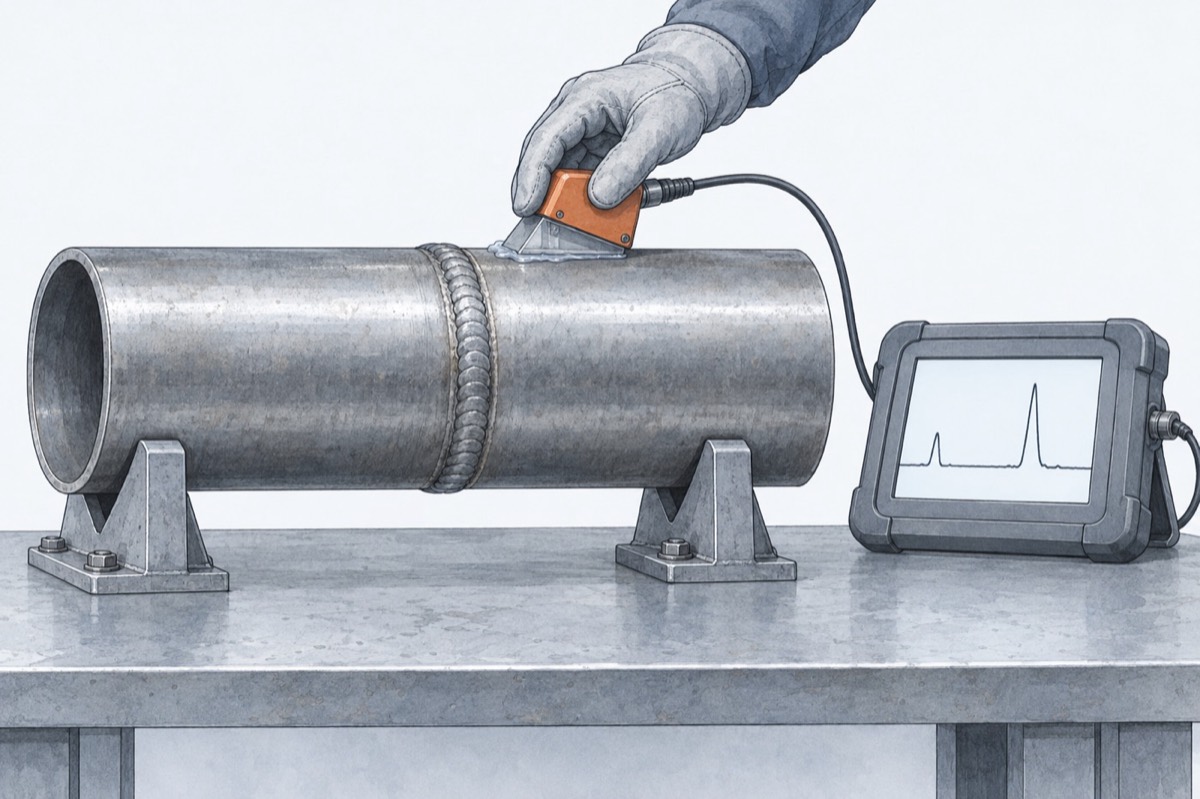
Non-destructive testing of materials. “Non-destructive” means checking a material without cutting or damaging it. A technician moves a probe along a steel pipe, a rail or an aircraft part. Each pulse travels through the metal and reflects from the far surface, the back wall. If there is a crack inside, part of the pulse reflects from the crack and returns earlier. The screen of the flaw detector then shows an extra echo before the back-wall echo, and the time of that echo gives the depth of the crack. In steel these echo times are only a few microseconds (µs): 1 µs = 0.000 001 s.
 (enlarge)
Worked example
How deep is the crack?
Supplement. Ultrasound travels through steel at 6000 m/s. On a steel plate the back-wall echo arrives 4.0 µs after the pulse and a crack echo arrives 2.0 µs after the pulse (1 µs = 0.000 001 s). Calculate the thickness of the plate and the depth of the crack in millimetres.
Change the times to seconds first: 4.0 µs = 0.000 004 0 s and 2.0 µs = 0.000 002 0 s. Back wall: the path is 6000 m/s × 0.000 004 0 s = 0.024 m, there and back, so the plate is 0.024 m ÷ 2 = 0.012 m = 12 mm thick. Crack: the path is 6000 m/s × 0.000 002 0 s = 0.012 m, so the crack is 0.012 m ÷ 2 = 0.006 m = 6 mm below the surface. The crack echo arrives at half the back-wall time, so the crack is halfway through the plate.
Try it in the experiment
Part 2 of the experiment takes you to sea. Decide whether the crew can hear the 50 kHz pulses, time one echo from the seabed, then sail the ship across the reef and watch the depth profile build up from the echo times. The sea, the ship and the reef are a model, with the vertical scale stretched so that the seabed fits on the screen.
time after the pulse / s
No pulse sent yet
Not to scale · depth stretched
Returning to these ideas
Try the return questions at the next lesson without rereading first, then mix them with earlier wave questions after one or two weeks and again several weeks later. These are suggested review intervals, adjustable by your teacher. An immediate correct retry is useful practice; it does not show that you remembered the idea days later. The final check uses new cases, and its self-check criteria are teaching points, not official Cambridge marks.