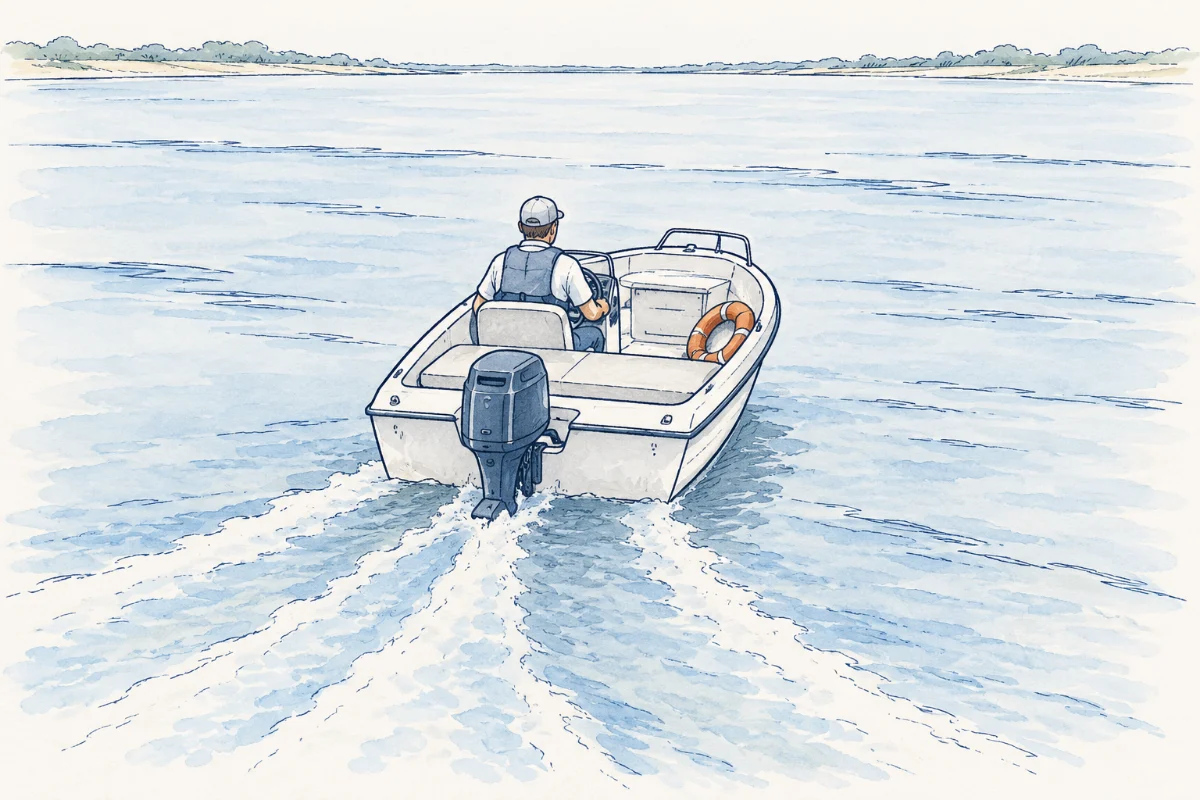
A small motorboat leaves a jetty and points straight across a river. Its engine pushes it through the water at a steady speed, and the pilot never turns the wheel. Yet the boat lands on the far bank well downstream of the point opposite the jetty. It pointed straight across the whole time, so why did it not go straight across? And how fast was it really moving? Everything in this part is Supplement content.
 (enlarge)
Supplement: Size only, or size and direction
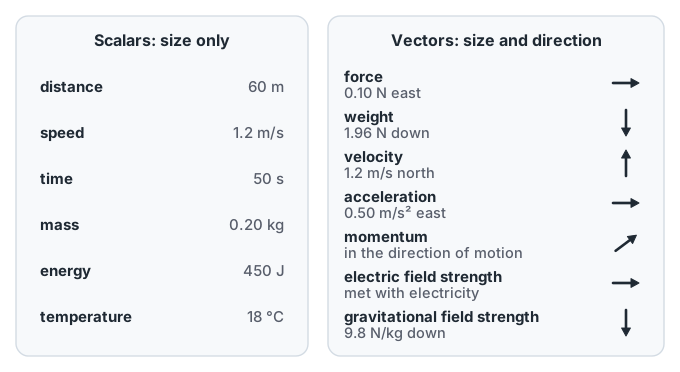
Some quantities are just a size. The temperature of the river is 18 °C. The trip takes 50 s. The boat has a mass of 300 kg. Asking “18 °C in which direction?” makes no sense. A quantity that has a size only is a scalar. Its size is also called its magnitude.
Other quantities only make sense with a direction. A force of 0.10 N on the puck could push it east, north or any other way, and each one moves it differently. A quantity that has a size and a direction is a vector. You draw a vector as an arrow: its length shows the size, and it points in the direction.
| Scalars: size only | Vectors: size and direction |
|---|---|
| distance | force |
| speed | weight |
| time | velocity |
| mass | acceleration |
| energy | momentum |
| temperature | electric field strength |
| gravitational field strength |
Some of these come in pairs, one of each kind. Speed is a scalar: the boat moves at 1.3 m/s. Velocity is a vector: the boat moves at 1.3 m/s in a direction a little downstream of straight across. Two boats can have the same speed but different velocities, if they move in different directions.
Mass and weight are another pair. The puck’s mass, 0.20 kg, is a scalar: it is the amount of matter in it. Its weight is the pull of the Earth on it, 1.96 N, and that pull points down, so weight is a vector. The gravitational field strength g is a vector too: 9.8 N/kg, downwards, towards the centre of the Earth. Force, velocity and acceleration all point somewhere too. You meet momentum in Momentum and collisions, and electric field strength in Static electricity and electric fields.
 (enlarge)
Trap: “A minus sign makes it a vector.” A temperature of −5 °C is still a scalar. The minus sign shows a value below zero on the scale, not a direction in space. A vector has a direction you could point to.
Trap: “Speed and velocity are the same thing.” A car going round a roundabout at a steady 10 m/s keeps the same speed. Its direction keeps changing, so its velocity keeps changing.
Worked example
Sorting a bike ride
Sara rides her bike 3.0 km to school in 600 s, at an average speed of 5.0 m/s. On the long straight road her velocity is 6.0 m/s north. Sara and her bike have a mass of 60 kg, so their weight is 588 N downwards. Near the school she brakes, and the brakes slow her with a force of 90 N towards the south. The ride uses 40 kJ of energy from her food, on a morning at 12 °C. Sort the quantities into scalars and vectors.
Ask of each one: does it need a direction to make sense? The distance, 3.0 km, the time, 600 s, and the average speed, 5.0 m/s, are scalars. So are the mass, 60 kg, the energy, 40 kJ, and the temperature, 12 °C. The velocity, 6.0 m/s north, the weight, 588 N down, and the braking force, 90 N south, are vectors. Each vector was given with a direction. If one were given without, the answer would be incomplete: “a force of 90 N” leaves out which way it pushes.
Pull east and north at once
Back to the air table. This time two meters pull the puck at the same time, at right angles to each other.
What is on the bench. The same air table, 1.00 m from west to east and 0.80 m from south to north, with the orange puck of 0.20 kg. Meter E pulls the puck towards the east with 0.08 N. Meter N pulls it towards the north with 0.06 N. Each meter moves with the puck and keeps its pull the same size and in the same direction. The overhead camera looks straight down on the table. Seen from straight above, east and north stay at right angles on the screen, so the angles in the picture are the true angles. The puck starts at rest near the south-west corner.
What you do. Before you let go, predict which way the puck will move. Will it go towards meter E, towards meter N, or somewhere in between? If in between, will it be closer to east or closer to north? Then let go, and watch the dots. Last, use the scale drawing on the camera view to find the size of the single force that would do the same, and type it in.
t = 0.00 s · speed 0.00 m/s · resultant after release
Grid 0.1 m · arrows: 1 square = 0.02 N
What the experiment showed
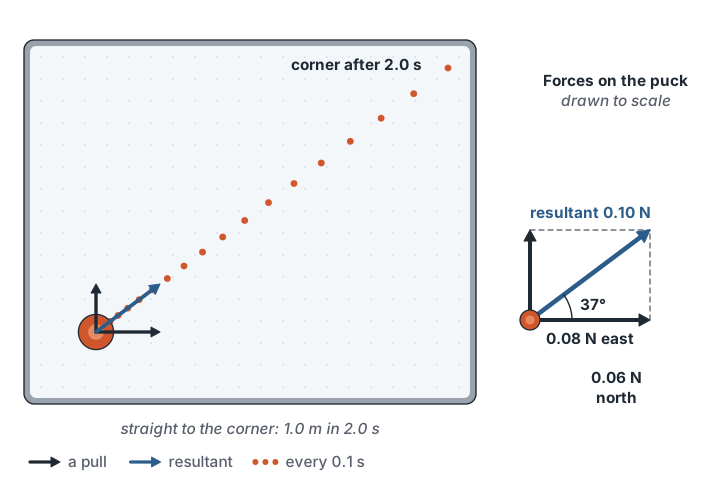
Do the experiment before you read on. The puck did not move towards meter E, and it did not move towards meter N. It moved in a straight line between them, closer to east than to north. The gaps between the dots grew, so it sped up. It crossed the table to the north-east corner, 1.0 m away, in 2.0 s, and reached 1.0 m/s.
The direction of the line was 37° north of east. Two pulls in two directions made the puck move along a single straight line. The two pulls together acted like one force along that line. That single force is their resultant. On the scale drawing it was 0.10 N long, pointing along the line of the dots.
 (enlarge)
Here is a check. In part 1, a resultant of 0.10 N east made the same puck speed up from rest. Its speed rose by 0.5 m/s every second. In this run the speed also rose by 0.5 m/s every second, to 1.0 m/s after 2.0 s. So the two pulls, 0.08 N and 0.06 N at right angles, did exactly what a single pull of 0.10 N would do.
Notice something odd about the numbers. 0.08 N + 0.06 N = 0.14 N, but the resultant was only 0.10 N. The two pulls are not in the same direction, so they cannot simply be added. Meter E pulls nothing towards the north, and meter N pulls nothing towards the east. Each one helps only partly with motion along the diagonal.
Supplement: Two vectors at right angles
When two forces, or two velocities, act at right angles, there are two ways to find their resultant. Both give the same answer.
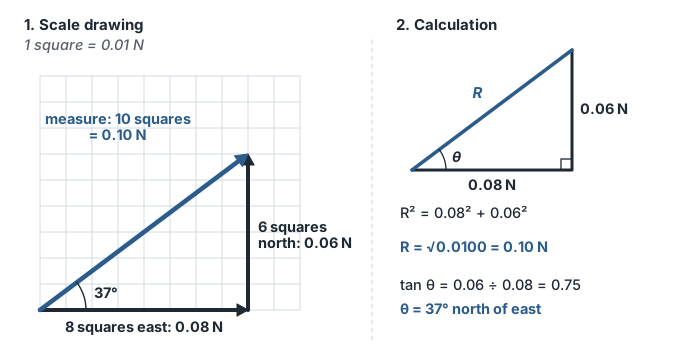
By scale drawing. Choose a scale, such as 1 square = 0.01 N, or 1 cm = 10 N for bigger forces. Draw the first vector as an arrow to scale, in its direction. From the tip of that arrow, draw the second vector to scale, at right angles to the first. The arrows go tip to tail, like two stages of a walk. The resultant is the arrow from the start of the first to the tip of the second. Measure its length and change it back with your scale. Then measure its angle with a protractor.
By calculation. The two vectors and the resultant make a right-angled triangle, and the resultant is its longest side. Pythagoras’ theorem gives its size: resultant² = first² + second². The tangent of the angle gives its direction: tan θ = opposite side ÷ adjacent side. For the puck, resultant² = 0.08² + 0.06² = 0.0064 + 0.0036 = 0.0100, so the resultant is √0.0100 = 0.10 N. And tan θ = 0.06 ÷ 0.08 = 0.75, so θ = 37°, measured from east towards north.
 (enlarge)
A direction needs a starting line. Always say which direction you measured the angle from: “37° north of east”. The angle 37° measured from north would be a different direction. A compass direction or a sketch with the angle marked also works.
Trap: “Just add the two sizes: 0.08 N + 0.06 N = 0.14 N.” Forces add like that only along the same line. At right angles, the resultant is always less than their sum and more than either one. Here it is 0.10 N.
Trap: “The resultant points halfway between the two.” It points closer to the bigger vector. The east pull, 0.08 N, was bigger than the north pull, 0.06 N, so the puck moved at 37° north of east, closer to east than to north.
Worked example
Two ropes on a sledge
On smooth ice, Ali pulls a sledge towards the east with a force of 40 N. At the same time Bea pulls it towards the north with a force of 30 N. Find the resultant force on the sledge, (a) by scale drawing and (b) by calculation.
(a) Choose a scale of 1 cm = 10 N. Draw a line 4.0 cm long towards the east. From its tip, draw a line 3.0 cm long towards the north. Join the start of the first line to the tip of the second. That line measures 5.0 cm, so the resultant is 5.0 × 10 N = 50 N. A protractor at the start gives an angle of 37° from the east line, so its direction is 37° north of east.
(b) Resultant² = 40² + 30² = 1600 + 900 = 2500, so the resultant is √2500 = 50 N. tan θ = 30 ÷ 40 = 0.75, so θ = 37°, north of east. Both methods agree. A scale drawing is only as good as your ruler, so its answer may be a little out, such as 49 N or 38°.
Worked example
Crossing the river
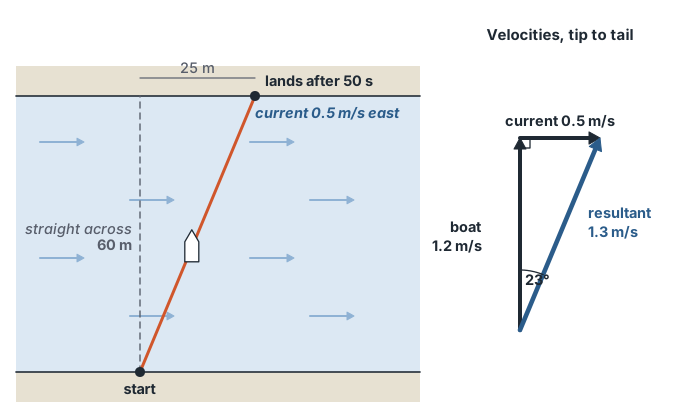
The boat in the picture moves through the water at 1.2 m/s, pointing straight across a river 60 m wide. The current carries the water, and the boat with it, downstream at 0.5 m/s. (a) Find the resultant velocity of the boat. (b) How long does it take to cross? (c) How far downstream of the point opposite the jetty does it land?
(a) The two velocities are at right angles: 1.2 m/s across and 0.5 m/s downstream. Resultant² = 1.2² + 0.5² = 1.44 + 0.25 = 1.69, so the resultant velocity is √1.69 = 1.3 m/s. tan θ = 0.5 ÷ 1.2 = 0.42, so θ = 23°. The boat moves at 1.3 m/s, 23° downstream of straight across.
(b) The current carries the boat along the river, not across it. So only the 1.2 m/s across counts for crossing the 60 m. Time = distance ÷ speed = 60 m ÷ 1.2 m/s = 50 s.
(c) During those 50 s, the current carries the boat 0.5 m/s × 50 s = 25 m downstream. The boat moves 1.3 m/s × 50 s = 65 m in all, along a straight line slanting downstream.
To land straight opposite the jetty, the pilot would have to point the boat partly upstream. Then part of its velocity through the water would cancel the current.
Case closed
 (enlarge)
The boat pointed straight across, but the current carried it downstream at the same time. Its real velocity was the resultant of the two: 1.3 m/s, at 23° downstream of straight across. It crossed the 60 m river in 50 s and landed 25 m downstream. Velocity and force are vectors: they have a size and a direction. Speed, distance, time, mass, energy and temperature are scalars, with a size only. Two vectors at right angles combine into one resultant. Find it with a scale drawing, tip to tail, or with Pythagoras’ theorem and the tangent of the angle.
About this model
The air table and the meters are simulated. In a real lab, keeping two pulls exactly east and exactly north while the puck moves diagonally is very hard. Each meter would have to slide along with the puck. In the model each pull keeps the same size and the same direction the whole time. There is no friction and no air resistance, and the runs are shown at half speed, with the real times on the graph. The overhead camera looks straight down on the table, so right angles stay right angles. A photo taken at a slant would squash them.