Step out of a dim room into bright sunshine and for a moment everything is dazzling; walk back inside and the room looks dark until your eyes adjust. Something in your eye changed both times, and you did not decide to change it. In this part you find out what the iris does to the pupil as the light changes, why that protects your eye, and (Supplement) which muscles do the work.
 (enlarge)
Bright light and dim light
 (enlarge)
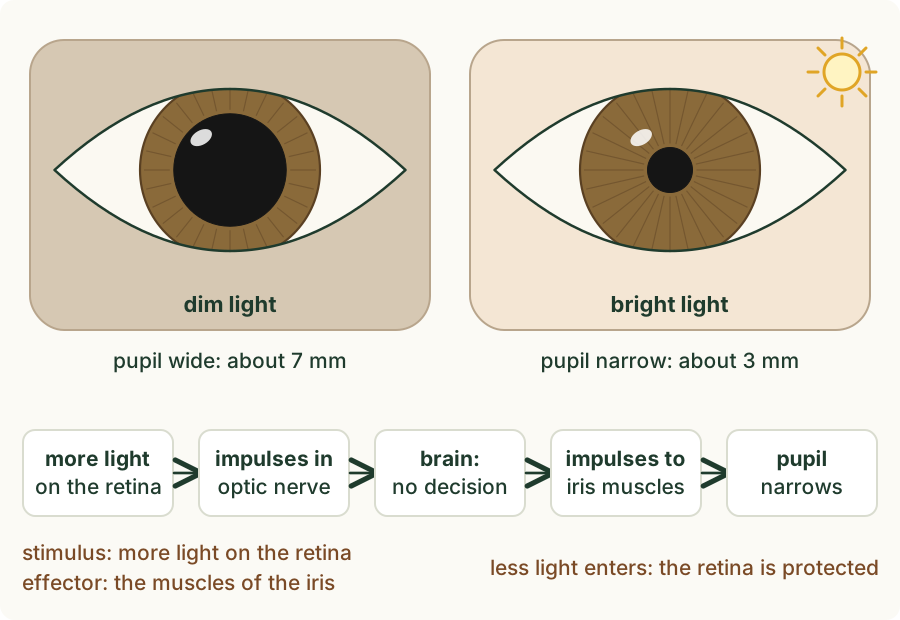
The pupil diameter is the distance across the pupil, measured in millimetres (mm). The iris changes it as the light intensity changes. Light intensity means how bright the light is.
- In bright light the iris makes the pupil narrower: its diameter gets smaller. Less light enters the eye, so the receptors in the retina are protected from damage by too much light.
- In dim light the iris makes the pupil wider: its diameter gets larger. More light enters the eye, so enough light reaches the retina for you to see.
This is the pupil reflex. Like the reflexes in the module on nerves and reflexes, it is automatic and rapid: you do not decide to make it. The stimulus is the change in light intensity, detected by light receptors in the retina. Impulses travel along the optic nerve to the brain, and impulses come back out to the muscles of the iris, the effector. The response is the change in pupil diameter. The path goes through the brain, but no decision is made on the way, so it is still a reflex.
Trap: "In bright light the eye gets smaller." Only the pupil gets smaller: the iris closes in round it. The eyeball stays the same size.
Trap: "You decide to make your pupils smaller when it is bright." You cannot choose your pupil's size. The pupil reflex is automatic: it happens without a decision.
Run the experiment below before you read on. First predict what the pupil will do when the lamp gets brighter. Then turn the desk lamp from setting 1 to setting 5 and watch the model eye's iris. The settings 1 (dim) to 5 (bright) only put the lamp in order of brightness; they are not measurements. The pupil diameters the model shows are typical values for a person, not measurements of your own eye. At setting 5 you read the diameter yourself, from a magnified front view with a millimetre scale; the model then reads the other four settings for you.
What the experiment showed
| Lamp setting | Pupil diameter (mm) |
|---|---|
| 1 (dim) | 7.5 |
| 2 | 6.0 |
| 3 | 4.5 |
| 4 | 3.5 |
| 5 (bright) | 3.0 |
As the lamp setting went up, the pupil diameter went down: the brighter the light, the narrower the pupil. The change was largest at the dim end, 1.5 mm for each setting from 1 to 3, and smaller at the bright end, where the pupil was already narrow. Less light reaching the retina in bright light protects it; more light in dim light lets you see.
(Supplement) Two muscles in the iris
 (enlarge)
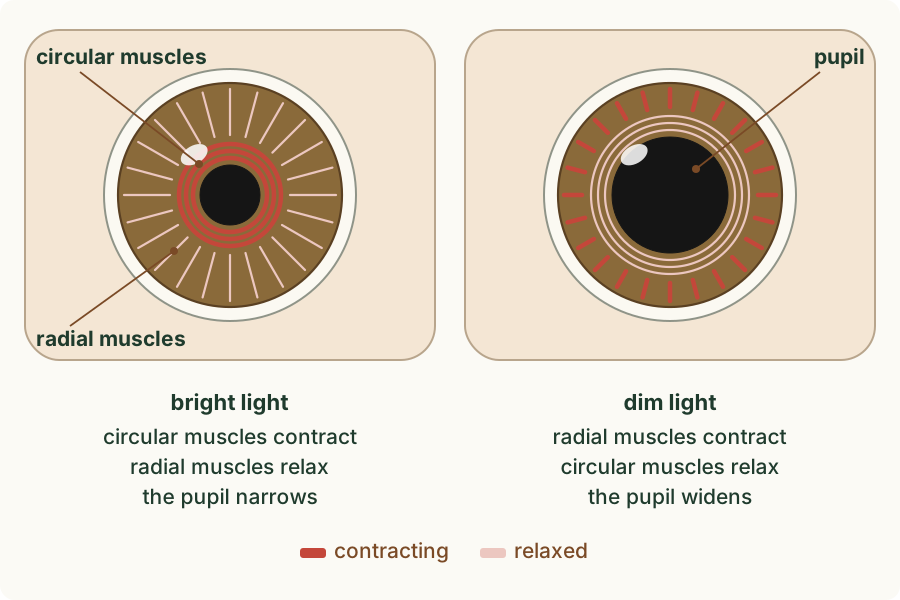
The iris contains two sets of muscle.
- The circular muscles form rings round the pupil. When they contract, the rings get smaller and the pupil narrows.
- The radial muscles run outwards from the pupil like the spokes of a wheel. When they contract, they pull the edge of the pupil outwards and the pupil widens.
A muscle can only pull when it contracts; it cannot push. So the two sets work against each other: when one set contracts, the other relaxes. Muscles that work against each other in this way are antagonistic.
- Bright light: the circular muscles contract and the radial muscles relax. The pupil narrows.
- Dim light: the radial muscles contract and the circular muscles relax. The pupil widens.
Trap: "The radial muscles contract to make the pupil smaller." Radial muscles run outwards, so contracting them pulls the pupil wider. The rings of circular muscle make it smaller.
Worked example
Reading a pupil diameter
A magnified front view of an eye has a millimetre scale beside it. The left edge of the pupil is at the 2.0 mm mark and the right edge is at the 6.5 mm mark. Find the pupil diameter.
The diameter is the distance from one edge of the pupil to the other: 6.5 − 2.0 = 4.5 mm. Measure across the black pupil only, not across the coloured iris: the iris is much wider.
Worked example
Describing a trend
Use the table in "What the experiment showed" to describe how pupil diameter changes with the lamp setting.
As the lamp setting increases from 1 to 5, the pupil diameter decreases, from 7.5 mm to 3.0 mm. The brighter the light, the narrower the pupil. The decrease is largest at the dim end (1.5 mm for each setting from 1 to 3: 7.5, 6.0, then 4.5 mm) and smallest at the bright end (3.5 to 3.0 mm between settings 4 and 5). A description quotes the data, with units: the highest and lowest values, and where the change is largest.
Worked example
Into a dark cinema
You walk from a sunny street into a dark cinema. Explain what happens to your pupils, and why it helps.
The light intensity falls, and light receptors in the retina detect the change. In a reflex, impulses reach the muscles of the iris, which make the pupil wider: its diameter increases. More light enters the eye, so enough light reaches the retina for you to see in the dim cinema. It happens automatically, without a decision. When you come back out into the sun, the reflex makes the pupils narrower again, which protects the retina.
Worked example
(Supplement) The muscles in dim light
Describe what the muscles of the iris do when the light becomes dim.
In dim light the radial muscles contract and the circular muscles relax. Contracting radial muscles pull the edge of the pupil outwards, so the pupil widens and more light enters. The two sets of muscles are antagonistic: one contracts while the other relaxes. In bright light it is the other way round.
Key idea: The pupil reflex changes the pupil's diameter as the light intensity changes. In bright light the pupil narrows, so less light enters and the retina is protected; in dim light it widens, so more light enters and you can see. It is automatic and rapid: a reflex. (Supplement) The circular and radial muscles of the iris are antagonistic: in bright light the circular muscles contract and the radial muscles relax, narrowing the pupil; in dim light the radial muscles contract and the circular muscles relax, widening it.