This part is Supplement content (syllabus 9.1.2, 9.1.3 and 9.1.4).
The heart is one organ, but it works as two pumps side by side, with the septum between them. Blood leaving the right side goes to the lungs; blood leaving the left side goes to the rest of the body. So where does one red blood cell go, starting in the body? In this part you follow it all the way round, and compare its trip with the trip round a fish.
Predict, then follow one cell
Predict first: a red blood cell starts in a capillary of the body. On one trip round, until it is back in the body, how many times does it pass through the heart? Once, twice, or four times (once through each chamber)? Make your prediction, then follow the cell in the experiment below before you read on. The model speeds the trip up: at rest a red blood cell takes about a minute to go round once.
What the model showed: two circulations
The cell passed through the heart twice on one trip round the body.
 (enlarge)
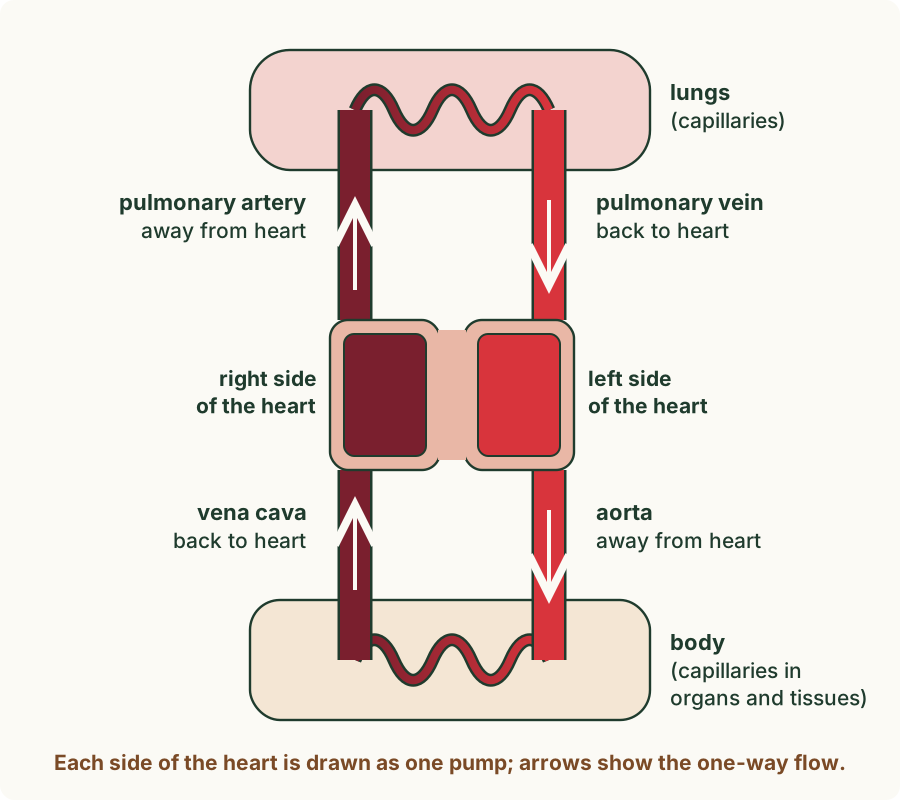
- The pulmonary circulation: right atrium → right ventricle → pulmonary artery → lungs, where the blood takes in oxygen and gives out carbon dioxide → pulmonary vein → left atrium.
- The systemic circulation: left atrium → left ventricle → aorta → the body's organs, where the blood gives oxygen to the cells and takes in carbon dioxide → vena cava → right atrium.
A mammal has a double circulation: on one trip round the body, the blood passes through the heart twice.
Worked example
The route of a cell
A red blood cell is in a capillary in the leg. List, in order, the parts it passes through until it reaches the aorta.
From the leg the cell travels back in the vena cava to the right atrium, then into the right ventricle. It is pumped along the pulmonary artery to the lungs, comes back in the pulmonary vein to the left atrium, passes into the left ventricle, and is pumped out into the aorta.
A fish has a single circulation
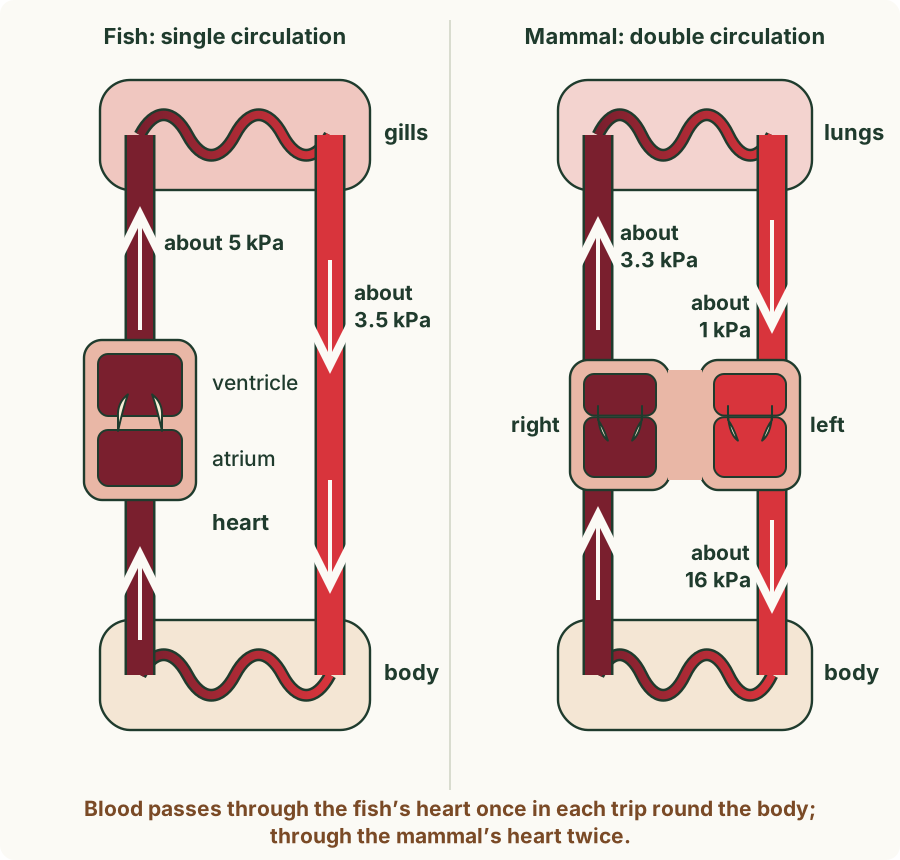
A fish's heart has one atrium and one ventricle. The ventricle pumps blood to the gills, where it takes in oxygen from the water. From the gills the blood flows straight on to the body's organs, and then back to the heart. On one trip round the body, the blood passes through the heart once: a single circulation.
 (enlarge)
Blood loses pressure as it squeezes through the narrow capillaries of the gills. In the model the fish's heart pumps blood out at about 5 kPa, but it reaches the body at only about 3.5 kPa, so it flows to the body's organs slowly.
Trap: "A fish has a single circulation because its blood is never deoxygenated." A fish's blood does lose oxygen in its body. "Single" means the blood passes through the heart once on each trip round the body; in a double circulation it passes through twice.
Why two circulations are better
In a mammal, blood also loses pressure in the capillaries of the lungs: it leaves the right ventricle at about 3.3 kPa and comes back to the left atrium at only about 1 kPa. But then it passes through the heart again.
- The left ventricle pumps the blood again, at a high pressure (about 16 kPa), so oxygenated blood reaches the body's organs quickly, and the cells get the oxygen and glucose they need for respiration quickly. Mammals are active and keep their bodies warm, so their cells respire fast.
- The lungs get blood at a lower pressure from the right ventricle. A high pressure would damage the thin walls of the lung capillaries and push fluid out of them into the air spaces.
- The septum keeps the two circulations apart, so oxygenated and deoxygenated blood do not mix and the blood sent to the body is fully oxygenated.
Both sides of the heart pump the same volume of blood: at rest, about 70 cm³ in each beat. If one side pumped more than the other, blood would build up in the lungs or in the body.
Worked example
Pressure after the gills
A fish's heart pumps blood out at about 5 kPa. After the gills it is at about 3.5 kPa. Explain one advantage of a mammal's double circulation over this single circulation.
In the fish, the blood loses pressure in the gill capillaries and is not pumped again before it goes to the body, so it reaches the body's organs at a lower pressure and more slowly. In a mammal, oxygenated blood from the lungs returns to the heart and the left ventricle pumps it again at a high pressure (about 16 kPa), so it reaches the organs quickly and the cells receive oxygen quickly.
Worked example
Same volume, different pressure
The left ventricle makes a pressure of about 16 kPa; the right ventricle about 3.3 kPa. A student says: "So the left ventricle pumps about five times as much blood." Is the student right?
No. Both ventricles pump the same volume in each beat, about 70 cm³ at rest, because all the blood that goes through the lungs comes back to the left side and goes round the body. The left ventricle pumps it at a higher pressure, to push it all round the body; it does not pump more of it.
Key idea: (Supplement) A fish has a single circulation: its heart pumps blood to the gills and from there straight to the body, so the blood passes through the heart once on each trip round the body. A mammal has a double circulation: the right side of the heart pumps blood to the lungs (the pulmonary circulation), and the left side pumps it to the rest of the body (the systemic circulation), so the blood passes through the heart twice. The advantages: blood that has lost pressure in the lungs is pumped again, so it reaches the body quickly at a high pressure; the lungs get blood at a lower pressure, which protects their capillaries; and oxygenated and deoxygenated blood are kept apart.