A surgeon who transplants a kidney must join it to the patient's blood supply: one vessel to bring blood in, one to take it away. To do that, the surgeon must know which vessel is which. In this part you learn to name the main vessels that carry blood to and from the heart, the lungs, the kidneys and the liver, and to pick them out on a diagram.
Naming a vessel
Two rules help you name most vessels.
- An artery carries blood away from the heart; a vein carries blood towards the heart. This holds even for the vessels between the heart and the lungs.
- Many vessels are named after the organ they serve. Pulmonary means "of the lungs", renal means "of the kidneys" and hepatic means "of the liver". So the renal artery carries blood to a kidney, and the renal vein carries blood away from it.
 (enlarge)
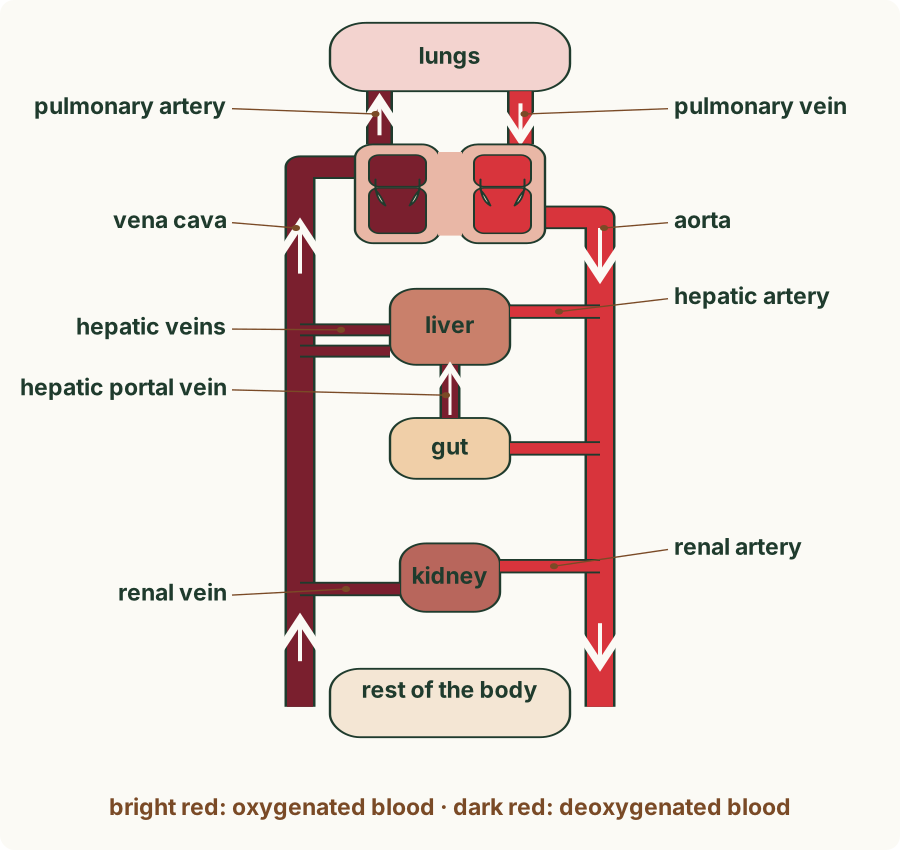
On the map, bright red shows oxygenated blood (blood that has collected oxygen in the lungs) and dark red shows deoxygenated blood (blood that has given up much of its oxygen to the tissues). The heart is drawn as two pumps side by side, as if you were facing the person: the right side of the heart is on your left.
The heart and the lungs
Four large vessels join the heart.
- The vena cava brings deoxygenated blood from the body into the right side of the heart.
- The pulmonary artery carries deoxygenated blood from the right side of the heart to the lungs.
- The pulmonary vein brings oxygenated blood from the lungs back to the left side of the heart.
- The aorta carries oxygenated blood from the left side of the heart to the body. It is the largest artery, and the arteries to every organ branch off it.
So the vessels to and from the lungs are the pulmonary artery and the pulmonary vein.
Trap: "The pulmonary artery carries oxygenated blood, because it is an artery." Arteries carry blood away from the heart, whatever is in it. The pulmonary artery carries deoxygenated blood to the lungs, and the pulmonary vein carries oxygenated blood back.
The kidneys
 (enlarge)
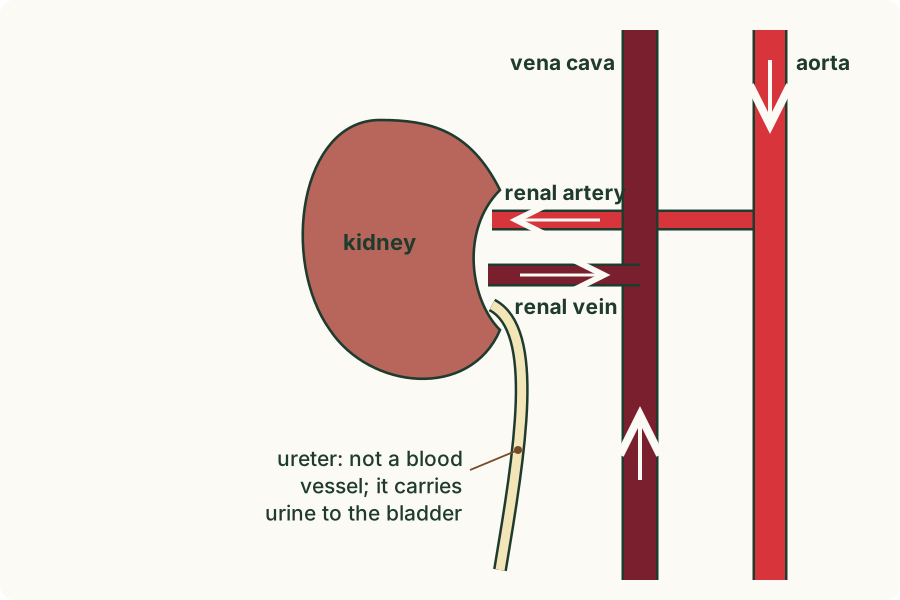
The kidneys clean the blood: they remove urea and excess water and salts, which leave as urine. Each kidney has two blood vessels. The renal artery, a branch of the aorta, brings blood to the kidney. The renal vein carries the cleaned blood away to the vena cava.
Trap: "The ureter carries blood away from the kidney." The ureter is a tube, but not a blood vessel: it carries urine from the kidney to the bladder. A kidney has three tubes leaving it: the renal artery, the renal vein and the ureter.
Worked example
A kidney transplant
A surgeon places a donated kidney in a patient. Name the vessels in the patient's body that the surgeon must join to the kidney's artery and to its vein, and say which way the blood will flow in each.
The kidney's renal artery is joined to an artery that branches from the aorta, so oxygenated blood flows from the aorta into the kidney. The kidney's renal vein is joined to a vein that leads to the vena cava, so the cleaned blood flows away from the kidney towards the heart. (The ureter is joined to the bladder, not to a blood vessel.)
The liver
(Supplement) The liver is unusual: blood reaches it through two vessels.
 (enlarge)
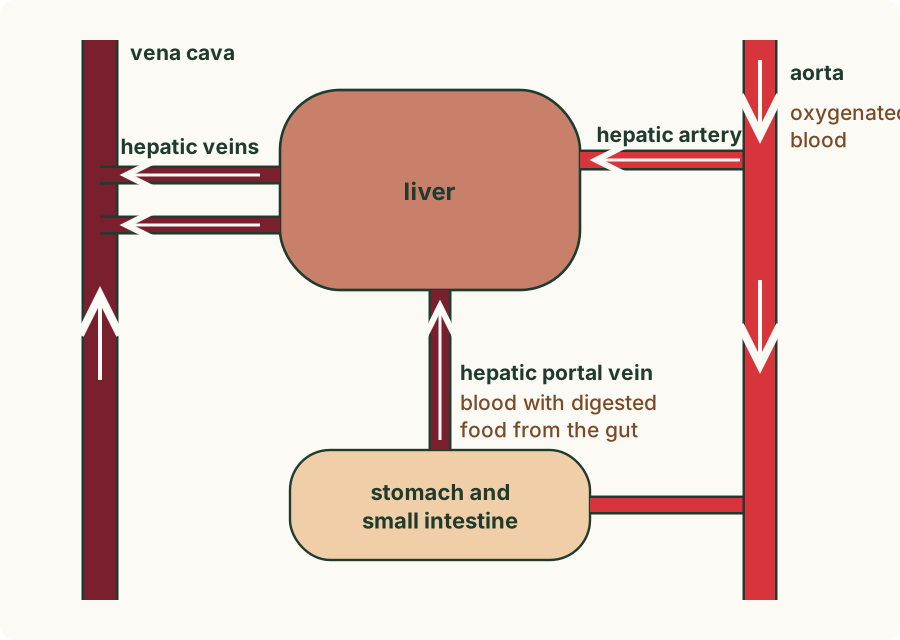
- The hepatic artery, a branch of the aorta, brings oxygenated blood to the liver, like the artery of any other organ.
- The hepatic portal vein brings blood from the stomach and small intestine straight to the liver. This blood has passed through the capillaries of the gut, so it is deoxygenated, and after a meal it carries the glucose, amino acids and other nutrients absorbed in the small intestine.
- The hepatic veins carry blood away from the liver to the vena cava.
The hepatic portal vein is a vein, because its blood is on its way back towards the heart. But it does not go to the heart directly. It goes from the capillaries of the gut to the capillaries of the liver, so the liver can deal with the absorbed nutrients first: for example, it stores some of the glucose and breaks down excess amino acids.
Worked example
From the gut to the heart
(Supplement) A molecule of glucose is absorbed into a capillary of a villus in the small intestine. Name, in order, the blood vessels it passes through before it reaches the heart.
From the capillaries of the small intestine, the glucose goes into the hepatic portal vein, which takes it to the liver. If the liver does not store it, it leaves in the hepatic veins, which lead into the vena cava, and so into the right side of the heart.
Worked example
Two ways in
(Supplement) Explain why the liver has two blood vessels bringing blood to it, when most organs have one.
The hepatic artery brings oxygenated blood, which the liver cells need for respiration, like any organ. The hepatic portal vein brings blood that has just collected the products of digestion from the small intestine, so the liver can process them, for example by storing glucose, before the blood goes on to the rest of the body.
Worked example
Naming vessels on a diagram
On a lettered diagram, vessel P carries blood from the left side of the heart down the body, and vessel Q carries blood from a kidney into a large vein that leads to the heart. Name P and Q.
Blood leaving the left side of the heart for the body is in the aorta, so P is the aorta. A vessel carrying blood away from a kidney is a vein of the kidney, so Q is the renal vein. Check the direction each time: arteries take blood away from the heart, veins bring it back.
Key idea: The vena cava brings blood from the body to the heart and the aorta takes it from the heart to the body; the pulmonary artery takes blood from the heart to the lungs and the pulmonary vein brings it back. The renal artery takes blood to a kidney and the renal vein takes it away. (Supplement) The liver receives blood from the hepatic artery and, from the gut, the hepatic portal vein; the hepatic veins take blood away from it.