Contents
Part 1 of 2
Lenses and real images
identify
Try it yourself
The diagram shows a parallel beam of light passing through a converging lens. Match each numbered part of the diagram to what it is.
identify: name or select.
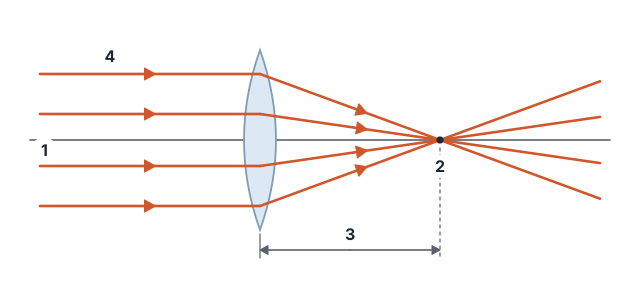 (enlarge)
Your saved work
Answers, earlier attempts and your Pause and check notes stay in this browser. Export a copy to keep, to move to another device or to hand to your teacher. Importing a copy keeps your current answers and adds earlier attempts.
Scope and sources
Cambridge IGCSE Physics 0625 · 2026–2028 v2 · Original learning materials.
The action of thin converging and diverging lenses on a parallel beam of light (3.2.3.1); focal length, principal axis and principal focus (3.2.3.2); ray diagrams for the formation of a real image by a converging lens (3.2.3.3); describing an image as enlarged, same size or diminished, upright or inverted, real or virtual (3.2.3.4); a virtual image formed when diverging rays are extrapolated backwards, which cannot be projected onto a screen (3.2.3.5); Supplement: ray diagrams for a virtual image formed by a converging lens (3.2.3.6), a single lens as a magnifying glass (3.2.3.7), and converging and diverging lenses correcting long-sightedness and short-sightedness (3.2.3.8). The lens equation and lens power are not in the syllabus; ray diagrams for images formed by a diverging lens are not drawn here; the structure of the eye is in Biology; dispersion of light is in Light and the electromagnetic spectrum.
Apparatus, amounts and times in the experiment are illustrative. Real practical work follows a teacher-approved safety method.
Official Cambridge syllabus