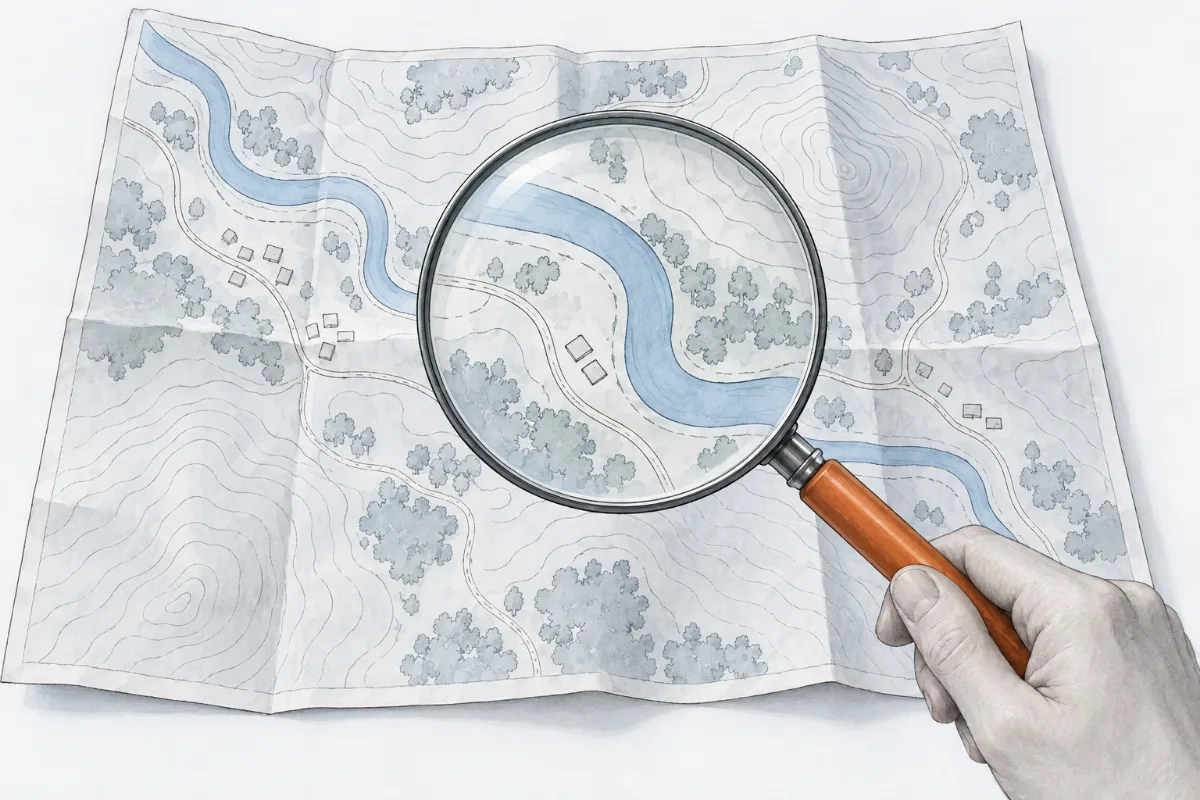
Hold a magnifying glass a few centimetres above a map, and the rivers, roads and houses under it look bigger, and still the right way up. Now take a sheet of white paper and try to catch that enlarged picture on it, above the glass or below it. Nothing appears: only a bright, blurred patch of light. You can see the bigger map clearly, but no screen can show it. This part is about images like that.
 (enlarge)
Rays that never meet
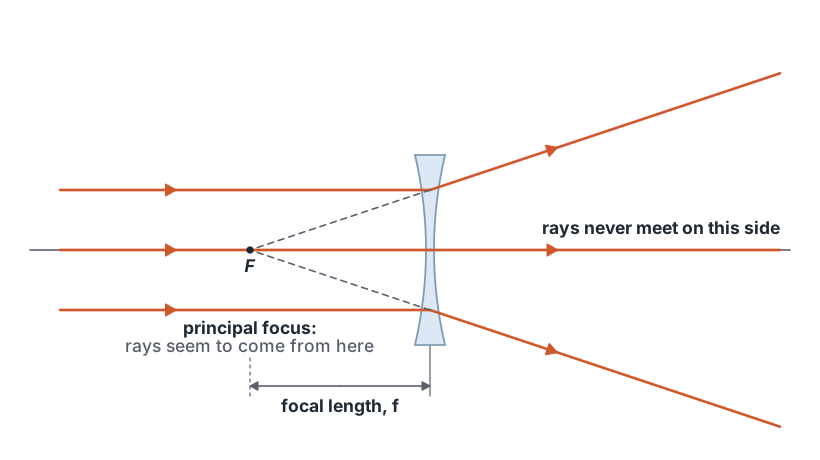
A diverging lens is thinner in the middle than at its edges. A beam of light parallel to its principal axis spreads out as it passes through. The rays leave the lens as if they all came from one point on the principal axis, on the side the light came from. If you trace the spreading rays backwards in straight lines, they all meet at that point. The backward lines are drawn dashed, because no light travels along them: the rays are extrapolated backwards. Rays that are spreading out like this are called diverging rays.
The point the rays seem to come from is the principal focus of the diverging lens, and its distance from the centre of the lens is the lens’s focal length. The light never passes through this principal focus, so it is a virtual focus. Spreading rays never meet on the far side of the lens, however far you follow them, so a screen anywhere beyond a diverging lens in parallel light shows only a patch of light, and the further away the screen, the bigger the patch.
 (enlarge)
Trap: “A diverging lens has its principal focus on the far side, like a converging lens.” Its rays never meet on the far side. For light arriving from one side, its principal focus is the point on that near side, where the spreading rays seem to come from.
Spreading light
Back at the optical bench, with light that spreads out.
What is on the bench. The same optical bench, window, lamp box and white screen. First the lamp is switched off and moved aside, and the converging lens is swapped for a diverging lens of focal length 10 cm, also 5.0 cm across, in the same holder at the 40 cm mark. Later the converging lens of focal length 10 cm comes back, and the lamp with its 2.0 cm arrow is put 8 cm from it: closer to the lens than its principal focus.
What you do. Predict what the diverging lens does to the window’s parallel light, then watch the screen sweep along the bench, and decide where the spreading rays seem to come from. Then put the converging lens back with the lamp at 8 cm, predict what the screen will show, and watch it sweep again. Finally (Supplement), take the screen away and look through the lens at the lamp.
What the experiment showed
Do the experiment before you read on. Behind the diverging lens, the window’s light spread out. As the screen moved away from the lens, the patch of light only grew: 10 cm from the lens it was twice as wide as the lens, 30 cm from the lens four times as wide, and at no distance was there a sharp image. Traced backwards, the edges of the beam met 10 cm in front of the lens, on the window’s side: that is the principal focus of the diverging lens, and its focal length is 10 cm.
With the converging lens back and the lamp 8 cm away, closer than the principal focus, the screen again showed no image at any distance, only a patch of light that grew as the screen moved away. The rays from each point of the arrow were still spreading out after the lens: the lens made them spread less, but it could not bring them together. Yet when you looked through the lens from the far side, you saw the arrow clearly: upright, and 10 cm tall instead of 2.0 cm, five times the height of the real one. Traced backwards, the rays from its tip met 40 cm from the lens, on the lamp’s side, further away than the lamp itself. That is where the image is, and no light is there at all.
So a screen that shows no image can mean two different things. If it shows a blurred patch at one distance and a sharp image at another, the image is real and the screen was in the wrong place. If there is no sharp image at any distance, either the rays leave the lens parallel, with the object at the principal focus, or they leave it spreading, and the image is virtual: you can see it only by looking into the lens.
Real and virtual images
| Real image | Virtual image | |
|---|---|---|
| The rays of light | actually meet at the image | only seem to come from the image, when they are extrapolated backwards |
| A screen placed at the image | shows it | shows nothing: no light is there |
| How you see it | on a screen, or with your eye where the rays have crossed and spread out again | only by looking into the lens or mirror |
| Examples | a camera, a projector, the image at the back of your eye | a magnifying glass, a plane mirror |
A converging lens forms a virtual image when the object is closer to the lens than its principal focus. The image is then always upright and enlarged, and on the same side of the lens as the object, further from the lens than the object is.
Trap: “A virtual image is imaginary, so you cannot see it.” You see a virtual image clearly, because the light from the object really does enter your eye. What you cannot do is catch it on a screen, because the light does not pass through the place where the image seems to be.
Worked example
Can it be caught on a screen?
Say whether each image could be caught on a screen, and why. (a) The image of a distant tree formed by a converging lens of focal length 10 cm. (b) The image of the print on a page seen through a converging lens of focal length 10 cm held 3 cm above the page. (c) Your face in a bathroom mirror.
(a) The tree is very far away, so the lens brings the rays together at its principal focus, 10 cm behind it. The rays really meet there, so the image is real, and a screen 10 cm from the lens shows it. (b) The page is closer to the lens than its principal focus, so the rays are still spreading out after the lens and never meet. The image is virtual: a screen anywhere shows nothing. (c) The rays reflected by a plane mirror spread out and only seem to come from behind the mirror, so the image is virtual. Only (a) can be caught on a screen: only there do the rays really meet.
Supplement: A ray diagram for a virtual image
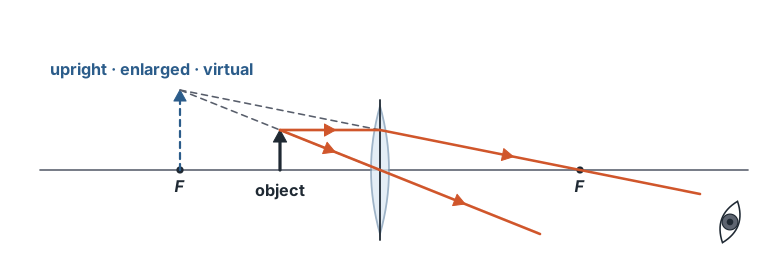
A virtual image is drawn with the same rules as a real one, using rays from the tip of the object.
- A ray parallel to the principal axis is refracted through the principal focus on the far side.
- A ray through the centre of the lens goes straight on.
With the object closer to the lens than F, these two rays are spreading apart after the lens, and they never cross. Extrapolate both of them backwards with dashed lines. The dashed lines meet on the same side as the object, further from the lens: that is the tip of the image. Draw the image as a dashed arrow from that point to the axis, because no light really travels there. The image is upright, enlarged and virtual.
 (enlarge)
Worked example
A magnifying glass to scale
Supplement. A letter printed on a stamp is 1.0 cm tall. It is 4.0 cm from a magnifying glass, a converging lens of focal length 6.0 cm. Draw a full-size ray diagram and describe the image.
Draw the principal axis and the lens, and mark F 6.0 cm from the lens on each side. Draw the letter as an arrow 1.0 cm tall, 4.0 cm from the lens: between the lens and F. From its tip, draw ray 1 parallel to the axis to the lens and then through F on the far side, and ray 2 straight through the centre of the lens. They spread apart, so extrapolate both backwards with dashed lines. They meet 12 cm from the lens, on the same side as the letter, 3.0 cm above the axis. The image is 12 cm from the lens on the letter’s side and 3.0 cm tall: upright, enlarged (three times the height) and virtual.
Supplement: The magnifying glass
A magnifying glass is a single converging lens used with the object closer to the lens than its principal focus. Your eye is on the other side of the lens and takes in the rays that are spreading out from it. You see an upright, enlarged, virtual image, further away than the object itself and the same way round.
Two things make the image bigger. A lens with a shorter focal length, one with more strongly curved faces, magnifies more. And for one lens, the image grows as the object gets closer to the principal focus, while still inside it. If you lift the lens until the object is beyond the principal focus, the view turns blurred and then upside down: the rays now meet, and the lens has started to form a real, inverted image instead.
Trap: “Any lens makes things look bigger if you hold it close enough.” A diverging lens never does: it always makes things look smaller. And a converging lens magnifies only while the object is closer to it than its principal focus.
Supplement: Correcting sight
Your eye forms images with a converging lens too. The curved front of the eye, the cornea, and the lens inside it together bring the light from an object to a real, inverted image on the retina, the light-sensitive layer at the back of the eye. The eye can change its focus to see near and far things clearly (how it does that is in Biology), but in many people it cannot change it far enough.
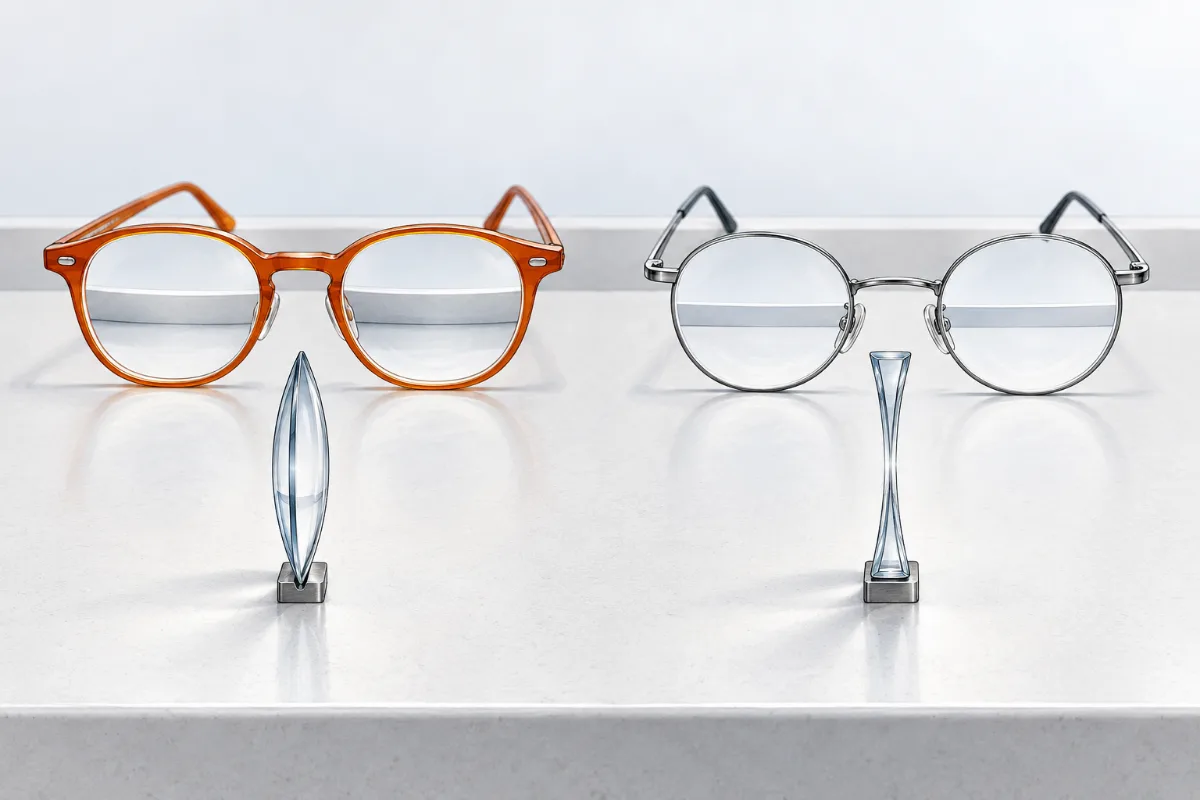
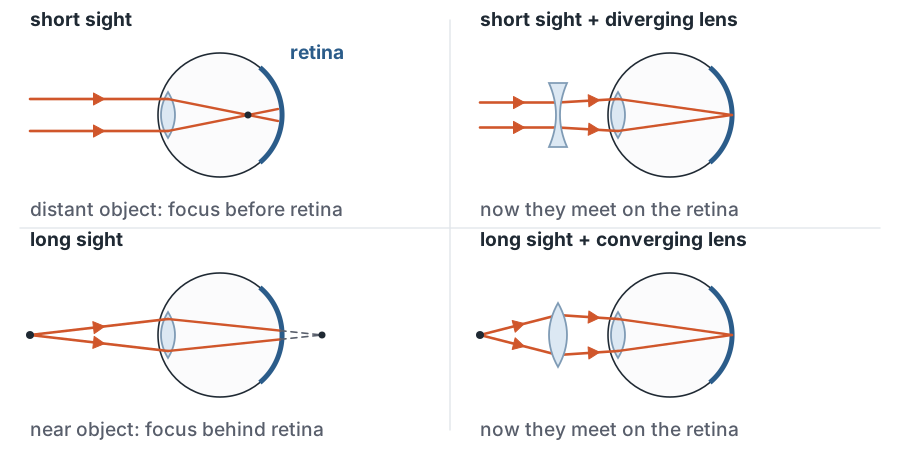
- A short-sighted person sees near objects clearly, but distant objects look blurred. The eye brings the rays from a distant object together too soon, in front of the retina, so they have crossed and are spreading out again when they reach it. A diverging lens in front of the eye spreads the rays out a little first, so the eye brings them together on the retina.
- A long-sighted person sees distant objects clearly, but near objects look blurred. The rays from a near object reach the retina before they have come together: they would meet behind it. A converging lens in front of the eye starts bringing the rays together, so the eye can finish the job on the retina.
 (enlarge)
 (enlarge)
Trap: “A short-sighted person needs a converging lens to make distant things look bigger.” The problem is not the size of the image but where the rays meet. A short-sighted eye brings the rays together too soon, so the correcting lens must spread them out: a diverging lens.
Worked example
Which lens for which eye?
Supplement. (a) Sam can read the small print on a medicine bottle easily, but the number on a bus coming down the road is blurred. (b) Sam’s grandmother reads the bus number easily, but has to hold a newspaper at arm’s length to read it. For each, name the sight problem, say where the rays from the blurred object meet, and name the lens that corrects it.
(a) Sam sees near things clearly and distant things blurred: short sight. Rays from the bus meet in front of the retina. A diverging lens spreads them a little before they enter the eye, so they meet on the retina. (b) The grandmother sees distant things clearly but not near ones: long sight. Rays from a newspaper held close would meet behind the retina. A converging lens brings them together a little before they enter the eye, so they meet on the retina. Short sight is corrected with a diverging lens, and long sight with a converging lens.
Case closed
Back to the map. The magnifying glass is a converging lens, held so that the map is closer to it than its principal focus. The rays from each point of a river or a house are still spreading out after they pass through the glass, so they never meet, and there is nowhere to hold a sheet of paper and catch a picture. Your eye takes in the spreading rays and your brain traces them back in straight lines to where they seem to come from: an upright, enlarged image a little further away than the map, where no light actually is. That is a virtual image. Lift the glass higher, past its principal focus, and the map goes blurred and then turns upside down: now the rays do meet, and a sheet of paper in the right place would catch an inverted, real picture of the map.
About this model
The lenses, lamp, screen and eye are simulated. Both lenses are thin, 5.0 cm across, with a focal length of 10.0 cm. The width of the patch behind the diverging lens is worked out from straight rays that seem to come from its principal focus: at a distance d from the lens, the patch is 5.0 cm × (d + 10 cm) ÷ 10 cm wide. The virtual image of the lamp’s arrow comes from the lens equation, which puts it 40 cm from the lens on the lamp’s side, five times as tall as the arrow; a ray diagram drawn to scale gives the same place. A real eye looking through a magnifying glass sees most comfortably when the image is at least about 25 cm away, which this image is. Real lenses bring rays through their edges together a little nearer the lens than rays through the middle, so real images and patches have softer edges than the model’s.