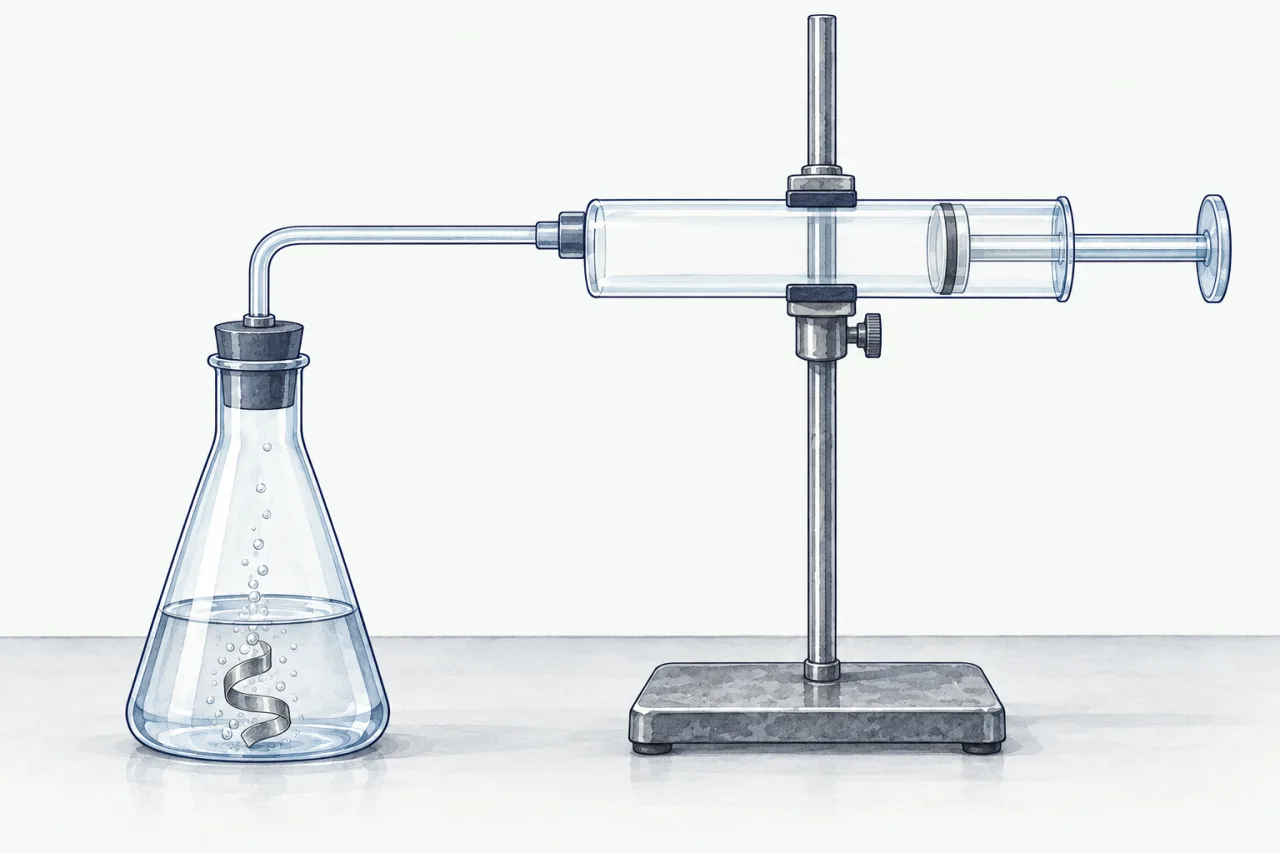
Drop a strip of magnesium into acid and it fizzes: hydrogen comes off, and a gas syringe can catch it. Before you start, can you say how much gas you'll collect, or how much acid you need? The equation tells you, once you read it in moles. In this part you'll use an equation to find the mass of a product, the volume of a gas and the volume of a solution that reacts. This whole module is Supplement, for the Extended papers.
 (enlarge)
An equation counts in moles
Here is the reaction in the flask:
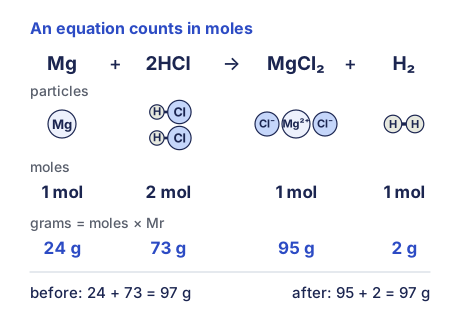
Mg + 2HCl → MgCl2 + H2
Read it as particles first: one magnesium atom reacts with two HCl molecules and makes one unit of magnesium chloride and one hydrogen molecule. A million magnesium atoms need two million HCl molecules, and 6.02 × 10²³ magnesium atoms need twice 6.02 × 10²³ HCl molecules. So the equation also reads in moles: 1 mol of Mg reacts with 2 mol of HCl and makes 1 mol of MgCl2 and 1 mol of H2. The numbers written in front of the formulae (not the small numbers inside them) give the mole ratio, here 1 : 2 : 1 : 1.
 (enlarge)
From moles you get masses with m = n × M, as in the previous module: 24 g of magnesium reacts with 2 × 36.5 = 73 g of HCl and makes 95 g of magnesium chloride and 2 g of hydrogen. The mass before, 97 g, is the mass after, 97 g.
Trap: “The masses react in the ratio 1 : 2.” The numbers in the equation count particles, so they give the ratio of moles. The masses here are 24 g and 73 g, not 1 g and 2 g.
Reacting masses in three steps
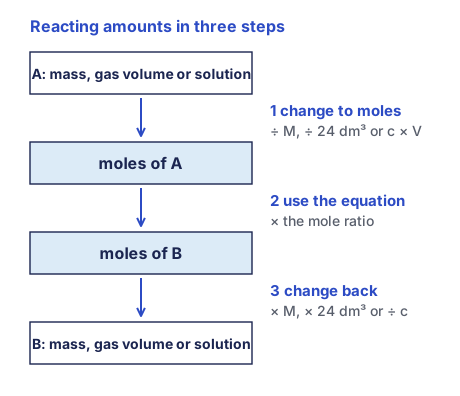
To find how much of one substance reacts with, or is made from, another, go through moles:
- Change to moles: the amount of the substance you know about.
- Use the equation: multiply by the mole ratio to get the amount of the substance you want.
- Change back: turn that amount into a mass, a gas volume or a solution volume.
 (enlarge)
Worked example
Burning magnesium
0.600 g of magnesium burns in air: 2Mg + O2 → 2MgO. What mass of magnesium oxide forms? (Ar: O 16, Mg 24.)
- n(Mg) = 0.600 g ÷ 24 g/mol = 0.0250 mol.
- The equation has 2Mg and 2MgO, a ratio of 2 : 2, which is 1 : 1. So 0.0250 mol of MgO forms.
- M(MgO) = 24 + 16 = 40 g/mol, so m = 0.0250 mol × 40 g/mol = 1.00 g.
The oxide is heavier than the metal because oxygen from the air has joined it.
A mole of any gas: 24 dm³
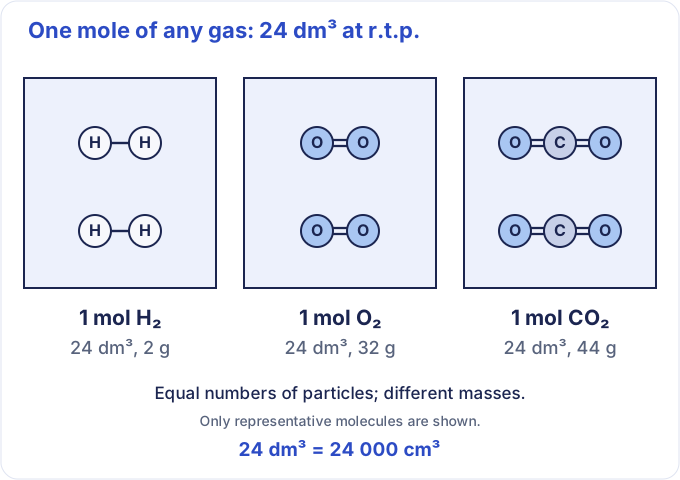
A mole of hydrogen has a mass of 2 g and a mole of carbon dioxide 44 g, yet at room temperature and pressure, r.t.p., both take up the same volume: 24 dm³. So does a mole of oxygen, nitrogen or any other gas. In a gas the particles are far apart, and almost all of the volume is the space between them. The number of particles decides the volume; their own size hardly matters. This volume, 24 dm³ at r.t.p., is the molar gas volume.
 (enlarge)
- volume of gas (dm³) = amount (mol) × 24, so amount = volume (dm³) ÷ 24;
- in cm³: volume (cm³) = amount × 24 000, so amount = volume (cm³) ÷ 24 000.
Trap: “One mole of gas is 24 cm³.” It is 24 dm³, which is 24 000 cm³. If the volume is in cm³, divide by 24 000 (or change it to dm³ first).
Trap: “A mole of water is 24 dm³ too.” Only gases. In solids and liquids the particles touch, so their size decides the volume: a mole of liquid water is just 18 cm³.
Free play: nothing here is marked or saved
Party balloons from a small gas tank
At room temperature and pressure the same amount of any gas fills the same balloon. Turn up the amount, then change the gas: what sets the balloon’s size, and what sets its mass?Supplement
Still picture: your device asks for less motion.
Try: Double the amount. What happens to the balloon?
- Particles N
- 3.01 × 10²³
- Volume V
- 12.0 dm³
- Molar mass M
- 2 g/mol
- Mass m
- 1.00 g
V = n × 24 = 0.500 mol × 24 dm³/mol = 12.0 dm³
m = n × M = 0.500 mol × 2 g/mol = 1.00 g
- A mole of anything is 6.02 × 10²³ particles (the Avogadro constant), so N = n × 6.02 × 10²³.
- At room temperature and pressure (r.t.p.) a mole of any gas fills 24 dm³, so V = n × 24 dm³/mol. The volume follows how many particles there are, not what they are.
- The mass follows what the particles are: m = n × M. The tag on the balloon gives the mass of the gas inside: carbon dioxide (44 g/mol) has 22 times the mass of the same balloon of hydrogen (2 g/mol).
- 24 dm³ is for gases only. In a liquid the particles touch, so a mole of water takes up just 18 cm³.
About this model. The balloon and the shot glass are drawn to one scale: a mole of gas fills a round balloon about 36 cm across. The gas is at r.t.p.; a real balloon’s rubber squeezes its gas a little, so a mole would fill a little less. The balloon stays on the tank’s nozzle, so it neither floats away nor sinks, and its tag counts the gas, not the rubber. The close-up shows one tiny piece of the gas, so it looks the same at any amount. It is not to scale: in a gas at r.t.p. the particles are about ten times their own width apart. Lighter particles move faster at the same temperature, so hydrogen’s are the quickest, yet the volume is the same.
Worked example
Heating limestone
25.0 g of calcium carbonate is heated until it has all decomposed: CaCO3 → CaO + CO2. What mass of calcium oxide forms, and what volume of carbon dioxide at r.t.p.? (Ar: C 12, O 16, Ca 40.)
- M(CaCO3) = 40 + 12 + 3 × 16 = 100 g/mol, so n = 25.0 ÷ 100 = 0.250 mol.
- The ratio is 1 : 1 : 1, so 0.250 mol of CaO and 0.250 mol of CO2 form.
- M(CaO) = 56 g/mol, so m = 0.250 × 56 = 14.0 g. The gas: V = 0.250 mol × 24 dm³/mol = 6.00 dm³.
Check: 25.0 g of solid became 14.0 g, so 11.0 g left as gas. 0.250 mol of CO2 × 44 g/mol = 11.0 g.
Worked example
Hydrogen from magnesium
0.0480 g of magnesium reacts with excess hydrochloric acid. What volume of hydrogen forms, in cm³ at r.t.p.? (Ar: Mg 24.)
n(Mg) = 0.0480 ÷ 24 = 0.00200 mol. Mg + 2HCl → MgCl2 + H2 has 1 Mg to 1 H2, so 0.00200 mol of H2 forms. V = 0.00200 mol × 24 000 cm³/mol = 48.0 cm³. “Excess acid” means there is more than enough acid, so all the magnesium reacts.
Worked example
Work backwards from a gas
You need 600 cm³ of carbon dioxide at r.t.p. from CaCO3 + 2HCl → CaCl2 + H2O + CO2, with excess acid. What mass of calcium carbonate do you use? (Ar: C 12, O 16, Ca 40.)
Start from the gas this time. n(CO2) = 600 cm³ ÷ 24 000 cm³/mol = 0.0250 mol. The ratio of CaCO3 to CO2 is 1 : 1, so you need 0.0250 mol of CaCO3: 0.0250 × 100 = 2.50 g.
Gases only: volumes in the mole ratio
Equal volumes of gases hold equal numbers of moles, as long as they are at the same temperature and pressure. So when every substance you compare is a gas, the volumes come in the mole ratio and you don't need moles at all.
Worked example
Burning methane
Methane burns: CH4 + 2O2 → CO2 + 2H2O. What volume of oxygen does 50 cm³ of methane need, and what volume of carbon dioxide forms? All volumes are at r.t.p.
The ratio CH4 : O2 : CO2 is 1 : 2 : 1, so 50 cm³ of methane needs 2 × 50 = 100 cm³ of oxygen and makes 50 cm³ of carbon dioxide.
Trap: “It also makes 100 cm³ of water.” At r.t.p. water is a liquid, so the gas rule doesn't apply to it. Only the gases have volumes in the mole ratio.
Volumes of solutions that react
For a solution, the amount comes from its concentration and volume, as in the previous module: amount = concentration × volume, n = c × V, with V in dm³. To find a volume, rearrange: V = n ÷ c.
Worked example
How much acid?
What volume of 0.500 mol/dm³ hydrochloric acid reacts exactly with 0.120 g of magnesium? (Ar: Mg 24.)
- n(Mg) = 0.120 ÷ 24 = 0.00500 mol.
- Mg + 2HCl: each mole of magnesium needs 2 mol of HCl, so 2 × 0.00500 = 0.0100 mol of HCl.
- V = n ÷ c = 0.0100 mol ÷ 0.500 mol/dm³ = 0.0200 dm³, which is 20.0 cm³.
Trap: “Use the mole ratio on the volumes of solutions.” 1 : 2 is a ratio of moles. A solution's volume depends on its concentration too, so change to moles first.
Case closed
How much gas will you get? Read the equation as a ratio of moles. Change what you know into moles, multiply by the mole ratio, then change back: × M for a mass, × 24 dm³ (24 000 cm³) for a gas at r.t.p., ÷ c for a solution. When every substance you compare is a gas, the volumes themselves come in the mole ratio. In the next part you'll find out what happens when one reactant runs out before the other.
For teachers: Supplement 3.3.4 and 3.3.5, its parts on stoichiometric reacting masses, volumes of gases at r.t.p. and volumes of solutions (Cambridge 0620 syllabus, p16). Limiting reactants are in part 2; percentage yield, composition, purity and formulae in part 3; titration comes in topic 12.