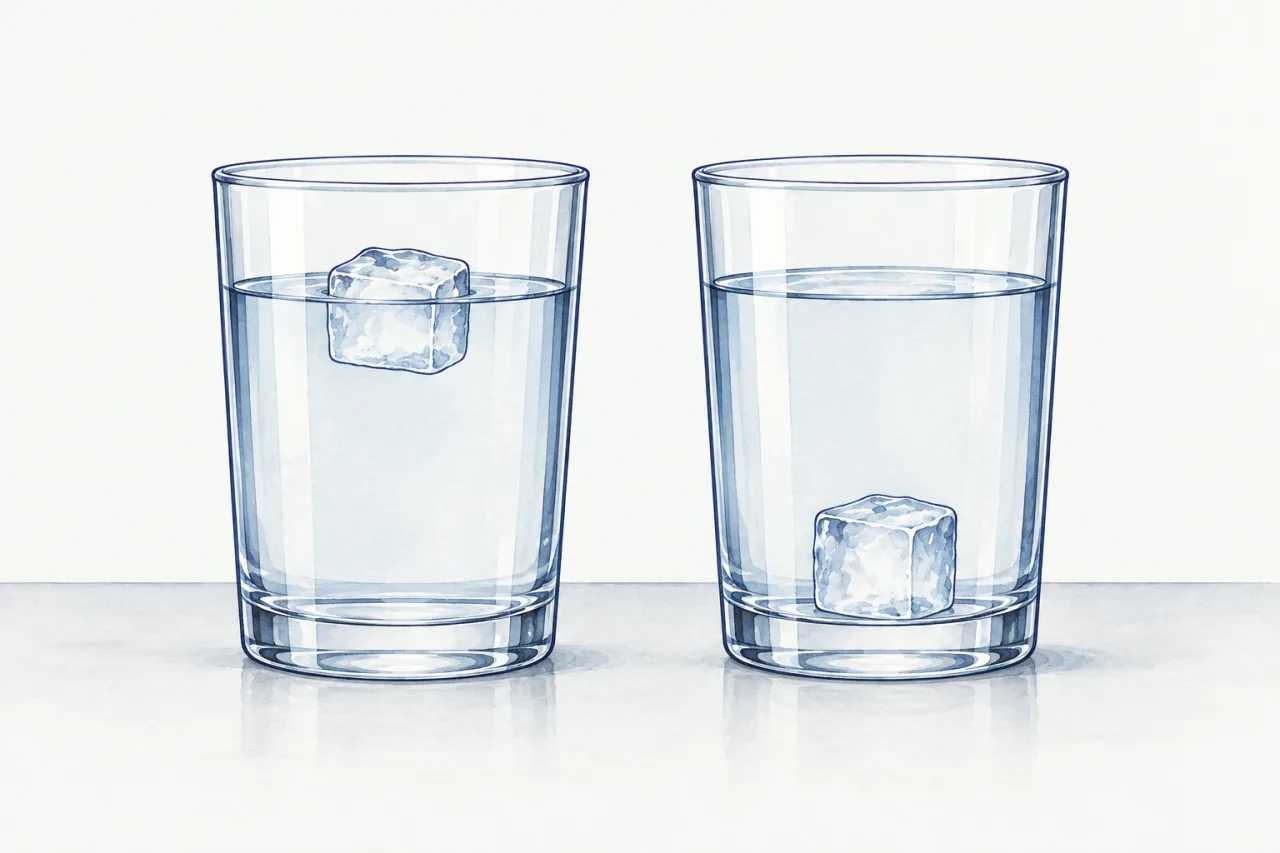
Two glasses of water, two ice cubes that look exactly the same. One cube floats, as ordinary ice does, but the other sinks straight to the bottom. The sinking cube is frozen heavy water. Melted, it's a clear, colourless liquid that you can't tell from ordinary water by looking, and like ordinary water it's H2O: two hydrogen atoms joined to one oxygen atom. Yet a cube of it is heavier than the same cube of ordinary ice, so it sinks. How can one water be heavier than another, if both are made of the same atoms? In this part you'll test two bottles of colourless liquid, find out which one is heavy water, and then look inside its atoms for the reason.
 (enlarge)
Two bottles, two tests
Bottle A and bottle B each hold a clear, colourless liquid. One is ordinary water and the other is heavy water, but the labels only say A and B. You have two tests to try.
Weigh equal volumes. Measure 10 cm³ of each liquid into two identical measuring cylinders and put them on the two pans of a balance. The side with the bigger mass goes down, so you can compare the two without any numbers.
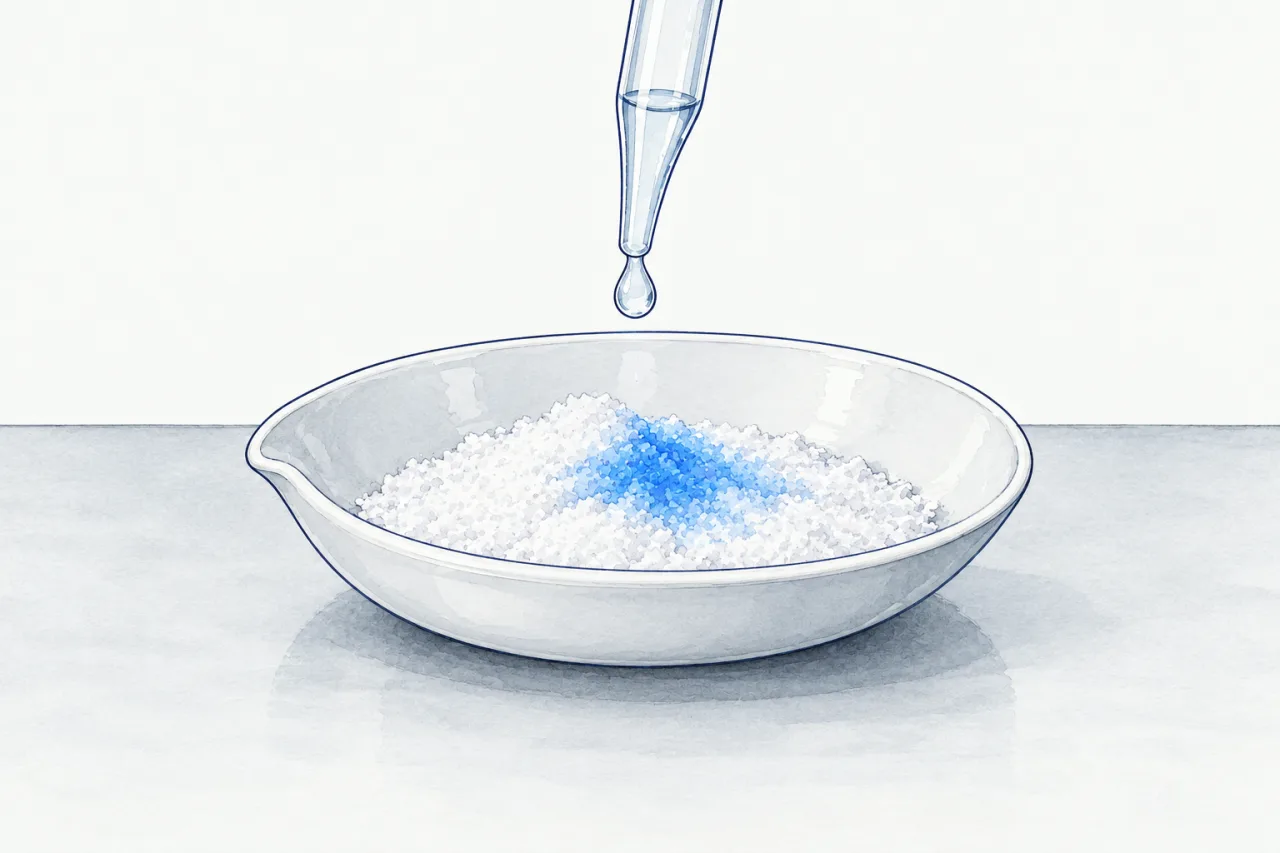
Add a few drops to anhydrous copper(II) sulfate. Anhydrous means "without water". Anhydrous copper(II) sulfate is a white powder, and when water is added to it, it turns blue. It's a chemical test for water: it uses a reaction of water, not its look or its mass.
 (enlarge)
Predict, then test
Here's the question for the experiment. Which test will tell the two waters apart: weighing, the copper(II) sulfate test, both, or neither? Make your prediction, then run each test and decide which bottle holds heavy water. At the end, look at a molecule from each bottle through the magnifier.
What the tests show
On the balance, the pan with bottle B's cylinder goes down. 10 cm³ of ordinary water has a mass of about 10.0 g, but 10 cm³ of heavy water has a mass of about 11.1 g, so heavy water is about 11 % heavier for the same volume. That's why B is the heavy water, and it's why heavy ice sinks in ordinary water.
The copper(II) sulfate test gives the same result for both: each liquid turns the white powder blue. In this chemical test both bottles behave as water, so the test can't tell them apart. The two waters differ in mass, not in the way they react. The reason must be inside their atoms.
Inside the hydrogen atoms
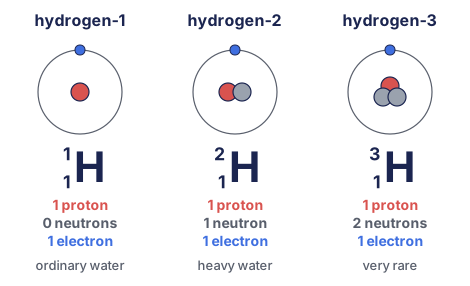
Every water molecule has one oxygen atom and two hydrogen atoms. In ordinary water, almost every hydrogen atom has a nucleus of just one proton. In heavy water, each hydrogen nucleus has one proton and one neutron.
 (enlarge)
Both kinds are still hydrogen, because both have one proton: proton number 1. The extra neutron changes only the mass number, from 1 to 2. That's why they're called hydrogen-1 and hydrogen-2: the number after the name is the mass number. So add up the mass numbers in one molecule. Oxygen has a mass number of 16, so ordinary water is 1 + 1 + 16 = 18, and heavy water is 2 + 2 + 16 = 20, about 11 % more. The same volume holds almost exactly the same number of molecules, so 10 cm³ of heavy water is about 11 % heavier too. That's just what the balance showed.
Isotopes
Hydrogen-1 and hydrogen-2 are two isotopes of hydrogen. Isotopes are different atoms of the same element that have the same number of protons but different numbers of neutrons. There's a third isotope, hydrogen-3, with two neutrons, but it's very rare.
Most elements have isotopes. Chlorine has chlorine-35 and chlorine-37, and carbon has carbon-12, carbon-13 and carbon-14. Each element still has just one proton number, because that's what makes it the element.
Trap: “Isotopes are different elements, because their mass numbers are different.” The element is decided by the number of protons only. Hydrogen-1 and hydrogen-2 both have 1 proton, so both are hydrogen; only their neutrons differ.
Trap: “Heavy water is heavier because its molecules have extra hydrogen atoms.” A heavy-water molecule still has two hydrogen atoms and one oxygen atom. The extra mass comes from the extra neutron in each hydrogen nucleus.
Symbols for isotopes and ions
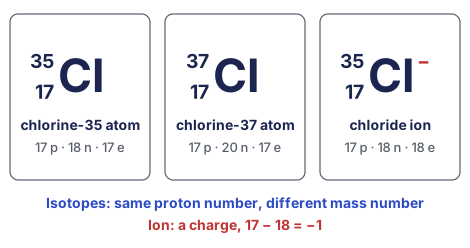
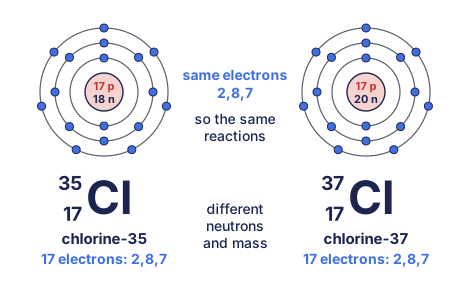
In an atom symbol such as ²³11Na, the mass number is at the top left and the proton number at the bottom left. Two isotopes of one element have the same symbol and the same bottom number, but a different top number: 3517Cl and 3717Cl. The difference between the two numbers is the number of neutrons, so chlorine-35 has 35 − 17 = 18 neutrons and chlorine-37 has 37 − 17 = 20.
For an ion, the charge goes at the top right. A chloride ion made from chlorine-35 is 3517Cl−: 17 protons and 18 neutrons, as in the atom, but 18 electrons, because the charge is protons − electrons = 17 − 18 = −1. The isotope sets the neutrons; the charge tells you about the electrons.
 (enlarge)
Supplement: same electrons, same reactions
When atoms react, only their electrons take part: electrons are lost, gained or shared, and the nucleus stays as it was. Isotopes of one element have the same number of protons, so their atoms have the same number of electrons, arranged in the same shells: the same electronic configuration. Chlorine-35 and chlorine-37 both have 17 electrons, 2,8,7, so each gains one electron to make a chloride ion in exactly the same way.
 (enlarge)
That's why the copper(II) sulfate test couldn't tell the bottles apart. Hydrogen-1 and hydrogen-2 each have one electron, so heavy water reacts as water does: isotopes have the same chemical properties. What the extra neutrons change is the mass, and properties that depend on mass. Heavy water is denser than ordinary water, it boils at 101.4 °C instead of 100 °C, and its ice melts at 3.8 °C instead of 0 °C. These are physical properties, so a test of mass, density, boiling point or melting point can tell isotopes apart.
Trap: “The extra neutrons make heavy water react differently.” Neutrons have no charge and stay in the nucleus, so they don't take part in reactions. The electrons are the same, so the chemical test gives the same result.
Key idea: Isotopes are atoms of the same element with the same number of protons but different numbers of neutrons. Their symbols have the same proton number but different mass numbers; an ion's symbol adds its charge at the top right. Isotopes have the same number of electrons and the same electronic configuration, so they have the same chemical properties. Their masses differ, so physical properties such as density and boiling point differ.
Worked example
Two isotopes of chlorine
Chlorine has two isotopes, 3517Cl and 3717Cl. Find the numbers of protons, neutrons and electrons in an atom of each, and explain why both isotopes react with sodium in the same way.
Both have proton number 17, so each atom has 17 protons and, being neutral, 17 electrons. The neutrons are the mass number minus the proton number: 35 − 17 = 18 for chlorine-35 and 37 − 17 = 20 for chlorine-37.
Reactions involve only electrons. Both atoms have 17 electrons arranged 2,8,7, so both gain one electron to form a chloride ion, Cl−, in the same way. The two extra neutrons in chlorine-37 add mass but don't change the reaction.
Worked example
The symbol for an ion
An ion has 20 protons, 24 neutrons and 18 electrons. Write its symbol with the mass number, the proton number and the charge.
The proton number is 20, which is calcium, so the symbol is Ca with 20 at the bottom left. The mass number is protons + neutrons = 20 + 24 = 44, at the top left. The charge is protons − electrons = 20 − 18 = +2, written 2+ at the top right. The symbol is 4420Ca2+: an ion of the isotope calcium-44.
Check: the bottom number tells you the element, the top number the isotope, and the charge the electrons.
Case closed
Bottle B was the heavy water: 10 cm³ of it had more mass, but it turned anhydrous copper(II) sulfate blue just like bottle A. Its hydrogen atoms are hydrogen-2, an isotope with one more neutron than ordinary hydrogen-1. Isotopes of an element have the same number of protons and electrons, so they react in the same way, but different numbers of neutrons, so their masses differ. To read an isotope's symbol, take the bottom number for the protons, the top number minus the bottom for the neutrons, and use the charge, if there is one, for the electrons.
About this model
Heavy water is real but costly, because it has to be separated from ordinary water, where only about one hydrogen atom in 6400 is hydrogen-2. It isn't safe to drink in large amounts, and anhydrous copper(II) sulfate is harmful, so this experiment is a virtual one or a teacher's demonstration. The masses come from the densities at 20 °C, 0.998 g/cm³ for ordinary water and 1.105 g/cm³ for heavy water; the tilt of the balance shows only which side is heavier, not by how much. Heavy water reacts a little more slowly in some reactions, so "the same chemical properties" means the same reactions and the same test results, not exactly the same speeds. The molecules in the magnifier aren't to scale, and their colours are only labels.
For teachers: Core 2.3.1–2.3.2; Supplement 2.3.3, the section "Supplement: same electrons, same reactions" (Cambridge 0620 syllabus, p13).