Contents
Independent final check
Explain without the key
define / deduce / explain
Final check
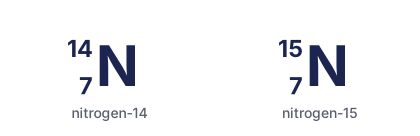
The symbols show two atoms of nitrogen. (a) Define isotopes, using these two atoms as the example. (b) A nitride ion formed from nitrogen-15 has 10 electrons. Write its symbol with the mass number, the proton number and the charge. (c) (Supplement) Explain why nitrogen-14 and nitrogen-15 have the same chemical properties.
define: give the precise meaning. deduce: reach a conclusion from the information given. explain: give reasons and connect them to evidence.
 (enlarge)
Your saved work
Answers, earlier attempts and your Pause and check notes stay in this browser. Export a copy to keep, to move to another device or to hand to your teacher. Importing a copy keeps your current answers and adds earlier attempts.
Scope and sources
Cambridge IGCSE Chemistry 0620 · 2026–2028 v2 · Original learning materials.
Isotopes (2.3 Core 1–2, Supplement 3–4): isotopes as atoms of the same element with the same number of protons and different numbers of neutrons, symbols for atoms and ions such as ¹²₆C and ³⁵₁₇Cl⁻, why isotopes have the same chemical properties (the same number of electrons and the same electronic configuration), and how to calculate relative atomic mass from isotope masses and abundances. Relative atomic mass measured against carbon-12, relative molecular mass, radioactivity and mass spectrometry are left to other modules or are not in the course.
Apparatus, amounts and times in the experiment are illustrative. Real practical work follows a teacher-approved safety method.
Official Cambridge syllabus