A glass of water and a bottle of hydrogen peroxide, the liquid sold to clean cuts and bleach hair, look exactly alike: both are clear and colourless, and both are made of hydrogen and oxygen and nothing else. Yet one is what you drink and the other bleaches. The difference is written in their formulae, H2O and H2O2: one extra oxygen atom in every molecule. In this part you'll learn to read a formula atom by atom, to write one from a model, and to know the formulae of the substances you meet in the course.
What the letters and numbers say
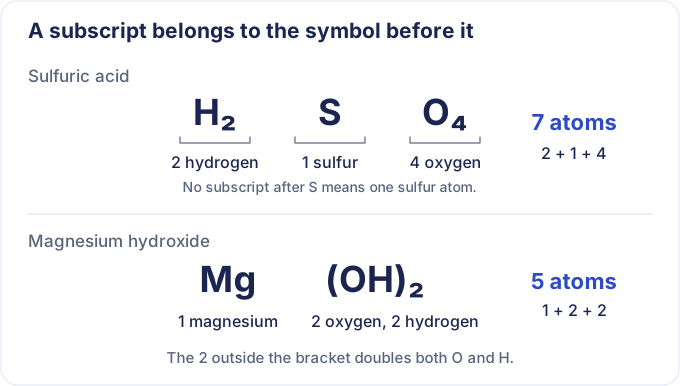
Every element has a symbol: one capital letter, sometimes followed by a small letter, such as H for hydrogen, O for oxygen and Mg for magnesium. A formula lists the symbols of the atoms in a substance. A small number written low after a symbol, called a subscript, counts the atoms of that element; no number means one atom.
So H2O says two hydrogen atoms and one oxygen atom, and H2SO4, sulfuric acid, says two hydrogen atoms, one sulfur atom and four oxygen atoms: seven atoms joined together. A subscript belongs only to the symbol just before it, which is why the 4 in H2SO4 counts oxygen atoms and nothing else.
 (enlarge)
Some formulae have brackets, because a group of atoms comes more than once. In magnesium hydroxide, Mg(OH)2, the 2 after the bracket multiplies everything inside it: one magnesium atom, two oxygen atoms and two hydrogen atoms.
Trap: "CO and Co are the same thing." A capital letter always starts a new element. Co is one element, cobalt; CO is carbon monoxide, a compound of one carbon atom and one oxygen atom.
The molecular formula
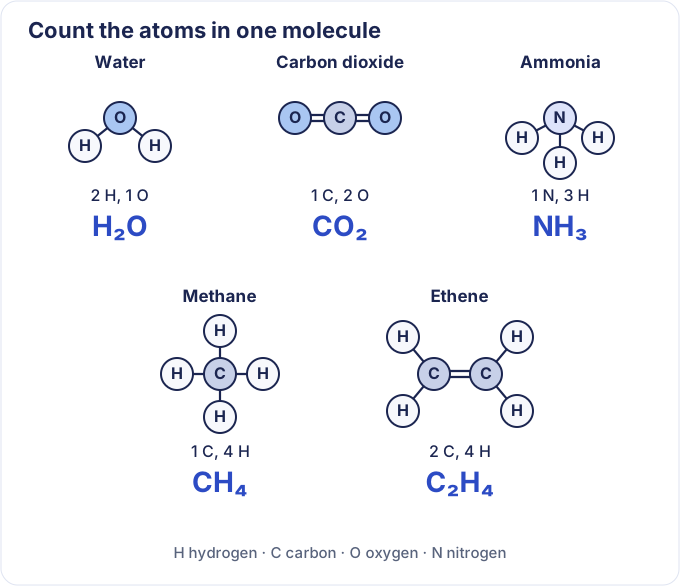
Pick up a model of an ammonia molecule from a model kit: one nitrogen ball with three small hydrogen balls stuck to it. Count them and you have its formula, NH3. That count of one molecule has a name: the molecular formula of a compound is the number and type of different atoms in one molecule. Ethene's molecular formula, C2H4, tells you that every ethene molecule has two carbon atoms and four hydrogen atoms.
To write a formula from a model or a diagram, take one molecule, count each kind of atom in it, and write each symbol with its count as a subscript (leave out a 1). Compounds of carbon usually start with C, then H; compounds of a metal start with the metal, as in NaCl and MgO.
 (enlarge)
Trap: "The diagram shows three water molecules, so the formula is H6O3." A formula describes one molecule, so count the atoms in one molecule only. Three water molecules are still water, H2O; you'll see in part 2 how to write "three of them".
Formulae you need to know
Elements are written in three ways, depending on their structure. Metals and carbon are giant structures, so each is written as its symbol alone: Mg, Fe, Cu, C. The noble gases are single atoms: He, Ne, Ar. Several non-metals are molecules of two atoms, so their formulae have a 2: hydrogen H2, oxygen O2, nitrogen N2, chlorine Cl2, and the other halogens too (F2, Br2, I2).
These compounds come up again and again in the course, so learn their formulae:
| Compound | Formula |
|---|---|
| water | H2O |
| carbon dioxide | CO2 |
| carbon monoxide | CO |
| methane | CH4 |
| ammonia | NH3 |
| hydrogen chloride (hydrochloric acid when dissolved) | HCl |
| sulfur dioxide | SO2 |
| ethene | C2H4 |
| sodium chloride | NaCl |
| magnesium oxide | MgO |
| calcium carbonate | CaCO3 |
| sodium hydroxide | NaOH |
| calcium hydroxide | Ca(OH)2 |
| copper(II) sulfate | CuSO4 |
| sulfuric acid | H2SO4 |
| nitric acid | HNO3 |
For a giant structure, such as sodium chloride or silicon(IV) oxide, there is no molecule to count: the formula gives the ratio of the ions or atoms, so NaCl means one sodium ion for every chloride ion.
Worked example
From a model to a formula
The gas in a camping stove cylinder is propane. A model of one propane molecule has three carbon atoms in a chain, with eight hydrogen atoms around them. Write its molecular formula.
Count each kind of atom in the one molecule: carbon 3, hydrogen 8. Carbon comes first, then hydrogen, each with its count as a subscript: C3H8. Because it describes one molecule, C3H8 is the molecular formula of propane.
Worked example
Counting atoms with brackets
Ammonium sulfate, (NH4)2SO4, is a fertiliser. How many atoms of each element are there in its formula?
The 2 after the bracket doubles everything inside it, so NH4 counts twice: nitrogen 1 × 2 = 2, hydrogen 4 × 2 = 8. The rest is outside the bracket: sulfur 1, oxygen 4. That makes 15 atoms in all.
Supplement: the empirical formula
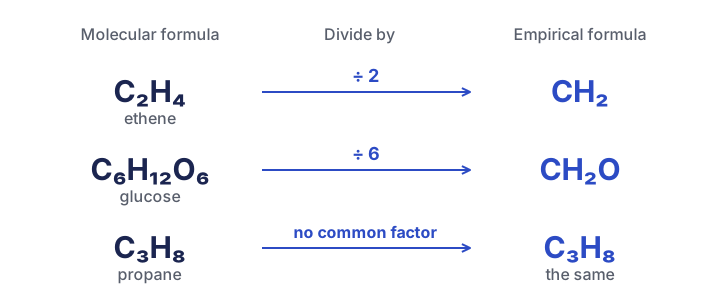
Look at ethene again: two carbon atoms for every four hydrogen atoms. Divide both numbers by 2 and the ratio is still the same, one carbon for every two hydrogens, so CH2 describes the proportions of ethene but not a real molecule. That simplest ratio has its own name: the empirical formula of a compound is the simplest whole number ratio of the different atoms or ions in a compound.
To find it, divide every number in the molecular formula by the largest whole number that divides them all. Glucose, C6H12O6, divides by 6 to give CH2O; hydrogen peroxide, H2O2, divides by 2 to give HO. Water, H2O, and propane, C3H8, can't be divided any further, so their empirical and molecular formulae are the same. For a giant structure, the formula you write, such as SiO2 or NaCl, is already the empirical formula, because it gives the ratio and there are no molecules.
 (enlarge)
Trap: "To get the empirical formula, halve every number." Divide by the largest number that goes into every subscript, which may be 2, 3, 6 or none at all. C6H12O6 divides by 6; C3H8 doesn't divide, so it stays C3H8.
Supplement: formulae of ionic compounds
An ionic compound is a giant lattice of positive and negative ions (you met this in the module on ions). The whole compound has no overall charge, so the positive charges and the negative charges must cancel, and that is how you work out its formula.
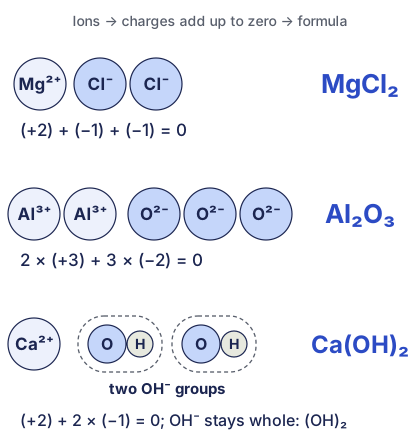
From a diagram, count the ions of each kind in a part of the lattice and write their simplest ratio. From the charges, take just enough of each ion for the charges to add up to zero. A magnesium ion, Mg2+, carries two positive charges, but a chloride ion, Cl−, carries only one negative charge, so it takes two chloride ions to balance one magnesium ion: MgCl2. With aluminium ions, Al3+, and oxide ions, O2−, the smallest total both can make is 6: two Al3+ give +6 and three O2− give −6, so the formula is Al2O3.
 (enlarge)
Some ions are groups of atoms that stay together: hydroxide OH−, nitrate NO3−, sulfate SO42−, carbonate CO32− and ammonium NH4+. When you need more than one of these, put the group in a bracket with the number after it, so calcium hydroxide is Ca(OH)2 and ammonium sulfate is (NH4)2SO4.
| Positive ions | Negative ions |
|---|---|
| H+, Na+, K+, NH4+, Ag+ | Cl−, Br−, OH−, NO3− |
| Mg2+, Ca2+, Cu2+, Zn2+, Fe2+ | O2−, SO42−, CO32− |
| Al3+, Fe3+ |
Trap: "Magnesium chloride is MgCl, because one magnesium joins one chlorine." The charges must add up to zero: Mg2+ carries +2 and each Cl− only −1, so two chloride ions are needed, MgCl2.
Trap: "Calcium hydroxide is CaOH2." Without the bracket, the 2 doubles only the hydrogen. Ca(OH)2 means two whole hydroxide ions, so two oxygen atoms and two hydrogen atoms.
Worked example
Empirical formulae (Supplement)
Butene, C4H8, and propane, C3H8, are both fuels. Write the empirical formula of each.
Butene: 4 and 8 both divide by 4, giving CH2. Propane: no whole number larger than 1 divides both 3 and 8, so the empirical formula is the molecular formula, C3H8.
Worked example
Formulae from charges (Supplement)
Write the formulae of aluminium oxide and sodium carbonate.
Aluminium oxide: Al3+ and O2−. The smallest total both charges make is 6, so two Al3+ (+6) and three O2− (−6): Al2O3. Sodium carbonate: Na+ and CO32−. One carbonate ion carries −2, so it needs two sodium ions (+2): Na2CO3. Only one carbonate ion is needed, so it needs no bracket.
Case closed
Water and hydrogen peroxide differ by one oxygen atom per molecule, and their formulae say so: H2O and H2O2. A formula counts atoms: each symbol is an element, and the subscript after it counts its atoms in one molecule, or, for a giant structure, gives the ratio. A bracket multiplies everything inside it. Write a formula from a model by counting the atoms of each kind in one molecule. Supplement: the empirical formula is the simplest whole number ratio; an ionic formula has just enough of each ion for the charges to cancel.
About this model
The ball-and-stick models show which atoms are joined, not their real sizes or colours: grey is carbon, white hydrogen, light blue oxygen and lilac nitrogen, and these colours are only labels. Sticks show covalent bonds; a double stick is a double bond. Real molecules are far too small to see, and their atoms are much closer together than the models suggest. The ion charges in the table are the ones you need in this course; how an atom's position in the Periodic Table gives its charge is in the module on ions.
For teachers: Core 3.1.1–3.1.3; Supplement 3.1.5–3.1.6, the sections "Supplement: the empirical formula" and "Supplement: formulae of ionic compounds" and worked examples W03 and W04 (Cambridge 0620 syllabus, p15).