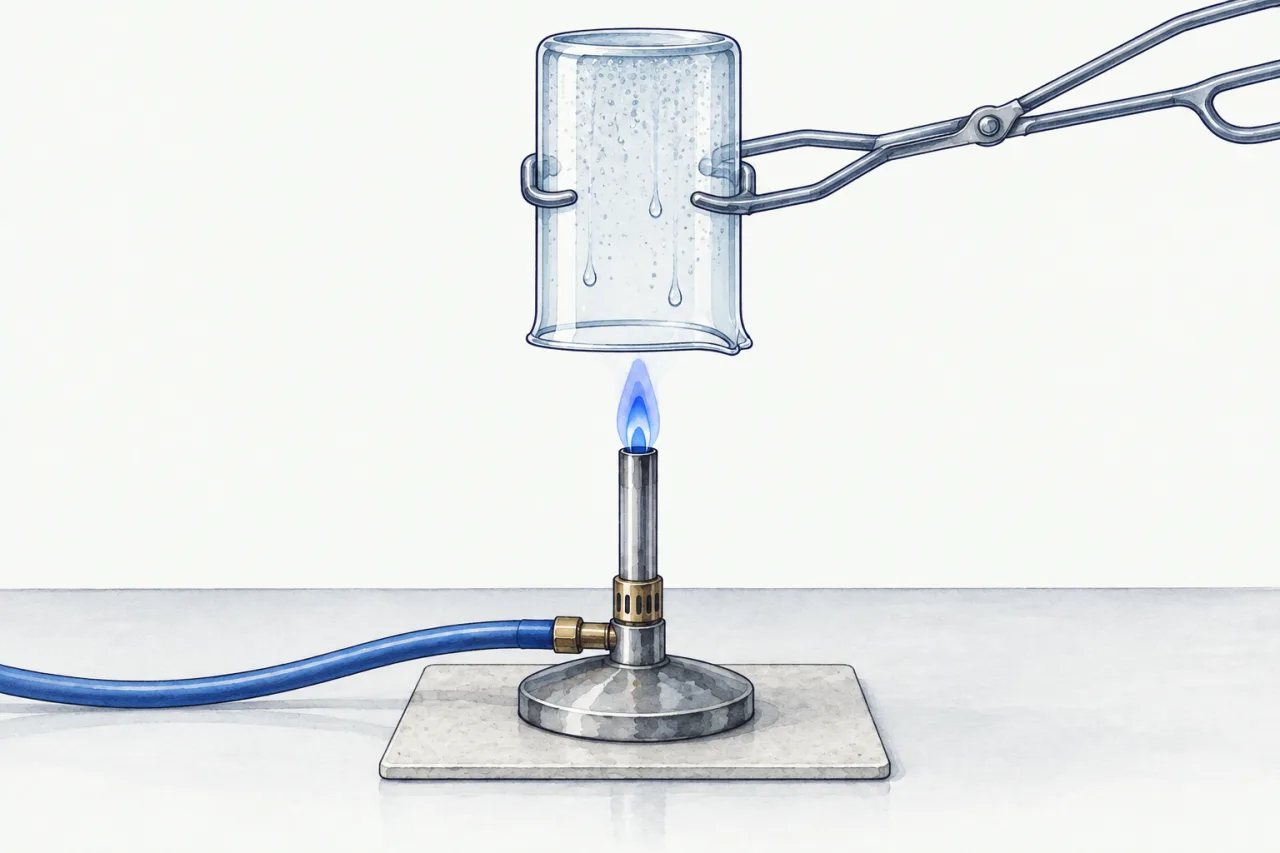
The gas that burns in a Bunsen burner, and in many kitchen cookers, is mostly methane. In the picture, a cold, dry beaker is held over a small blue flame, and within seconds its inside mists over with drops of water. When the gases from the flame are bubbled through limewater, it turns milky, the test for carbon dioxide. So burning methane in oxygen makes carbon dioxide and water. But how many oxygen molecules does each methane molecule use? In this part you'll find out by taking molecules apart and building new ones, and you'll learn to write the equation for any reaction, with the right numbers and state symbols.
 (enlarge)
Word equations
A word equation names the substances that react, the reactants, on the left, and the substances that form, the products, on the right, with an arrow between them:
methane + oxygen → carbon dioxide + water
Read the arrow as "react to make" and each + as "and". A word equation tells you what reacts and what forms, but nothing about how many particles take part. For that you need the formulae.
Predict, then rebuild
On the bench is a model tray. On its left half stand a model of a methane molecule, CH4, and a model of an oxygen molecule, O2. In the middle is a small dish, and on the right half are places for the products, CO2 and H2O. Behind the tray are jars of spare models, and they hold whole molecules only, because oxygen, hydrogen and nitrogen exist as molecules of two atoms.
The rules are the rules of every reaction. You may take the reactant models apart into loose atoms in the dish, and build product models from those atoms. No atom may be made, thrown away or turned into another element, and you may not change any model's formula. When the dish is empty, every atom has a place.
How many oxygen molecules does one methane molecule need? Make your prediction, then rebuild the molecules. After methane, try hydrogen burning in oxygen, and, for the Supplement, nitrogen and hydrogen making ammonia.
What the tray shows
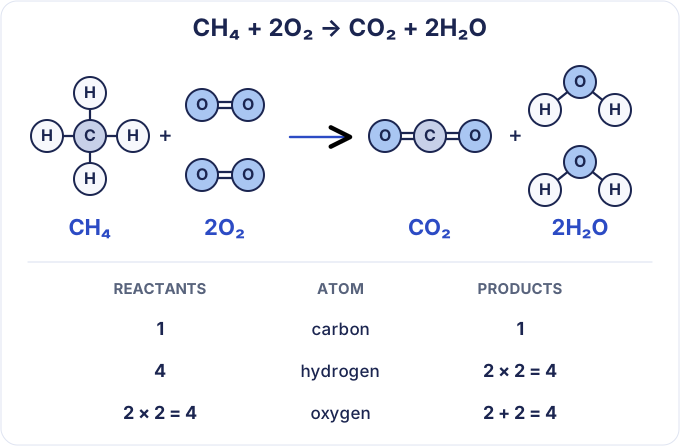
Taking one methane molecule and one oxygen molecule apart puts one carbon atom, four hydrogen atoms and two oxygen atoms in the dish. A carbon dioxide molecule uses the carbon atom and both oxygen atoms, and then four hydrogen atoms are left with no oxygen to go with them. One more whole O2 from the jar gives two more oxygen atoms, just enough for two water molecules, and the dish is empty:
CH4 + 2O2 → CO2 + 2H2O
 (enlarge)
Count the atoms on each side. On the left there are 1 carbon, 4 hydrogen and 2 × 2 = 4 oxygen atoms; on the right there are 1 carbon, 2 × 2 = 4 hydrogen and 2 + 2 = 4 oxygen atoms. That's no accident. In a chemical reaction, atoms are not made or destroyed: the bonds between them break and new bonds form, so the same atoms end up arranged in new substances. That's why every element must have the same number of atoms on both sides of the equation. An equation that shows this is balanced.
Big numbers and small numbers
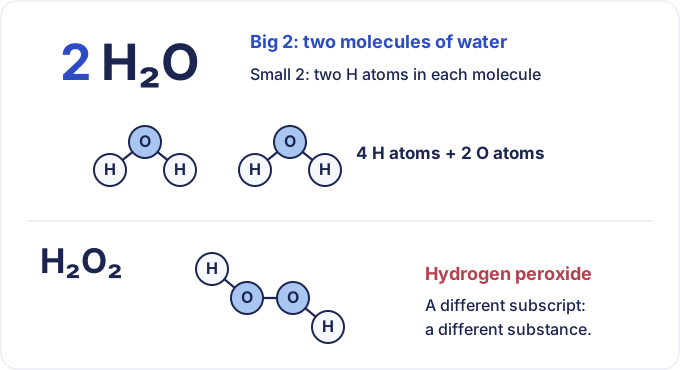
There are two kinds of number in an equation, and they mean different things. A small number written low after a symbol, a subscript, is part of the formula: it says how many atoms of that element are in one molecule. A big number in front of a formula says how many molecules (or, for an ionic compound, how many formula units) take part. So 2H2O means two water molecules, which contain four hydrogen atoms and two oxygen atoms.
 (enlarge)
You balance an equation by changing the big numbers only. Changing a subscript changes the substance, and then the equation describes a reaction that isn't happening. That's why the jars on the tray hold whole molecules: the only way to get more oxygen atoms is to take more O2 molecules.
Trap: "I can balance H2 + O2 → H2O by writing H2O2 on the right." H2O2 is hydrogen peroxide, not water. The formula of water stays H2O; to balance, put numbers in front: 2H2 + O2 → 2H2O.
Balancing step by step
- Write the word equation.
- Write the correct formula of each substance, and don't change it after this.
- Count the atoms of each element on each side.
- Put a number in front of a formula to make one element balance. Start with an element that is in only one substance on each side, and leave an element on its own, such as O2 or H2, until last.
- Count every element again, and repeat step 4 until they all balance.
- Check that the numbers are the smallest whole numbers. A 1 isn't written.
Trap: "2CH4 + 4O2 → 2CO2 + 4H2O is a different answer." It is balanced, but every number can be halved. Write the smallest whole numbers: CH4 + 2O2 → CO2 + 2H2O.
Worked example
Hydrogen and oxygen
Hydrogen burns in oxygen to make water. Write the balanced symbol equation.
The formulae are H2, O2 and H2O. Counting: hydrogen 2 on the left and 2 on the right, oxygen 2 on the left but only 1 on the right. A 2 in front of H2O makes oxygen 2 and 2, but now there are 4 hydrogen atoms on the right, so put a 2 in front of H2 as well:
2H2 + O2 → 2H2O
Check: hydrogen 4 and 4, oxygen 2 and 2.
Worked example
Magnesium burning
 (enlarge)
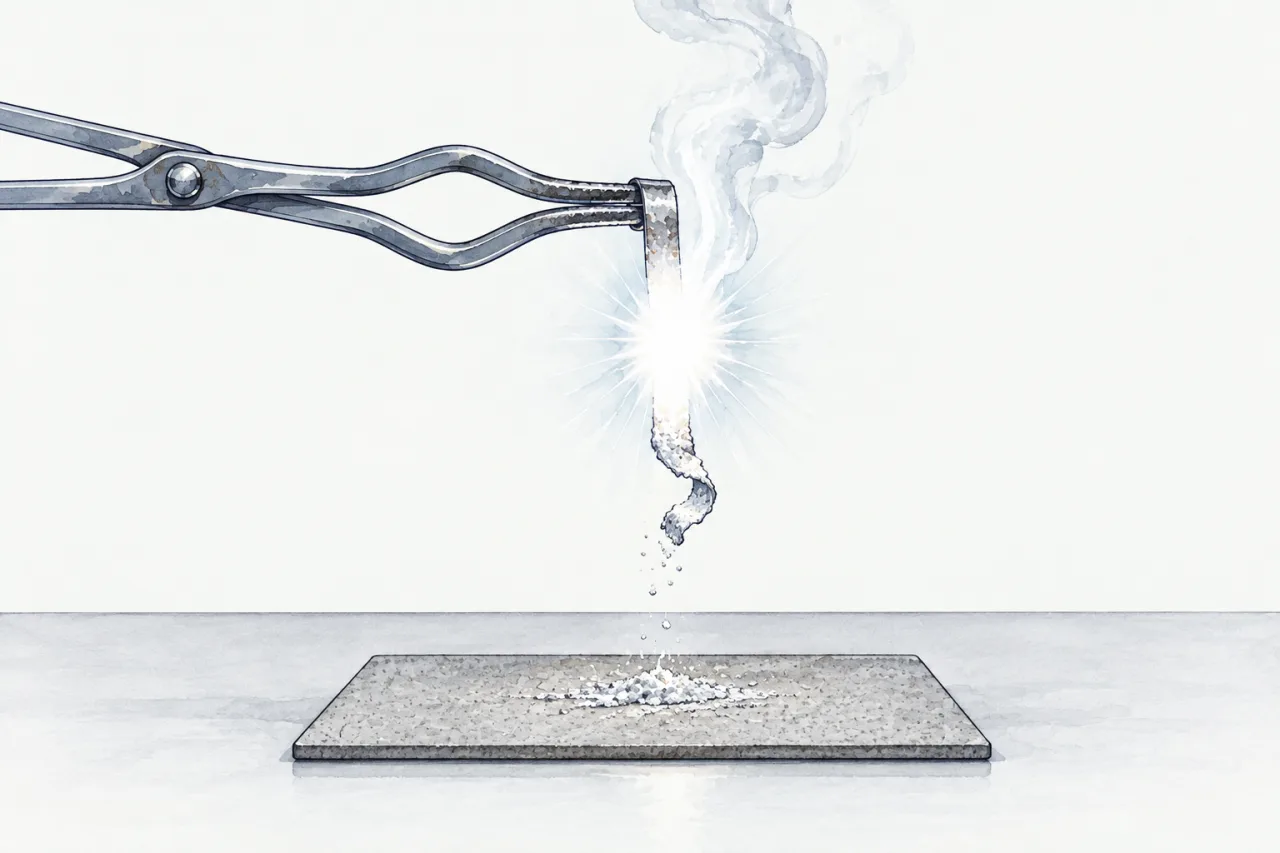
Magnesium burns in oxygen with a dazzling white light, leaving white magnesium oxide. Write the balanced symbol equation.
The formulae are Mg, O2 and MgO (magnesium is a metal, so it is written as its symbol). Oxygen is 2 on the left and 1 on the right, so put a 2 in front of MgO. That makes 2 magnesium on the right, so put a 2 in front of Mg:
2Mg + O2 → 2MgO
Magnesium oxide is ionic, so 2MgO means two formula units, two Mg2+ ions and two O2− ions, but you count the atoms exactly as before.
State symbols
An equation can also say what state each substance is in, with a state symbol in brackets after its formula: (s) solid, (l) liquid, (g) gas and (aq) aqueous, which means dissolved in water.
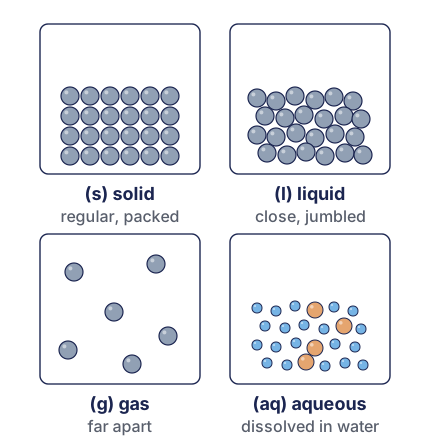 (enlarge)
The state symbol depends on the conditions, so read the question for them. Water is H2O(l) at room temperature but H2O(g) as steam in a hot flame. Hydrochloric acid is hydrogen chloride dissolved in water, HCl(aq). A salt that dissolves is (aq), while a solid that forms in a solution, a precipitate, is (s).
Trap: "Water in an equation is H2O(aq)." Aqueous means dissolved in water, and water isn't dissolved in itself. Liquid water is H2O(l).
Worked example
Marble and acid
Marble chips, calcium carbonate, react with hydrochloric acid. They fizz as carbon dioxide gas escapes, leaving a solution of calcium chloride. Write the balanced equation with state symbols.
The word equation is calcium carbonate + hydrochloric acid → calcium chloride + water + carbon dioxide, so the formulae are CaCO3, HCl, CaCl2, H2O and CO2. Chlorine is 1 on the left and 2 on the right, so put a 2 in front of HCl; then hydrogen is 2 and 2, oxygen 3 and 3, and calcium and carbon 1 and 1. The marble is a solid, the acid and the calcium chloride are dissolved in water, water is a liquid and carbon dioxide is a gas:
CaCO3(s) + 2HCl(aq) → CaCl2(aq) + H2O(l) + CO2(g)
Supplement: ionic equations
When two solutions of ionic compounds are mixed, their ions move about separately in the water. Mix silver nitrate solution with sodium chloride solution and a white solid appears at once, silver chloride:
AgNO3(aq) + NaCl(aq) → AgCl(s) + NaNO3(aq)
Only the silver ions and the chloride ions have changed: they have come together as a solid. The sodium ions and the nitrate ions were dissolved before and are still dissolved after, so they are spectator ions. An ionic equation leaves the spectators out and shows only the ions that react.
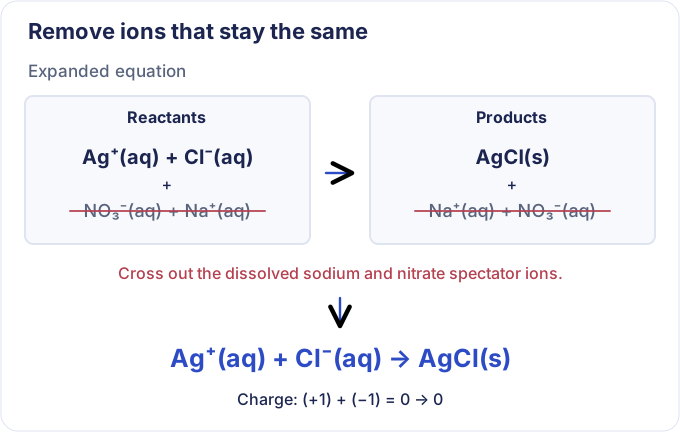 (enlarge)
To write one: write the balanced equation with state symbols; split each dissolved ionic compound, (aq), into its ions; cross out any ion that is the same on both sides; write what is left; then check that both the atoms and the total charge balance. Solids, liquids, gases and dissolved molecules stay as they are. Acids are the exception: in water an acid forms hydrogen ions, H+(aq), so hydrochloric acid, HCl(aq), is split into H+(aq) + Cl−(aq), and dilute sulfuric acid, H2SO4(aq), into 2H+(aq) + SO42−(aq). Two ionic equations come up again and again: neutralisation, H+(aq) + OH−(aq) → H2O(l), and the displacement of a metal, such as Zn(s) + Cu2+(aq) → Zn2+(aq) + Cu(s).
Trap: "In an ionic equation only the atoms need to balance." The total charge must balance too. In Zn(s) + Cu2+(aq) → Zn2+(aq) + Cu(s) the charge is +2 on each side.
Worked example
Lead(II) iodide (Supplement)
 (enlarge)
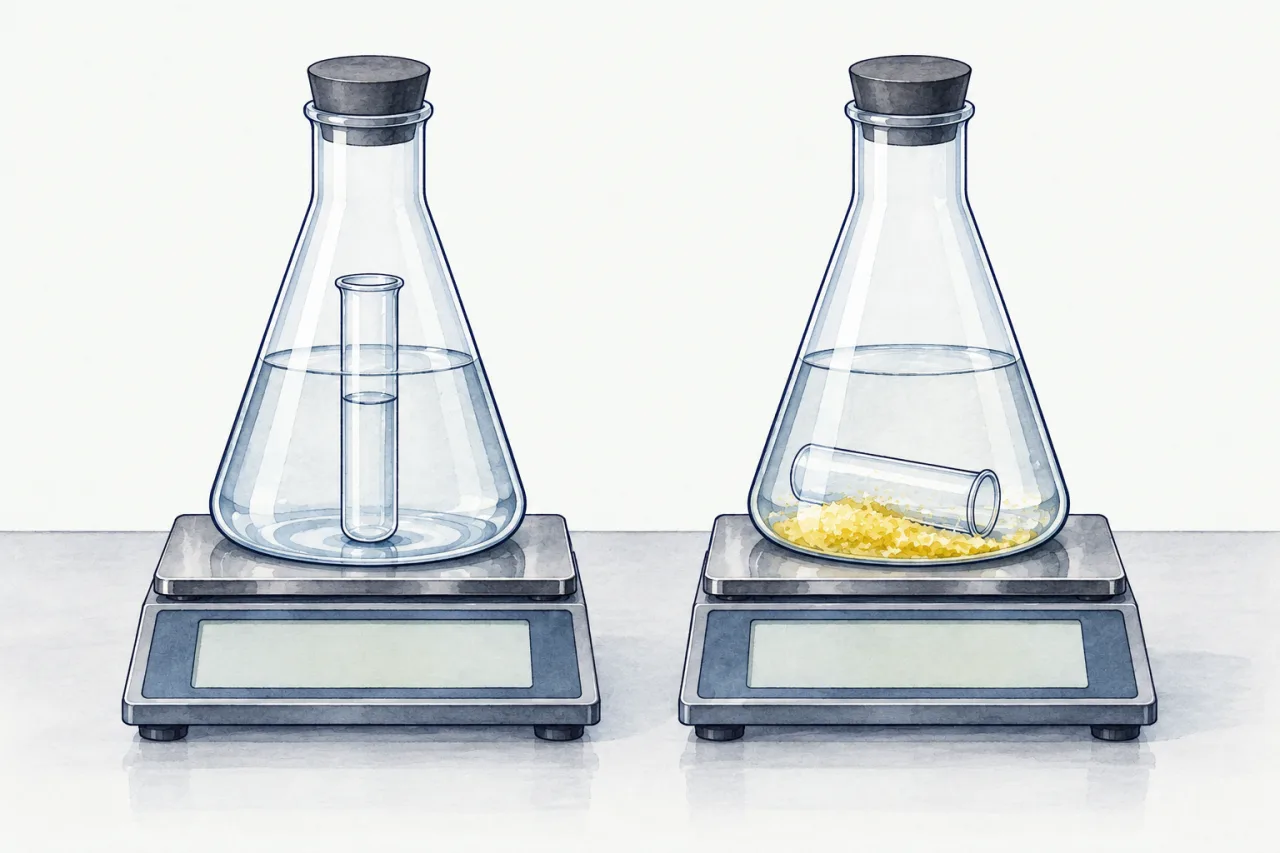
In the picture, a tube of potassium iodide solution stands in a sealed flask of lead(II) nitrate solution. When the tube is tipped over, a bright yellow precipitate of lead(II) iodide forms, and the balance reading doesn't change, because no atom leaves the sealed flask. Write the balanced equation and the ionic equation, with state symbols.
The ions are Pb2+ and NO3−, so lead(II) nitrate is Pb(NO3)2; K+ and I− make KI; Pb2+ with two I− make PbI2; and K+ with NO3− make KNO3. Two iodide ions are needed, so put a 2 in front of KI, and then 2KNO3 balances the potassium and the nitrate:
Pb(NO3)2(aq) + 2KI(aq) → PbI2(s) + 2KNO3(aq)
The potassium ions and the nitrate ions are spectators. What is left is the ionic equation:
Pb2+(aq) + 2I−(aq) → PbI2(s)
Check: one lead and two iodine on each side; the charge is +2 − 2 = 0 on the left and 0 on the right.
Supplement: an equation from given information
An exam question may describe a reaction in words and give you a formula you haven't met. Write each formula (use the ones you're given), balance the equation, and then take each state symbol from the information: a temperature, "solution", "precipitate", "gas" or "fizzes". On the tray, the information "nitrogen and hydrogen react at 450 °C to make ammonia, NH3" became:
N2(g) + 3H2(g) → 2NH3(g)
At 450 °C, all three are gases. (This reaction is in fact reversible, written ⇌; you will meet that in a later module.)
Worked example
Ethene in a flame (Supplement)
Ethene, C2H4, burns completely in oxygen. In the hot flame, the products are carbon dioxide and steam. Write the balanced equation with state symbols.
Carbon is 2 on the left, so put 2 in front of CO2; hydrogen is 4, so put 2 in front of H2O. Now count oxygen on the right: 2 × 2 + 2 × 1 = 6 atoms, which is three O2 molecules. The water is steam, so it is a gas:
C2H4(g) + 3O2(g) → 2CO2(g) + 2H2O(g)
Case closed
One methane molecule needs two oxygen molecules: CH4 + 2O2 → CO2 + 2H2O. In a reaction, atoms are not made or destroyed, only rearranged, so a balanced equation has the same number of atoms of each element on both sides. Balance it by changing the numbers in front of the formulae, never the formulae themselves, and use the smallest whole numbers. State symbols, (s), (l), (g) and (aq), come from the conditions. Supplement: an ionic equation shows only the ions that change, and its charges balance as well as its atoms.
About this model
The model tray is bookkeeping: it shows which atoms end up in which product, not how the reaction happens. In a real flame, molecules collide, and bonds break and form in several steps while energy is given out; nothing on the tray burns. The jars hold whole molecules because oxygen, hydrogen and nitrogen exist as molecules of two atoms. The models aren't to scale, and their colours only label the elements. The real reaction of nitrogen and hydrogen is reversible and never makes ammonia from all of them; that comes in a later module, and the tray only balances its equation.
For teachers: Core 3.1.4; Supplement 3.1.7–3.1.8, the sections "Supplement: ionic equations" and "Supplement: an equation from given information" and worked examples W08 and W09 (Cambridge 0620 syllabus, p15).