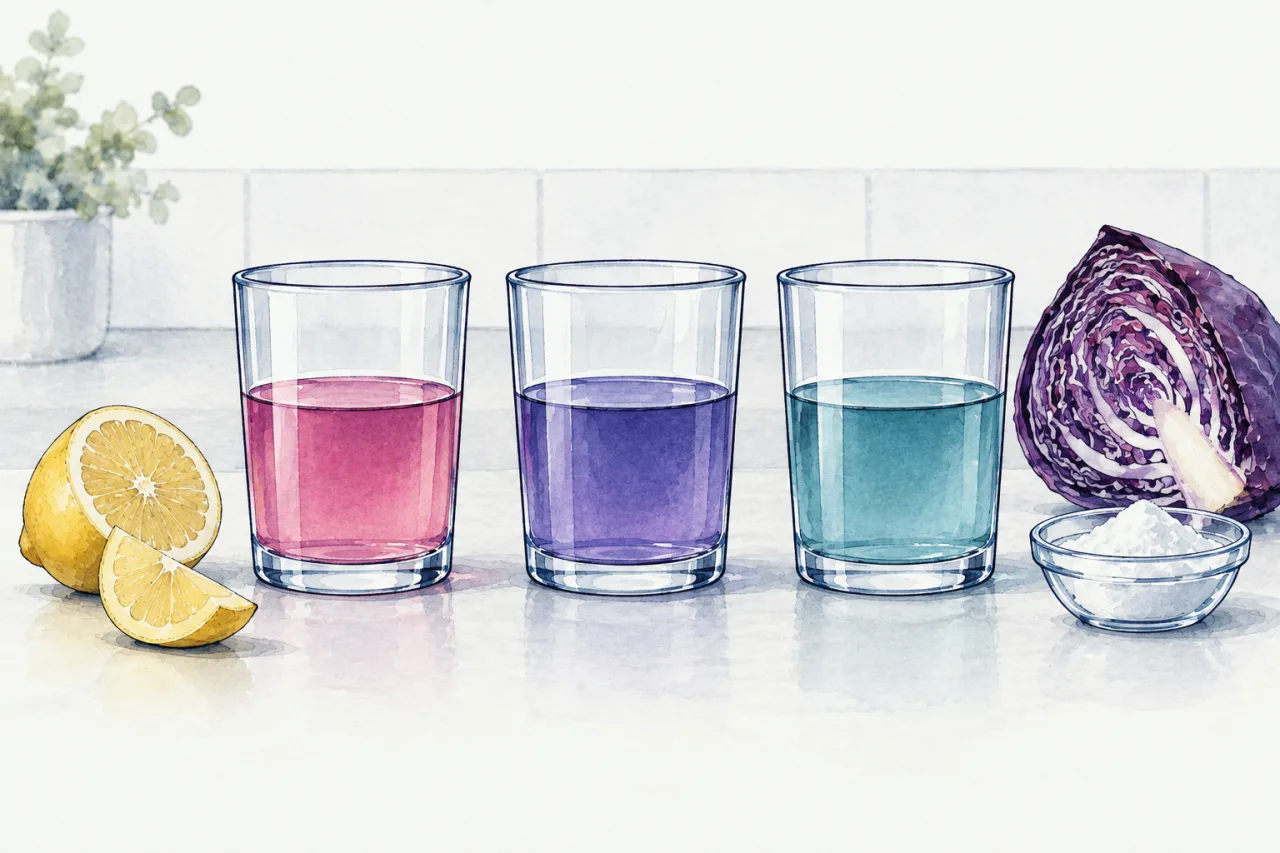
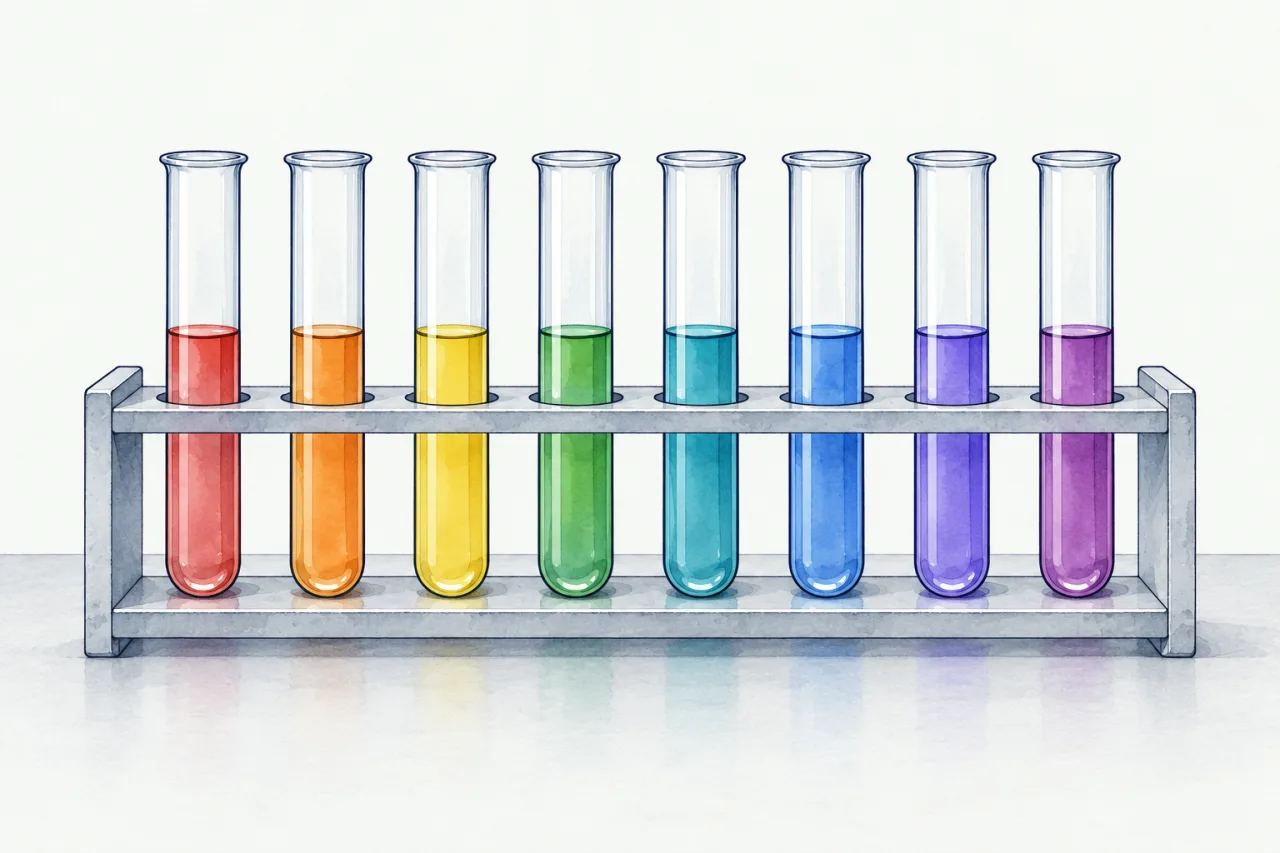
Chop a red cabbage, boil the leaves in water, and you get a deep purple juice. Pour it into three glasses. Squeeze lemon juice into the first glass and it turns pink. Stir a spoonful of baking soda into the third and it turns green-blue. The middle glass, with nothing added, stays purple.
Lemon juice isn't pink and baking soda isn't blue, so the colours must come from the cabbage juice itself, changing with what it meets. What does a colour change tell you about a liquid? In this part you'll learn to read three laboratory indicators and a colour chart, and find out what is inside a solution that makes it an acid or an alkali.
 (enlarge)
Indicators tell acids from alkalis
Lemon juice and vinegar belong to a family of substances called acids. Baking soda solution, soap solution and oven cleaner belong to the opposite family, the alkalis. Pure water and sugar solution belong to neither family: they are neutral.
Most acids and alkalis in a laboratory are colourless solutions that look exactly like water, so you can't sort them by looking. That's why chemists use an indicator: a substance that has one colour in an acid and a different colour in an alkali. A few drops show which family a solution belongs to. Red cabbage juice is an indicator: pink in an acid, green-blue in an alkali and purple in a neutral solution.
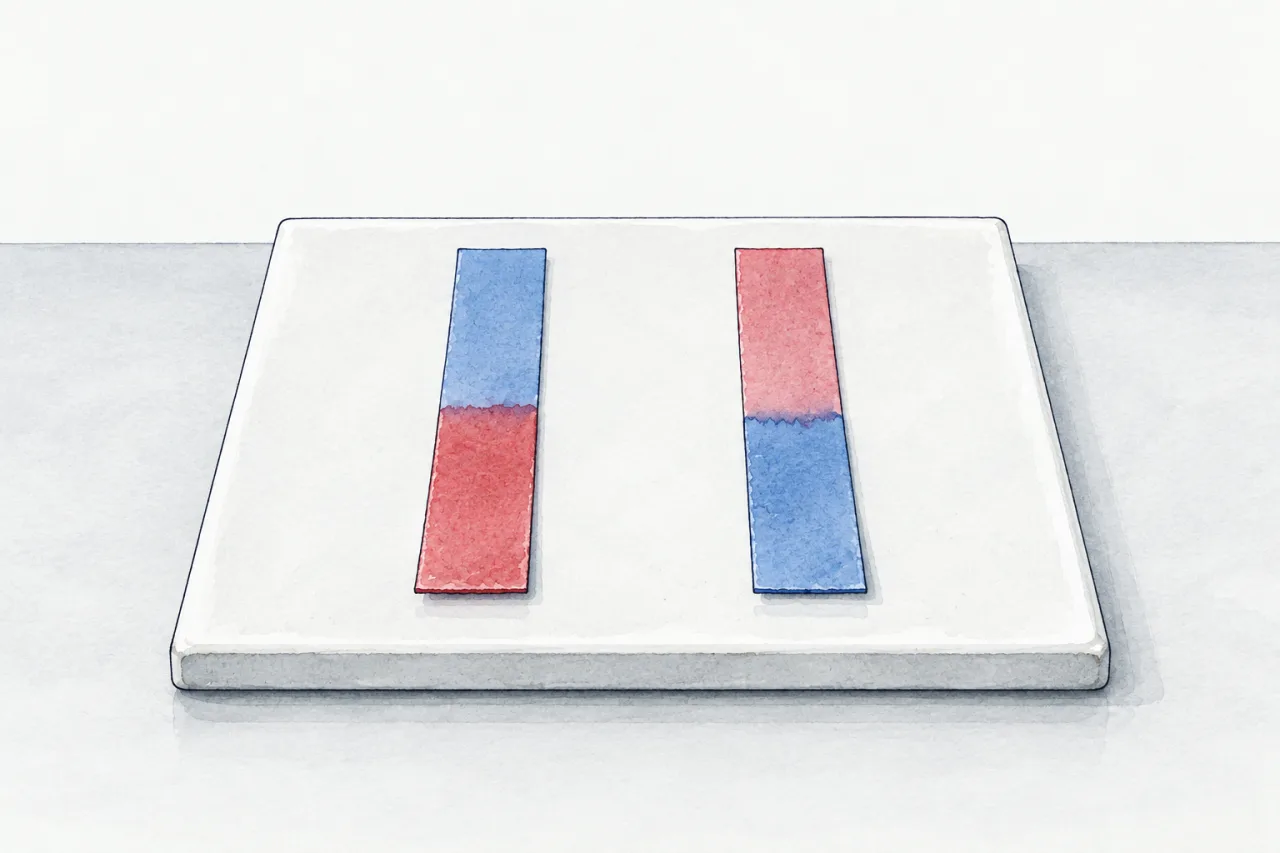
The oldest laboratory indicator is litmus, a dye made from lichens. It comes as a purple solution or as strips of paper, red or blue. An acid turns litmus red, and an alkali turns it blue. In a neutral solution, purple litmus solution stays purple. So blue litmus paper dipped in an acid turns red, and red litmus paper dipped in an alkali turns blue. A strip that doesn't change tells you something too: red litmus paper stays red in an acid and in a neutral solution, so it can only pick out an alkali.
 (enlarge)
Trap: "Litmus turns red in an alkali." It's the other way round: an acid turns litmus red, and an alkali turns it blue. One way to remember it: Blue turns Red in Acid.
Two more indicators
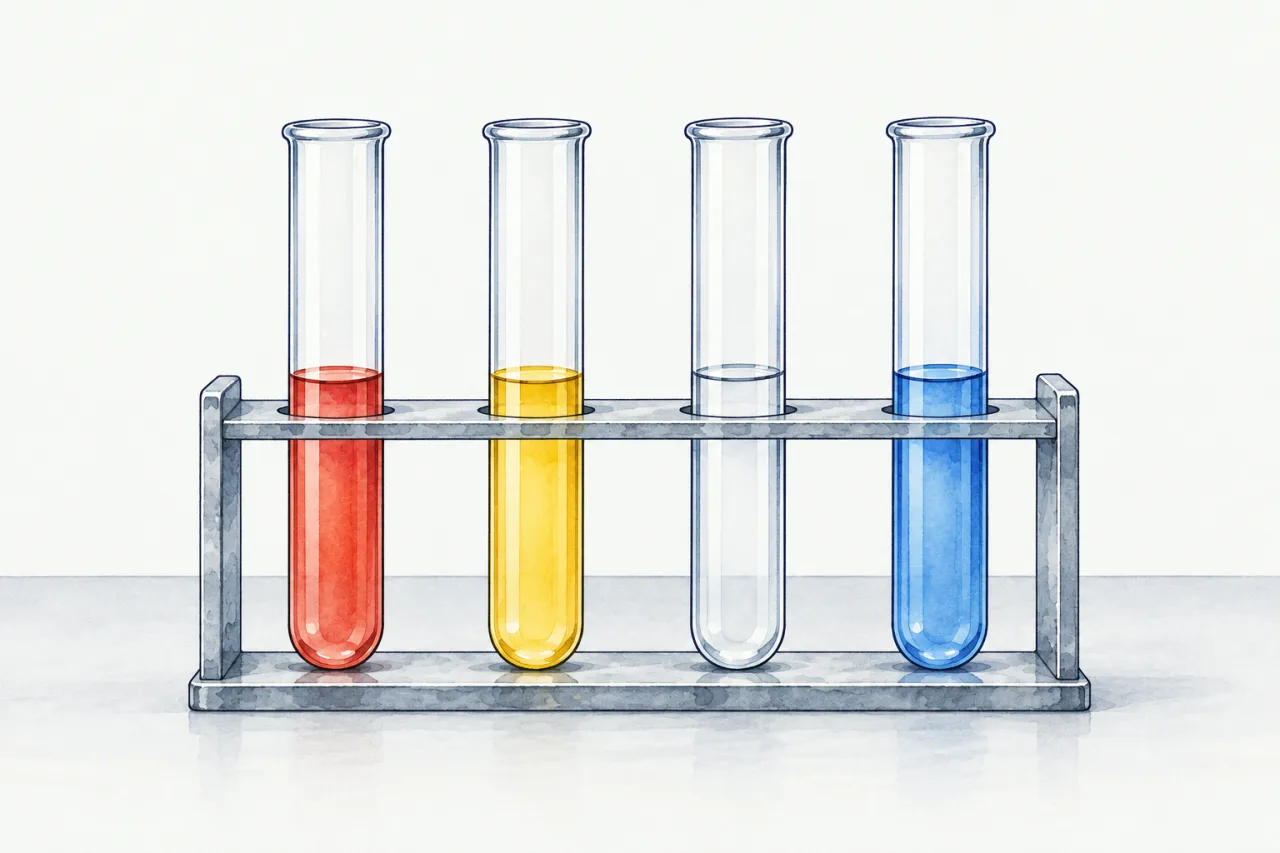
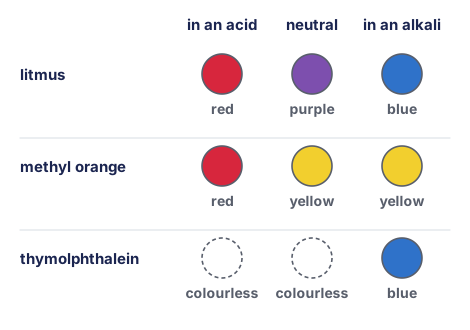
Litmus isn't the only indicator you need. Methyl orange is red in an acid and yellow in an alkali. Thymolphthalein (say "thy-mol-thal-een") is colourless in an acid and blue in an alkali.
 (enlarge)
Each indicator changes colour at its own point, and that matters when a solution is neutral. In pure water, methyl orange is already yellow, the same colour as in an alkali, and thymolphthalein is still colourless, the same as in an acid. So one indicator on its own can mislead you: yellow methyl orange doesn't prove an alkali, and colourless thymolphthalein doesn't prove an acid. Litmus is the one with a third colour, purple, for a neutral solution.
The change points can mislead you the other way too. Methyl orange turns red only in a clearly acidic solution: a very weakly acidic one, such as rainwater, already makes it yellow. Thymolphthalein turns blue only in a clearly alkaline solution: a weakly alkaline one, such as seawater, leaves it colourless. So yellow methyl orange doesn't prove that a solution is not an acid, and colourless thymolphthalein doesn't prove that it is not an alkali. When one colour fits more than one answer, test with another indicator, or with universal indicator, which comes later in this part.
 (enlarge)
Trap: "Methyl orange goes red in an alkali, and thymolphthalein goes blue in an acid." Both are the wrong way round. Red methyl orange and colourless thymolphthalein are the acid colours; yellow methyl orange and blue thymolphthalein are the alkali colours.
Worked example
Washing soda
Washing soda crystals are dissolved in water, and the solution is tested with all three indicators. Litmus turns blue, methyl orange turns yellow and thymolphthalein turns blue. Is the solution an acid, an alkali or neutral?
- Litmus is blue, so the solution is an alkali.
- Methyl orange is yellow, which fits an alkali, but a neutral solution would give yellow too, so on its own it can't decide.
- Thymolphthalein is blue, and it is blue only in an alkali.
- Two indicators say alkali, and the third fits. The solution is an alkali.
Your investigation
On your bench stand four dropper bottles, A, B, C and D. Each holds a colourless solution, and all four were made up at the same concentration, 0.10 mol/dm³. Two of them are acids, one is neutral and one is an alkali, but the labels don't say which. In front of them is a white spotting tile: a tile with rows of small hollows, called wells. One row of wells holds litmus, one methyl orange and one thymolphthalein, and each bottle has its own column. Beside the tile wait four squares of universal indicator paper and a colour chart, for later.
You put a drop from each bottle into its column and read the colours. Before you start, predict: two of the bottles are acids. Will the three indicators tell the two acids apart?
What the tile showed
Here is what the four columns showed.
| Bottle | Litmus | Methyl orange | Thymolphthalein | So it is |
|---|---|---|---|---|
| A | red | red | colourless | an acid |
| B | purple | yellow | colourless | neutral |
| C | red | red | colourless | an acid |
| D | blue | yellow | blue | an alkali |
Bottle D turned litmus blue and thymolphthalein blue, so it is the alkali. Bottle B turned litmus purple, so it is neutral; its yellow methyl orange and colourless thymolphthalein are what both indicators show in a neutral solution. Bottles A and C gave the same three colours, the acid colours of all three indicators.
So the indicators did their job, and then they stopped: on the tile, the two acids look exactly the same. With acids as clearly acidic as these two, each indicator shows its one acid colour: together they answer acid, alkali or neutral, but not how acidic. To find out how acidic a solution is, you need an indicator with many colours.
Universal indicator and the pH scale
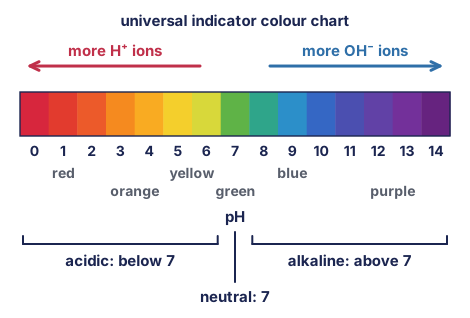
Universal indicator is a mixture of several indicators, so it doesn't just switch between two colours. As a solution goes from strongly acidic to strongly alkaline, universal indicator runs through red, orange, yellow, green, blue and purple. It is sold as a solution or soaked into strips of paper, called universal indicator paper.
 (enlarge)
Each colour matches a number on the pH scale, which runs from 0 to 14. You put a drop of the solution on the paper, then match the colour on the chart and read off the pH. A solution with a pH below 7 is acidic, a pH of exactly 7 is neutral, and above 7 is alkaline. The further below 7, the more acidic the solution; the further above 7, the more alkaline.
 (enlarge)
On the paper, the bottles finally look different. Square A turned orange: pH 3. Square C turned red: pH 1. Square B turned green, pH 7, and square D purple, pH 13. Both acids are below 7, but C, at pH 1, is more acidic than A, at pH 3. In order from the most acidic to the most alkaline, the bottles go C, A, B, D.
Trap: "pH 1 and pH 3 are the same thing: both are just acid." Both are acids, but not equally acidic. The lower the pH, the more acidic the solution, so the pH 1 solution is the more acidic of the two. The next section shows what that difference is made of.
What makes a solution acidic
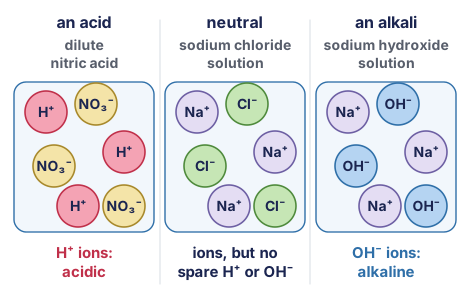
Why does every acid turn litmus red, whatever the acid is? The answer is in the particles. When an acid dissolves in water, it forms hydrogen ions, H+: hydrogen atoms that have lost their electron, so they carry a positive charge. Every aqueous solution of an acid contains H+(aq) ions, where (aq) means dissolved in water. An alkali in water forms hydroxide ions, OH−(aq). The indicators respond to these ions: H+ ions turn litmus red, and OH− ions turn it blue.
A neutral solution still has ions in it. Bottle B was sodium chloride solution, full of sodium ions, Na+, and chloride ions, Cl−. What a neutral solution lacks is spare H+ or OH− ions: neither kind is left over to change an indicator. Bottle D was sodium hydroxide solution, with Na+ ions and OH− ions.
 (enlarge)
The pH scale is a way of comparing the concentration of hydrogen ions: how many H+ ions there are in each cm³ of solution. The lower the pH, the higher the concentration of hydrogen ions. Bottle C, at pH 1, had a much higher concentration of H+ ions than bottle A, at pH 3, even though both held the same amount of acid in each dm³. Above 7 it works the other way: the higher the pH, the more OH− ions, so D, at pH 13, is strongly alkaline. Why two acids at the same concentration give different amounts of H+ is a question for part 3, which is Supplement.
Trap: "Neutral means there are no ions in the solution." Sodium chloride solution is full of Na+ and Cl− ions and is still neutral. Neutral means there are no spare H+ or OH− ions.
Key idea: Acids in water contain H+ ions; alkalis contain OH− ions. Litmus, methyl orange and thymolphthalein each tell a clearly acidic solution from a clearly alkaline one; universal indicator gives the pH, and the lower the pH, the higher the concentration of H+ ions.
Worked example
Three kitchen liquids
Drops of three liquids are put on universal indicator paper. Lemon juice turns it red, pH 2. Tomato juice turns it orange, pH 4. Baking soda solution turns it blue, pH 9. Which liquid has the highest concentration of hydrogen ions, and which is alkaline?
- Sort by the 7 line. Lemon juice (2) and tomato juice (4) are below 7, so both are acidic. Baking soda solution (9) is above 7, so it is alkaline.
- Compare the two acids. Lemon juice has the lower pH, so it is the more acidic of the two.
- Link pH to H+ ions. The lower the pH, the higher the concentration of hydrogen ions: lemon juice has the most H+ ions.
Repeat readings and the mean
A pH meter gives a number, and a careful pupil measures more than once. Suppose a pupil measures the pH of tap water four times with a pH meter: 7.2, 7.4, 8.6 and 7.3. What is the pH of the tap water?
- Look for a reading that doesn't fit. 7.2, 7.4 and 7.3 lie close together. 8.6 is far from all three: it is an anomalous reading, perhaps from a probe that wasn't rinsed.
- Leave the anomaly out. If you can, repeat that reading to check it; if not, leave it out. Only the readings that agree go into the mean.
- Calculate the mean: add the readings and divide by how many there are: (7.2 + 7.4 + 7.3) ÷ 3 = 21.9 ÷ 3 = 7.3.
Case closed
What does a colour change tell you? The colour of an indicator shows whether a solution is an acid, an alkali or neutral. Litmus is red in an acid and blue in an alkali; methyl orange is red in an acid and yellow in an alkali; thymolphthalein is colourless in an acid and blue in an alkali. Those are the colours in clearly acidic and clearly alkaline solutions; a very weak one can give the neutral colour, so check with a second indicator. These three can't tell one acid from another, but universal indicator can: its colour gives the pH, from 0 to 14, with 7 neutral. Acids contain H+ ions and alkalis OH− ions, and the lower the pH, the higher the concentration of H+ ions. In the next part you'll find out what acids do to metals, bases and carbonates, and what happens to the ions when an acid meets an alkali.
About this model
The pH values here are typical values for these solutions, read from a chart, not calculated. Ethanoic acid at 0.10 mol/dm³ has a pH of 2.9, which the chart, marked in whole numbers, shows as 3. Each indicator changes colour over a small range of pH, not at one exact number, and between its two colours it shows a mixture: methyl orange looks orange at about pH 4. Only the acid and alkali colours are needed here. Universal indicator colours differ a little from one maker to another, so always use the chart that comes with the paper. Pure water does contain a very few H+ and OH− ions, in equal numbers, which is why it is neutral; the drawings leave the water out. A change of 1 in pH means the concentration of hydrogen ions changes ten times, but you won't need that number in this course.