This part is Supplement.
In part 1, two of the four bottles turned out to be acids. Both were made up at the same concentration, 0.10 mol/dm³: the same amount of acid dissolved in every dm³ of solution. On the spotting tile they looked exactly alike. On universal indicator paper, bottle C showed pH 1 and bottle A pH 3. So C had a much higher concentration of hydrogen ions than A.
The same amount of acid, but not the same number of H+ ions. Where did A's missing hydrogen ions go? To answer that, you need to look inside the two solutions, at the particles.
What an acid gives away
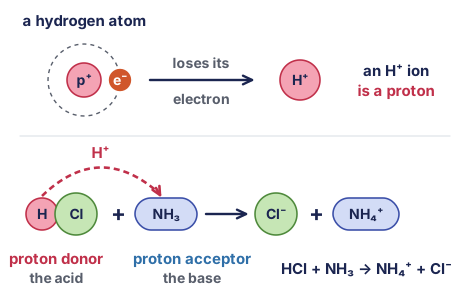
A hydrogen atom is the simplest atom there is: one proton in the nucleus and one electron around it. Take the electron away and only the proton is left. So a hydrogen ion, H+, is just a proton.
When an acid dissolves in water, its molecules split up, and each gives away a hydrogen ion: a proton. Hydrogen chloride, HCl, splits into H+ and Cl− ions. The splitting of a molecule into ions like this is called dissociation: the acid dissociates. The more of its molecules dissociate, the more H+ ions the solution has.
That gives a way to explain the two bottles. Perhaps both acids gave away all their protons, or perhaps one of them kept most of its own.
Your investigation
Back on the bench, the four bottles stand where you left them. Now a magnifier opens over bottles A and C: its left half shows the particles in A, its right half the particles in C, with the water left out. One of the two bottles is hydrochloric acid, HCl, and the other is ethanoic acid, CH3COOH, the acid in vinegar.
Before you look, predict: which bottle will show more H+ ions, and what else will you see in the other one?
What the magnifier showed
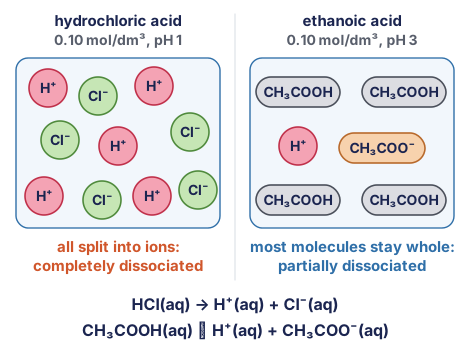
Under the magnifier, bottle C held nothing but ions: H+ ions and Cl− ions, and not one whole HCl molecule. Every hydrogen chloride molecule had dissociated. Bottle C is hydrochloric acid.
Bottle A looked quite different. Most of what it held were whole CH3COOH molecules, with just a few H+ ions and ethanoate ions, CH3COO−, among them. Only a small share of its molecules had dissociated. Bottle A is ethanoic acid. That is where its missing hydrogen ions went: they never left their molecules.
 (enlarge)
Strong and weak acids
Hydrochloric acid is a strong acid: it is completely dissociated in water. Every molecule gives up its H+ ion, and the equation, with state symbols, has a one-way arrow:
HCl(aq) → H+(aq) + Cl−(aq)
Ethanoic acid is a weak acid: it is partially dissociated in water. Only a small share of its molecules give up their H+ ions at any moment, so its equation has a two-way arrow:
CH3COOH(aq) ⇌ H+(aq) + CH3COO−(aq)
The ⇌ arrow means the reaction is reversible: molecules keep splitting into ions, and ions keep joining back into molecules, so most of the acid stays as whole molecules. Sulfuric acid and nitric acid are strong acids too; ethanoic acid, citric acid and the acid in fizzy drinks are weak.
This explains part 1. At the same concentration, a strong acid has a higher concentration of H+ ions than a weak acid, so it has the lower pH: bottle C, pH 1, against bottle A, pH 3.
The H+ ions are also what react. Magnesium ribbon in an acid reacts with the H+ ions to make hydrogen gas. In a strong acid there are more H+ ions in each cm³ than in a weak acid at the same concentration, so more of them meet the magnesium each second, and it fizzes faster. For a fair comparison, keep everything else the same: the temperature, the volume of acid and identical pieces of magnesium.
Trap: "A weak acid has no H+ ions." It has some: bottle A turned universal indicator orange, and an acid's colour comes from its H+ ions. A weak acid has fewer H+ ions than a strong acid at the same concentration, because most of its molecules stay whole.
Worked example
Two acids in a test
Nitric acid, HNO3, and methanoic acid, HCOOH, are both made up at 0.10 mol/dm³. Nitric acid has a pH of 1.0, and methanoic acid a pH of 2.4. Which is the weak acid? Give its equation, with state symbols.
- Same concentration, different pH. The acid with the higher pH has the lower concentration of H+ ions.
- Fewer H+ ions means fewer molecules dissociated. Methanoic acid, pH 2.4, is only partially dissociated: it is the weak acid.
- The equation needs the two-way arrow. HCOOH(aq) ⇌ H+(aq) + HCOO−(aq).
- Check the strong acid. Nitric acid is completely dissociated: HNO3(aq) → H+(aq) + NO3−(aq).
Strong is not the same as concentrated
A shop sells a very dilute hydrochloric acid, 0.0010 mol/dm³: a hundred times more dilute than bottle C. Its pH is 3, the same as bottle A, the ethanoic acid. Has hydrochloric acid become a weak acid?
No. Every one of its molecules is still dissociated: it is still a strong acid. There is simply far less acid in each dm³, so there are fewer H+ ions. Two different ideas are at work. Strong or weak says how completely an acid dissociates. Concentrated or dilute says how much acid is dissolved in each dm³. A strong acid can be dilute, and a weak acid can be concentrated.
Trap: "A strong acid is a concentrated acid." Strong is about the share of molecules that dissociate; concentrated is about how much acid is in the solution. To compare the strength of two acids by their pH, they must be at the same concentration.
Worked example
Same pH, different acids
Solution 1 is hydrochloric acid at 0.0010 mol/dm³. Solution 2 is ethanoic acid at 0.10 mol/dm³. Both have a pH of 3. Which solution contains the strong acid, and which the more concentrated solution?
- Same pH, so both have the same concentration of H+ ions.
- Strength: hydrochloric acid is completely dissociated: solution 1 holds the strong acid.
- Concentration: solution 2 has 0.10 mol/dm³, a hundred times more acid in each dm³: it is the more concentrated.
- Why the pH matches: solution 2 has far more acid, but only a small share of it dissociates; solution 1 has little acid, but all of it dissociates. The two give the same number of H+ ions.
Proton donors and proton acceptors
Hold an open bottle of concentrated hydrochloric acid next to an open bottle of ammonia solution, and a white smoke forms in the air between them. Hydrogen chloride gas meets ammonia gas, and they make tiny grains of ammonium chloride. What has passed from one molecule to the other?
The HCl molecule gives its H+ ion, a proton, to the ammonia molecule, NH3, which becomes an ammonium ion, NH4+:
HCl + NH3 → NH4+ + Cl−
So an acid is a proton donor: it gives away H+ ions. A base is a proton acceptor: it takes them. In neutralisation, the hydroxide ion is the proton acceptor: H+ + OH− → H2O. Ammonia has no hydroxide in it, yet it is still a base, because it accepts protons.
 (enlarge)
Key idea: Acids are proton donors and bases are proton acceptors. A strong acid is completely dissociated in water, HCl(aq) → H+(aq) + Cl−(aq); a weak acid is partially dissociated, CH3COOH(aq) ⇌ H+(aq) + CH3COO−(aq). At the same concentration, a strong acid has more H+ ions and a lower pH than a weak acid.
Case closed
Why did two acids at the same concentration give different pH values? Because they don't give up their protons in the same way. Hydrochloric acid is a strong acid: every molecule dissociates, so its solution is full of H+ ions and has pH 1. Ethanoic acid is a weak acid: only a few of its molecules dissociate, so it has far fewer H+ ions and pH 3. Every acid is a proton donor, and every base a proton acceptor. Strong and weak describe how completely an acid dissociates, not how much of it is dissolved.
About this model
The magnifier draws only a handful of particles, and it leaves out the water, which is by far the most common particle in both solutions. In real ethanoic acid at 0.10 mol/dm³, only about 1 molecule in 75 is dissociated; the magnifier and the drawings show more ions than that, so that you can see some. The ⇌ arrow describes a balance: at every moment some molecules split up and some ions join back, and the share that is dissociated stays the same. Hydrochloric acid at very high concentrations is not quite completely dissociated, but at the concentrations used here it is. The pH values are typical values read from a chart or a meter, not calculated: calculating pH from concentration is beyond this course.