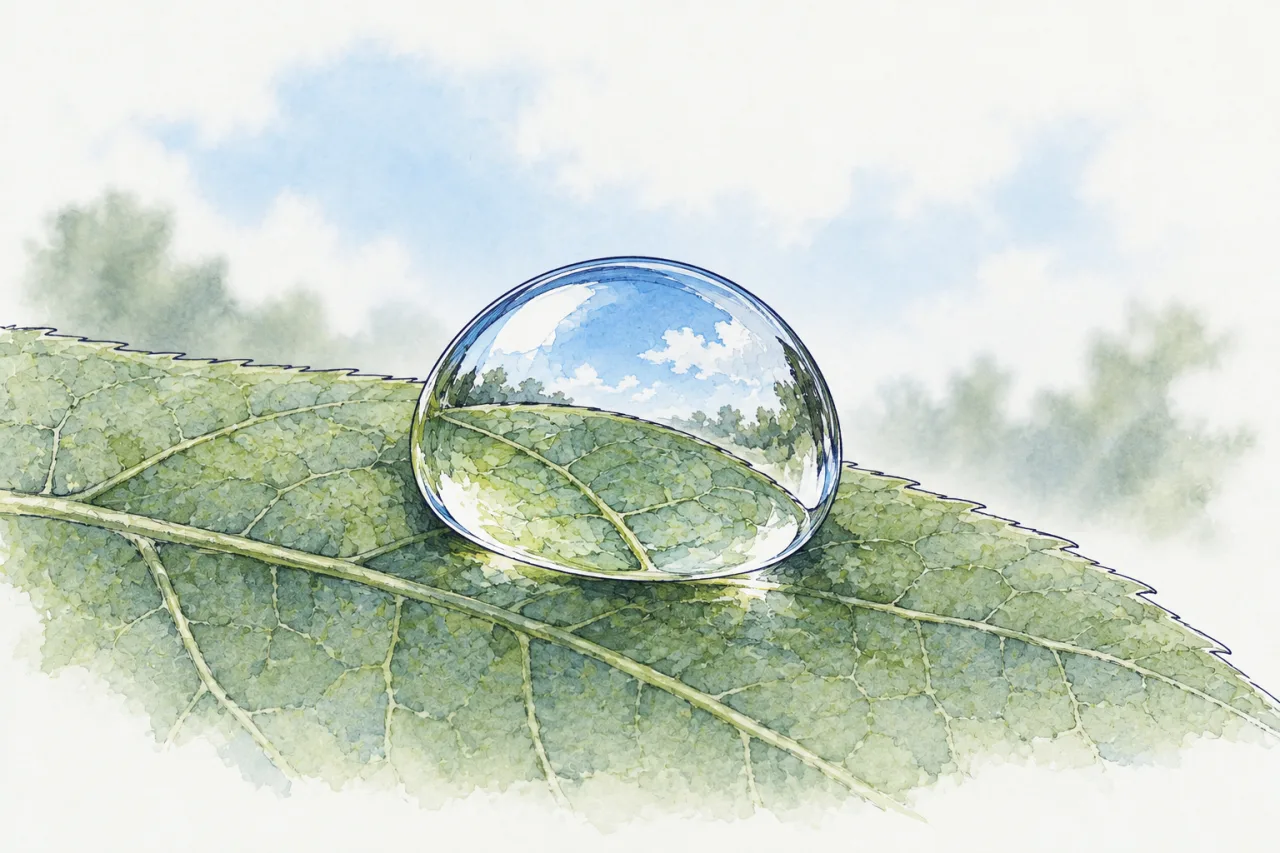
A drop of rain on a leaf has a mass of about 0.05 g, so a good school balance can only just weigh it. Yet that one drop holds roughly 2 000 000 000 000 000 000 000 water molecules. So a single molecule is far too light for any balance: written in grams, its mass has 22 zeros after the decimal point before the first digit. Even so, chemists say that a water molecule "weighs 18". Eighteen what? In this part you'll find out what that number means, where it comes from, and how to work it out for any formula, so that in part 2 you can use it to predict a real mass on a real balance.
 (enlarge)
Compare, don't weigh
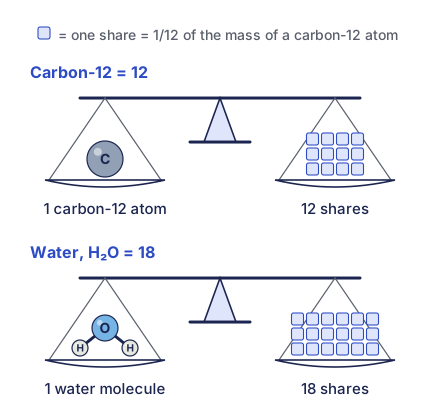
When something is too light to weigh on its own, you can still say how heavy it is compared with something else. Chemists compare the mass of every atom with one chosen atom: an atom of carbon-12, the isotope of carbon with 6 protons and 6 neutrons. They split its mass into 12 equal shares and use one share, 1/12 of the mass of a carbon-12 atom, as the unit for the comparison. A carbon-12 atom is then exactly 12 on this scale. A hydrogen atom has about the same mass as one share, so it's 1, and an oxygen atom has about the mass of 16 shares, so it's 16.
Picture a balance so sensitive that it could hold a single atom. No real balance can, so this is only a thought model. Put a carbon-12 atom on one pan and it balances 12 shares. Put a water molecule there instead and it balances 18 shares. That's what "a water molecule weighs 18" means: its mass is 18 times 1/12 of the mass of a carbon-12 atom, so it's one and a half times as heavy as a carbon-12 atom. Because the number compares two masses, it has no unit. It isn't 18 grams.
 (enlarge)
Most elements are a mix of isotopes
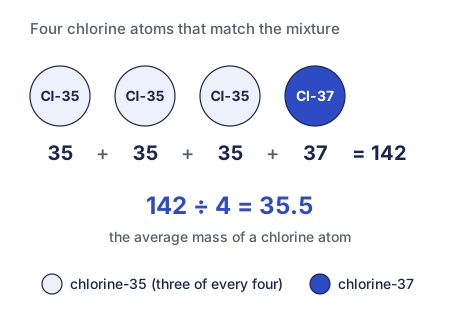
In the Isotopes module you met atoms of one element with different numbers of neutrons. Chlorine has two: chlorine-35 and chlorine-37. Every sample of chlorine is a mixture of the two, with about three chlorine-35 atoms for every chlorine-37 atom. Take four atoms that match this mixture, three of mass 35 and one of mass 37. Together they have a mass of 35 + 35 + 35 + 37 = 142, so on average each atom has a mass of 142 ÷ 4 = 35.5. No single chlorine atom has a mass of 35.5, but the average atom in any real sample does.
 (enlarge)
This average is the number the Periodic Table gives for each element, its relative atomic mass, Ar. The relative atomic mass of an element is the average mass of its isotopes compared to 1/12 of the mass of an atom of carbon-12. The average counts each isotope by how common it is, so chlorine's 35.5 lies nearer 35, where three quarters of the atoms are. The Periodic Table you'll use in the exam rounds most Ar values to whole numbers (hydrogen 1, carbon 12, oxygen 16, copper 64) and gives chlorine as 35.5 because its value is so close to a half. If you take the Extended papers, you have already calculated averages like this from percentages in the Isotopes module.
Trap: “The relative atomic mass is the mass number.” The mass number counts the protons and neutrons in one atom of one isotope, so it's always a whole number. Ar is the average of all the element's isotopes, so it can be 35.5.
Trap: “The Ar of oxygen is 16 grams.” Ar compares an atom's mass with 1/12 of a carbon-12 atom, so it has no unit. An oxygen atom is 16 times as heavy as one share, not 16 g.
Key idea: The relative atomic mass, Ar, of an element is the average mass of its isotopes compared to 1/12 of the mass of an atom of carbon-12. It has no unit, and you read it from the Periodic Table.
Add up the atoms
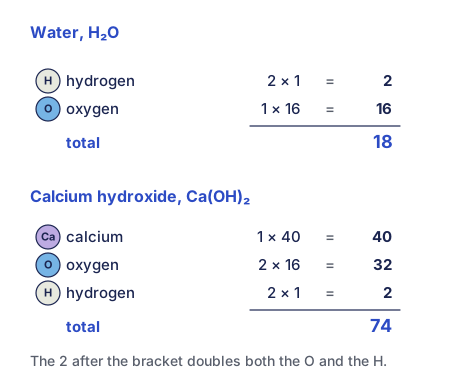
A water molecule is H2O: two hydrogen atoms joined to one oxygen atom. Its mass is the mass of its atoms added together, so on the carbon-12 scale it's 2 × 1 + 16 = 18. The sum of the relative atomic masses of all the atoms in a formula is the relative molecular mass, Mr. To work it out, multiply each element's Ar by the number of its atoms in the formula, then add. Carbon dioxide, CO2, has one carbon atom and two oxygen atoms, so its Mr is 12 + 2 × 16 = 44. A carbon dioxide molecule is heavier than a water molecule, 44 against 18.
A number after a bracket multiplies everything inside the bracket. Calcium hydroxide, Ca(OH)2, has one calcium atom and two whole OH groups, so the sum is 40 + 2 × (16 + 1) = 74. Calcium hydroxide is ionic, so this sum is its relative formula mass (see below), but you add it up in the same way.
 (enlarge)
Trap: “Mr of Ca(OH)2 is 40 + 16 + 1 × 2 = 58.” The 2 after the bracket doubles the whole OH group, so there are two oxygen atoms as well as two hydrogen atoms: 40 + 2 × 17 = 74.
Ionic compounds: relative formula mass
Sodium chloride has no molecules. As you saw in the Ions and ionic bonding module, it's a giant lattice of sodium ions and chloride ions, and its formula, NaCl, gives the ratio of the ions: one Na+ for every Cl−. You still add up the relative atomic masses in the formula in the same way, 23 + 35.5 = 58.5, but because there's no molecule, this sum is called the relative formula mass. It uses the same symbol, Mr. An ion has almost exactly the mass of its atom, because an electron is so light, about 1/1840 of the mass of a proton, that gaining or losing a few makes no difference you could notice here.
Blue crystals with water inside
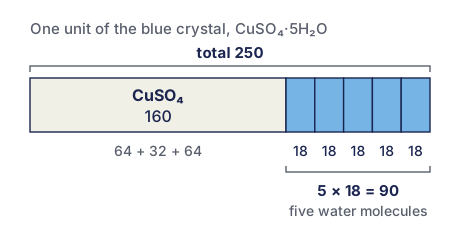
The blue crystals of copper(II) sulfate that you grew in the Crystallisation module have water molecules locked inside them: five water molecules for every CuSO4. Their formula is written CuSO4·5H2O. The dot means "together with", and the 5 in front of H2O counts whole water molecules, so you add the water to the CuSO4 rather than multiply:
Mr = 64 + 32 + 4 × 16 + 5 × (2 × 1 + 16) = 64 + 32 + 64 + 90 = 250
So 90 of the 250 is water. Crystals that have water chemically combined in them like this are hydrated. In part 2 you'll heat these crystals to drive the water out, and you'll be able to predict, before you start, how much lighter they get.
 (enlarge)
Trap: “The dot means multiply: 160 × 90.” The dot means "with": the crystal holds CuSO4 together with five water molecules, so their masses add, 160 + 90 = 250.
Worked example
Bromine
Bromine is a mixture of two isotopes, bromine-79 and bromine-81, in almost equal amounts. Estimate its relative atomic mass.
Equal amounts means one atom of each isotope for every two atoms. Two such atoms have a mass of 79 + 81 = 160, so the average is 160 ÷ 2 = 80. Ar = 80, which is the value on the Periodic Table.
Check: 80 lies between 79 and 81, and exactly halfway because neither isotope is more common.
Worked example
Sulfuric acid
Calculate the relative molecular mass of sulfuric acid, H2SO4. (Ar: H 1, S 32, O 16.)
Count the atoms: 2 hydrogen, 1 sulfur, 4 oxygen. Multiply and add: 2 × 1 + 32 + 4 × 16 = 2 + 32 + 64 = 98.
Mr = 98. Check: there's no unit, and every atom in the formula has been counted once.
Worked example
A fertiliser, ammonium sulfate
Calculate the relative formula mass of ammonium sulfate, (NH4)2SO4. (Ar: N 14, H 1, S 32, O 16.)
The 2 after the bracket doubles everything inside it, so there are 2 nitrogen atoms and 2 × 4 = 8 hydrogen atoms; outside the bracket there's 1 sulfur and 4 oxygen. Nitrogen 2 × 14 = 28, hydrogen 8 × 1 = 8, sulfur 32, oxygen 4 × 16 = 64. Total: 28 + 8 + 32 + 64 = 132.
Ammonium sulfate is made of ions, NH4+ and SO42−, so 132 is its relative formula mass.
Worked example
How much of the blue crystal is water?
The blue crystals are CuSO4·5H2O, Mr 250. How much of that is water?
One water molecule is 2 × 1 + 16 = 18, and there are five of them: 5 × 18 = 90. The rest, 250 − 90 = 160, is the Mr of CuSO4 (64 + 32 + 4 × 16 = 160, which checks). So in every 250 of the crystal's mass, 90 is water.
Case closed
How heavy is a water molecule? On the carbon-12 scale it's 18: its mass is 18 times 1/12 of the mass of a carbon-12 atom, one and a half times as heavy as a carbon-12 atom. The number has no unit because it's a comparison. Each element's relative atomic mass, Ar, is the average mass of its isotopes on the same scale, and you read it from the Periodic Table. Add up the Ar values of every atom in a formula, multiplying by the small numbers and brackets, and you get the relative molecular mass, Mr, or the relative formula mass for an ionic compound.
About this model
The balance in the figure is a thought model: no balance can hold one atom, and real atomic masses are compared with an instrument called a mass spectrometer, which isn't part of this course. The Ar values here are the rounded ones on the Periodic Table you'll use in the exam; more precise values have decimals, such as 63.55 for copper. A molecule's mass in grams comes with the mole, in a later module.
For teachers: Core 3.2.1–3.2.2, the whole part (Cambridge 0620 syllabus, p15).