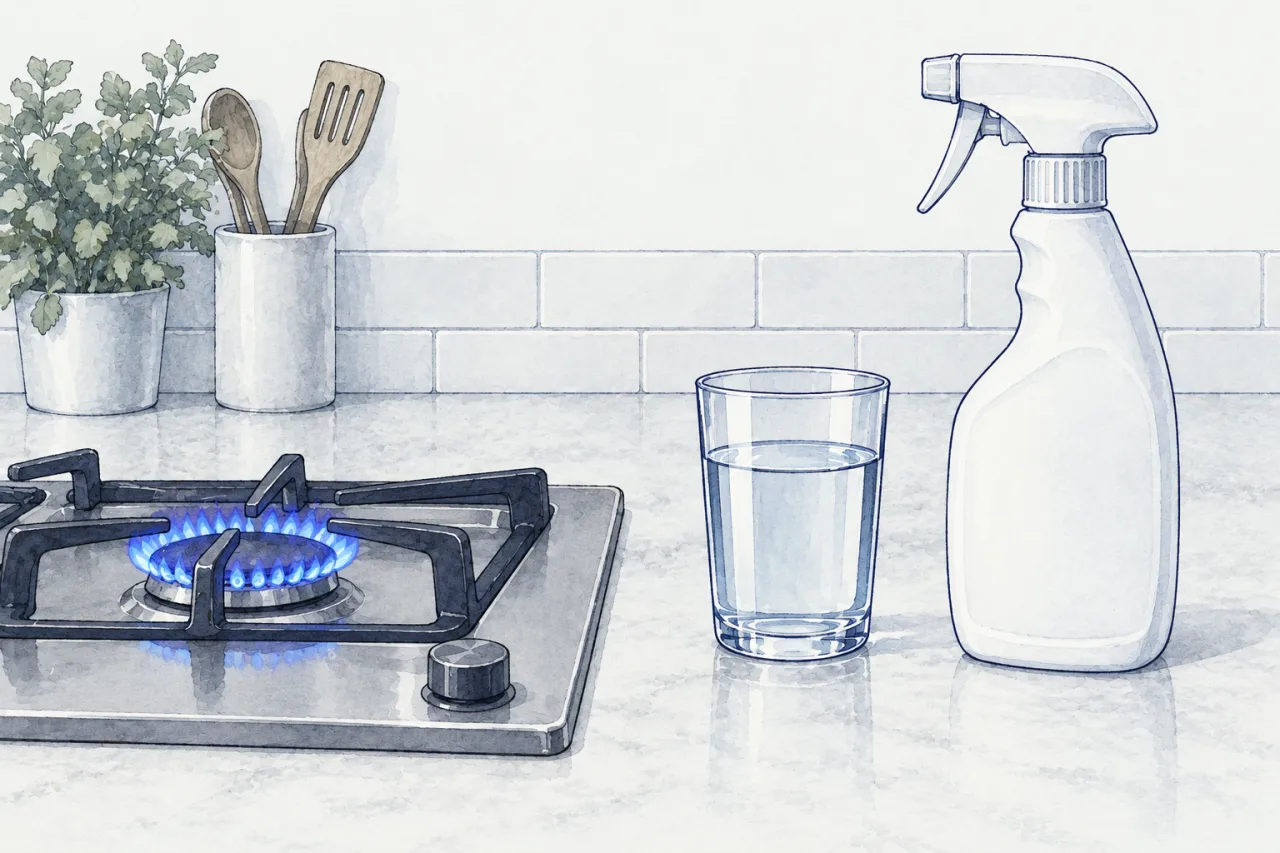
The gas burning on a hob is methane, CH4. The water in the glass is H2O, and many window cleaners contain ammonia, NH3. All three are compounds of non-metals only, so there's no metal atom to give electrons away and no ions to hold them together. Yet the hydrogen atoms in them hold on to their partners so firmly that the water boils and the cleaner evaporates without the molecules falling apart. In this part you'll find out what holds non-metal atoms together, and you'll draw it.
 (enlarge)
Two atoms that both need electrons
In ionic bonding, a metal atom gave its outer electrons to a non-metal atom, and both ended with full outer shells. Hydrogen and chlorine can't do that, because both are non-metals: a chlorine atom, 2,8,7, is one electron short of a full outer shell of 8, and a hydrogen atom, with 1 electron in a shell that holds 2, is one short too. If one of them took the other's electron, the other would be left further from a full shell than before.
Predict, then share
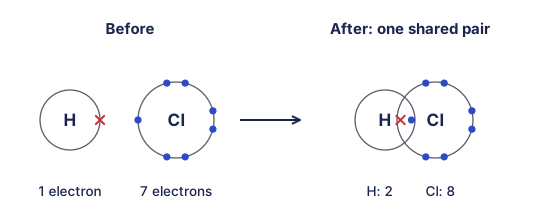
Here's the question for the experiment. The two atoms stand on a board as their outer shells, with hydrogen's 1 electron and chlorine's 7 electrons on them. How many pairs of electrons must they share so that both outer shells are full: one pair, two pairs, or none, because hydrogen simply gives its electron to chlorine? Make your prediction, then share pairs on the board and watch the count under each atom.
What the board shows
One shared pair is enough. Hydrogen puts in its 1 electron and chlorine puts in 1 of its 7, and the two shells overlap around the pair. Both atoms count the shared pair as their own, so hydrogen now counts 2 electrons, the same as the noble gas helium, and chlorine counts 7 + 1 = 8, the same as argon's outer shell. A second pair is impossible, because hydrogen has no more electrons to share and chlorine's shell is already full.
 (enlarge)
That's a covalent bond: a pair of electrons shared between two atoms. Both nuclei attract the shared pair, and that's what holds the two atoms together. Atoms share electrons in this way until each has a full outer shell, which is the same arrangement as a noble gas, a noble gas electronic configuration. A small group of atoms joined by covalent bonds is a molecule, so hydrogen chloride is made of HCl molecules.
Trap: “Hydrogen gives its electron to chlorine, as sodium does.” Hydrogen and chlorine are both non-metals, and neither ends up as an ion. The electron isn't given away: it's shared, and it counts for both atoms.
How many bonds?
The number of covalent bonds an atom makes is the number of electrons it needs to fill its outer shell, because each shared pair adds one electron to its count:
| Atom | Electronic configuration | Outer electrons | Needs | Covalent bonds |
|---|---|---|---|---|
| hydrogen, H | 1 | 1 | 1 (to make 2) | 1 |
| chlorine, Cl | 2,8,7 | 7 | 1 | 1 |
| oxygen, O | 2,6 | 6 | 2 | 2 |
| nitrogen, N | 2,5 | 5 | 3 | 3 |
| carbon, C | 2,4 | 4 | 4 | 4 |
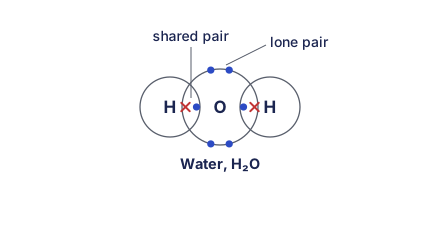
The outer electrons an atom doesn't share stay on its own shell in pairs, called lone pairs. Chlorine shares 1 of its 7 and keeps 6 as three lone pairs.
A covalent bond is often written as a line between the two symbols: H–Cl is hydrogen chloride, and water is H–O–H.
Drawing a dot-and-cross diagram of a molecule
- Write each atom's electronic configuration and find how many electrons it needs: that's how many pairs it shares.
- Draw the outer shells as circles, overlapping wherever two atoms share electrons. Inner shells are usually left out.
- Draw one atom's electrons as dots and the other's as crosses. In a molecule of more than two atoms, each element keeps one symbol. In each overlap, draw the shared pairs, one electron from each atom.
- Draw the unshared electrons in lone pairs on the rest of each atom's shell.
- Check: count each atom's electrons, including every one in its overlaps. Hydrogen should count 2 and every other atom 8.
 (enlarge)
Trap: “A shared pair counts for only one of the two atoms.” It counts for both. That's the whole point of sharing: in water, oxygen counts both electrons of each shared pair, so 2 + 2 + 4 in lone pairs = 8.
Trap: “Hydrogen needs 8 electrons as well.” Hydrogen's only shell holds 2, like helium's, so one shared pair fills it and hydrogen always makes one bond.
Worked example
Water
Oxygen is 2,6 and hydrogen is 1. Describe how the covalent bonds form in a water molecule, and draw its dot-and-cross diagram.
Oxygen has 6 outer electrons and needs 2 more, so it shares two pairs. Each hydrogen atom needs 1, so it shares one pair. So one oxygen atom shares a pair with each of two hydrogen atoms: H2O. Draw the oxygen shell overlapping two hydrogen shells, with one dot and one cross in each overlap and oxygen's other 4 electrons as two lone pairs (the diagram above).
Check: oxygen counts 2 + 2 + 4 = 8, like neon (2,8); each hydrogen counts 2, like helium.
Worked example
Ammonia and methane
Nitrogen is 2,5 and carbon is 2,4. How many hydrogen atoms bond to one nitrogen atom, and to one carbon atom?
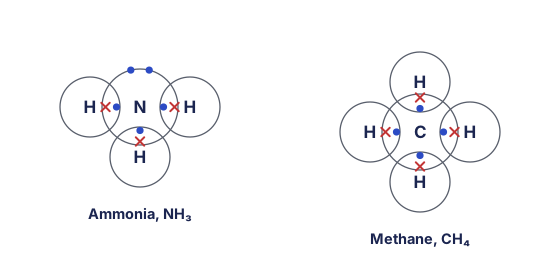
Nitrogen has 5 outer electrons and needs 3, so it shares three pairs, one with each of three hydrogen atoms: NH3. Its other 2 electrons are one lone pair. Carbon has 4 outer electrons and needs 4, so it shares four pairs with four hydrogen atoms: CH4, with no lone pairs.
 (enlarge)
Check: nitrogen counts 3 × 2 + 2 = 8 and carbon 4 × 2 = 8, both like neon (2,8); every hydrogen counts 2, like helium.
Two atoms of the same element share electrons in the same way. A hydrogen molecule, H2, is two hydrogen atoms sharing one pair, and a chlorine molecule, Cl2, is two chlorine atoms sharing one pair, each with three lone pairs. That's why hydrogen and chlorine gases are made of H2 and Cl2 molecules, not single atoms.
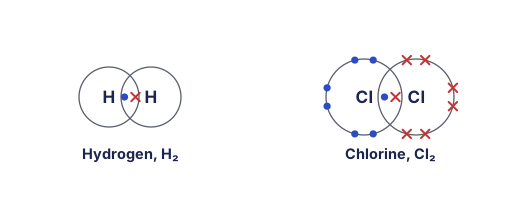 (enlarge)
Key idea: A covalent bond is a pair of electrons shared between two atoms, and both atoms count it in their outer shell. Atoms share pairs until each has a noble gas electronic configuration: 2 for hydrogen, 8 for the others. So hydrogen and chlorine make 1 bond, oxygen 2, nitrogen 3 and carbon 4. In a dot-and-cross diagram each shared pair sits in the overlap of the two shells, one electron from each atom. Supplement: two shared pairs make a double bond and three a triple bond.
Supplement: double and triple bonds
Two atoms can share more than one pair. An oxygen atom needs 2 electrons, so in an oxygen molecule, O2, the two atoms share two pairs: a double bond. A nitrogen atom needs 3, so the two atoms of N2 share three pairs: a triple bond. Each nitrogen atom then counts 3 × 2 = 6 shared electrons and 2 in its lone pair, which makes 8. A double bond counts as two of an atom's bonds and a triple bond as three, so oxygen in O2 still makes 2 bonds. As lines: O=O and N≡N.
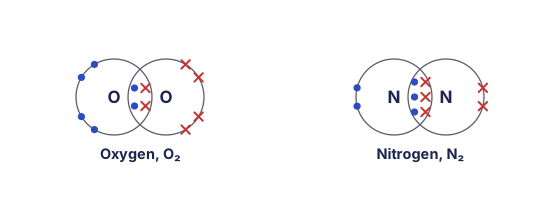 (enlarge)
The same counting works for bigger molecules. In ethene, C2H4, each carbon atom shares two pairs with the other carbon and one pair with each of two hydrogen atoms: 4 pairs, so 8 electrons. In methanol, CH3OH, every bond is single: carbon shares a pair with each of three hydrogen atoms and with the oxygen, and the oxygen shares its second pair with a hydrogen and keeps two lone pairs. Both carbon atoms of ethene are drawn with dots, because each element keeps one symbol, so its double bond is four dots. When a molecule has three elements, a third symbol, such as an open circle, shows the third element's electrons.
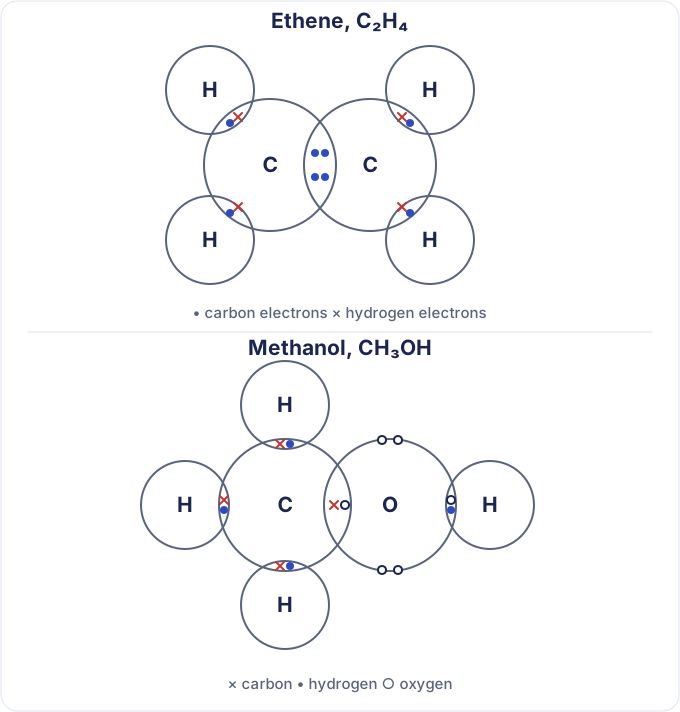 (enlarge)
Trap: “A double bond is two electrons shared.” A double bond is two shared pairs, 4 electrons; a triple bond is three pairs, 6 electrons. In each pair, one electron comes from each atom.
Worked example
Carbon dioxide (Supplement)
Carbon is 2,4 and oxygen is 2,6. Draw a dot-and-cross diagram of carbon dioxide, CO2, and say what kind of bonds it has.
Carbon needs 4 electrons and each oxygen atom needs 2. If carbon shared one pair with each oxygen, every atom would still be short. So carbon shares two pairs with each oxygen atom: two double bonds. Each oxygen keeps its other 4 electrons as two lone pairs.
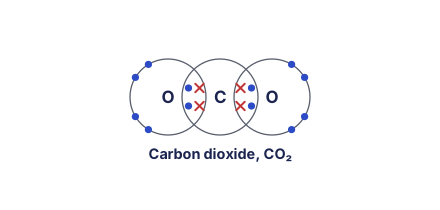 (enlarge)
Check: carbon counts 2 × 4 = 8; each oxygen counts 4 shared + 4 in lone pairs = 8.
Case closed
Non-metal atoms hold together by sharing electrons, not by giving them away. Each shared pair, one electron from each atom, is a covalent bond, and it counts in both atoms' outer shells. Hydrogen and chlorine share one pair, so both shells are full: hydrogen counts 2 like helium, chlorine 8 like argon. The number of bonds an atom makes is the number of electrons it needs, which is why water is H2O, ammonia NH3 and methane CH4.
About this model
The board and the diagrams draw shells as circles and electrons as dots and crosses; real electrons aren't little balls sitting on rings, and all electrons are identical. The dots and crosses only show which atom each electron came from. The diagrams don't show the shape of a molecule either: a water molecule is bent, and methane's hydrogen atoms point to the corners of a tetrahedron, which IGCSE doesn't ask for. Giant structures held by covalent bonds, such as diamond, come in the next module.
For teachers: Core 2.5.1–2.5.2; Supplement 2.5.4, the section "Supplement: double and triple bonds" and worked example W03 (Cambridge 0620 syllabus, p14).