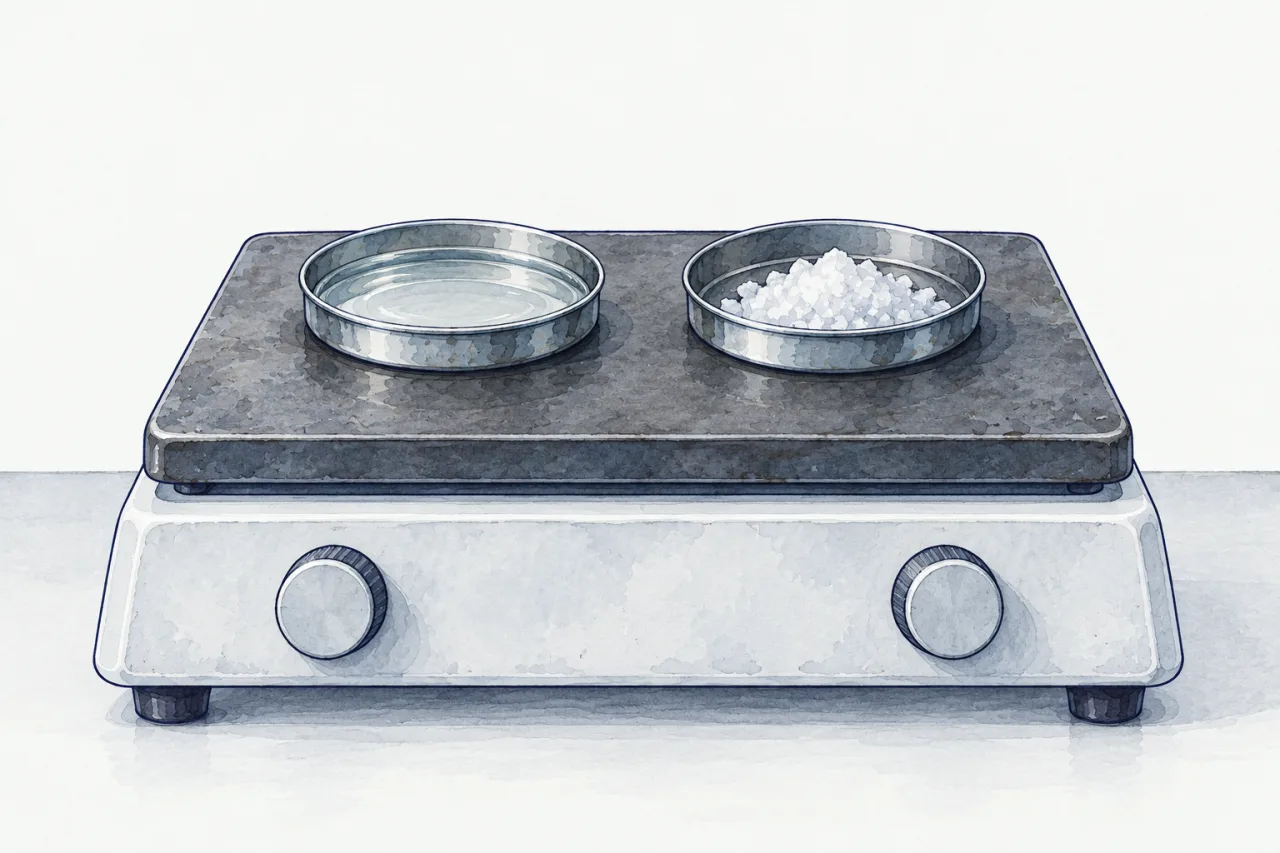
Put a lump of candle wax and a pile of salt on the same hotplate. Within a minute the wax runs into a clear puddle, while the salt sits there as white crystals: it won't melt until 801 °C, far hotter than any hotplate. Candle wax is made of molecules of carbon and hydrogen atoms joined by covalent bonds, and salt is a lattice of ions. In this part you'll find out why so many molecular substances melt and boil so easily, and why they don't conduct electricity.
 (enlarge)
The evidence
Here are the substances whose molecules you drew in the first part, with sodium chloride for comparison:
| Substance | Bonding | Melting point / °C | Boiling point / °C | State at 20 °C |
|---|---|---|---|---|
| methane, CH4 | covalent molecules | −182 | −162 | gas |
| chlorine, Cl2 | covalent molecules | −101 | −34 | gas |
| ammonia, NH3 | covalent molecules | −78 | −33 | gas |
| water, H2O | covalent molecules | 0 | 100 | liquid |
| sodium chloride, NaCl | ions in a lattice | 801 | above 1400 | solid |
Every molecular substance here melts and boils far below the ionic compound, and most of them are gases at room temperature. None of them conducts electricity either: pure water barely conducts at all, so a bulb in the circuit stays dark, and liquid chlorine or methane doesn't conduct.
Separate molecules
These substances are simple molecular substances: each is made of small, separate molecules. Inside a molecule the atoms are held by covalent bonds, and covalent bonds are strong. But the molecules themselves are only weakly attracted to each other.
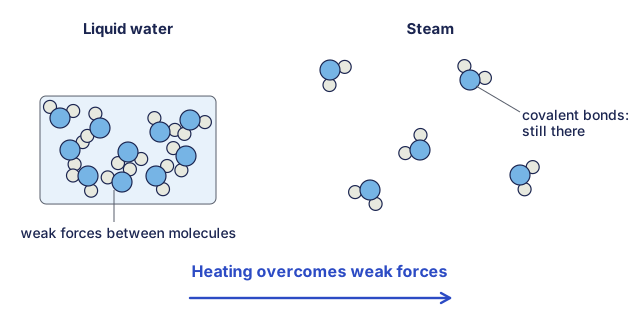
When a simple molecular substance melts, its molecules leave their fixed places and move past each other; when it boils, they move far apart. The molecules themselves don't break up. Freeing them from each other takes only a little energy, so the melting and boiling points are low. When water boils, the steam is still H2O molecules, with every covalent bond in place.
Trap: “Water boils at 100 °C because the covalent bonds between hydrogen and oxygen break.” Boiling doesn't break any covalent bonds: steam is still H2O molecules. Only the molecules move apart. Breaking the bonds inside water molecules takes far more energy than boiling.
An ionic compound is different. Melting salt means pulling apart ions that strongly attract every oppositely charged ion around them in a giant lattice, and that needs a lot of energy, so the melting point is high.
Why they don't conduct
To carry an electric current, a substance needs charged particles that can move: ions, as in molten or dissolved salt, or electrons that are free to move, as in a metal. A molecule has no overall charge, and its electrons stay in its own atoms' shells and shared pairs. So simple molecular substances have no charged particles that can move, and they conduct electricity poorly, whether they are solid, liquid or gas.
Trap: “Water conducts, so molecular substances can conduct.” Pure water conducts so little that a bulb stays dark. Tap water and seawater conduct because they contain dissolved ions, not because of the water molecules.
Worked example
Methane and salt
Methane boils at −162 °C and sodium chloride melts at 801 °C. Use structure and bonding to describe why methane's melting and boiling points are so low.
Methane is a simple molecular substance: it is made of separate CH4 molecules, each held together by strong covalent bonds. When methane melts or boils, the molecules only separate from each other, and that needs little energy, so its melting and boiling points are low. Sodium chloride is a giant lattice of ions with strong attractions between oppositely charged ions, so melting it needs much more energy.
Key idea: Simple molecular substances are made of small, separate molecules. Inside each molecule, strong covalent bonds hold the atoms together, but melting and boiling only separate the molecules, which needs little energy, so their melting and boiling points are low. Molecules have no overall charge and no electrons free to move, so these substances conduct electricity poorly.
Supplement: forces between molecules
The weak attractions between separate molecules are called intermolecular forces. When a simple molecular substance melts or boils, heat energy overcomes the weak intermolecular forces, while the strong covalent bonds inside each molecule stay. Because the intermolecular forces are weak, little energy is needed, so the melting and boiling points are low.
 (enlarge)
Keep the two words apart: a covalent bond holds atoms together inside one molecule; an intermolecular force attracts one whole molecule to another. You don't need to name the different kinds of intermolecular force for IGCSE.
Trap: “Covalent bonds are weak, so molecular substances melt easily.” Covalent bonds are strong, and melting doesn't break them. What is weak is the attraction between molecules, the intermolecular forces.
Worked example
Chlorine (Supplement)
Chlorine, Cl2, is a gas at room temperature, and liquid chlorine doesn't conduct electricity. Explain both facts in terms of structure and bonding.
Chlorine is made of separate Cl2 molecules, each with a strong covalent bond between its two atoms. The intermolecular forces between the molecules are weak, so little energy is needed to overcome them, and chlorine boils at −34 °C, below room temperature. The molecules have no overall charge, and their electrons aren't free to move, so liquid chlorine has no mobile charged particles to carry a current.
Case closed
The wax melts on the hotplate because it is made of separate molecules. Melting only moves the molecules apart, and the attraction between molecules is weak, so little energy is needed, while every strong covalent bond inside the molecules stays. The salt is a giant lattice of ions with strong attractions all around, so it needs 801 °C. And because molecules have no overall charge and no electrons free to move, molecular substances don't conduct electricity.
About this model
The data are for pure substances at normal atmospheric pressure, rounded to whole degrees. The ball pictures show molecules much larger than they are and far fewer than in any real sample. Bigger molecules attract each other more strongly, which is why candle wax, with large molecules, is a solid that melts at about 55 °C while methane is a gas. Hydrogen chloride gas is molecular, but its solution in water does conduct: it reacts with water to form ions, which comes with acids in topic 7. Giant covalent substances such as diamond, where covalent bonds run through the whole structure, come in the next module.
For teachers: Core 2.5.3; Supplement 2.5.5, the section "Supplement: forces between molecules" and worked example W05 (Cambridge 0620 syllabus, p14).