Table salt is made of two things you would never sprinkle on your chips: sodium, a soft metal that fizzes and races about on water, and chlorine, a poisonous yellow-green gas. Yet salt is a white solid that you put on food. So when two substances meet, sometimes they just sit side by side, and sometimes they turn into something completely new. How can you tell which happened? In this part you'll mix iron with sulfur, then heat the mixture, and use a magnet to find out whether the iron is still there.
 (enlarge)
Two elements: iron and sulfur
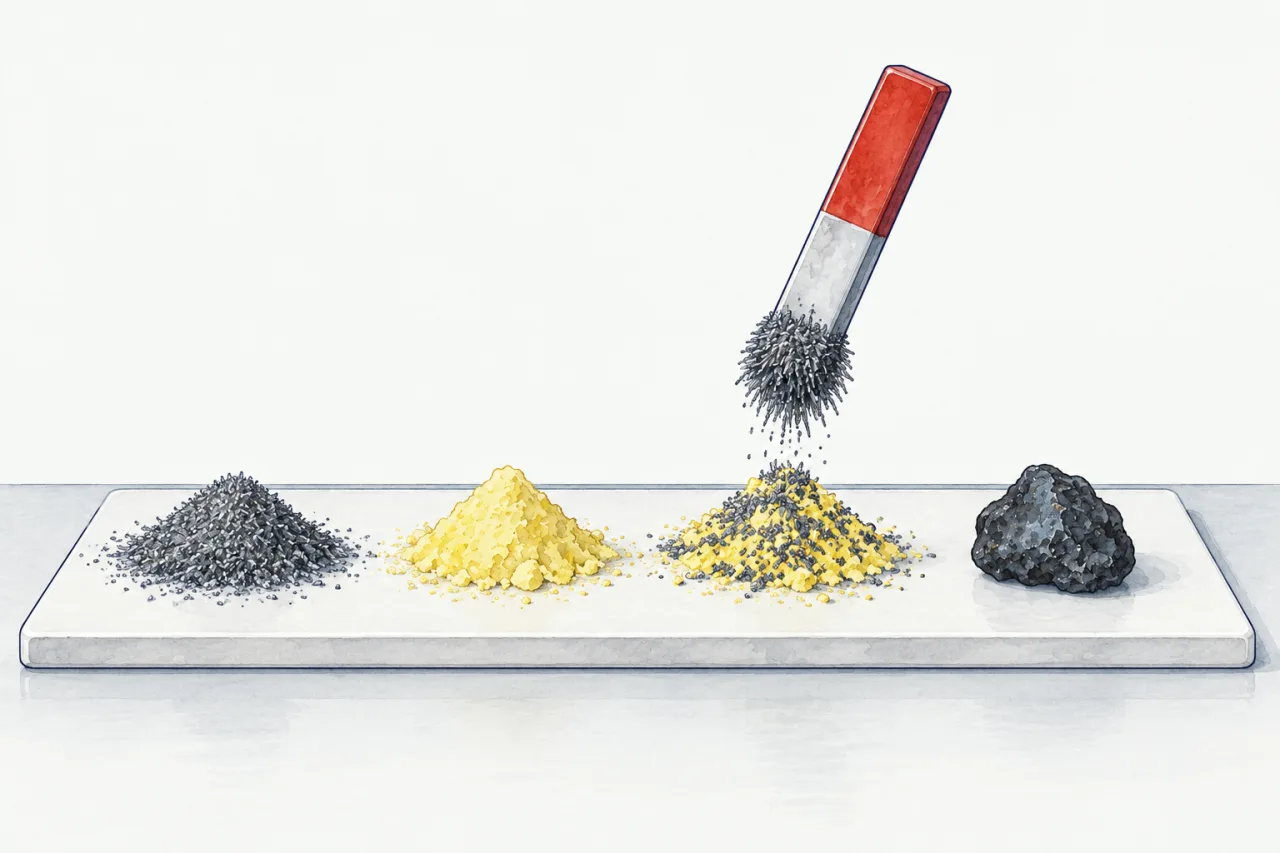
Iron filings are tiny grey bits of metal, and a magnet pulls them up. Sulfur is a yellow powder, and a magnet doesn't pull it at all. Both are elements. Everything around you is made of tiny particles called atoms, and 118 kinds of atom are known. An element is a substance made of only one kind of atom: iron contains only iron atoms, and sulfur contains only sulfur atoms. So an element can't be split into simpler substances.
Mixing: still iron, still sulfur
Stir the iron filings into the sulfur and you get a grey-yellow powder. Look closely and you can still see grey bits and yellow bits. Hold a magnet over it: the iron jumps up onto the magnet and the sulfur stays behind. The iron is still iron and the sulfur is still sulfur, because each keeps its own properties. That's a mixture: two or more substances that are together but not chemically combined.
You can make this mixture with any amounts: a pinch of sulfur or a whole spoonful, it's still a mixture of iron and sulfur. Stirring them together makes nothing new, so nothing glows or gets hot. And you can take the mixture apart again by a physical method, one that doesn't make any new substance: here, the magnet.
Predict, then heat
Now heat one end of a tube of the mixture in a Bunsen flame. Before you do: will the magnet still pull the iron out afterwards? And does it matter how much sulfur you start with? The experiment uses 7 g of iron each time and lets you choose 2 g, 4 g or 6 g of sulfur.
Watch the tube after you turn the Bunsen off. Then watch what the magnet does with what comes out.
Something new
Once one end of the mixture glows red, you can turn the Bunsen off and the glow keeps spreading along the tube by itself. The flame only started the change. After that, the change gives out enough energy to keep itself going.
When the tube cools, you tip out a black solid. It isn't grey or yellow, and the magnet doesn't pull it, so there's no loose iron left in it. It's a new substance, called iron sulfide. A change that makes a new substance is a chemical reaction. In iron sulfide, the iron atoms and the sulfur atoms are now chemically combined: joined to each other. A substance made of two or more elements chemically combined is a compound.
A compound has new properties, different from those of the elements in it. That's why iron sulfide is black and not magnetic, although it's made of iron and sulfur. And a magnet can't get the iron back out, because the iron atoms are joined to sulfur atoms. Only another chemical reaction can split a compound.
Always 4 g of sulfur for 7 g of iron
| Sulfur heated with 7 g of iron | After heating | Magnet |
|---|---|---|
| 2 g | 5.5 g of iron sulfide and 3.5 g of iron | pulls out the leftover iron |
| 4 g | 11 g of iron sulfide only | pulls nothing out |
| 6 g | 11 g of iron sulfide and 2 g of sulfur | pulls nothing out; yellow sulfur on the cool glass |
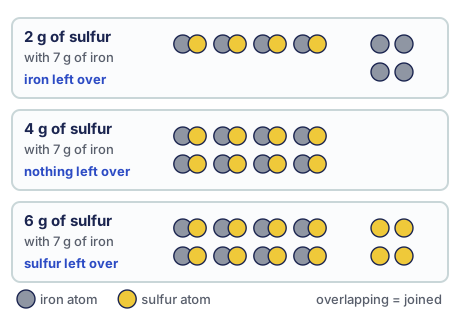
In every run, iron and sulfur combined in the same ratio, 7 g of iron to 4 g of sulfur, so 7 g of iron could take at most 4 g of sulfur. With 2 g, there wasn't enough sulfur for all the iron: only 3.5 g of iron combined, so 3.5 g of iron stayed as iron, and the magnet found it. With 6 g, there was 2 g more sulfur than the iron could take. That sulfur stayed as sulfur: some of it turned to vapour in the heat and settled as a yellow coat on the cool glass near the mouth of the tube.
So a compound always contains its elements in a fixed ratio: iron sulfide is always 7 parts of iron to 4 parts of sulfur by mass. A mixture can have any proportions. Extra sulfur doesn't make iron sulfide with more sulfur in it; it's just left over.
Inside: joined or side by side
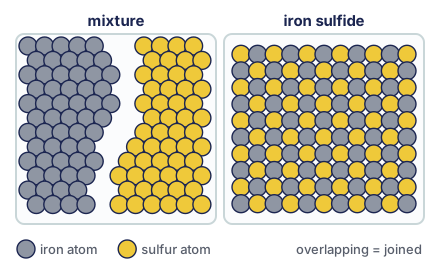
In the mixture, each grain of iron is a huge number of iron atoms packed together, and each grain of sulfur is a huge number of sulfur atoms. Where two grains touch, the atoms sit side by side, but they aren't joined. In iron sulfide, the iron atoms and sulfur atoms are joined, one iron atom for every sulfur atom, all through the solid.
 (enlarge)
That one-to-one pattern explains the fixed ratio. A sulfur atom has only about 4/7 of the mass of an iron atom, so 4 g of sulfur contains as many atoms as 7 g of iron. With less sulfur, some iron atoms have no sulfur atom to join; with more, some sulfur atoms have no iron atom.
 (enlarge)
Trap: “Iron sulfide is just iron and sulfur stuck together very tightly.” Stuck-together grains would still be grey and yellow, and the magnet would still pull the iron. In iron sulfide the atoms are joined in a new substance with its own properties.
Trap: “More sulfur makes iron sulfide with more sulfur in it.” Iron sulfide always has the same ratio. Extra sulfur stays as sulfur, left over beside the compound.
Mixture or compound?
| Mixture of iron and sulfur | Iron sulfide, a compound | |
|---|---|---|
| Making it | stirring: nothing new forms | a chemical reaction: here it gives out energy and glows (some reactions take energy in) |
| Proportions | any amounts | always 7 g of iron to 4 g of sulfur |
| Properties | those of iron and of sulfur: grey bits, yellow bits | new properties: a black solid, not pulled by a magnet |
| Separating | by a physical method, such as a magnet | only by another chemical reaction |
Key idea: In a mixture, the substances are not chemically combined: each keeps its properties, any proportions are possible and physical methods can separate them. In a compound, the elements are chemically combined in a fixed ratio, so the compound has new properties.
Worked example
The run with 6 g of sulfur
After heating 7 g of iron with 6 g of sulfur, there's yellow sulfur on the cool glass. Does that mean the iron and sulfur didn't react?
Look at all the evidence first. The mixture glowed and kept glowing with the Bunsen off, so energy was given out. The solid that came out is black, and the magnet pulls nothing from it, so there's no loose iron left. Both point to a chemical reaction that made a compound.
The yellow sulfur is the part that couldn't react. 7 g of iron combines with only 4 g of sulfur, because iron sulfide has a fixed ratio. That leaves 6 g − 4 g = 2 g of sulfur with no iron to join, so it stays as sulfur. So the iron and sulfur did react: there was just more sulfur than the iron could take.
Worked example
Salt is not sodium plus chlorine
Back to the chips. Why is salt (sodium chloride) a compound, and not just sodium and chlorine mixed together?
Its properties are new. Sodium fizzes on water and chlorine is a poisonous gas, but salt is a white solid that dissolves quietly in water and is safe to eat in small amounts. When sodium burns in chlorine, it gives out a lot of energy as a bright flame, so a chemical reaction makes the salt. And no physical method gives the sodium back: dissolve salt in water and evaporate the water, and you get salt again, not a metal and a gas.
Salty water is different. It's a mixture of salt and water, so the salt keeps its taste and evaporating the water separates them again.
Case closed
To decide whether substances have only mixed or have combined, look for the evidence. New properties, energy given out as it forms, a fixed ratio and no way to separate them by a physical method are the evidence that a chemical reaction made a compound. Old properties, any proportions and separation by a physical method mean a mixture.
About this model
The experiment shows the reaction as a teacher would demonstrate it, in a fume cupboard: hot sulfur also burns in the air, making a harmful gas, sulfur dioxide. The masses are ideal and rounded. In a real tube a little sulfur burns away, and the product often holds a few unreacted grains of iron that a magnet can pick up. The magnified views show a few flat atoms, hugely enlarged; real sulfur atoms are joined in rings of eight, and each iron atom in iron sulfide sits among six sulfur atoms, though the whole solid still has one sulfur atom for every iron atom.