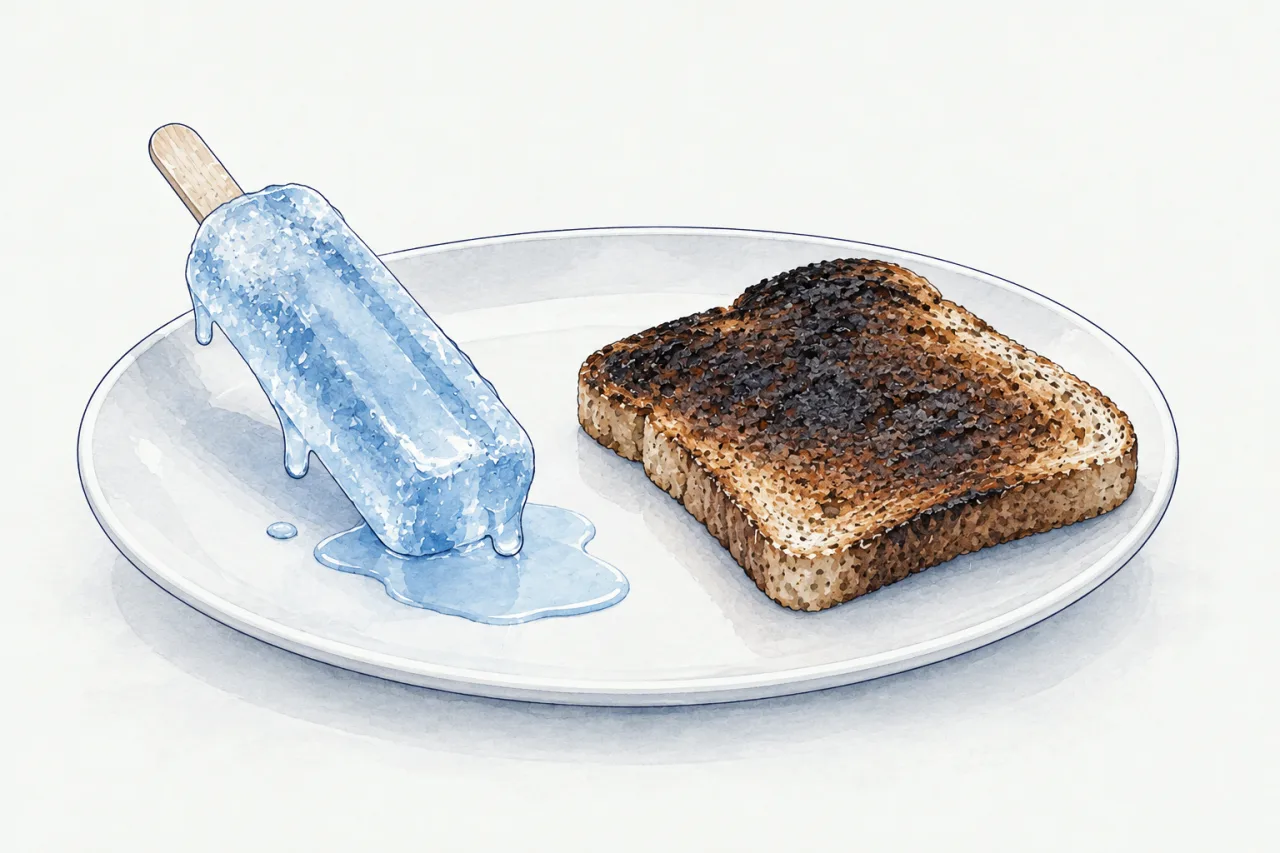
Leave an ice lolly on a plate on a hot day and it soon drips into a sweet puddle. Leave a slice of bread in the toaster too long and it comes out black in the middle. Both changed when they got warm. Put the puddle in the freezer and you get an ice lolly again, but no fridge or freezer will turn the black toast back into bread. Is that the difference, whether you can turn it back? In this part you'll heat two solids, test what comes off them, and find out what really tells the two kinds of change apart.
 (enlarge)
Your investigation
Your bench has two boiling tubes, each held upright in a clamp stand with a Bunsen burner underneath. The left tube holds a few lumps of white candle wax; the right tube holds a spatula of green powder, copper(II) carbonate. Each tube is closed with a bung (a rubber stopper), and a bent glass delivery tube leads from the bung over and down into a test tube of limewater, held in a second clamp on the same stand. Any gas that comes out of the hot tube has to bubble through the limewater.
You need one fact about limewater: limewater turns milky when carbon dioxide bubbles through it. Other gases, such as air, leave it clear.
You'll heat the wax first and then let it cool. Then you'll heat the green powder and let it cool. Watch the solid, the bubbles and the limewater each time. Predict first: which tube will make a new substance, the wax, the green powder, both or neither? At the end, decide which tube did, and choose the evidence that proves it.
The wax: still wax
A gentle flame is enough for wax. Within a minute the white lumps soften at the edges, then melt into a clear, colourless liquid that pools at the bottom of the tube. A few bubbles come out of the delivery tube at the start, and then they stop. The limewater stays clear.
Where did the bubbles come from? The tube was full of air before you started. Air expands when it's heated, so some of it is pushed out through the delivery tube. That's all the bubbles were: air, which doesn't turn limewater milky.
When the flame goes out, the liquid wax cools. Within a few minutes it sets into a white solid at the bottom of the tube. It's the same wax you started with: the same colour, it melts over the same range of temperatures, and you could heat it and melt it again as many times as you like.
Melting wax is a physical change. The wax changed state, from solid to liquid and back, but no new substance was made.
The green powder: something new
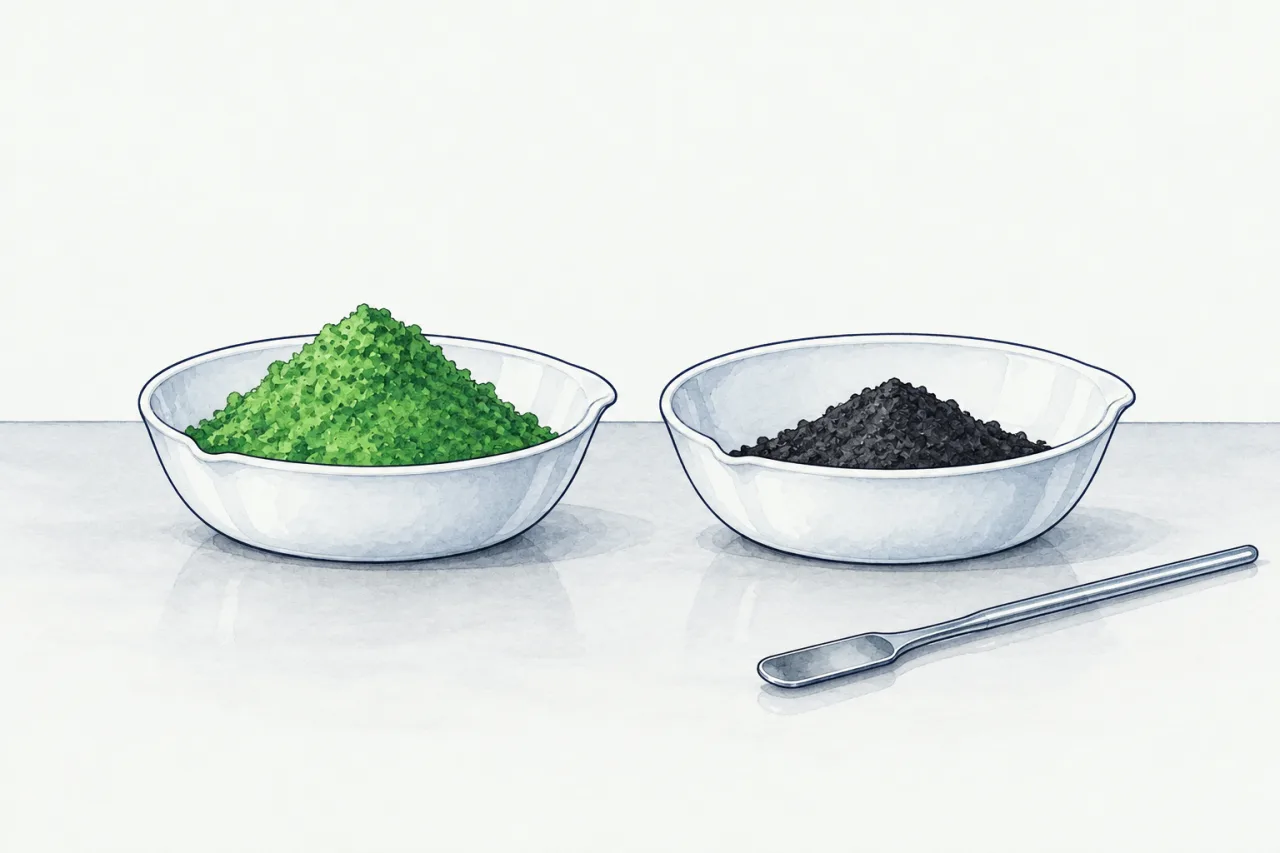
Copper(II) carbonate needs a stronger flame. A few bubbles of air come out first, as with the wax. Then the green powder starts to turn black from the bottom of the tube upwards, and a steady stream of bubbles comes out of the delivery tube. This time the limewater turns milky, so the gas is carbon dioxide.
When the flame goes out, the tube cools, but the powder stays black. Leave it for an hour and it's still black. Something new has been made: a black solid, copper(II) oxide, and a gas, carbon dioxide. The word equation is:
copper(II) carbonate → copper(II) oxide + carbon dioxide
Heating copper(II) carbonate is a chemical change: new substances were made.
 (enlarge)
There's less black powder than there was green powder. That's not because anything was destroyed: the carbon dioxide took some of the mass with it out of the tube.
Key idea: In a physical change no new substance is made: the substance changes its state, shape or how it's mixed, but it's the same substance afterwards. In a chemical change one or more new substances are made.
Trap: “It bubbled, so a new substance was made.” Both tubes bubbled. The wax tube gave off only air, pushed out as the tube warmed, and the wax didn't change. Bubbles tell you a gas came out; they don't tell you which gas. The limewater test did that: milky means carbon dioxide, a new substance.
Inside the tubes
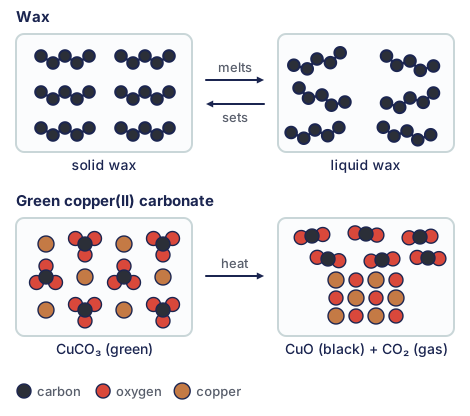
A particle diagram shows why the two tubes are so different. Wax is made of molecules, long chains of carbon and hydrogen atoms. When it melts, the same molecules slide out of their neat rows and move around each other; when it sets, they settle back. Not one wax molecule falls apart, so it's still wax.
Copper(II) carbonate is made of copper and carbonate particles. A carbonate group is one carbon atom joined to three oxygen atoms. When it's heated strongly enough, each carbonate group breaks up: one oxygen atom stays with the copper, and the carbon and the other two oxygen atoms leave together as a molecule of carbon dioxide. Every atom is still there, but they're grouped in new ways, into new particles. New particles mean a new substance.
 (enlarge)
Worked example
The two tubes side by side
Write the results of the two tubes in a table and use it to decide which tube made a new substance.
- Record what you saw in each tube:
| Tube | While heating | Limewater | After cooling | New substance? |
|---|---|---|---|---|
| white wax | melted to a colourless liquid; a few bubbles at first | stayed clear | white solid again, the same wax | no |
| green copper(II) carbonate | turned black; a stream of bubbles | turned milky | still black | yes: copper(II) oxide and carbon dioxide |
2. The wax gave off only air (the limewater stayed clear) and was the same substance when it cooled: a physical change. 3. The copper(II) carbonate gave off carbon dioxide, which the limewater test identified, and left a black solid that stayed black when cold, so it's not the green powder: a chemical change.
Pause and check
Lauric acid is a white solid. A pupil heats some in a tube connected to limewater. It melts to a clear liquid, a few bubbles come out at the start and the limewater stays clear. When it cools it's a white solid again, and it melts at the same temperature as before. Physical or chemical change? Answer in your head, then read on.
It's a physical change. The bubbles were the air in the tube, pushed out as it warmed: the limewater stayed clear. The solid at the end melts at the same temperature as the lauric acid at the start, so it's the same substance. The lauric acid only changed state.
Clues and proof
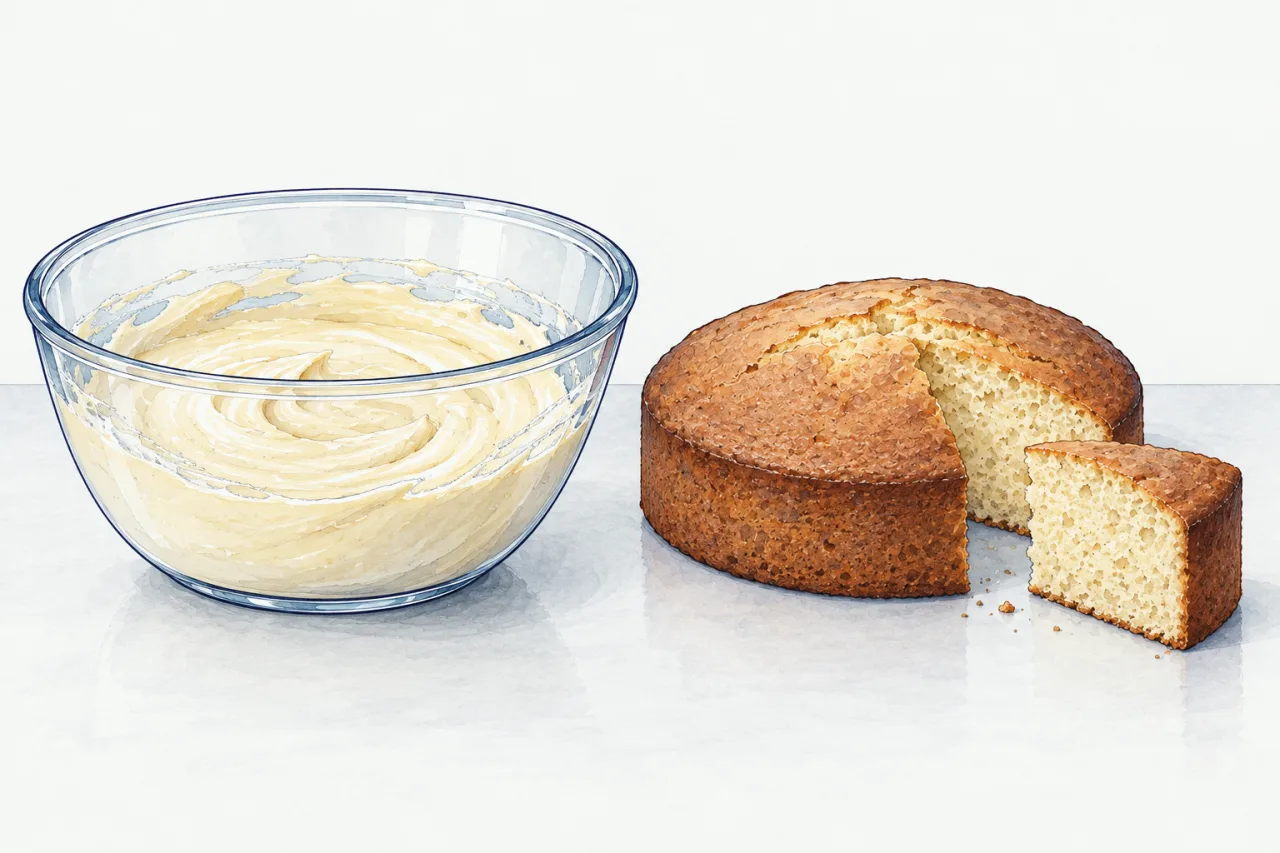
Mix a cake batter and bake it, and it rises into a golden, spongy cake. The cake has a new colour, a new smell and a new texture, and a gas made it rise: new substances have been made. Cooking is full of chemical changes.
 (enlarge)
When a chemical change happens you often see one or more of these clues:
- a colour change, like green to black;
- a gas given off, seen as bubbles or fizzing;
- a temperature change: the mixture gets hotter or colder, as in the last module;
- a solid forming when two solutions are mixed;
- a new smell.
But each clue on its own isn't proof, because physical changes can show them too. Boiling water gives off bubbles of steam. Dissolving some salts in water makes it colder. Even a colour can change in a physical change: some substances look a different colour when they're hot.
Proof that a new substance was made means showing that a substance is there at the end that wasn't there at the start. There are two ways. You can test for it, as the limewater identified carbon dioxide. Or you can show that the substance at the end has different properties from the one you started with, as the black solid didn't turn back into a green one when it cooled.
Worked example
Zinc carbonate
Zinc carbonate is a white powder. Heated in a tube connected to limewater, it turns yellow while it's hot, and the limewater turns milky. When it cools, the powder is white again. Did a chemical change happen?
- The colour change is a clue, but it came back when the powder cooled, so on its own it proves nothing.
- The limewater turned milky, so carbon dioxide came off. There was no carbon dioxide in the tube at the start, so a new substance was made: the limewater test is the proof.
- Zinc carbonate is ZnCO3. With carbon dioxide gone, what's left is zinc oxide, ZnO, a new substance that happens to be white when cold and yellow when hot:
zinc carbonate → zinc oxide + carbon dioxide
4. It's a chemical change, even though the powder looks the same as at the start. The colour isn't the test; whether a new substance was made is.
Case closed
What tells the two kinds of change apart? Not whether something bubbled, changed colour or can be turned back. The test is whether a new substance was made. The ice lolly melts and freezes again, still the same ice lolly: a physical change. The toast turns black because some of the bread has become new substances, among them carbon: a chemical change. Your wax melted and set again, still wax; your green powder gave off carbon dioxide and left a black solid. In the next part you'll look inside more everyday changes and see why "can you turn it back?" isn't the test either.
About this model
The green powder sold as copper(II) carbonate isn't pure CuCO3: it's a mixture of copper(II) carbonate and copper(II) hydroxide, so heating it gives off a little water as well. The syllabus treats it as CuCO3, and so does this module. Candle wax is a mixture of long-chain molecules, so it melts over a range of temperatures, roughly 50 to 60 °C, rather than at one exact temperature. In the experiment the limewater moves down off the delivery tube before each flame goes out: as a hot tube cools, the gas inside it shrinks and would draw cold limewater back into the hot glass. The particle diagrams show a few particles, not to scale; colours are a key, not real colours.
For teachers: Core 6.1.1 (Cambridge 0620 syllabus, p19). The limewater test for carbon dioxide belongs to topic 12 (gas tests); thermal decomposition as a reaction type, and reversible reactions (6.3), come later.