A kettle comes to the boil on the kitchen counter, bubbling hard and puffing out steam. Next to it, someone tips sherbet into a glass of water and it fizzes up to the rim. Both are full of bubbles, both happen in seconds, and both give off a gas. Yet one is a physical change and the other is a chemical change. You can't tell which by watching the bubbles. In this part you'll look at the particles instead, and learn to sort any change by one question: are the particles at the end the same particles, or new ones?
Physical changes: the same particles
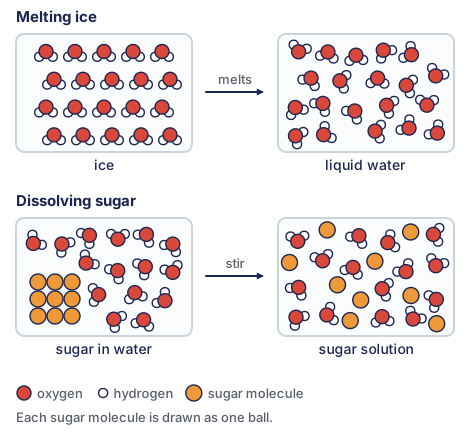
In a physical change the particles themselves don't change. They only move, spread out, pack together or mix in a new way. Here are the physical changes you'll meet most often:
- changes of state: melting, freezing, boiling, evaporating, condensing and subliming. Ice, liquid water and steam are all made of the same water molecules, H2O; only how close they are and how they move changes;
- dissolving: sugar stirred into tea seems to vanish, but the sugar molecules are still there, spread out among the water molecules. The tea tastes sweet, and if you boiled all the water away you'd get the sugar back;
- changing shape: crushing, cutting, bending, grinding or breaking. A crushed can is still aluminium; a smashed glass is still glass;
- mixing: iron filings stirred into sulfur, sand stirred into salt. Each substance keeps its own particles and its own properties.
 (enlarge)
Trap: “The sugar has disappeared, so it's become something new.” It's still sugar: you can taste it, and it comes back when the water evaporates. Dissolving spreads the sugar molecules out so finely that you can't see them, but each one is still a sugar molecule.
Chemical changes: new particles
In a chemical change the atoms let go of their partners and join up in new ways, so new particles are made, and new particles mean new substances. Everyday chemical changes include:
- burning: a gas ring burning methane, a candle burning wax, a match burning wood;
- rusting: iron reacting with oxygen and water to make rust, a flaky orange-brown solid;
- cooking and food going off: frying an egg, baking a cake, toasting bread, milk going sour;
- acids reacting: vinegar fizzing on baking soda, an acid fizzing on a carbonate, giving off carbon dioxide.
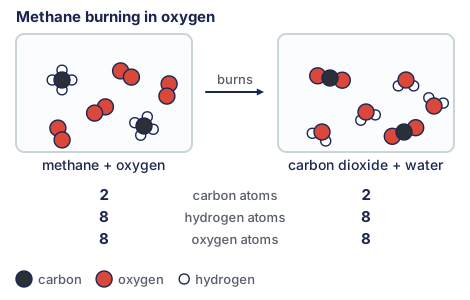
Look at methane burning. Before: methane molecules, CH4, and oxygen molecules, O2. After: carbon dioxide molecules, CO2, and water molecules, H2O. Count the atoms on each side and they match: no atom is made or destroyed. But they're joined in new ways, so the substances at the end are different from the ones at the start.
 (enlarge)
Trap: “Burning is just melting and boiling at a higher temperature.” A burning candle does melt some of its wax, and that's a physical change. But the flame itself is wax reacting with oxygen from the air to make carbon dioxide and water: new substances. Burning is a chemical change; melting is not.
Key idea: In a physical change the particles stay the same: they only move, spread out or mix. In a chemical change atoms join up in new ways to make new particles, so new substances are made. The atoms themselves are never made or destroyed in either kind.
Reading a particle diagram
A before-and-after particle diagram tells you which kind of change it shows, if you ask three questions in order:
- What particles are there before? Name each kind: separate atoms, or molecules made of which atoms.
- What particles are there after?
- Is there any kind of particle after that wasn't there before? If yes, new substances were made: a chemical change. If every particle after is one of the kinds you had before, only arranged, spread out or mixed differently, it's a physical change.
Don't be put off by how far apart or how jumbled the particles look. Spreading out is what happens when a liquid boils or a gas mixes; it's the kinds of particle that matter.
Can you always turn it back?
Many physical changes are easy to reverse: freeze the water and you get ice again; evaporate the water and you get your salt back. Many chemical changes are hard to reverse: no one can turn ash back into wood. That's why "can you turn it back?" sounds like a test. It isn't.
Trap: “If you can reverse it, it's physical.” Some chemical changes go back too. Heat blue copper(II) sulfate crystals and they turn into a white powder and water; add the water back and the powder turns blue again. New substances are made each way, so both are chemical changes: you'll meet these reversible reactions later in this topic. Ask whether a new substance was made, not whether you can turn it back.
It works the other way round too. A physical change can be hard to undo: a smashed glass doesn't jump back together, but it's still glass.
Worked example
Six everyday changes
Sort each change as physical or chemical, and give the reason.
| Change | Physical or chemical? | Reason |
|---|---|---|
| butter melting in a warm pan | physical | still butter, now a liquid: a change of state |
| a match burning | chemical | wood reacts with oxygen: carbon dioxide, water and ash are new substances |
| salt dissolving in water | physical | the salt is spread out in the water; evaporate the water and it's back |
| an iron nail rusting | chemical | rust is a new substance, made from iron, oxygen and water |
| water droplets forming on a cold window | physical | water vapour from the air condensing to liquid water: a change of state |
| an egg frying | chemical | the clear, runny egg white turns into a white solid that never turns clear again: a new substance |
For each one, the question was the same: is there a new substance at the end?
Worked example
Iron and sulfur, mixed and then heated
Iron filings are stirred into yellow sulfur powder. Then the mixture is heated in a tube: it glows, and when it cools, a black solid is left that a magnet doesn't pull. Which step is a physical change and which a chemical change?
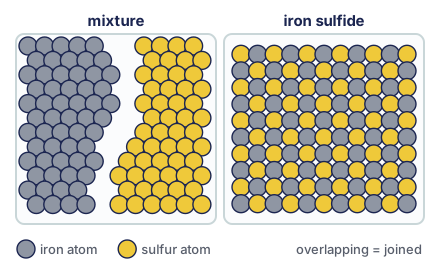
- Mixing: the iron and sulfur keep their own particles. You can still see grey bits and yellow bits, and a magnet pulls the iron out. No new substance: a physical change.
- Heating: iron atoms and sulfur atoms join up, one of each, to make iron sulfide. The black solid isn't attracted to a magnet and looks like neither element. A new substance, so a chemical change:
iron + sulfur → iron sulfide
3. The glow is a clue (energy given out), and the magnet test is the proof: iron sulfide has different properties from both the iron and the sulfur it was made from.
 (enlarge)
Pause and check
A block of dry ice, solid carbon dioxide, sits on a tray. It doesn't melt: it turns straight into a gas, and white clouds roll off it. Is this a physical or a chemical change? Answer in your head, then read on.
It's a physical change. The block is made of carbon dioxide molecules, CO2, and the gas it turns into is made of the same CO2 molecules, only far apart: the dry ice is subliming, a change of state. The white clouds are tiny droplets of water from the air, condensing because the cold gas chills it, another physical change. No new substance is made.
Case closed
The kettle and the sherbet both bubbled, but only one made something new. In the kettle, water molecules leave the liquid and form bubbles of steam: the same H2O molecules in a new state, a physical change. In the sherbet, an acid and sodium hydrogencarbonate in the powder react as soon as they're wet and make carbon dioxide, a gas that wasn't there before: a chemical change. To sort any change, look past the bubbles, the colour and whether it goes back, and ask: same particles, or new ones?
About this model
Each particle diagram shows only a few particles, drawn far bigger than real particles; colours are a key, not real colours. A sugar molecule is drawn as one ball, though it's really 45 atoms joined together. Many everyday changes, like cooking or burning, are mixtures of physical and chemical changes at the same time: a candle melts and burns, and an egg's water evaporates as it cooks. When a question asks you to classify one, look for the step where a new substance is made.
For teachers: Core 6.1.1 (Cambridge 0620 syllabus, p19). Reversible reactions with hydrated copper(II) sulfate are 6.3; conservation of atoms in equations is FORM01 (topic 3).